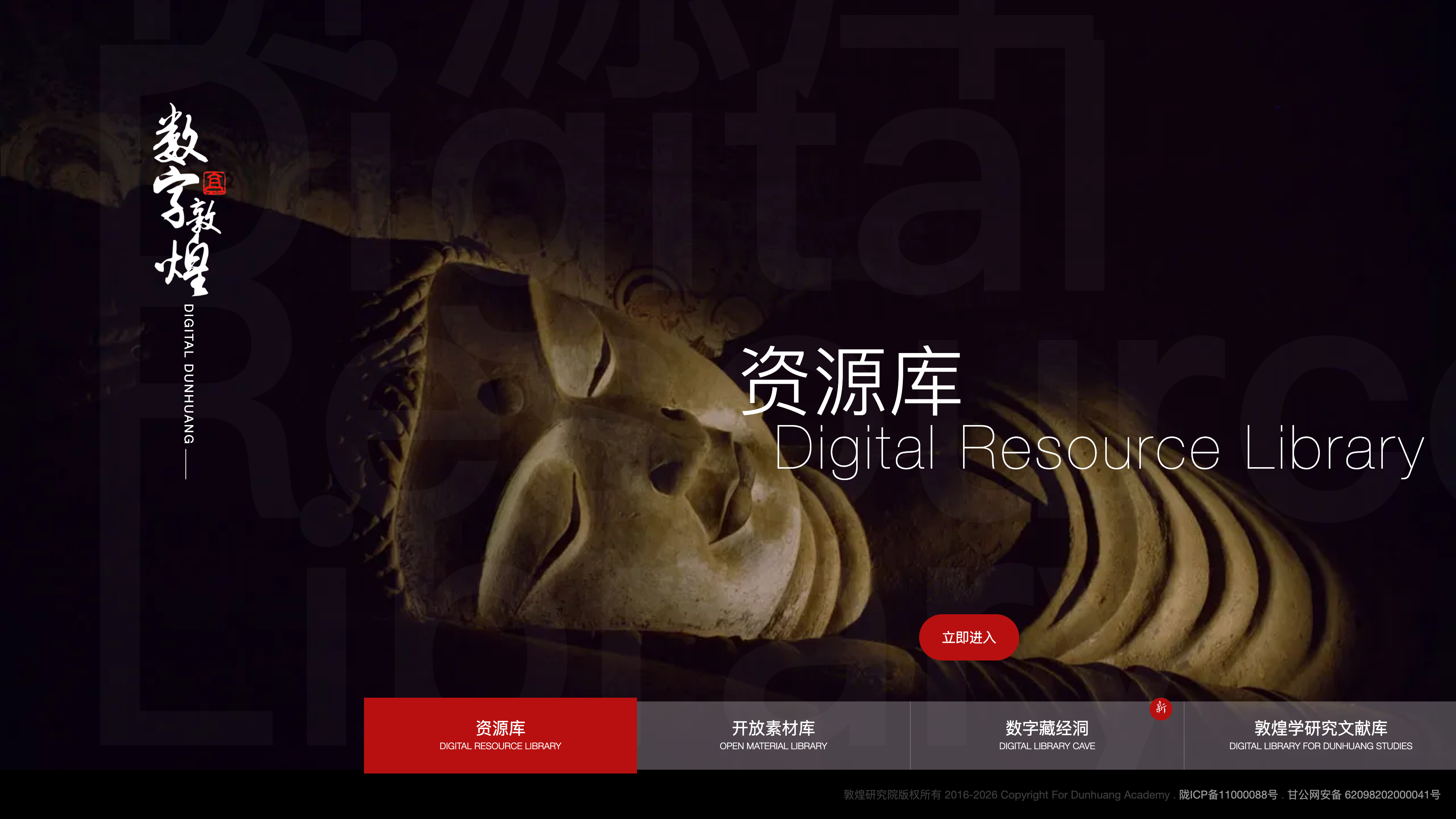
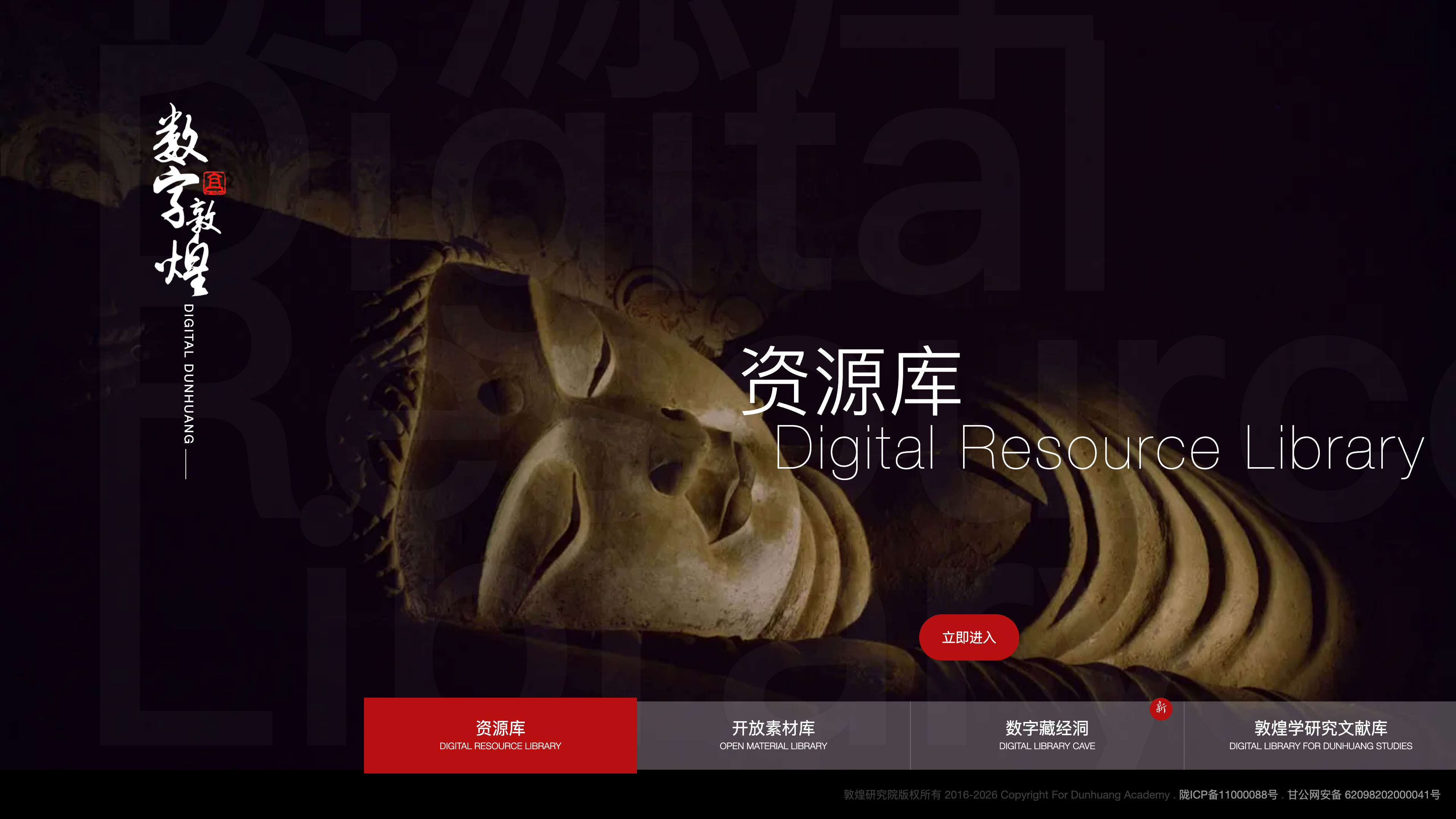
Digital Dunhuang (e-dunhuang.com) is the official website of the Dunhuang Academy's grotto digitization project, describing its goal as "permanently preserving, studying, and presenting the cultural heritage of the Mogao Grottoes through digital technology." The problem it addresses is concrete: cave murals age naturally and on-site visits are capped by conservation limits, while high-resolution digitization lets anyone examine whole-cave murals online. Its verifiable traits: the resource library publishes whole-cave high-resolution images and panorama tours of 30 classic caves for free (the site states 4,430 m² of mural area captured at 300 DPI), with a bilingual Chinese-English interface; and it is run directly by the Dunhuang Academy ("敦煌研究院版权所有" in the footer, ICP filing 陇ICP备11000088号), not a third-party image site.
At a glance
- URL: https://www.e-dunhuang.com/
- Type: official cultural-heritage digitization project (resource library + licensed materials + interactive exhibition + research bibliography)
- Operator: Dunhuang Academy (敦煌研究院)
- Cost: the resource library is free to browse; high-resolution material licensing in the Open Material Library is priced by use case
- Registration: none for browsing the resource library; downloads and licensing require an account
- Interface languages: Simplified Chinese and English (switch in the page settings; the English version launched September 2017)
Background and structure
The Dunhuang Academy began exploring digital conservation of the grottoes in the late 1980s (Beijing News interview with deputy director Yu Tianxiu, 2025-09-23, which also reports that 300 caves had been digitally captured by then). The Digital Dunhuang resource library officially launched on May 1, 2016, the first time 30 selected caves' high-resolution images and panorama tours were shared globally over the internet; the English version followed in September 2017 (Dunhuang Academy article "数字'延寿',敦煌文物'重生'", corroborated by the Beijing News report).
The portal homepage now unifies four sections:
- Digital Resource Library (www.e-dunhuang.com/index.htm): the core section for browsing high-resolution cave and mural imagery.
- Open Material Library (ip.e-dunhuang.com): launched 2022, a licensing platform for reusing materials (details below).
- Digital Library Cave (cave17.e-dunhuang.com): launched April 18, 2023, a "super-time-and-space participatory museum" co-built by the Dunhuang Academy and Tencent (launch coverage), now operating as a searchable database of Library Cave artifacts.
- Digital Library for Dunhuang Studies (dl.dha.ac.cn): a bibliographic database for Dunhuang research.
The resource library: 30 whole caves in high resolution
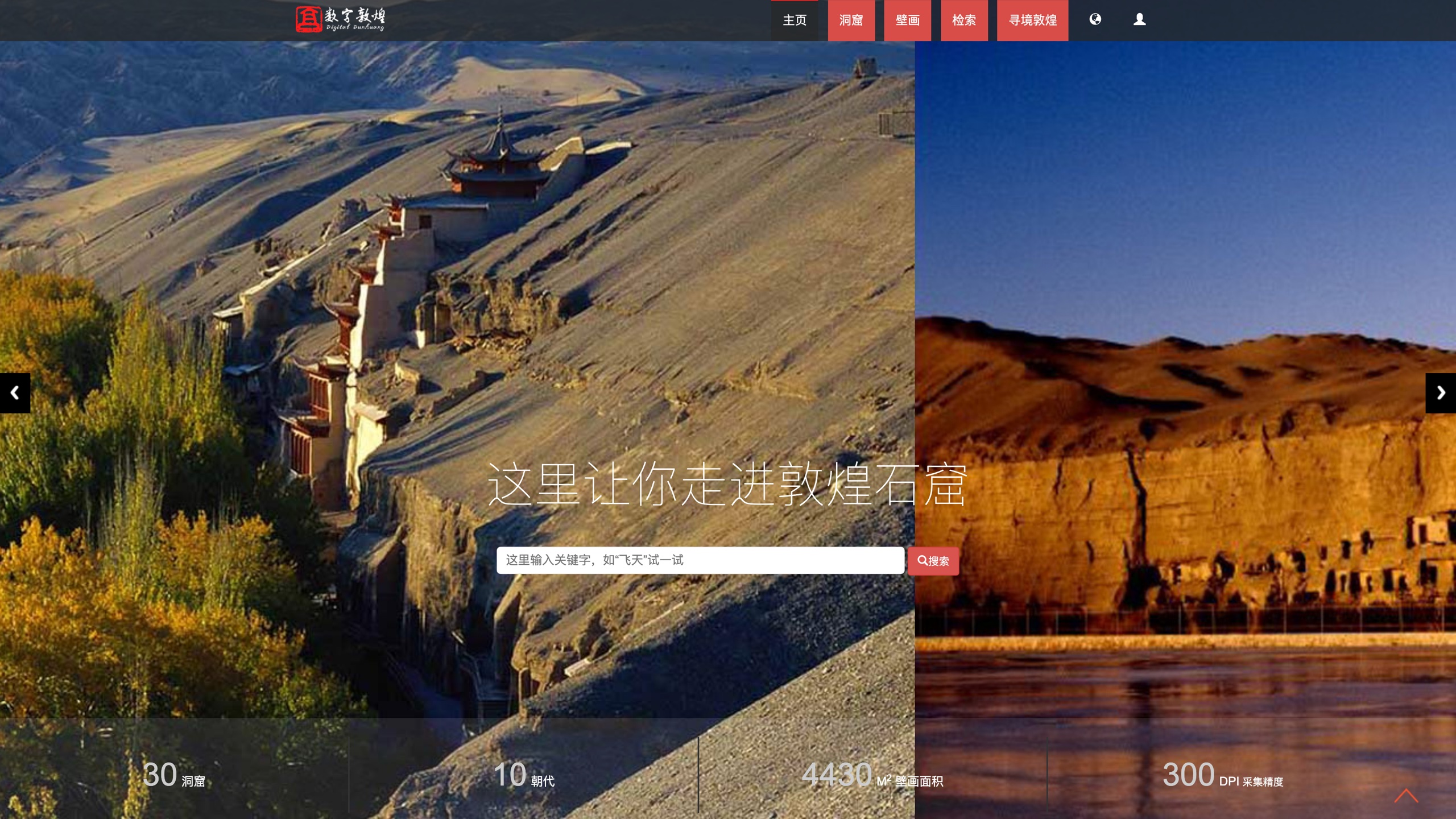
The resource library's hero banner states the project's key figures directly: 30 caves, 10 dynasties, 4,430 m² of mural area, 300 DPI capture precision. We verified on 2026-09-02 that the cave list indeed numbers 30: 28 Mogao caves (from the Northern Wei Cave 254 onward) plus 2 Yulin caves (Caves 3 and 25), spanning the Northern Wei to the Yuan dynasty. A "classic murals" section indexes famous wall sections, such as the Nine-Colored Deer jataka in Cave 257 and the apsaras of Cave 320.
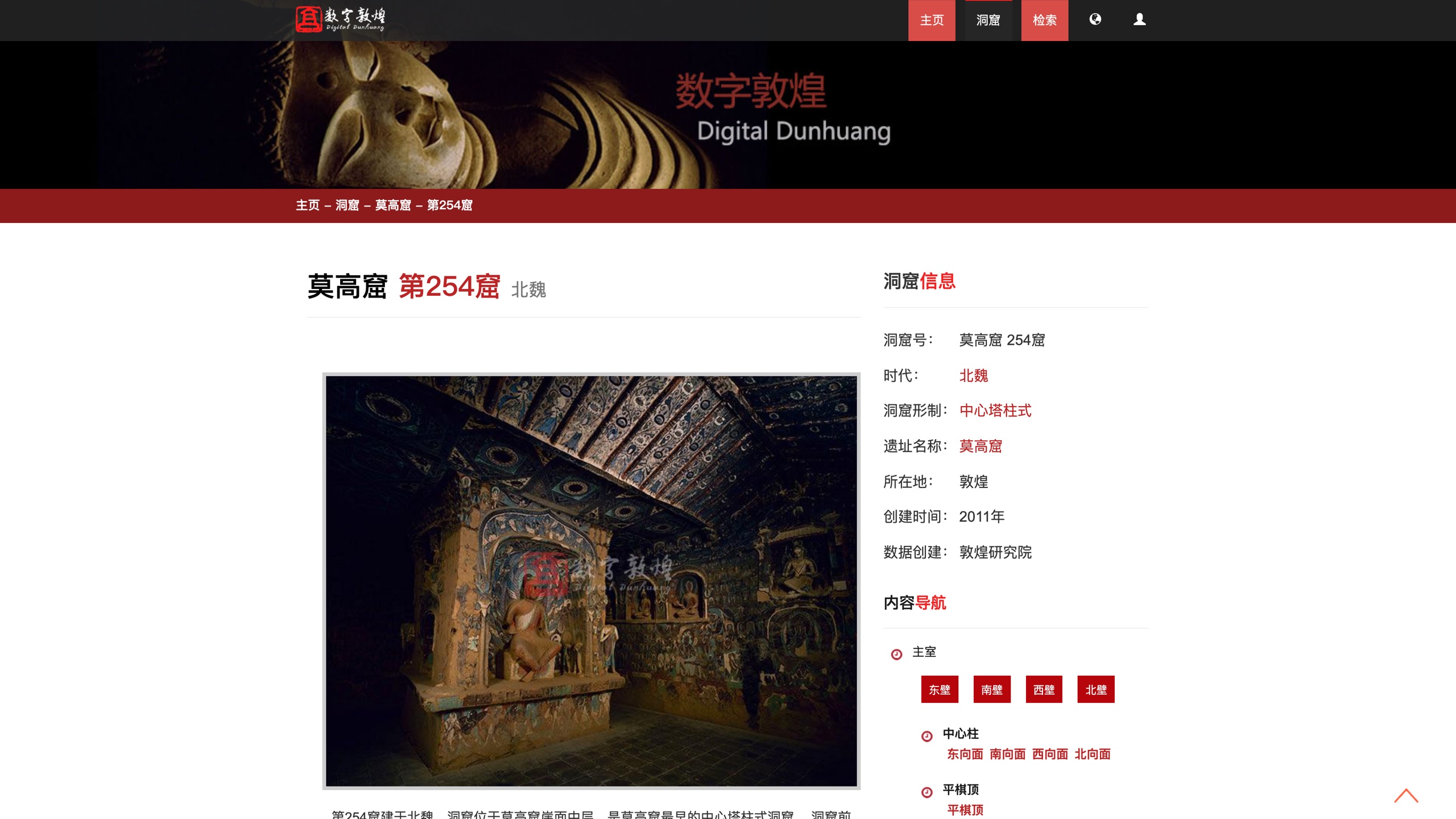
Each cave has its own page: cave number, era, architectural form, site name, the data producer (Dunhuang Academy), and the digitization date. Content navigation follows the cave's surfaces (main chamber's east/south/west/north walls, central pillar, ceiling), and you can inspect high-resolution images wall by wall or enter the whole-cave panorama to look around inside. For Cave 254 (Northern Wei), the page shows its digital resources were produced in 2011. A search page filters by cave and dynasty, and a "寻境敦煌" (Digital Lab) entry offers a VR-style immersive visit of Cave 285.
The Open Material Library and its licensing rules
The Open Material Library (ip.e-dunhuang.com) calls itself "the world's first blockchain-based open co-creation platform for digital cultural heritage," covering six grotto sites — Mogao, Yulin, Xiqianfodong, Maijishan, Binglingsi, and Beishiku — across sections for curated materials, mural themes, Library Cave documents, co-created works, mural elements, and art photography. Its About page states it is "the Dunhuang Academy's sole official material library," with materials authenticated via blockchain and digital watermarking.
Resource-library images are free to view, but downloads and reuse go through a licensing system, detailed in the library's authorization guide:
- Five licensable use categories: academic research, public cultural promotion, news reporting, personal study, and commercial cooperation (the last negotiated separately).
- Licenses are ordinary (non-exclusive) — no exclusive or sole licenses are granted, and sublicensing to third parties is prohibited; agreements are signed case by case, and use must credit the Dunhuang Academy as the source of the digital material.
- The flow is: register, pick materials and state the intended use, sign the electronic agreement, pay the listed fee, then download.
- Whole-cave and whole-wall digital resources are in principle not licensed externally, and original digital images of 300 DPI or higher are in principle not licensed for exhibitions.
Copyright and usage policy in short
The site's rules divide into two layers: the resource library (30 caves' high-resolution images and panoramas) is free for public browsing with no account needed; downloading materials or reusing them in publications, exhibitions, or merchandise requires applying for a license through the Open Material Library — with clear channels for academic and non-profit uses, while commercial uses are negotiated with the Academy individually. The co-created works section, where outside creators' derivatives based on Dunhuang materials are registered and authenticated by the platform, is a rare official channel for derivative-work certification among Chinese heritage institutions.
When it is useful
- Examining mural details online (300 DPI images zoom down to pigment and brushwork)
- Panorama tours when an on-site visit is impossible, or pre-visit orientation
- Teaching and outreach: building course materials by dynasty, cave, and wall
- Academic and media image use with a formal license from the material library
- Dunhuang studies bibliography (research library) and an interactive introduction to the Library Cave artifacts
Limitations
- High-resolution panorama pages are data-heavy and load slowly on weaker connections (in our tests the panorama viewer took a long wait).
- The 30 published caves are only a small fraction of Mogao's 700-plus caves; most of the captured data is not publicly browsable.
- High-resolution materials are not free: downloads and reuse require registration, application, and payment, and whole-cave original imagery is in principle not licensed.
- Only Chinese and English interfaces; the Digital Library Cave has separate international versions (English and French), but the main site offers no further languages.
Similar services
The Palace Museum's Digital Collection (数字文物库) is a comparable official high-resolution platform from a Chinese heritage institution; Google Arts & Culture aggregates high-resolution artworks and virtual galleries from museums worldwide as an international reference point.
References
- Digital Dunhuang official site (portal and resource library tested, including the on-page figures of 30 caves, 4,430 m², and 300 DPI; checked 2026-09-02)
- Digital Dunhuang Open Material Library (About, authorization guide, terms of service; checked 2026-09-02)
- Dunhuang Academy: "数字'延寿',敦煌文物'重生'" (official account of the 2016/2017 Chinese and English library launches and the 2022 material library)
- Beijing News: Dunhuang Academy deputy director on digitization progress (2016-05-01 launch, September 2017 English version, capture scale)
- Tencent News/Guanlan: Dunhuang Academy and Tencent launch the "Digital Library Cave" (2023-04-18 launch)