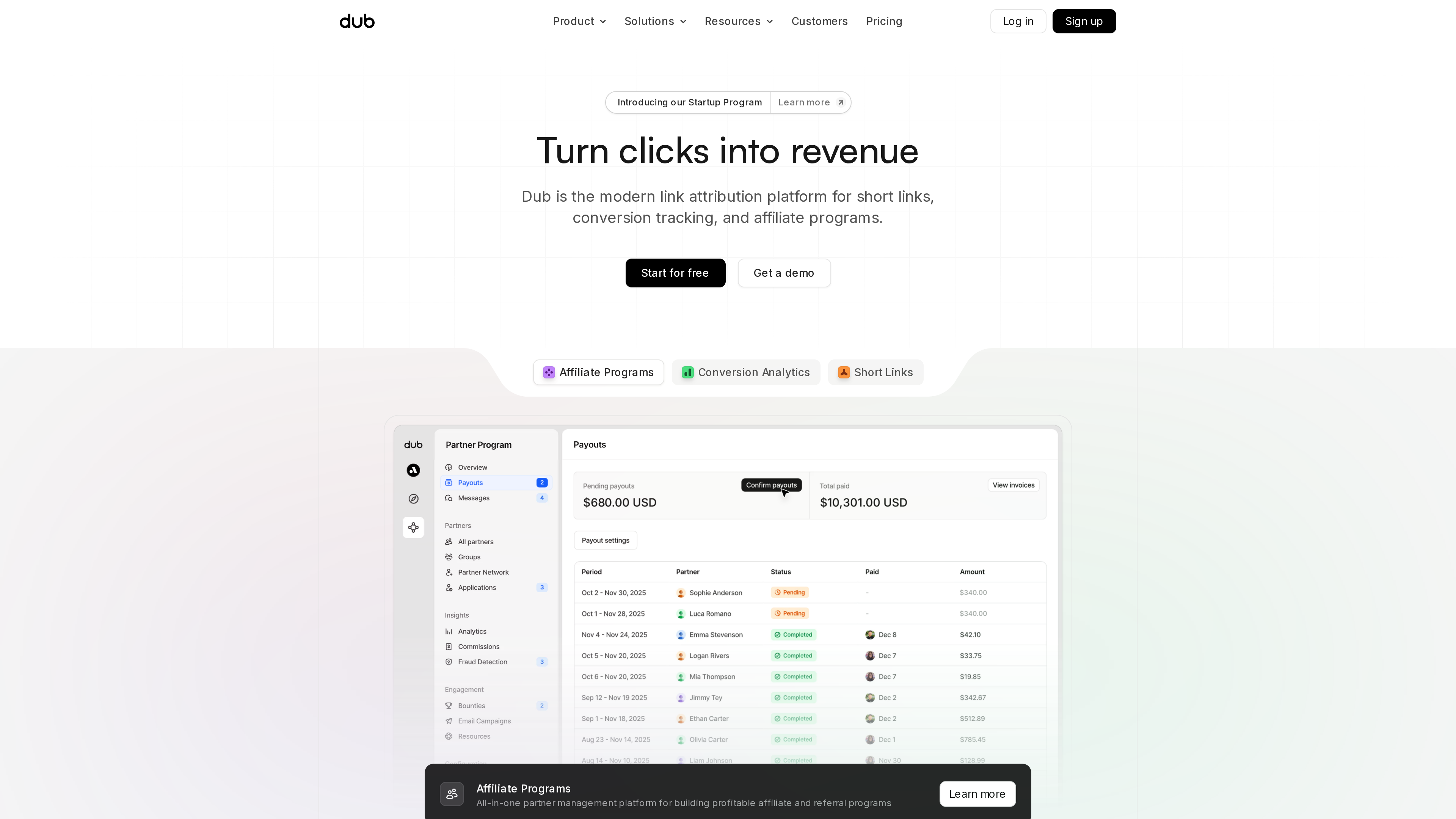
Dub (dub.co) is an open-source link attribution platform: it starts with short links and connects "create a link → track clicks → attribute conversions" into one pipeline. The product is organized into three lines — Dub Links for short-link management, Dub Analytics for conversion tracking, and Dub Partners for affiliate/referral programs — plus a REST API and multi-language SDKs for developers (homepage, developer docs, checked 2026-10-01). Compared with incumbents like Bitly or Short.io, its clearest differences are that the core codebase is open source (AGPLv3 plus a small set of enterprise-edition directories) and self-hostable, and that attribution extends beyond the click to sign-ups and sales.
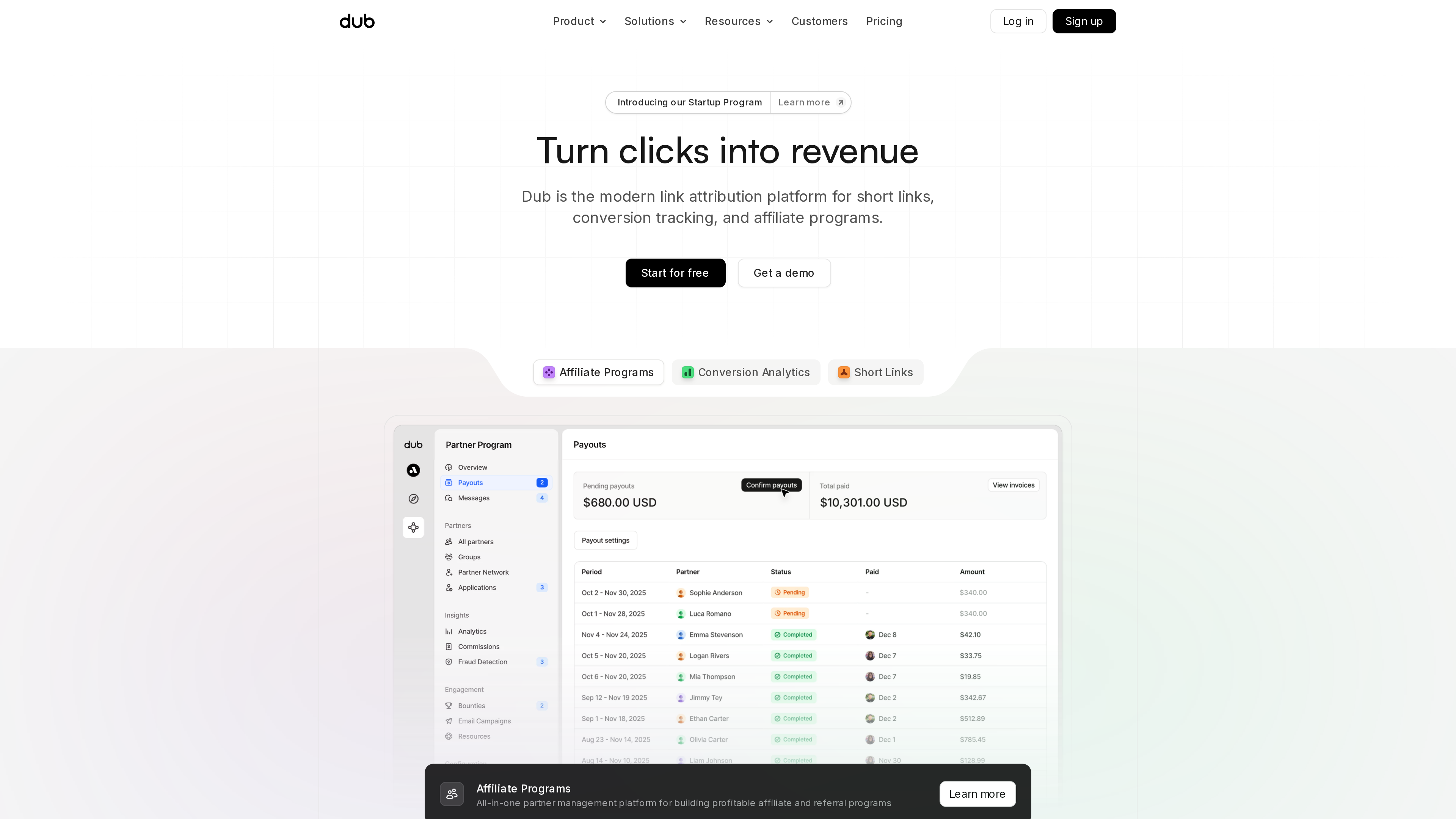
The screenshot above shows Dub's homepage: the hero positions it as "the modern link attribution platform for short links, conversion tracking, and affiliate programs," and the product preview below displays the Payouts view of a Dub Partners program.
At a glance
| Item | Details |
|---|---|
| URL | https://dub.co/ |
| Type | Open-source link attribution platform (short links + conversion analytics + affiliate programs + API) |
| Pricing | Free tier (30/month, 10% off yearly (pricing, as of 2026-10-01) |
| Sign-up | Account required: work email, or Google/GitHub OAuth (register); partner accounts register separately at partners.dub.co |
| Interface language | English (no other UI languages observed on the site or dashboard) |
| License | Repository mainly AGPLv3; (ee) directories under the Dub.co Commercial License (LICENSE) |
| Launched | Publicly launched as dub.sh on 2022-09-22; renamed dub.co in August 2023 (official blog) |
Background
- Founder Steven Tey (now CEO) started Dub as a personal side project, created the GitHub repository on 2022-08-27, and launched it publicly on Hacker News on 2022-09-22 as dub.sh, an "open-source Bitly alternative"; the Show HN post reached 255 points (official blog, Show HN post).
- On 2023-08-21 the project rebranded from dub.sh to dub.co; around the same period it shipped one-click migration assistants from Bitly, Rebrandly, and Short.io. On 2024-01-17, Tey announced he was building a company around Dub (official blog).
- The company is Dub Technologies, Inc., self-described as a small fully-remote team. The About page lists individual investors including Joseph Jacks (OSS Capital), Guillermo Rauch (Vercel), Balaji Srinivasan, and Framer founders Koen Bok and Jorn Van Dijk (About).
- Dub Partners launched on 2025-08-12, expanding the product from short links into a "link attribution + affiliate programs" dual focus (official blog).
- Official scale claims vary by page: the README states the platform handles 100M+ clicks and 2M+ links monthly, the homepage cites 100,000+ customers, and the About page cites 1,000+ companies (all official self-descriptions, as of 2026-10-01). Public customer examples include Perplexity (pplx.ai), Vercel (vercel.fyi), Framer (framer.link), and Cal.com (go.cal.com) (help center).
Core capabilities: short links, conversion analytics, and affiliate programs
Dub Links (short-link management). Create branded short links on your own domains (the free tier allows 3 custom domains), with a UTM builder and templates, custom social-media preview cards (which Dub describes as unique among link management platforms), device/geo targeting, password protection, expiration dates, link cloaking, A/B testing, deferred deep links, and folder/tag organization; every link automatically gets a customizable QR code (help center, homepage).
Dub Analytics (conversion analytics). Click analytics cover geolocation, device, browser, and referrer, with timeseries charts and a real-time events stream, data export, and an "Ask AI" feature. From the Business plan up, clicks can be attributed further to leads (sign-ups) and sales, with customer journey and lifetime-value (LTV) insights (homepage, pricing).
Dub Partners (affiliate/referral programs). Launched in August 2025: configurable reward structures per click, lead, or sale (down to individual partners and links), one-click global payouts with built-in tax compliance, dual-sided incentives, an AI-generated program landing page, and an in-app embedded referral dashboard. A case study on the sign-up page states that Framer manages over $900K in monthly affiliate payouts through Dub (official blog, register page).
API and integrations. The REST API supports programmatic bulk link creation with rate limits from 600 to 3,000 requests/minute depending on plan; official SDKs exist for TypeScript, Python, Go, PHP, and Ruby, alongside real-time event webhooks and an MCP server. Integrations include Stripe (revenue attribution), Shopify, Google Tag Manager, Zapier, HubSpot, and Segment (developer docs, pricing).
Cloud pricing (as of 2026-10-01)
Prices below are from the monthly-billing view of the pricing page; yearly billing takes 10% off and grants 12x the monthly usage upfront. Paid plans include a 14-day free trial.
Dub Links:
| Plan | Price | New links/mo | Tracked events/mo | Analytics retention | Key quotas |
|---|---|---|---|---|---|
| Free | $0 | 25 | 1K | 30 days | 3 custom domains, 1 user, API access, QR codes |
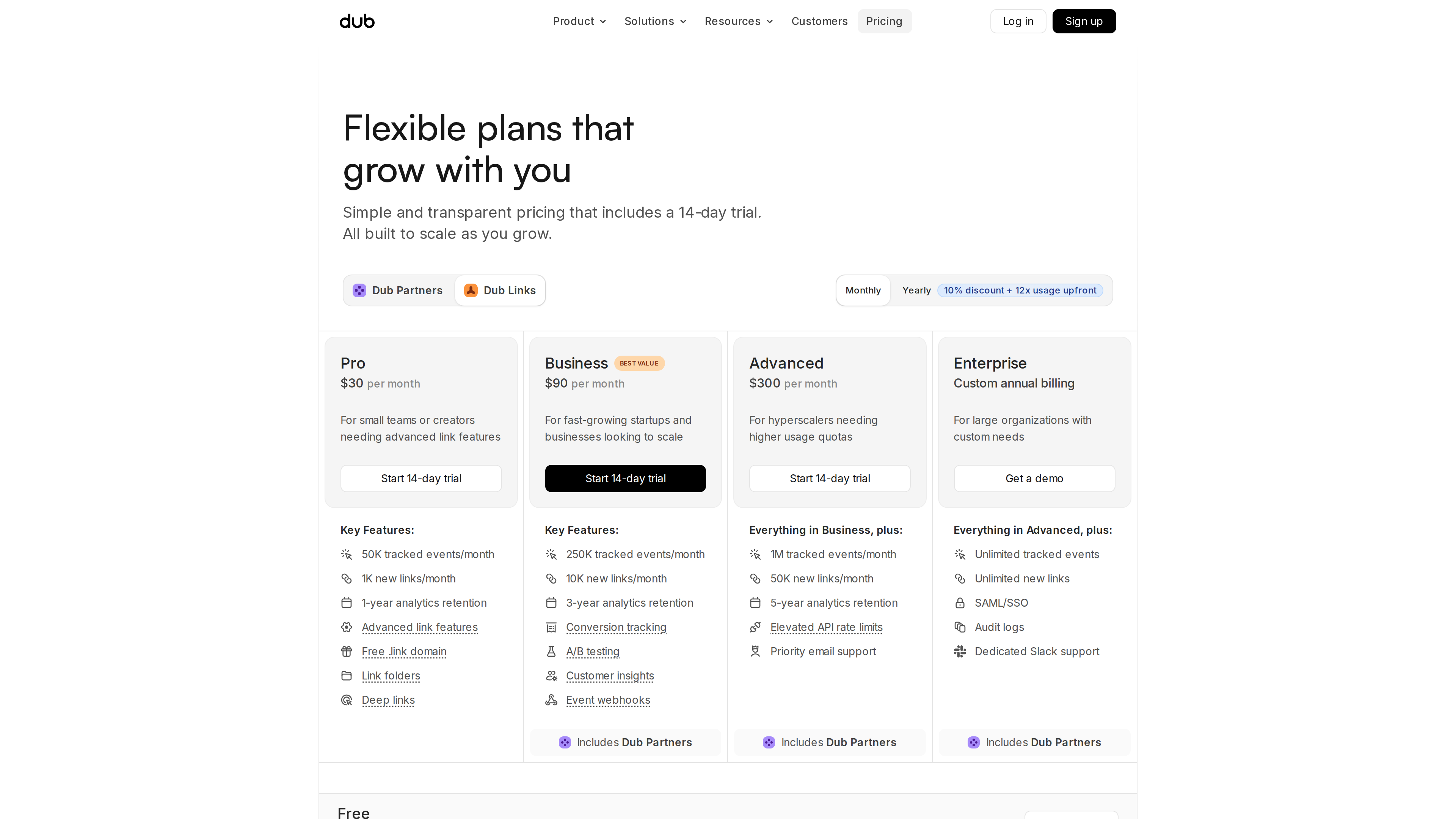
| Pro | $30/mo | 1K | 50K | 1 year | 3 users, 10 domains, API 600 req/min |
| Business | $90/mo | 10K | 250K | 3 years | 10 users, 100 domains, conversion tracking, A/B testing, includes Dub Partners |
| Advanced | $300/mo | 50K | 1M | 5 years | 20 users, 250 domains, API 3,000 req/min |
| Enterprise | Custom (annual) | Unlimited | Unlimited | Unlimited | SAML/SSO, audit logs, dedicated Slack support, SLA |
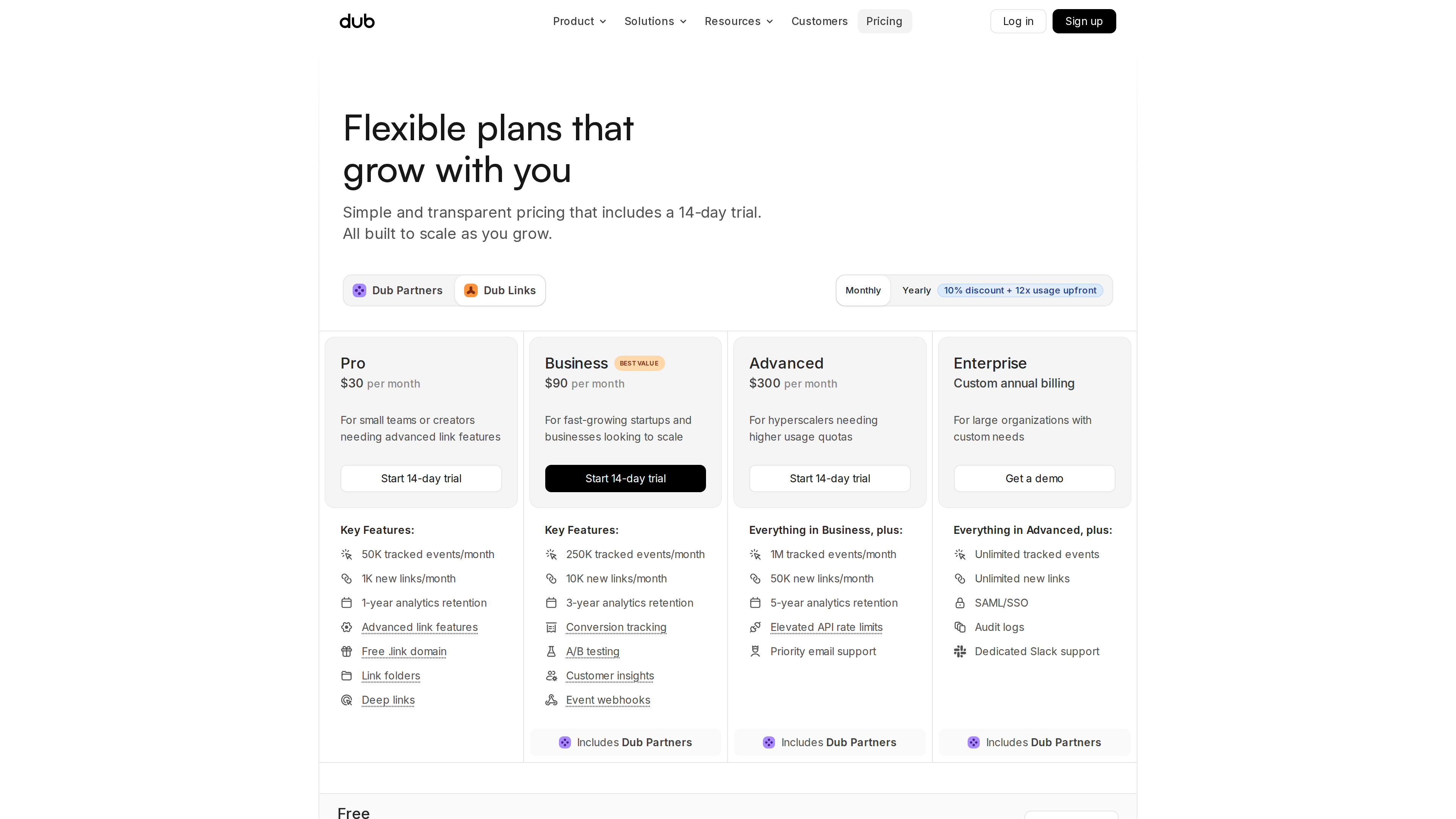
The screenshot above shows the Dub Links pricing view (monthly billing): Pro, Business, and Advanced each offer a 14-day trial, and Business onward is marked "Includes Dub Partners." Below the paid tiers, the page lists a forever-free plan (25 new links, 1K tracked events, and 3 custom domains per month).
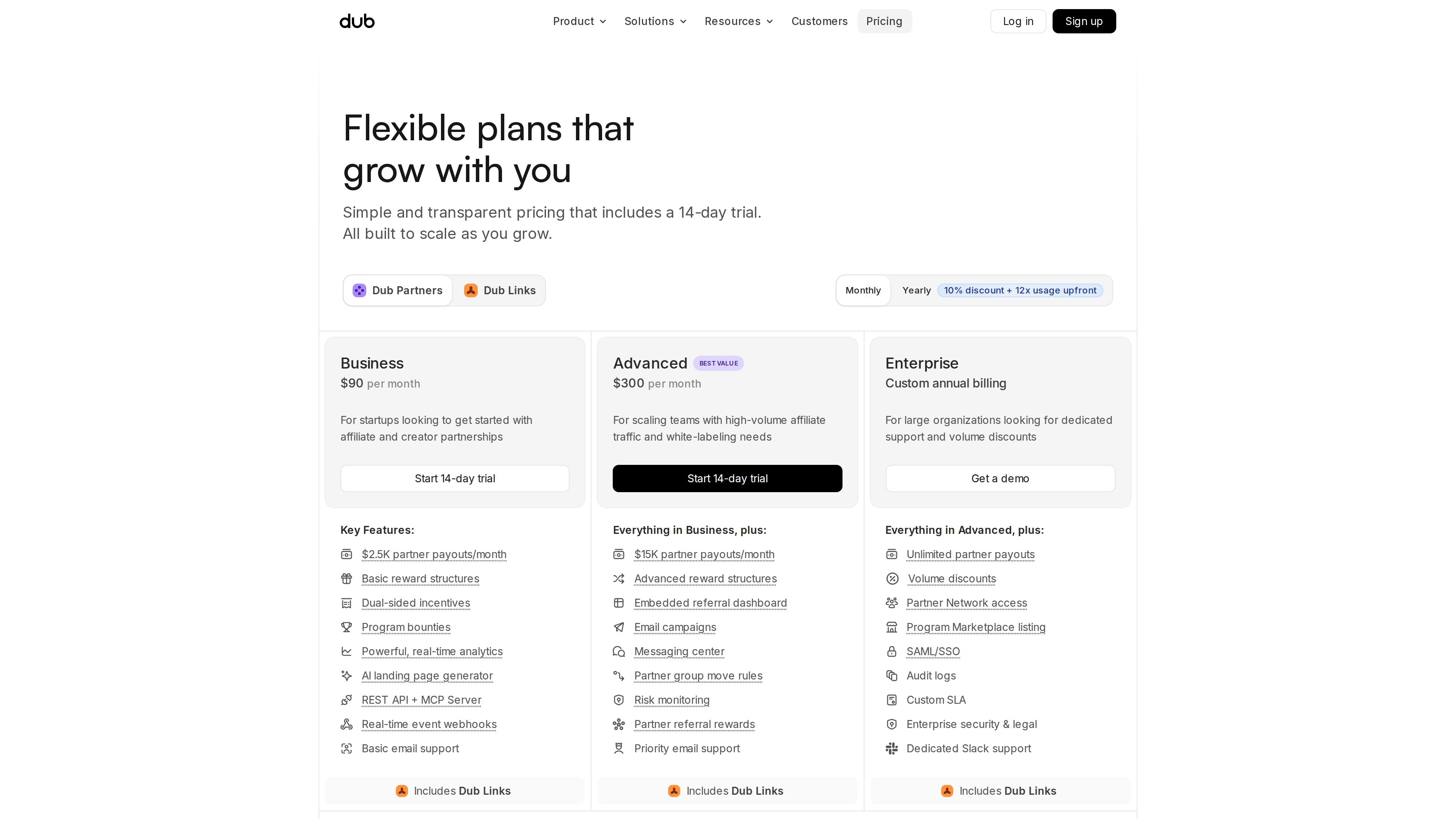
Dub Partners shares the same Business/Advanced/Enterprise tiers and prices as Links, but meters on the partner dimension: Business allows 15K/month with a 3% fee, unlimited partners, the embedded referral dashboard, and email campaigns; Enterprise removes payout limits and adds Partner Network access and a Marketplace listing (pricing).
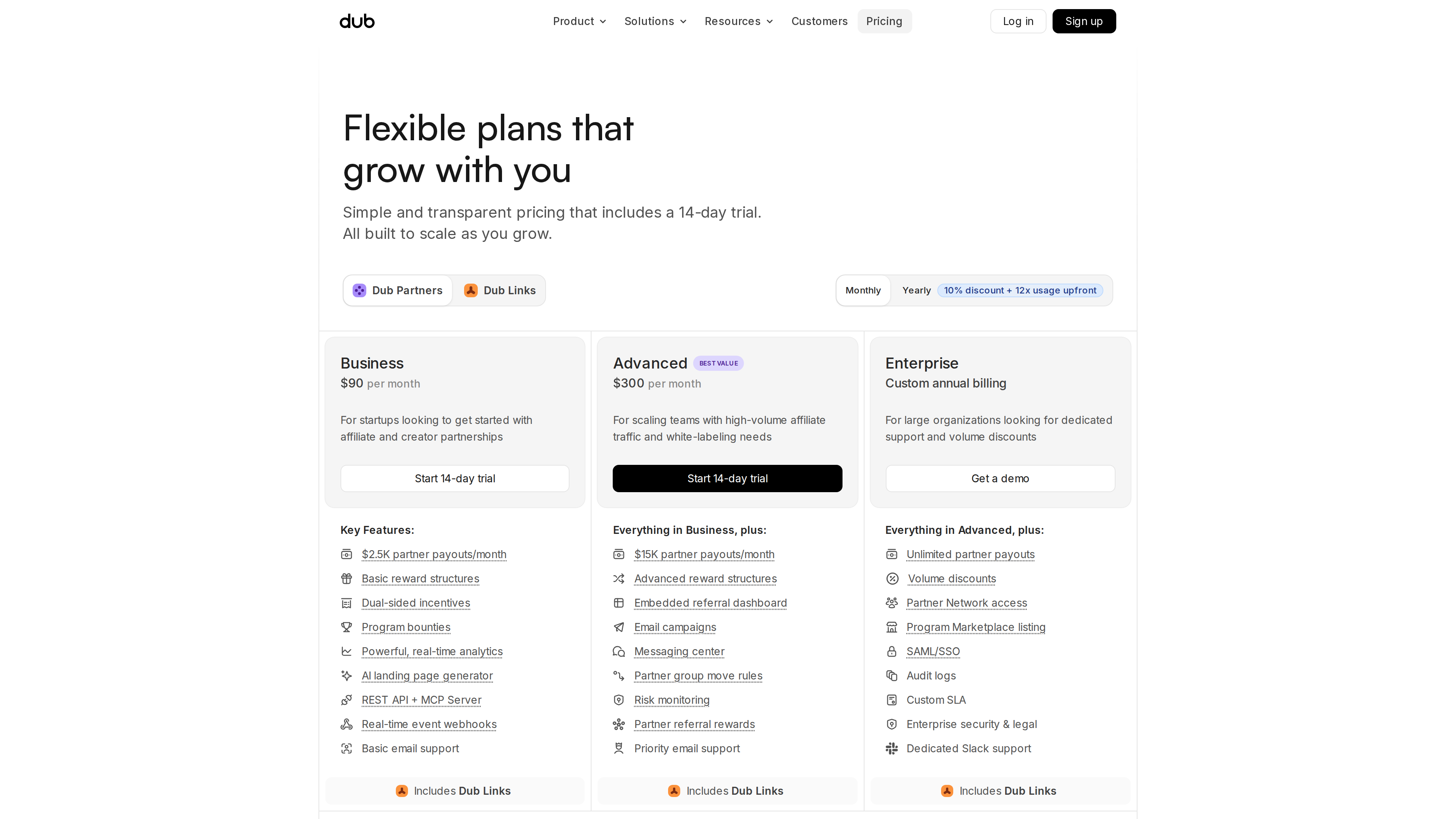
The screenshot above shows the Dub Partners pricing view: Business includes basic reward structures and an AI landing-page generator, Advanced adds the embedded referral dashboard, email campaigns, and risk monitoring, and all tiers are marked "Includes Dub Links."
Dub also runs a Startup Program: funded companies less than 5 years old, with fewer than 15 employees, that are not existing paying customers get the Advanced plan at 50% off in year one and 25% off in year two (Startup Program).
Open-source license and self-hosting
- License model. Everything in the repository is AGPLv3 except two
(ee)directory trees —apps/web/app/(ee)and the(ee)section of the dashboard — which fall under the "Dub.co Commercial License": copying and modification are free for development and testing, but production use requires a valid Enterprise subscription. Because of this mixed licensing, GitHub flags the repository license as NOASSERTION (LICENSE.md, EE LICENSE). - Repository activity. As of 2026-10-01, the repository has about 24,851 stars and 3,312 forks, with commits pushed on the day of checking; the project does not publish versioned GitHub Releases (GitHub API, as of 2026-10-01).
- Self-hosting requirements. The official docs provide a 9-step guide, but it depends on a chain of third-party cloud services: Tinybird (ClickHouse analytics), Upstash (Redis and QStash), a PlanetScale-compatible MySQL database, Vercel (hosting and Edge Middleware), Cloudflare R2 or AWS S3 (asset storage), Resend (transactional email — required if you want magic-link sign-in), GitHub OAuth (login), and your own domain (self-hosting docs).
- Self-hosting limitations. The docs list explicit caveats: there is no official Docker support yet (only community issues/PRs), and Dub plans to eventually swap the managed dependencies for native MySQL/Redis/ClickHouse. The docs also remind self-hosters that the AGPLv3 requires making source code — including modifications — available when offering the service to users (self-hosting docs).
Who it's for
- Marketing teams that want branded short links on their own domains with click and conversion tracking, as an alternative to Bitly, Rebrandly, or Short.io; the free tier supports custom domains, so small-scale validation costs nothing.
- SaaS companies and startups building affiliate or referral programs on Dub Partners, offloading global payouts and tax compliance instead of building partner infrastructure in-house.
- Developers who need to generate short links programmatically, consume event webhooks, or implement deep links inside their own products.
- Teams that value auditability and data control: the core codebase is open source and self-hostable, so the implementation can be reviewed or run on private infrastructure.
Limitations
- Small free-tier quotas: 25 new links, 1K tracked events per month, and 30-day retention — enough for personal use or evaluation only. Conversion tracking (lead/sale attribution) starts at the Business plan ($90/month).
- Self-hosting has a high bar: the official deployment path ties you to Tinybird, Upstash, PlanetScale, and Vercel, with no official Docker image — unfriendly to teams wanting a fully offline deployment.
- Mixed licensing: the enterprise features under the dashboard's
(ee)directories are not AGPL and require a commercial subscription for production use, so the self-hosted edition trails the cloud Enterprise plan in functionality. - English-only interface: the website, dashboard, and documentation offer no other UI languages.
- Enterprise security features sit at the top tier: SAML/SSO and audit logs are Enterprise-only (custom annual billing).
Alternatives
Dub's own comparison pages position Dub Links against Bitly, Rebrandly, Short.io, and Bl.ink (footer Compare section), and Dub Partners against Rewardful, PartnerStack, FirstPromoter, and Tolt. Combining short links with attribution — under an open-source core — is its main differentiator from the link-management incumbents; against dedicated affiliate platforms, its distinction is running referral links, attribution, and payouts on a single link infrastructure.
References
- Dub homepage and About page (checked 2026-10-01)
- Dub Links pricing and Dub Partners pricing (checked 2026-10-01)
- Developer docs, self-hosting guide, Dub Links help center (checked 2026-10-01)
- Official blog: Introducing Dub and Introducing Dub Partners (checked 2026-10-01)
- GitHub repository dubinc/dub and LICENSE.md (checked 2026-10-01)
- Show HN post (2022-09-22)