Dribbble is a community platform built around snapshots of design work. Designers publish "shots" — small images or short videos of work in progress — to gain exposure, feedback and job opportunities, while clients and recruiters use the same site to browse portfolios, contact designers, post jobs and run freelance projects. Launched in 2009 and majority-owned by Canadian holding company Tiny since 2017, it now operates as a hybrid of community site, Pro subscription product and hiring marketplace.
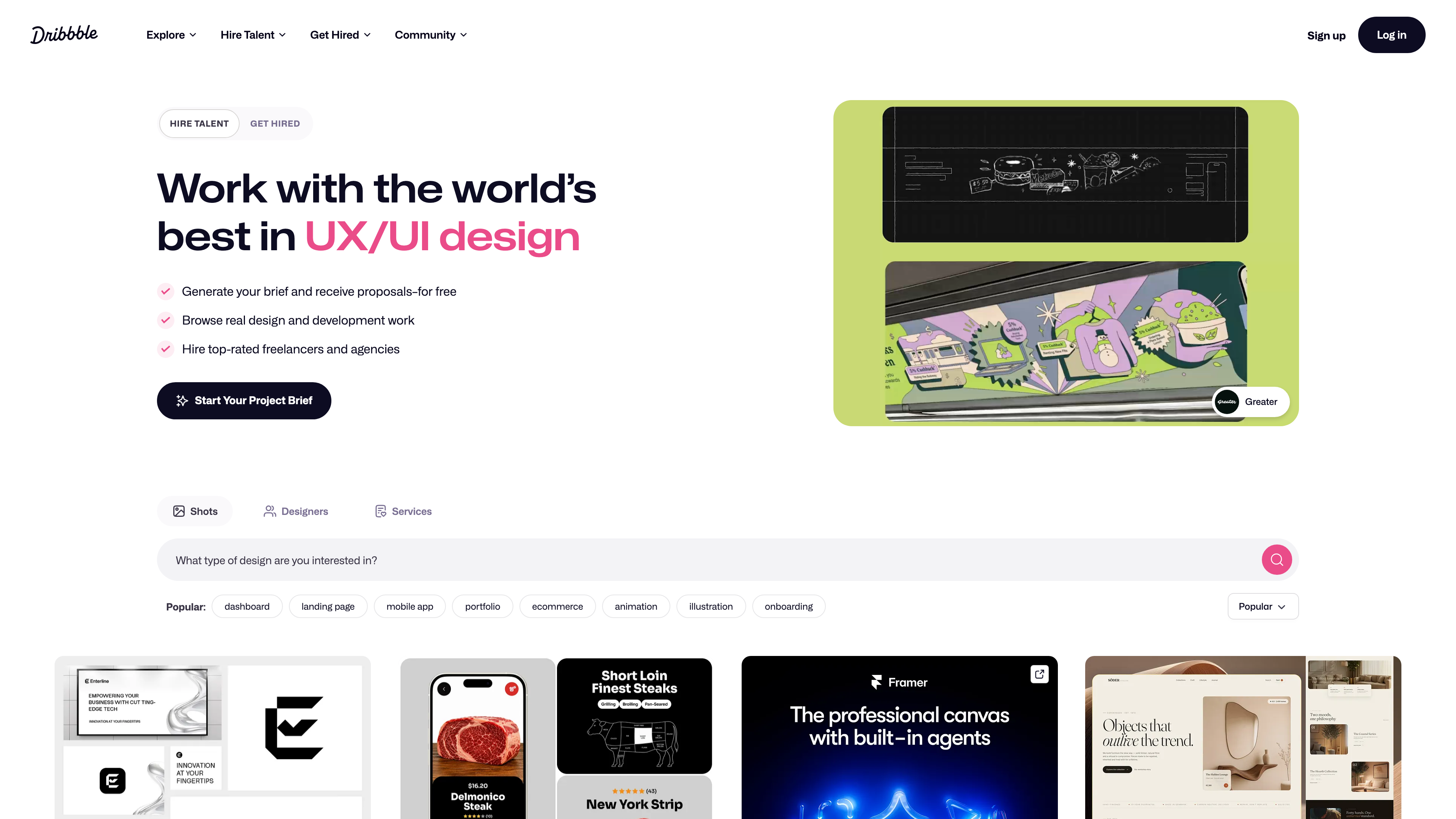
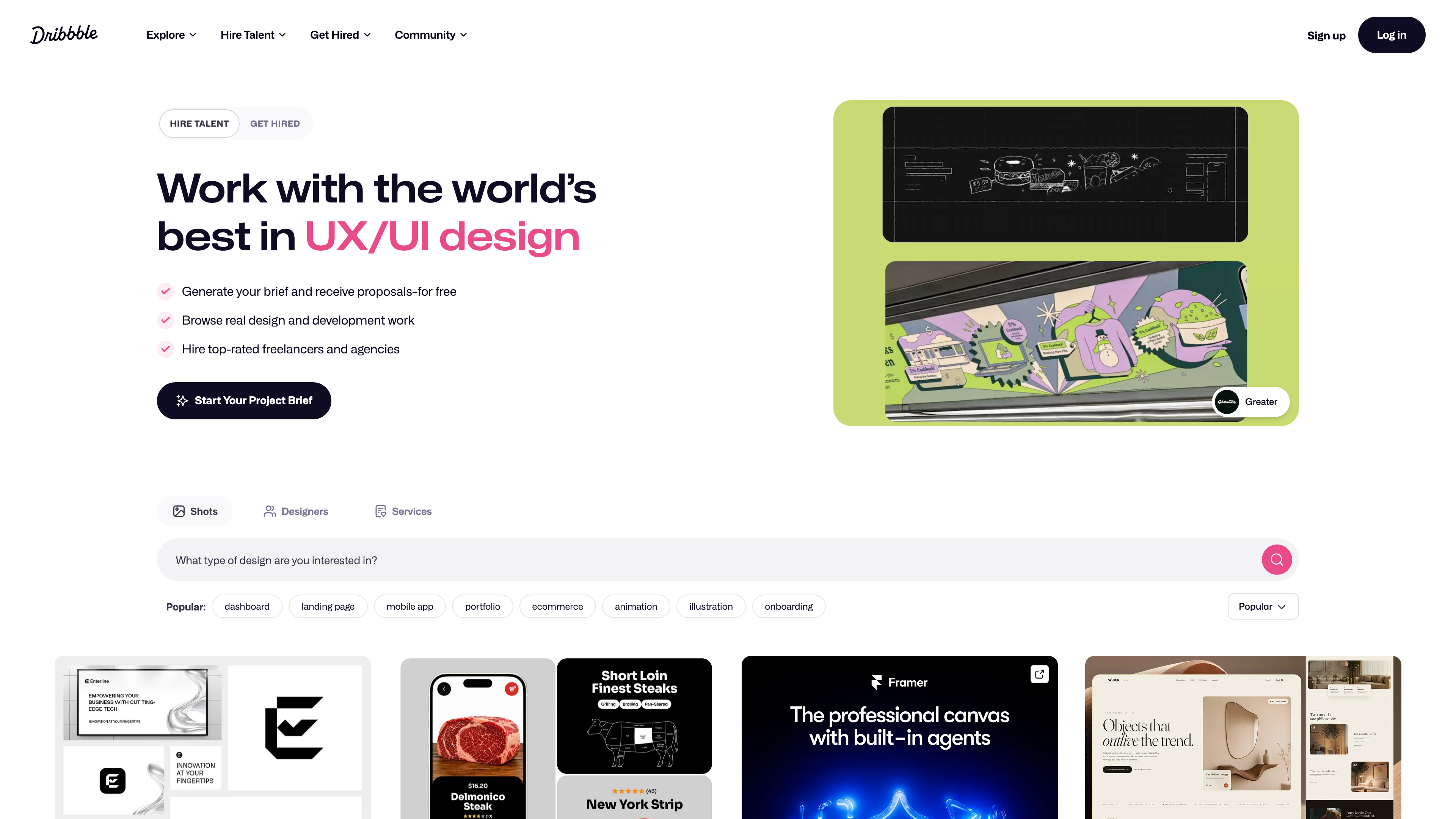
The homepage above was captured on 2026-09-21. The hero promotes the hiring side of the business ("Work with the world's best in UX/UI design"), followed by a search box spanning Shots, Designers and Services, a row of trending tags, and the shot feed — a fair summary of Dribbble's three identities today: a portfolio community, a designer directory and a deal-making marketplace.
At a glance
- URL: https://dribbble.com/
- Type: design portfolio community + freelance/job marketplace
- Cost: free to browse; designer Pro plans 99/month (yearly billing); job posts from $150/month; freelance projects carry a 2–5% client-side platform fee (all as of 2026-09-21)
- Sign-up: browsing needs no account; publishing work requires an approved designer application or an invite from a member
- Interface language: English only (checked 2026-09-21)
- Launched: 2009 (invite-only beta)
Background
Dribbble was founded in 2009 by Dan Cederholm and Rich Thornett as an invite-only beta; the first shot was posted on July 9, 2009, and the site opened to the public in March 2010 with invitations still required for new members (source: Wikipedia). According to Cederholm, the name plays on the dual metaphors of "bouncing ideas" and "leaking your work", with an extra "b" because the domain was available. The basketball theme runs through the site's vocabulary: shots, rebounds (remixes of someone else's work), debuts (a designer's first shot) and playoffs (official design challenges) (source: The Next Web's 2013 interview). Early shots were capped at 400×300 pixels, and that constraint — together with the invite system — shaped the community's quality-over-length character (source: Tiny's Dribbble page).
In January 2017, Tiny acquired a majority stake in Dribbble, Zack Onisko became CEO, and Cederholm stayed on as an advisor (sources: Andrew Wilkinson's announcement, Tiny). In April 2017 Dribbble bought the freelancer platform Crew, moving into transaction matchmaking (source: BetaKit). Video shots and an Android app arrived in 2018 (source: Dribbble 2018 Year in Review), and in 2019 the company raised the upload size limit and redesigned the shot layout, retiring the 400×300 rule (source: Dribbble's official blog).
The invite system changed fundamentally in April 2021, when Dribbble announced that anyone could apply for a designer account; approved applicants can publish shots and comment publicly. Invites still exist but are no longer the only way in (source: A bigger, more inclusive Dribbble).
The service is operated by Dribbble Holdings Ltd. (Terms of Service, updated 2025-03-17) by an all-remote team — the About page listed 23 team members as of 2026-09-21 (source: About us). On scale, the company's advertising page claims 20 million users and 100 million monthly pageviews; treat these as marketing figures (source: Advertise).
Core features: shots and browsing
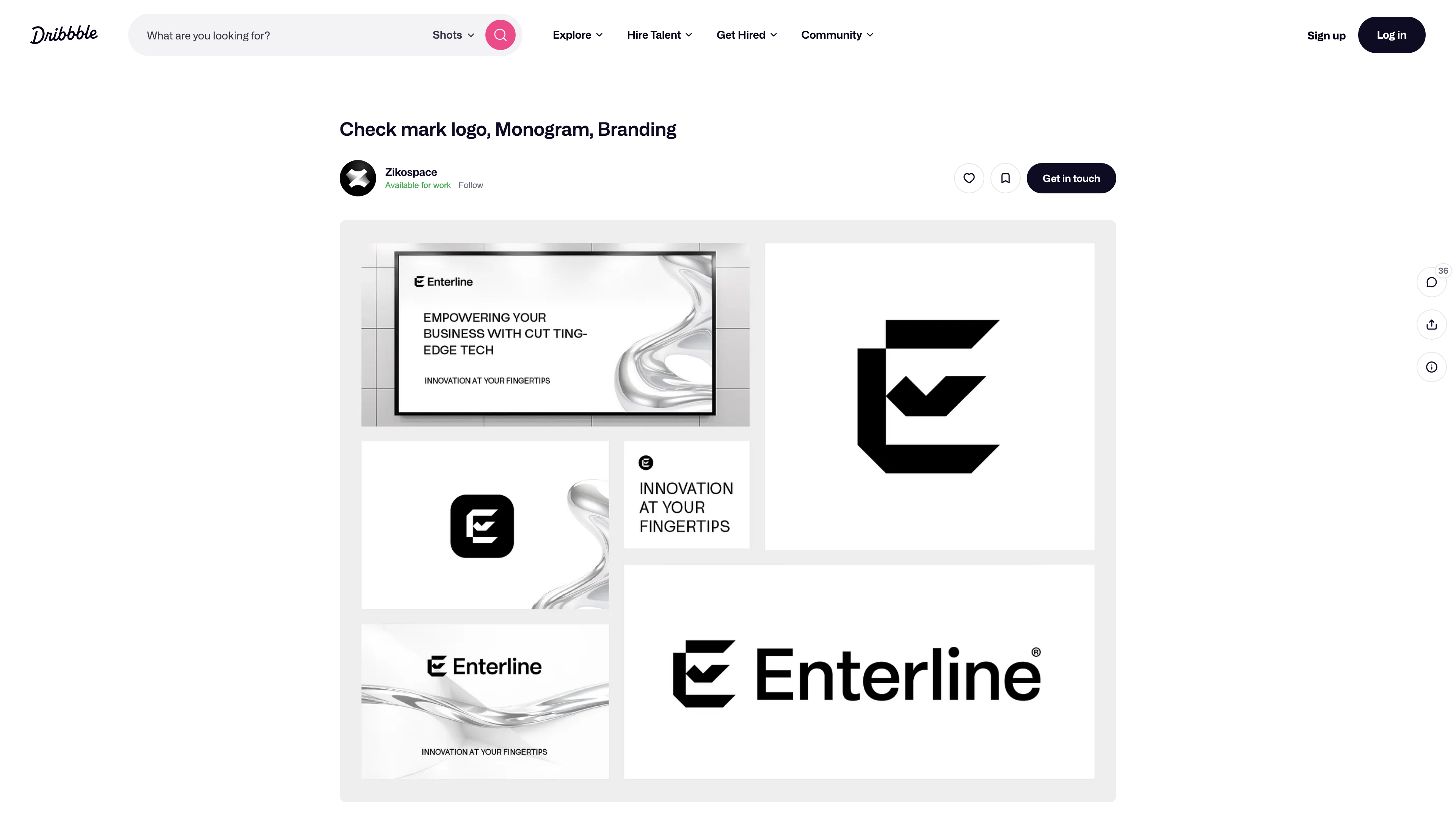
- Shots are the basic unit of publishing: multi-image or video posts with a title, description and tags. A shot page (one example captured above on 2026-09-21) surfaces the author, an "Available for work" status, like/save counts and a "Get in touch" button.
- Browsing and search: the feed can be sorted by Popular and filtered into categories such as Discover, Animation, Branding, Illustration, Mobile, Print, Product Design, Typography and Web Design. Search spans Shots, Designers and Services — the last being fixed-price offerings listed by designers.
- Rebounds and debuts: inspired work can be linked back to the original as a rebound; a designer's first published shot is badged as a debut.
- Profiles as portfolios: a designer's profile aggregates shots, services and availability. Pro adds a standalone portfolio site (Playbook), an intro video (Pitch) and a Pro badge (source: Pro plan comparison).
Accounts and Pro subscriptions
Browsing and search require no account; a free registered account can like, save and follow (the Code of Conduct governs how these gestures may be used). Publishing work publicly requires either a designer application (since 2021) or an invite from an existing member — paying for Pro skips the application process (sources: 2021 announcement, Pro plan comparison).
Pro comes in three tiers (yearly billing, as of 2026-09-21; source: Pro pricing):
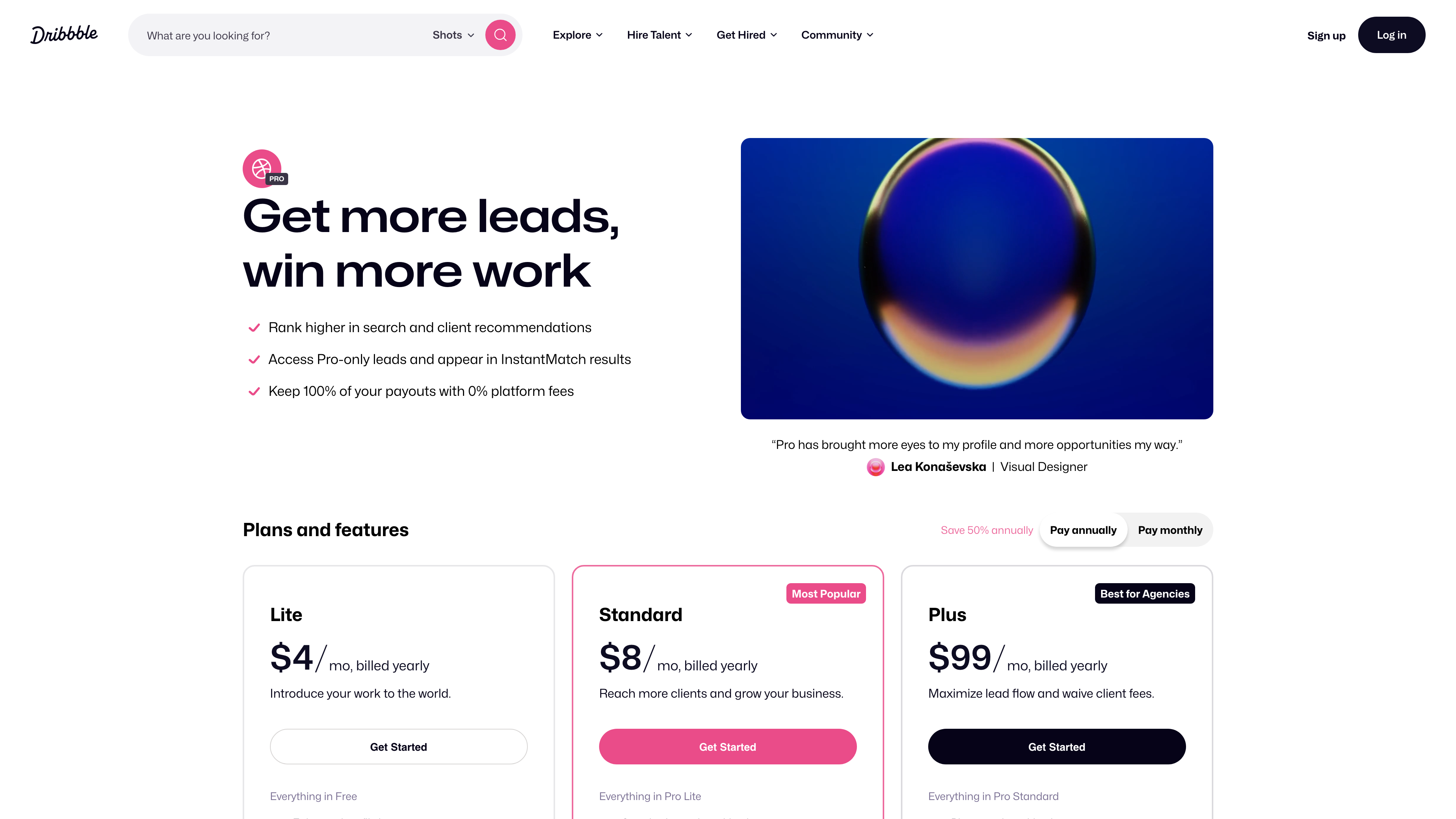
- Lite — $4/month: enhanced profile layout, a lite search-ranking boost, the ability to receive leads and send proposals, up to 3 listed services, and a Playbook portfolio site.
- Standard — $8/month: standard ranking boost, placement in Recommendations and InstantMatch results, 30 Project Brief credits per month, 0% designer platform fee on yearly plans, 3 team seats, advanced analytics and the Pro badge.
- Plus — $99/month: aimed at agencies, with the highest ranking boost, 0% client platform fee, 300 Project Brief credits per month, 10 team seats, upload and tagging assistance, and VIP support.
Free accounts may upload up to 10 shots per day; Lite, Standard and Plus raise that to 15, 25 and 50 respectively. Paid tiers also include monthly Boosted Shot advertising credit (300 for Plus).
Hiring and the freelance marketplace
Monetization centers on hiring. As of 2026-09-21, the hiring page lists three options:
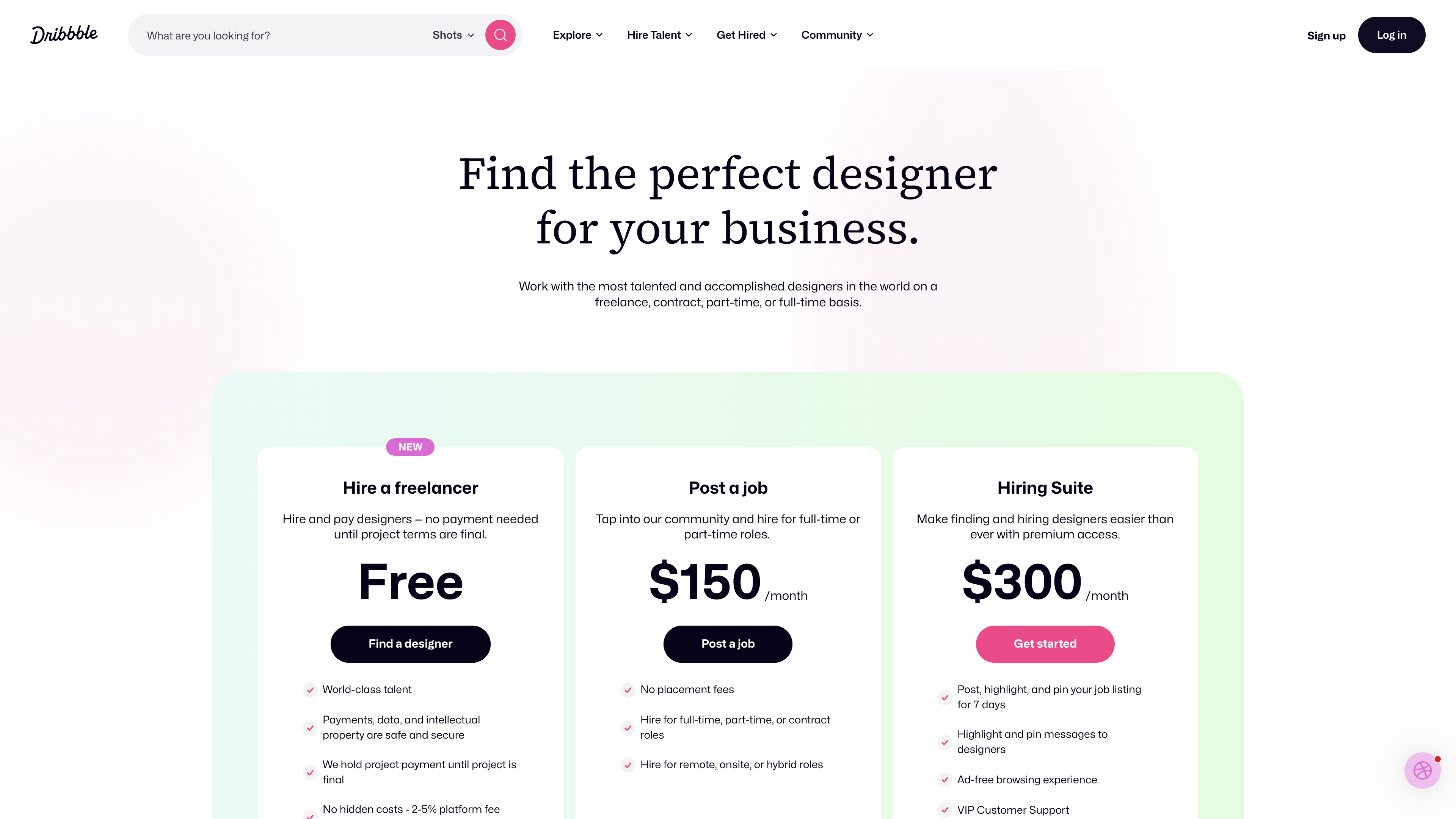
- Hire a freelancer (free to start): clients post a project brief for free and settle terms with the designer; Dribbble holds the payment in escrow until the project is complete. Clients pay a 2–5% platform fee scaled by project size; designers on free accounts pay a designer-side fee (waived on yearly Pro plans).
- Post a job ($150/month): job-board listings for full-time, part-time or contract roles; cancel anytime.
- Hiring Suite ($300/month): job posts highlighted and pinned for 7 days, highlighted messages to designers, ad-free browsing and VIP support.
Under section 5 of the Terms of Service, once a platform-brokered project is completed, the final deliverables — including copyright and trademark rights — are assigned to the client by default unless the proposal says otherwise; the designer's pre-existing IP stays with the designer, licensed to the client. Section 6 adds a 12-month non-circumvention rule: parties introduced through the platform may not take the deal off-platform within 12 months (designers subscribed to designated advertising products are exempt).
Copyright and content policy
For a UGC platform, the rules live mainly in the Terms of Service (updated 2025-03-17) and the Code of Conduct:
- Ownership: users keep the copyright in their content, but posting grants Dribbble a royalty-free, sublicensable, transferable, perpetual, irrevocable, non-exclusive, worldwide license to operate, promote and redistribute the service; other users get a license to access the content through site features (Terms §8–9). In practice this means your work may be used in Dribbble's marketing, and the grant cannot be revoked later.
- Content rules: design work only; no reposting other people's work, no watermarks, no content with copyright or trademark conflicts, and no wholly AI-generated content (AI-assisted work should be credited in the description). The site aims for PG-13 overall. If a piece is inspired by someone else's work, it should be posted as a rebound rather than a copy.
- Hiring rules: every work inquiry must be for paid design work — design contests and spec work are banned.
- Infringement handling: a DMCA notice channel and a designated copyright agent are in place, and repeat infringers face account disabling or termination (Terms §14).
API
Dribbble publishes a REST API v2 (api.dribbble.com/v2/, JSON). Applications must be registered and authenticate via OAuth 2; published limits are 60 requests per minute and 1,440 per day per authenticated user, with 30 items per page by default (source: API documentation, checked 2026-09-21). Third-party clients and portfolio sync tools are typically built on it.
Who it's for
- Designers building a public portfolio, gaining exposure, and picking up freelance work or job offers through their profile and Services listings.
- Founders and companies searching for freelance designers by style, or posting design roles.
- Non-designers using Dribbble as a quick-scan inspiration library for UI, branding and illustration trends.
Limitations
- English-only interface, with a strongly anglophone community context (observed 2026-09-21).
- A publishing gate remains: the invite system became an application system, but new accounts still need approval or an invite before posting — it is not sign-up-and-publish.
- The snapshot trade-off: single-image presentation dominates, so project context, process and full case-study depth are limited; readers wanting long-form case studies are better served by platforms like Behance.
- Visibility is partly paid: ranking boosts and recommendation placements are explicit Pro selling points, so organic exposure for free users is subject to platform ranking, and the feed includes ad slots.
- Transaction costs and constraints: freelance matching involves platform fees and the 12-month non-circumvention clause; funds are held in escrow and dispute outcomes rest with Dribbble (Terms §5–6).
- Soft scale numbers: the headline figures (20M users and similar) come from the company's advertising page, and third-party estimates of revenue and headcount vary widely — treat all of them as indicative only.
Alternatives
- Behance (Adobe): organized around complete project case studies — longer-form and free to publish, with a weaker hiring loop than Dribbble.
- Awwwards: a juried gallery of outstanding websites — an awards showcase rather than an open community.
References
- About us | Dribbble
- Dribbble Pro pricing / Hire designers
- Terms of Service / Code of Conduct
- A bigger, more inclusive Dribbble (2021 announcement)
- How Dribbble became the most influential online platform for graphic designers (The Next Web, 2013)
- Dribbble | Tiny / Dribbble 2.0 (Andrew Wilkinson, 2017)
- Crew sold to Dribbble (BetaKit, 2017)
- Dribbble 2018 Year in Review / More Pixels and a Perfect Crop (official blog, 2019)
- Dribbble API v2 documentation
- Dribbble - Wikipedia