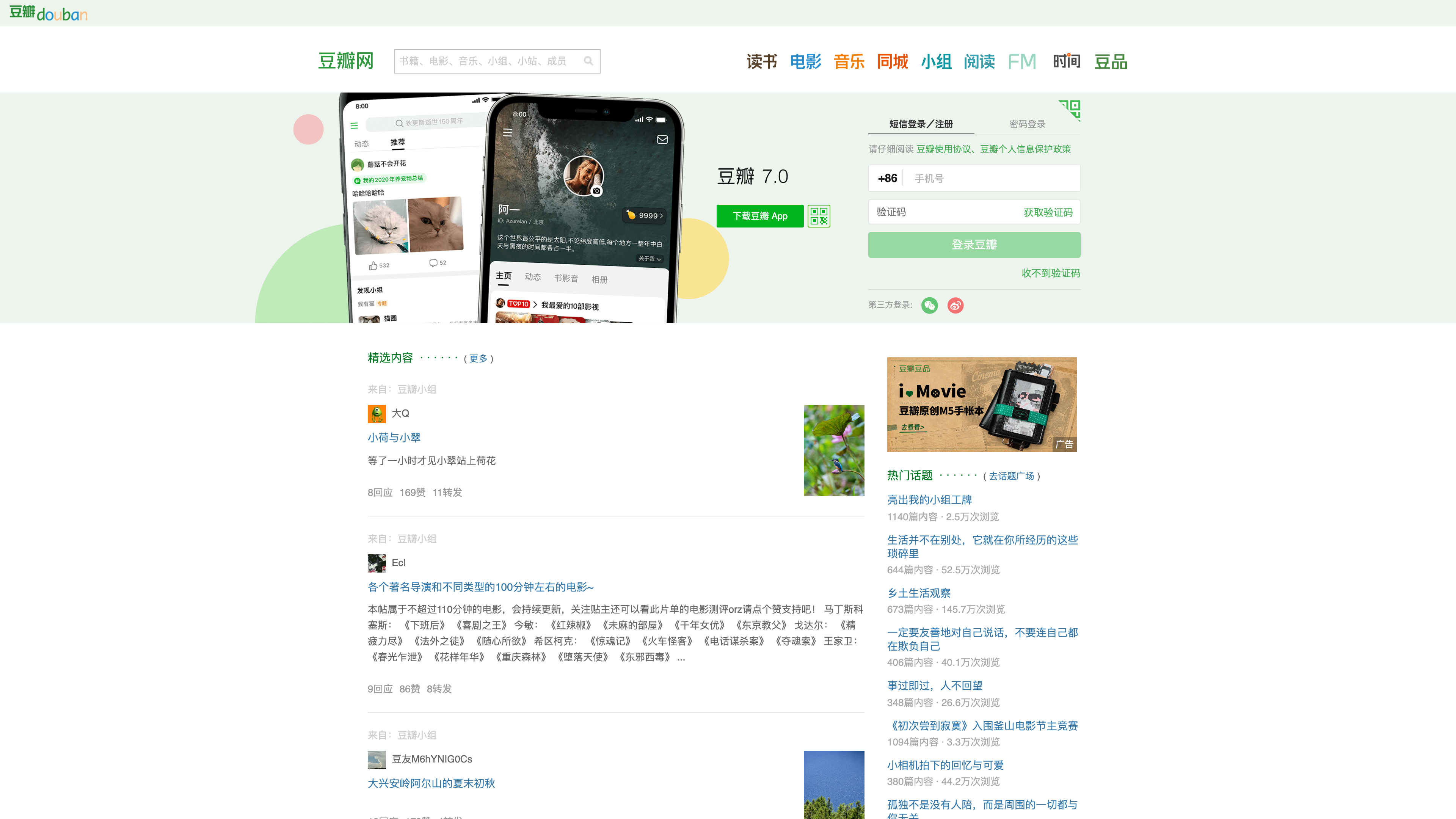
Douban(豆瓣, douban.com)is a community website operated by Beijing Douwang Technology Co., Ltd., and at its core a user-maintained online database: every book, film, TV series or music release gets a subject page where members' star ratings, short comments and long reviews accumulate. That makes it a widely cited word-of-mouth reference for books and screen media in the Chinese-speaking world. The problem it set out to solve, per its own About page, is that neither friends nor professional media can keep up with the explosion of cultural choices — Douban wants "strangers with the closest taste" to find each other. Its verifiable distinctions versus international rating sites: content is almost entirely in Simplified Chinese with deep coverage of Chinese-language books and films; subject pages are readable without any account; and its account system follows China's real-name registration rules. Note there is no English interface — it is documented here because of its reference value for Chinese books and cinema, but readers will need to navigate a Chinese UI.
At a Glance
- URL: https://www.douban.com/
- Type: Book/film/music subject database plus rating and interest community (web and mobile apps)
- Cost: Browsing, rating and groups are free; pages carry ad slots (visible on 2026-09-02)
- Registration: Not required for reading subject pages, reviews, group highlights or city events; rating, marking and posting require an account, with real-name verification in principle tied to a mainland China phone number (see "Accounts and openness")
- Interface language: Simplified Chinese only
- Operator: Beijing Douwang Technology Co., Ltd. (legal statement)
(Verified by direct visit on 2026-09-02.)
Background
Douban was founded by Yang Bo (screen name "Abei" 阿北) and opened for public registration on March 6, 2005; the site is named after Douban Hutong in Beijing, near the café where he wrote the first code (The Paper profile). According to the Chinese Wikipedia timeline, the Groups feature launched in March 2005 and the city-events feature in August 2005. Douban announced over 100 million monthly unique visitors in August 2012 and 200 million in 2013.
The founder rarely speaks publicly, but his December 2015 essay "Eight Questions about Douban's Movie Ratings" (豆瓣电影评分八问) remains the authoritative explanation of the rating system: every registered user casts one vote of one to five stars, converted to a ten-point scale and averaged, with the calculation re-run automatically every few minutes. He states there is no "modify the score" function in the backend and that the rating business is independent of commercial partnerships.
The Subject Database and Ratings
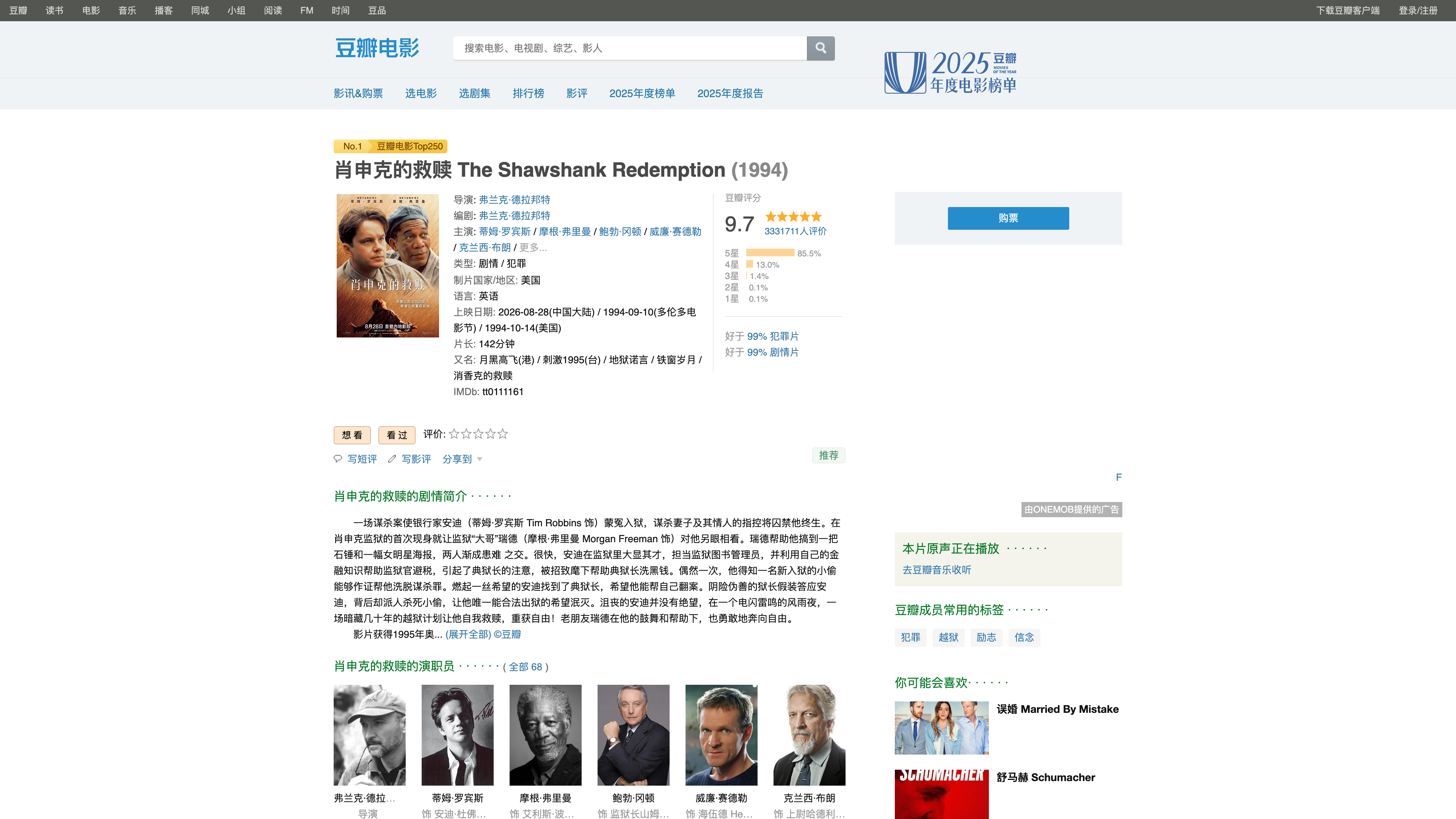
Douban's core asset is the subject page: basic metadata (author, director, publication or release info), the aggregate score, the star distribution, short comments, long reviews and "want to read/watch" counters. On The Shawshank Redemption's subject page, for example, as of 2026-09-02 the film holds a 9.7 Douban score from more than 3.33 million voters, and it has long topped the "Douban Movie Top 250" chart.
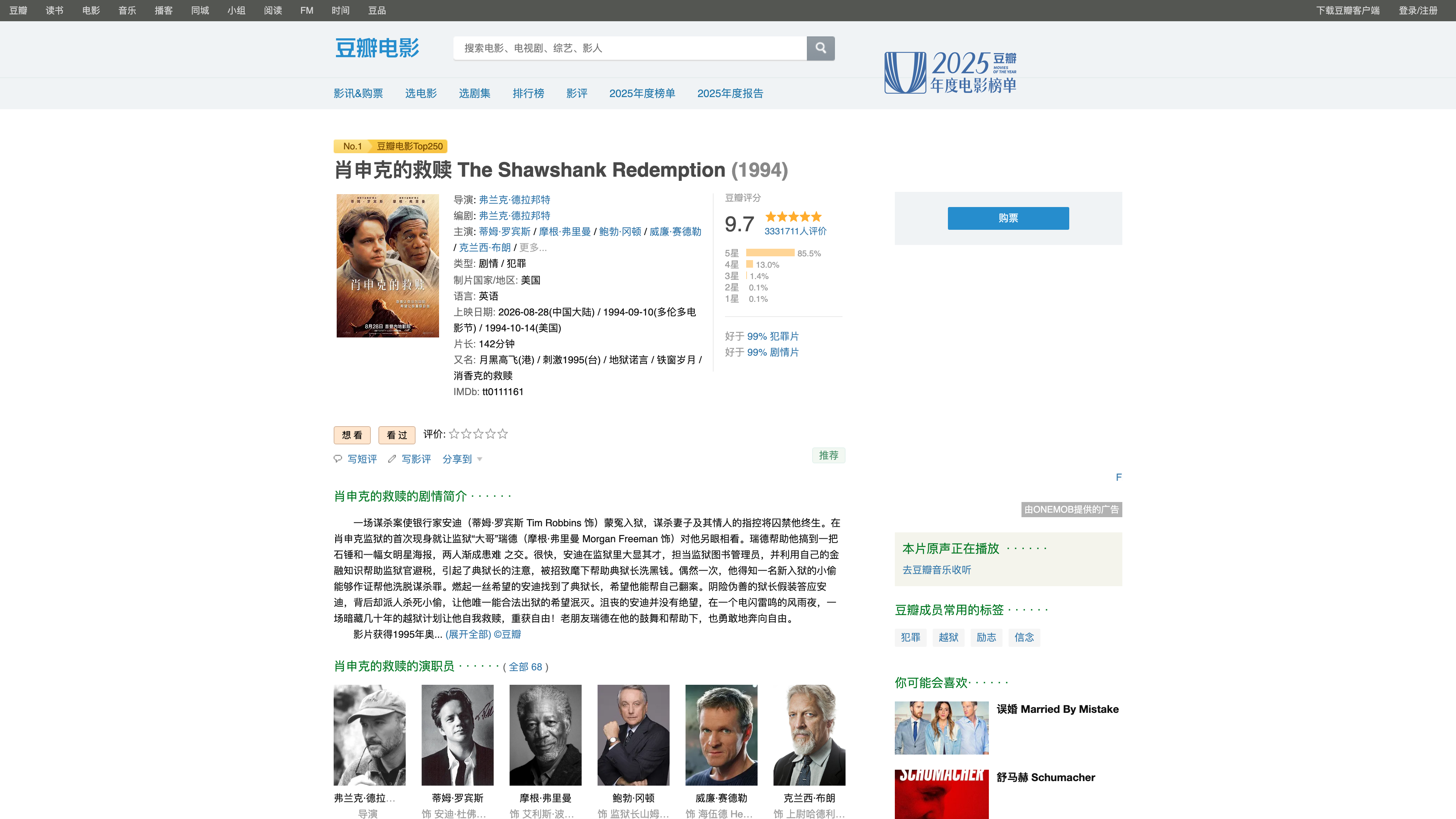
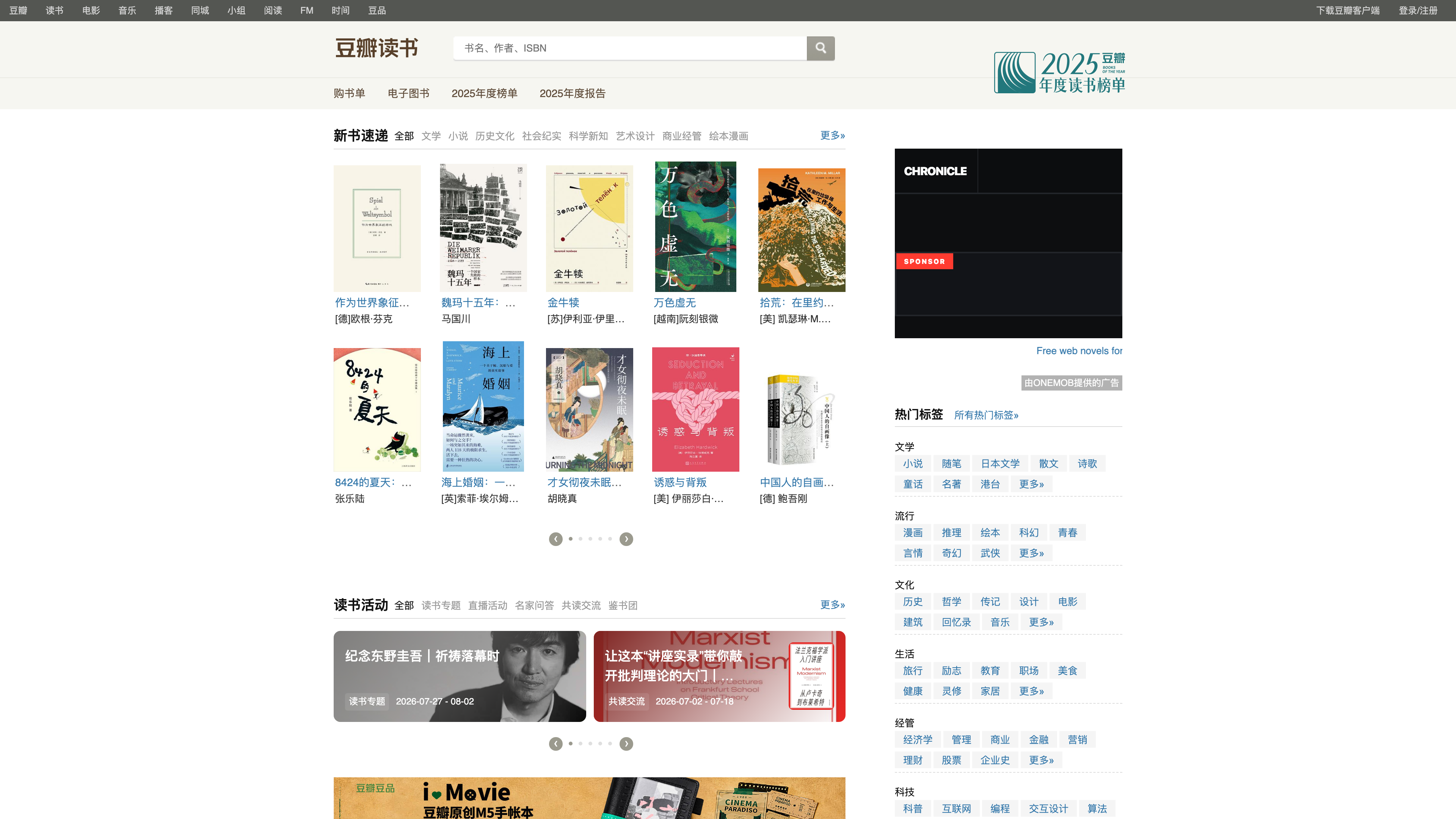
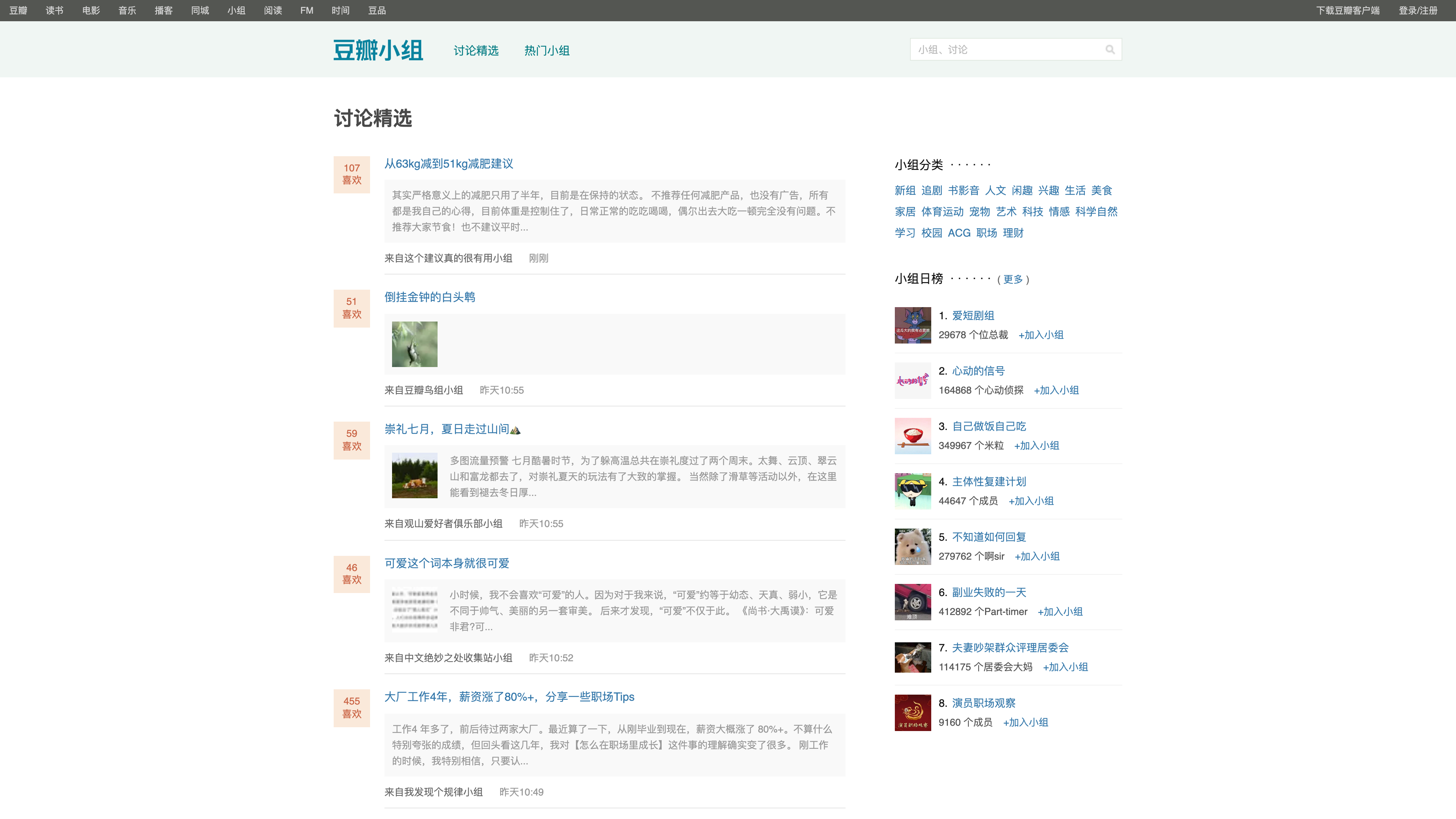
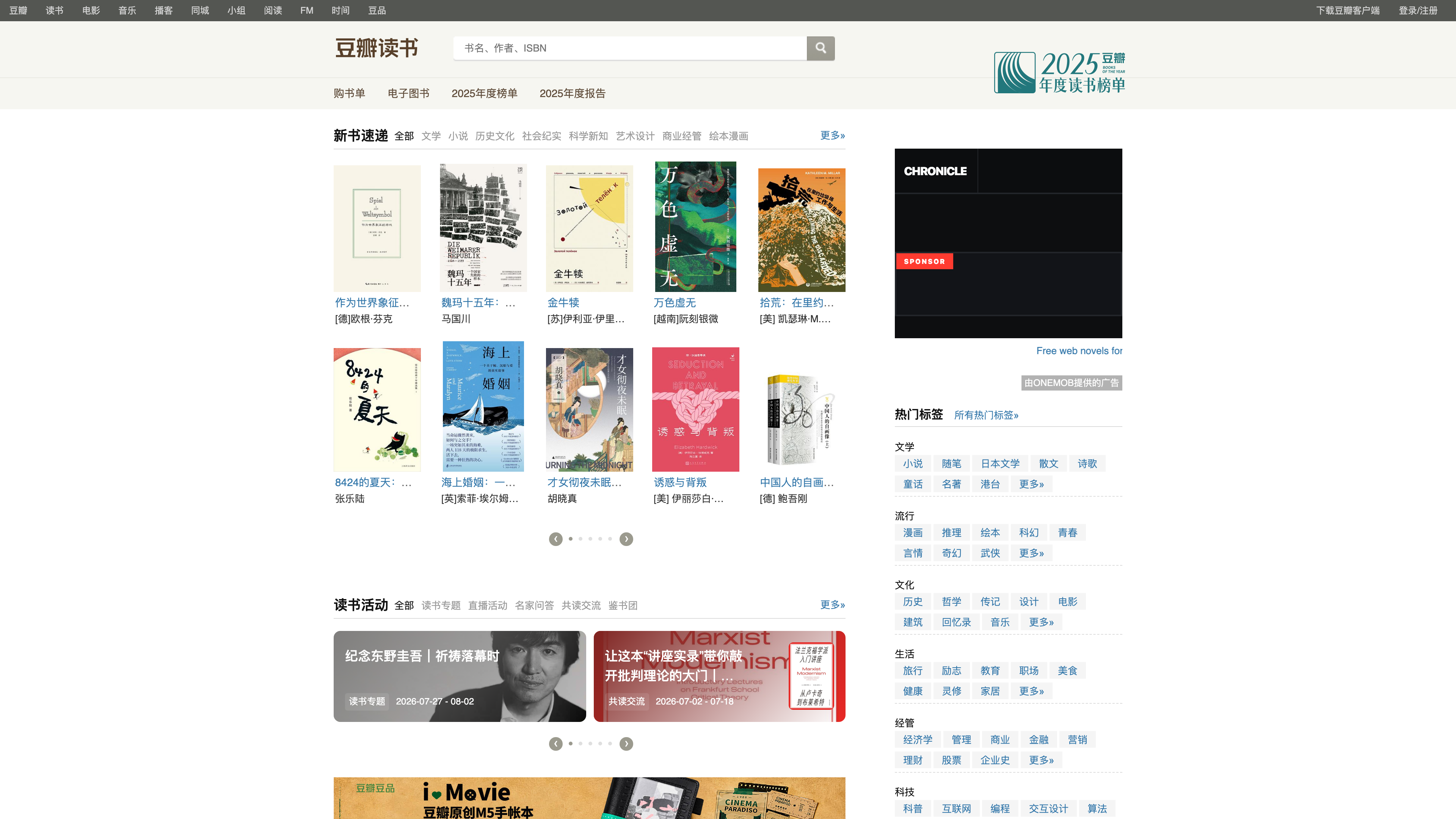
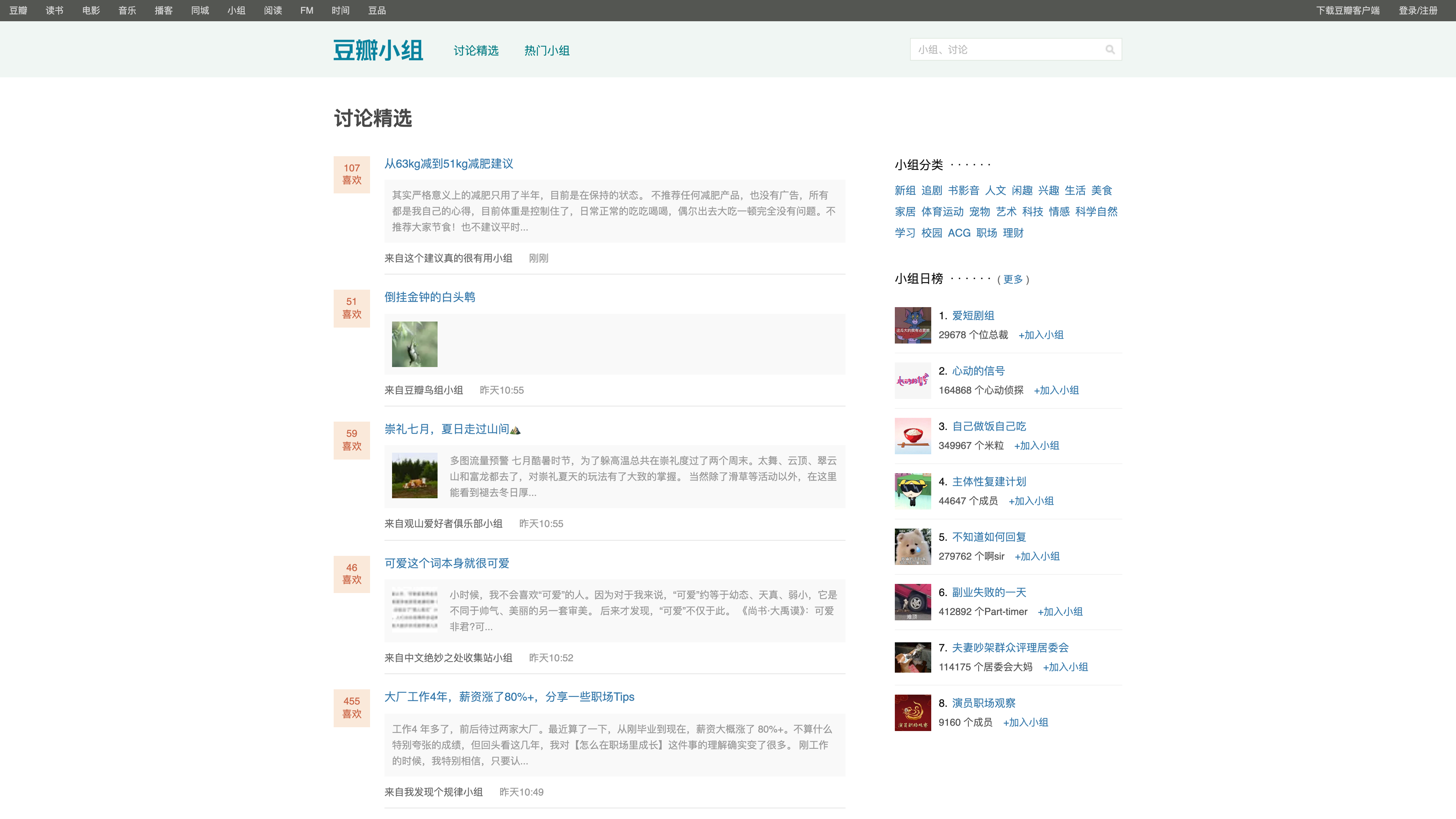
None of this requires an account. Tested on 2026-09-02: a logged-out visitor can open the homepage, subject pages (score, synopsis, review lists), the Douban Read homepage, the group highlights page and city event pages. A login wall only appears when rating, marking, posting or opening personal features.
Because scores are crowd-sourced rather than editorial, Douban perennially faces "vote brigading" accusations. Beyond the mechanism described in the Eight Questions essay, Douban said in November 2020 — responding to criticism that short comments were no longer shown in full — that the change was meant "to fight scraping and paid reviewers without hurting the user experience," and that the rating algorithm itself had not changed (36Kr report). In August 2025, Douban Movie announced action against account-farming rings that had posted large volumes of suspected AI-generated comments (Ruicaijing report, reposted).
Groups, City Events and Community Features
Beyond the database, two long-running community features were both still operating as of 2026-09-02:
- Groups (launched March 2005): user-created discussion boards by topic. The group highlights page shows trending discussions, categories and a daily group chart without login. Groups have gone through several rounds of regulator-driven rectification: the Cyberspace Administration of China summoned Douban in December 2021, and a work supervision team was stationed at the site in March 2022 (CAC announcement). Douban subsequently dissolved a number of groups, including the influential "E Zu" gossip group, and shut down private groups entirely in June 2022 (see the Chinese Wikipedia entry for the sequence).
- City events (launched August 2005): offline events organized by city. The events homepage currently centers on ticketed performances ("购票直通车") and organizer listings.
Accounts and Openness
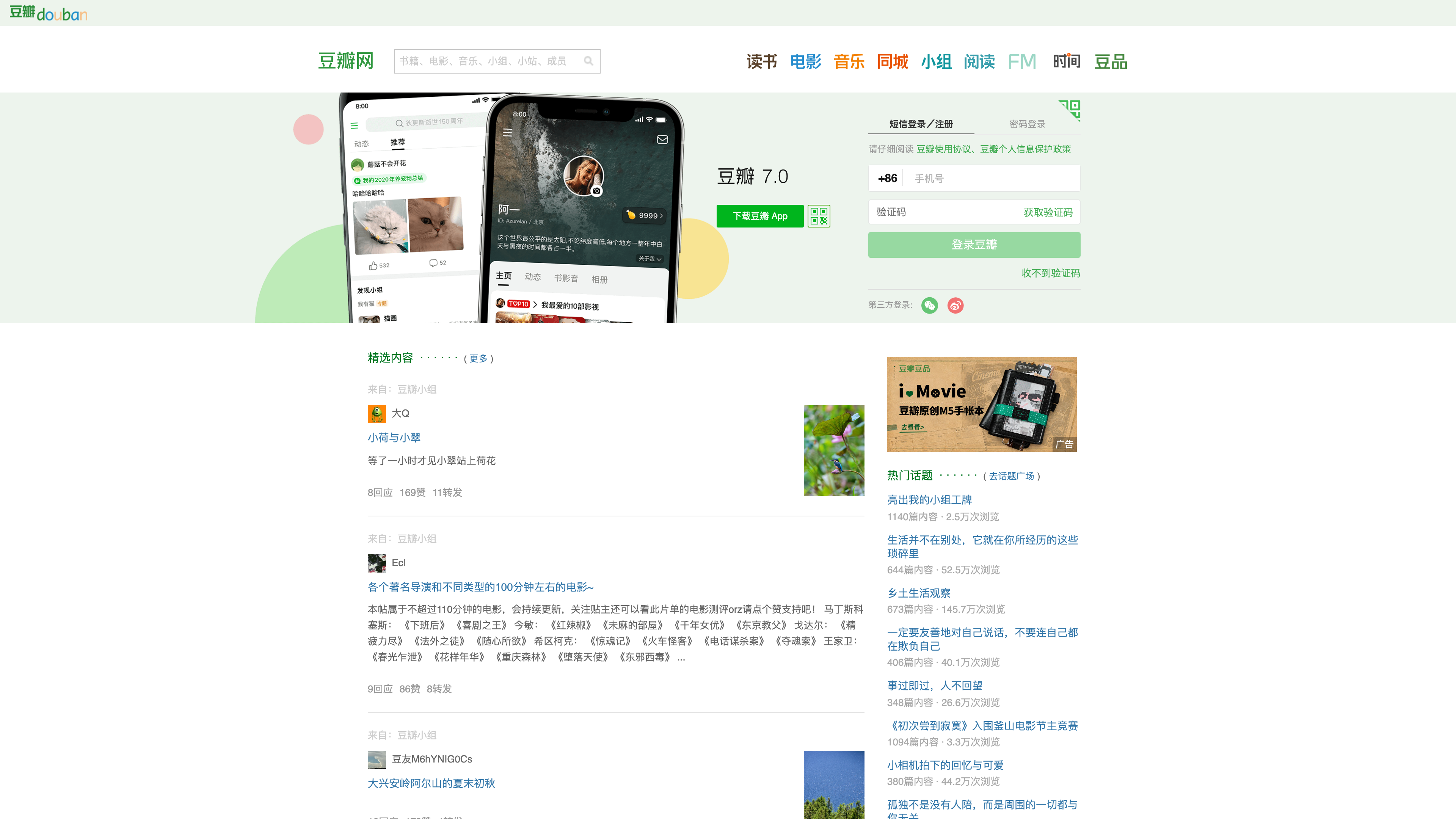
The logged-out homepage offers SMS sign-in/registration (+86 phone number plus verification code), as shown below. Per the personal information protection policy updated in July 2026, registration and login support password, phone number, or third-party accounts (WeChat, Weibo, Apple, Huawei). Real-name verification is in principle based on a mainland China phone number; creating a group, creator verification and cash withdrawals require document-based identity verification, and users without a mainland number must go through the document channel.
Developers should note: Douban once offered a public API (api.douban.com/v2), but the personal API-key application page disappeared around November 2015 (contemporaneous Zhihu thread), and by 2018 the developer documentation site developers.douban.com was unreachable and the official API went offline (course Q&A record, community-maintained API doc mirror). As of 2026-09-02 there is no public open API; per the legal statement, any use of Douban content requires authorization via bd-team@douban.com.
On mobile, Douban provides iOS and Android apps (official download page; Android package com.douban.frodo, with the Tencent MyApp listing showing an August 2026 update). The app was delisted by the Ministry of Industry and Information Technology in December 2021 over excessive personal-data collection, and became unsearchable in some Android stores in March 2022 (LanJing TMT report); it has since been restored.
Copyright and Content Policy
Douban is a user-generated-content site, and its legal statement draws unusually explicit lines:
- Original content posted by users remains the user's own intellectual property; Douban offers an originality flag and an off-platform infringement complaint channel.
- Rights in Douban's public site content — explicitly including book, film and music subject data together with ratings, reviews, rating counts and mark records, plus topic and group content — belong to Douban, except where the law says otherwise.
- Without Douban's written permission, that content may not be used for any purpose. The statement's prohibited list covers commercial use, use in R&D or data training for large language models and other AI technologies, derivative plugins or apps, and crawling.
Combined with strict anti-scraping enforcement, this means Douban's subject and rating data cannot lawfully be bulk-scraped or redistributed; third-party products are expected to negotiate a commercial license.
Good Use Cases
- Checking word of mouth for a Chinese film, a Chinese-language book or an album: large voter bases, public star distributions and short comments make it the standard reference in Chinese;
- Keeping a personal media log: mark items as want-to-read/watched/listened and get taste-based recommendations;
- Finding discussion communities for a city, hobby or niche topic via Groups;
- Looking up performances and offline events in a Chinese city.
Limitations
- Ratings are a reference, not an authority: one-person-one-vote works well for popular titles, but niche entries have few voters and volatile scores; vote manipulation and account farming are persistent problems the company itself says it must keep fighting.
- Registration is unfriendly to overseas users: real-name verification in principle requires a mainland China phone number, and users without one must submit identity documents (privacy policy); after the 2022 tightening, some overseas users left the platform (Chinese Wikipedia entry).
- Closed data: no public API, and the rights statement over subject and rating data is strict, so lawful third-party integration is difficult.
- Simplified Chinese only: effectively unusable for non-Chinese readers.
- Community features are exposed to regulation: Groups have been through repeated rectification rounds, private groups are gone, and the boundaries may keep shifting.
- Entry data is user-contributed: metadata for obscure works can be wrong or incomplete, with no official guarantee of accuracy.
Comparable Sites
The closest international counterparts are IMDb and Letterboxd, the latter already covered on this site: IMDb's metadata is more industrial and global; Letterboxd is built around film-buff social logging. Douban's edge is Chinese book entries — which neither covers — and the density of commentary on Chinese-language screen media. For English-language film data IMDb is the default; for Chinese books and Chinese-language word of mouth, Douban is usually the fuller source.
References
- Douban official site, About, legal statement, privacy policy (checked 2026-09-02)
- Abei and Douban's eighteen years (The Paper, 2023-02)
- Eight Questions about Douban's Movie Ratings (Abei, 2015-12)
- Douban (Chinese Wikipedia, timeline and regulatory record)
- Cyberspace authorities station supervision team at Douban (CAC, 2022-03)
- Douban responds to "no longer showing all short comments": anti-scraping, anti-brigading (36Kr, 2020-11)
- Suspected AI-generated reviews flood Douban, platform responds (Ruicaijing, 2025-08, reposted)
- Douban app unsearchable in some Android stores but still on the App Store (LanJing TMT, 2022-03, reposted)
- Why did Douban close API-key applications (Zhihu, 2015-12) and the community API doc mirror