Discogs is a user-maintained database of audio recordings with a built-in second-hand marketplace. The problem it solves is that one album can exist in dozens or hundreds of distinct pressings: where ordinary retailers list a single product, Discogs files each pressing separately by label, catalogue number, year, and country, so collectors can identify exactly which version they own and what it sells for.
As of September 2, 2026, the live counters on its public API report more than 19.4 million releases, 10.2 million artists, and 2.4 million labels. Browsing needs no account; contributing data, trading, and collection management do.
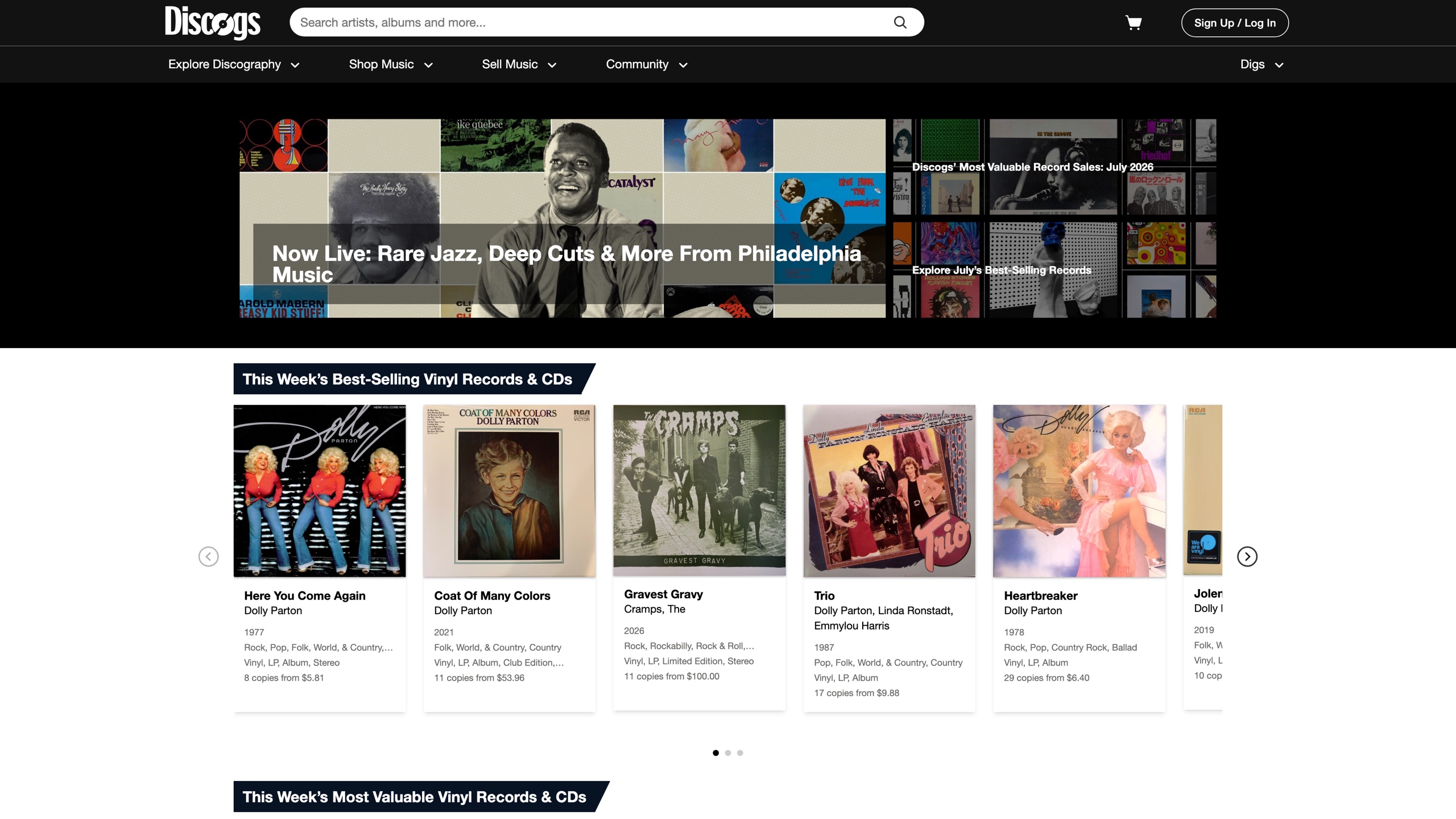
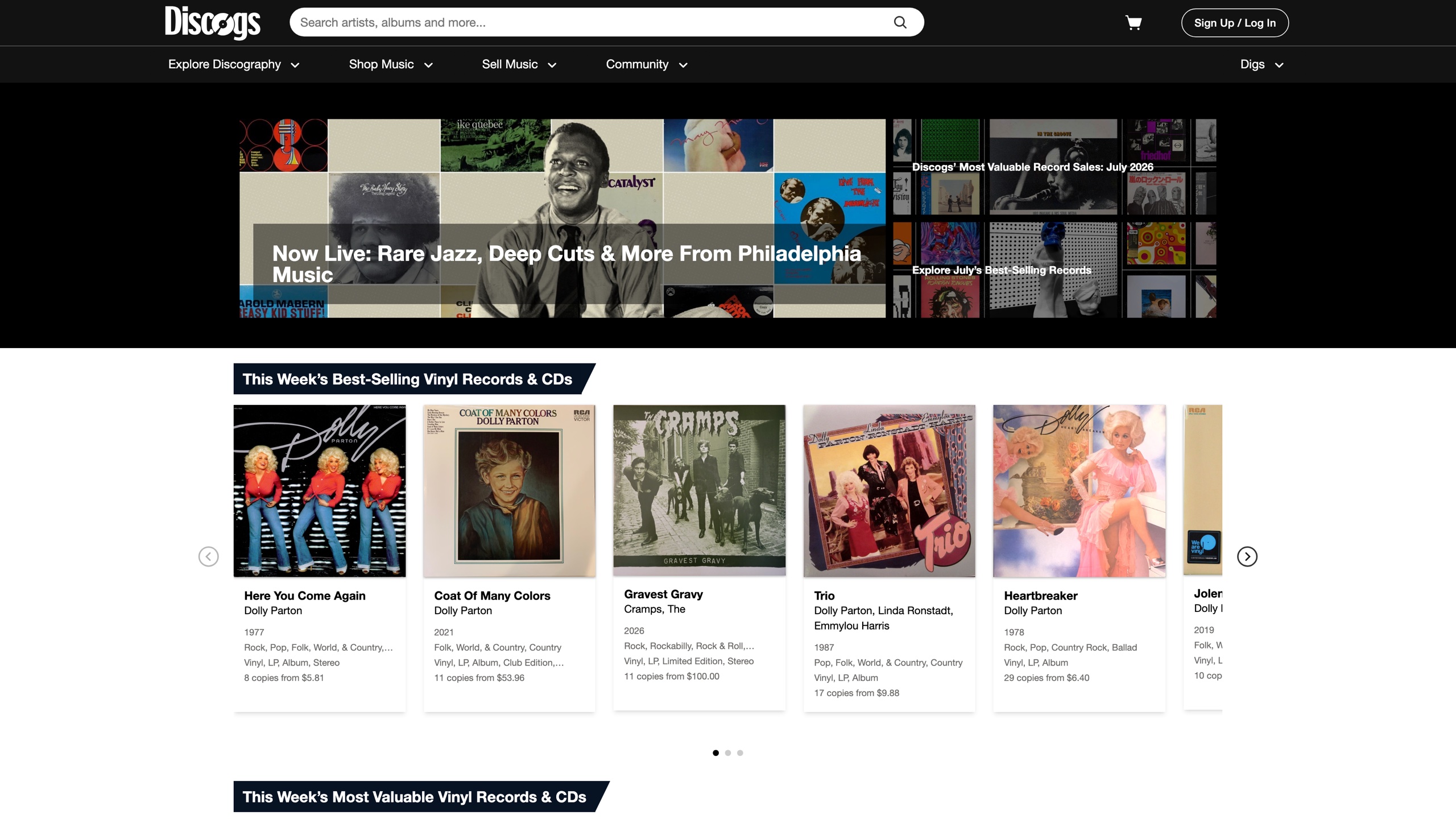
The homepage puts both halves of the site on one screen: the database search bar and genre navigation up top, and the marketplace's "best-selling vinyl & CDs" chart below.
At a glance
- URL: https://www.discogs.com/
- Type: Record database + C2C second-hand marketplace, operated by Zink Media, LLC of Beaverton, Oregon
- Cost: Free to browse and use the database; sellers pay a 9% fee on sales
- Registration: Optional for browsing; required for contributing, trading, and collections
- Interface languages: English, German, Spanish, Brazilian Portuguese, French, Italian, Japanese, Korean, Russian
- Mobile: iOS and Android apps (rewritten version released November 2025)
Background
Discogs was created by Kevin Lewandowski, then a programmer at Intel. In a 2010 Resident Advisor interview he recalled writing the code over roughly six months of nights and weekends and launching in November 2000. The site initially covered only electronic music before expanding to every genre and format; around 2015 its stated goal became "cataloging every single piece of physical music ever created." The Marketplace opened in 2005, letting users buy vinyl, CDs, and tapes from sellers worldwide. In 2007 the site dropped its earlier $12/year premium subscription and made all features free, funding itself through marketplace fees and advertising.
The database: cataloging by pressing
What sets Discogs apart from streaming services and ordinary retail is granularity. The database has two levels: the master (the album as a work) and the release (one specific pressing). Michael Jackson's Thriller, for example, has a master entry with 845 versions attached (API query, September 2, 2026), from the 1982 first press to later reissues worldwide. Each release entry records label, catalogue number, tracklist, credits, and matrix details, all submitted and cross-checked by users in what The New York Times once described as a "Wikipedia-like" model.
Coverage depends on user contributions: popular albums are documented exhaustively, while obscure entries may lack images or contain errors.
Marketplace and fees
The Marketplace, launched in 2005, works much like eBay: sellers list their own copies against the exact release entry, graded by condition, and buyers filter by pressing, ship-from country, and currency. Every entry shows twelve months of sold-price history for free, which doubles as a valuation tool. Thriller alone had 5,040 copies for sale starting at $1.15 on September 2, 2026.
Sellers pay a 9% fee on each sale — according to Billboard, the rate rose from 8% in May 2023, a change that drew visible backlash from the seller community. Buyers pay no platform fee. Transactions settle directly between buyer and seller: shipping and after-sales are the seller's responsibility, with Discogs mediating disputes.
Collections and open data
- Collection: Register the records you own; each copy and the whole collection gets an estimated value derived from marketplace sales history. An official year-end summary published in January 2026 reports that users added a record 114.2 million items to their collections in 2025, pushing the all-time total past 920 million cataloged items; the average collection holds 191 items with an estimated value of about $571.77.
- Wantlist: Track records you are looking for and get notified when copies are listed.
- API: A public REST API exposes database and marketplace data; unauthenticated requests are limited to 25 per minute (observed via the
x-discogs-ratelimitresponse header on September 2, 2026), with higher limits for authenticated clients. - Data exports: data.discogs.com publishes full monthly XML dumps of releases, artists, labels, and masters under CC0, ready for research and development use.
Copyright and content policy
Database entries and images are user-contributed; the textual metadata is released as CC0 through the monthly dumps, while record covers remain the property of their rights holders and are displayed for identification. The marketplace is consumer-to-consumer second-hand trading: sellers must list genuine copies matching the specific pressing, bootlegs are prohibited, and grading standards, feedback, and support mediation keep the market orderly.
When it is useful
- Identifying the exact pressing of a record and estimating its value
- Buying second-hand vinyl, CDs, or tapes by version, with sold-price history for comparison
- Managing a physical collection systematically via Collection and Wantlist
- Pulling music metadata for research or development through the API or the CC0 dumps
Limitations
- Centered on physical media: digital-only and streaming-exclusive releases get limited coverage.
- Data quality depends on user contributions; obscure entries may be incomplete or wrong, and photo quality varies.
- No Chinese-language interface; catalog data is predominantly in English.
- Seller sentiment soured after the 2023 fee increase to 9%, and complaints about fees and policies surface regularly in the press.
- Pages and images are tightly guarded against automated access; bulk retrieval is expected to go through the official API.
Alternatives
MusicBrainz is an openly editable, non-profit music metadata database with no trading features and complements Discogs well; Rate Your Music is a rating and review community, likewise without a marketplace.
Sources
- Discogs official site and API root live statistics (checked 2026-09-02)
- Discogs monthly data dumps (CC0, checked 2026-09-02)
- Billboard: How Discogs Hopes to Turn Seller Discord Over Fees Into Positive Change (2024-02, the 8%→9% fee change)
- Shore Fire Media: Discogs 2025 collection figures (2026-01)
- AIM Group: Used-vinyl record marketplace Discogs relaunches its app (2025-11 app rewrite)
- Wikipedia: Discogs (cross-reference for founding date, 2005 marketplace launch, 2007 move to free, interface languages)