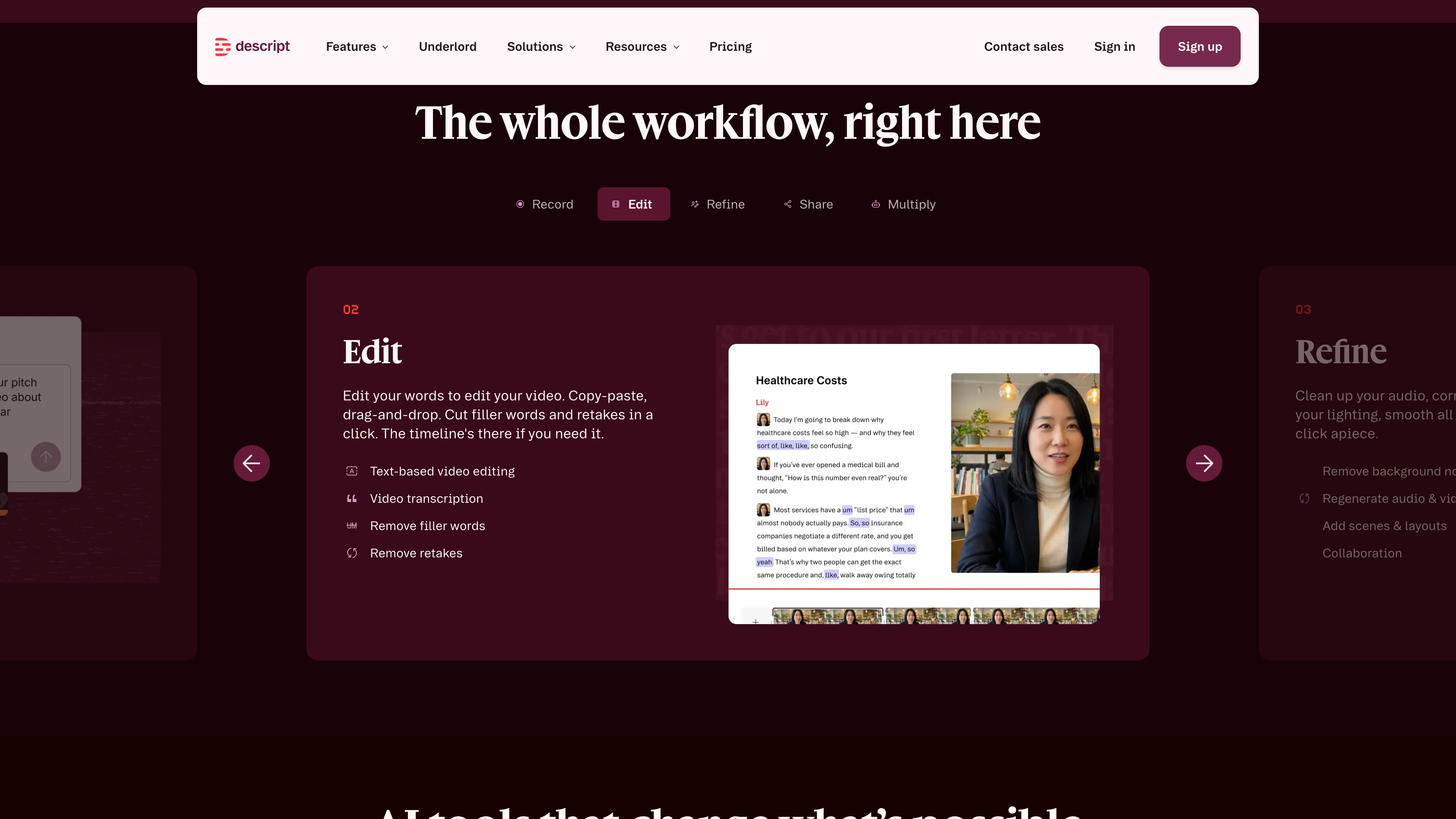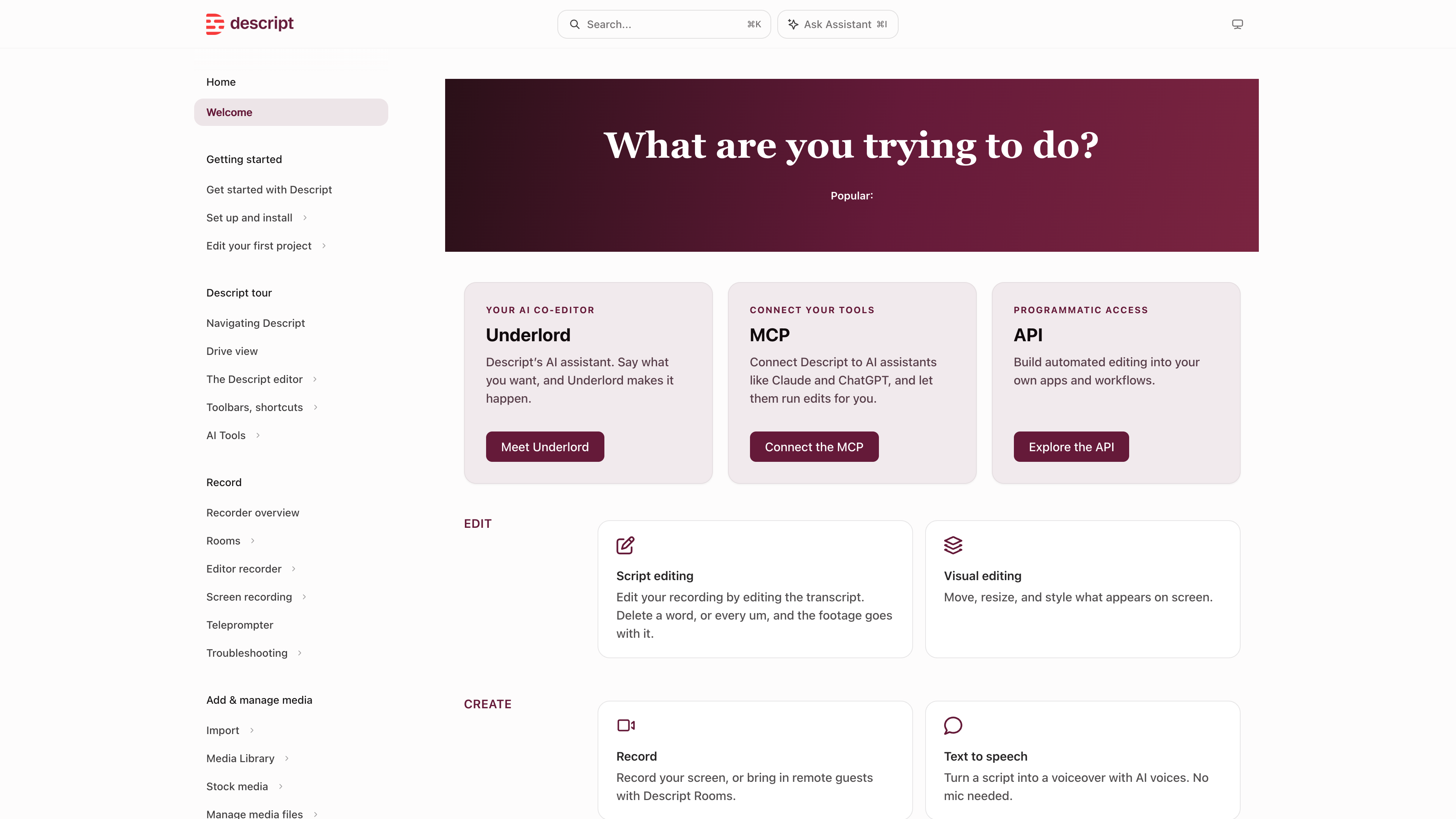
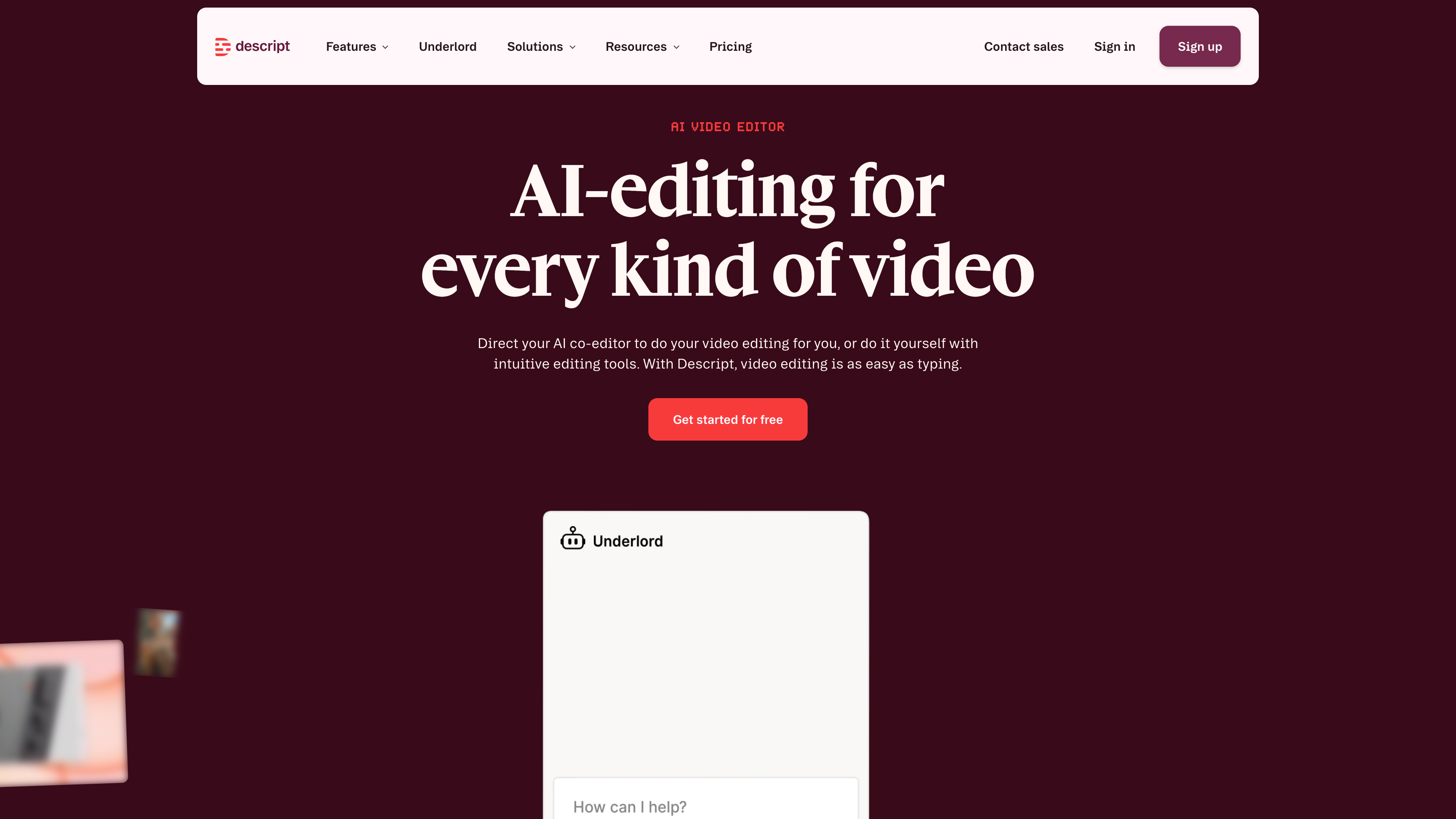
Descript (descript.com) is an AI-driven audio and video editor whose core mechanic is text-based editing: import a recording (or capture one in the app), and it automatically produces a speaker-labeled transcript — delete or rearrange words in that transcript and the underlying audio and video are cut or reordered with them. A timeline is still there for fine control, but most rough cutting can happen entirely in the text. This collapses the classic "transcribe, scrub, cut" loop into "read, delete," which is why the product is aimed primarily at podcasts, talking-head videos, tutorials, and business communication rather than film-style post-production. On top of that mechanic, Descript bundles Studio Sound noise removal, voice cloning, remote multi-participant recording, translation and dubbing, an AI co-editor called Underlord (launched in 2024), and a developer-facing API plus MCP server (official site, pricing page, checked 2026-09-16).
At a glance
- URL: https://www.descript.com
- Type: AI audio/video editing SaaS (desktop app + web version)
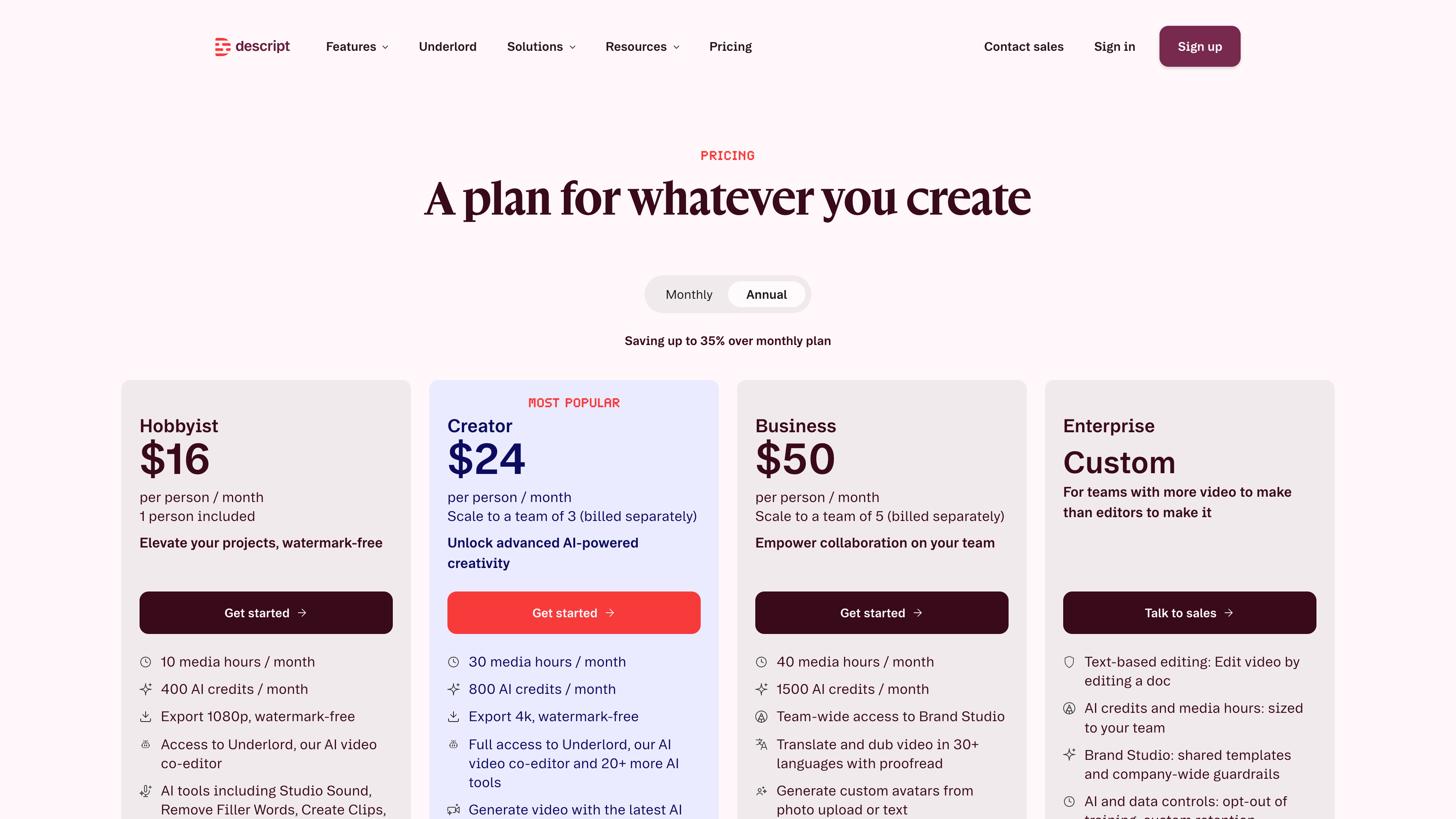
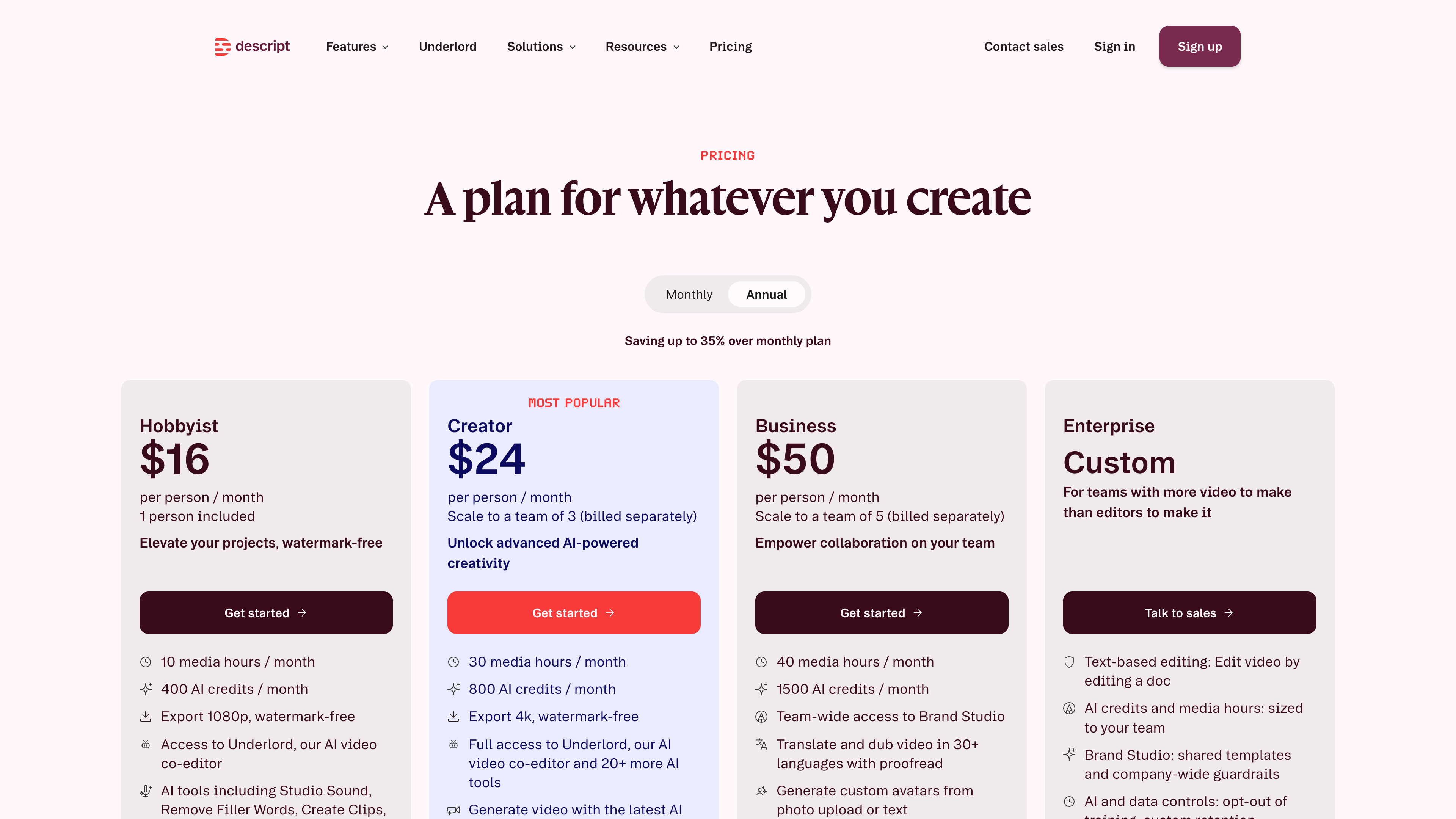
- Cost: Free plan at 16, Creator 50 per person/month, with custom Enterprise pricing (Descript advertises savings of up to 35% versus monthly billing; as of 2026-09-16, official pricing)
- Sign-up: Browsing the site needs no account; using the product requires registration, and the free plan needs no credit card (site FAQ)
- Interface language: English; transcription supports 25 languages (Chinese, Japanese, and Korean are not among them), while caption translation covers 61 languages and dubbing 30 — both including Chinese (pricing feature table)
- Platforms: Desktop app for macOS 14 (Sonoma) or later and Windows 11 or later (minimum 8 GB RAM), plus a web version at web.descript.com (install guide, system requirements)
- Launched: 2017 (TechCrunch)
Background
Descript was founded in San Francisco in 2017 by Andrew Mason, better known as the founder and first CEO of Groupon. The product grew out of an internal editing tool that Mason's previous startup, Detour (a location-based audio tour app), had built to produce its tour audio; the tool was spun out as a standalone company (TechCrunch, Contrary Research company profile).
Key milestones:
- 2019: Descript acquired voice-synthesis startup Lyrebird and built Overdub on its technology — a voice-cloning feature that generates speech in the user's own voice from typed text (Contrary Research). The capability now lives under the "AI Speech" product line.
- 2020: Expanded from audio into video editing, applying the same text-based paradigm to both media (Contrary Research).
- November 2022: Raised a 100 million; other major backers include Andreessen Horowitz, Redpoint Ventures, and Spark Capital. The same month brought a major redesign, "The New Descript" (TechCrunch, official About page, Product Hunt).
- June 2024: Underlord, an AI co-editor that executes multi-step jobs from natural-language instructions — rough cuts, captions, highlight clips — went live (Product Hunt).
- September 2025: Mason stepped aside as CEO to become Executive Chairman; Laura Burkhauser, previously VP of Product, took over as CEO (Podcast News Daily).
As of 2026-09-16, the company claims more than 6 million creators and teams use Descript (pricing page). On compliance, the site states that Descript is SOC 2 Type II certified, supports SAML SSO and SCIM, and is GDPR compliant; its G2 rating is 4.6/5 across 837 reviews (homepage).
Core mechanic: edit media like a document
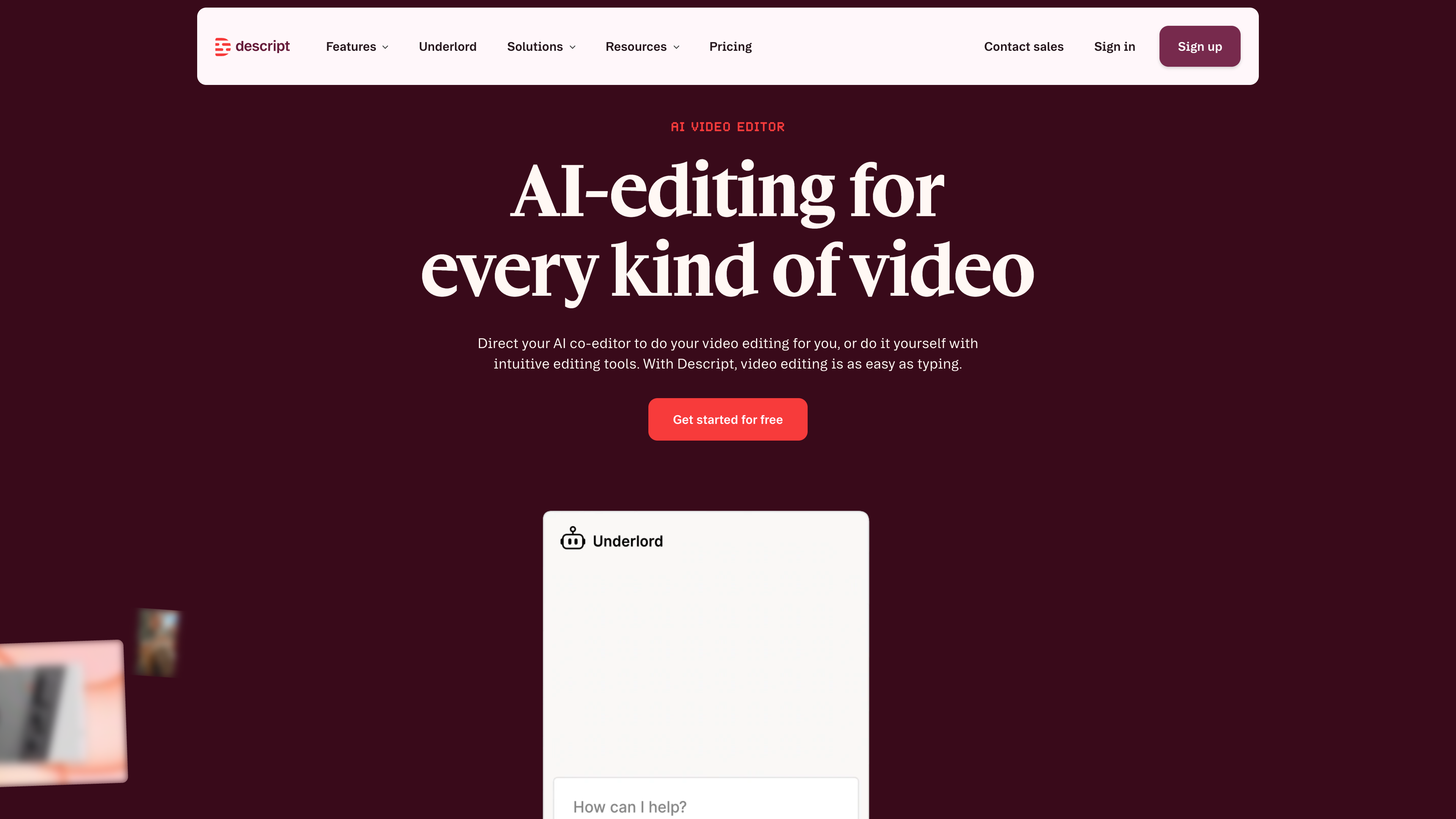
Text-based editing is the fundamental design choice that sets Descript apart from traditional editors, and each part of it is documented officially:
- Automatic transcription with speaker labels: Imported or recorded media is transcribed with timestamps, and the app can automatically detect and label 8 or more speakers. Transcription currently supports 25 languages — English, Spanish, French, German, Hindi, and others — but not Chinese, Japanese, or Korean (pricing feature table).
- Delete words, delete footage: Removing sentences or reordering paragraphs in the transcript cuts or rearranges the media in sync; a timeline remains available for precision work. For bulk cleanup, Remove Filler Words highlights and deletes "ums" and "ahs," Edit for Clarity cuts obvious digressions, Remove Retakes keeps only the best take, and Shorten Word Gaps tightens long silences (feature list).
- Studio Sound: One-click AI background-noise removal and voice enhancement, positioned as studio-quality cleanup for ordinary recordings (official site).
- Visual editing: Scenes, layouts, transitions, animations, and animated captions are applied in a slides-like model with no keyframing required; AI visual tools include Eye Contact (gaze correction), Green Screen (background removal without a physical screen), and Automatic Multicam (feature list).
- Export: Local video export tops out at 720p on the Free plan, 1080p on Hobbyist, and 4K from Creator up; audio export is unlimited. Timelines can also be handed off to Adobe Premiere, Final Cut Pro, Pro Tools, Logic, or Adobe Audition for further finishing (pricing feature table).
The AI toolbox: Underlord, voice cloning, and generation
Beyond text-based editing, Descript layers a set of "AI does the work" features (all as listed on the official site and pricing table):
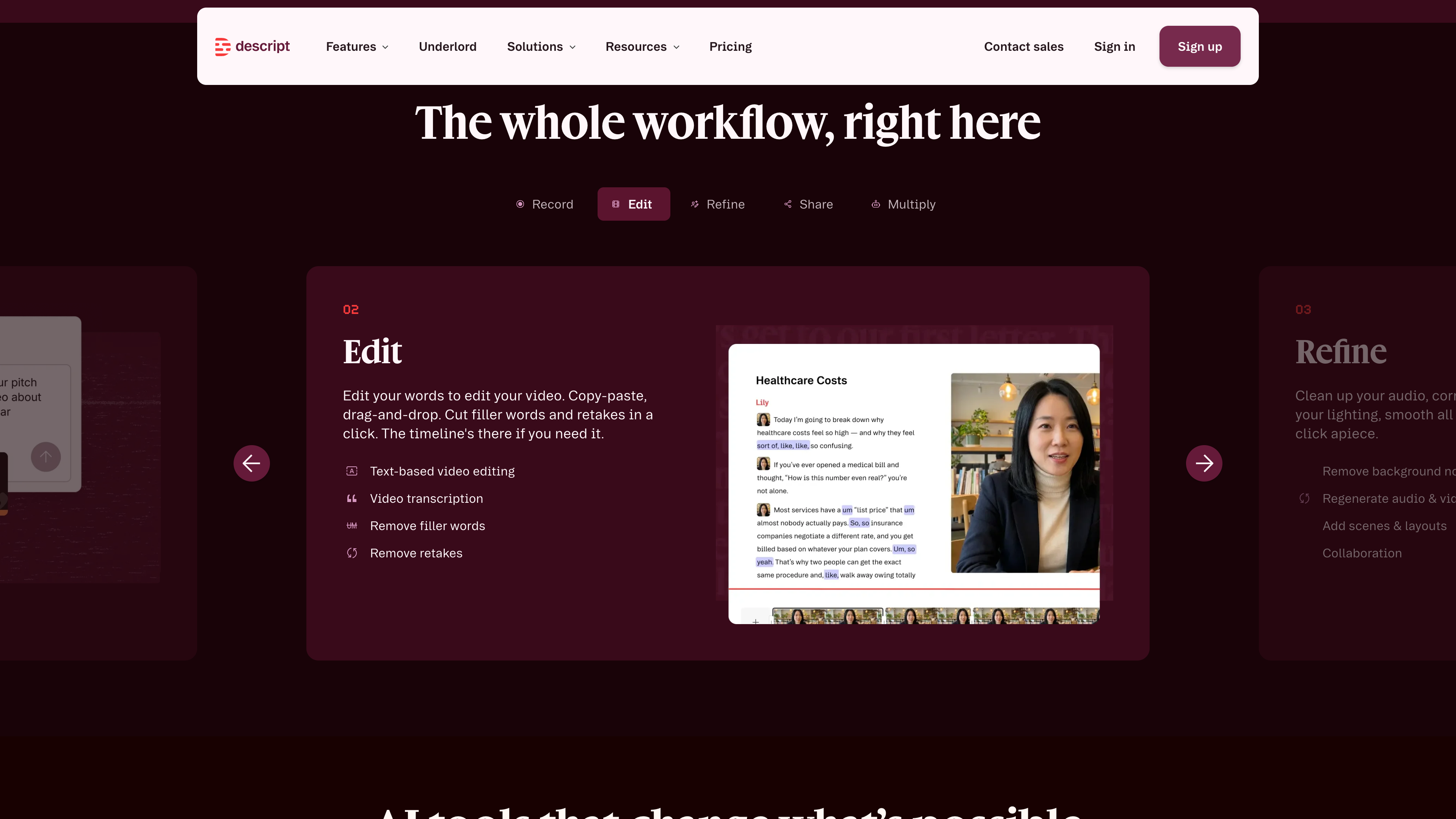
- Underlord: The AI co-editor launched in 2024. Natural-language instructions drive multi-step tasks such as rough cuts, captions, short-clip creation (Create Clips), and show notes; the free plan includes limited access (official site).
- AI Speech (formerly Overdub): Text-to-speech with stock AI voices (60+ on Business) or a clone of your own voice; the Regenerate feature repairs flubbed words and blends patched audio into the surrounding tone (pricing).
- Translation and dubbing: Caption translation in 61 languages and dubbing in 30 (both including Chinese), with a proofread view on Business; "native-sounding" AI voices are available in 14 languages, Chinese among them (pricing feature table).
- Generative media: Prompt-based generation of video, images, and music for B-roll and gap-filling; AI Avatars (added April 2025) create on-screen presenters from a photo or a text description (official site, Product Hunt).
- Stock library: Built-in royalty-free videos, images, GIFs, music, and sound effects, with unlimited search-result usage from Creator up (pricing).
Recording, collaboration, and publishing
Recording is folded into the same workflow: the desktop app includes screen and camera capture, and Rooms handles remote multi-participant recording for up to 10 people, with separate tracks per guest, automatic cloud backups, and automatic import and transcription when the session ends (official site, pricing feature table; recording hours per drive run from 2 per month on Free to 25 on Business).
Collaboration features include commenting and live co-editing; Business adds Brand Studio for shared templates and brand guardrails. Finished work can be exported as files or published to a shareable web page with an embeddable player (pricing).
Open capabilities: API and MCP
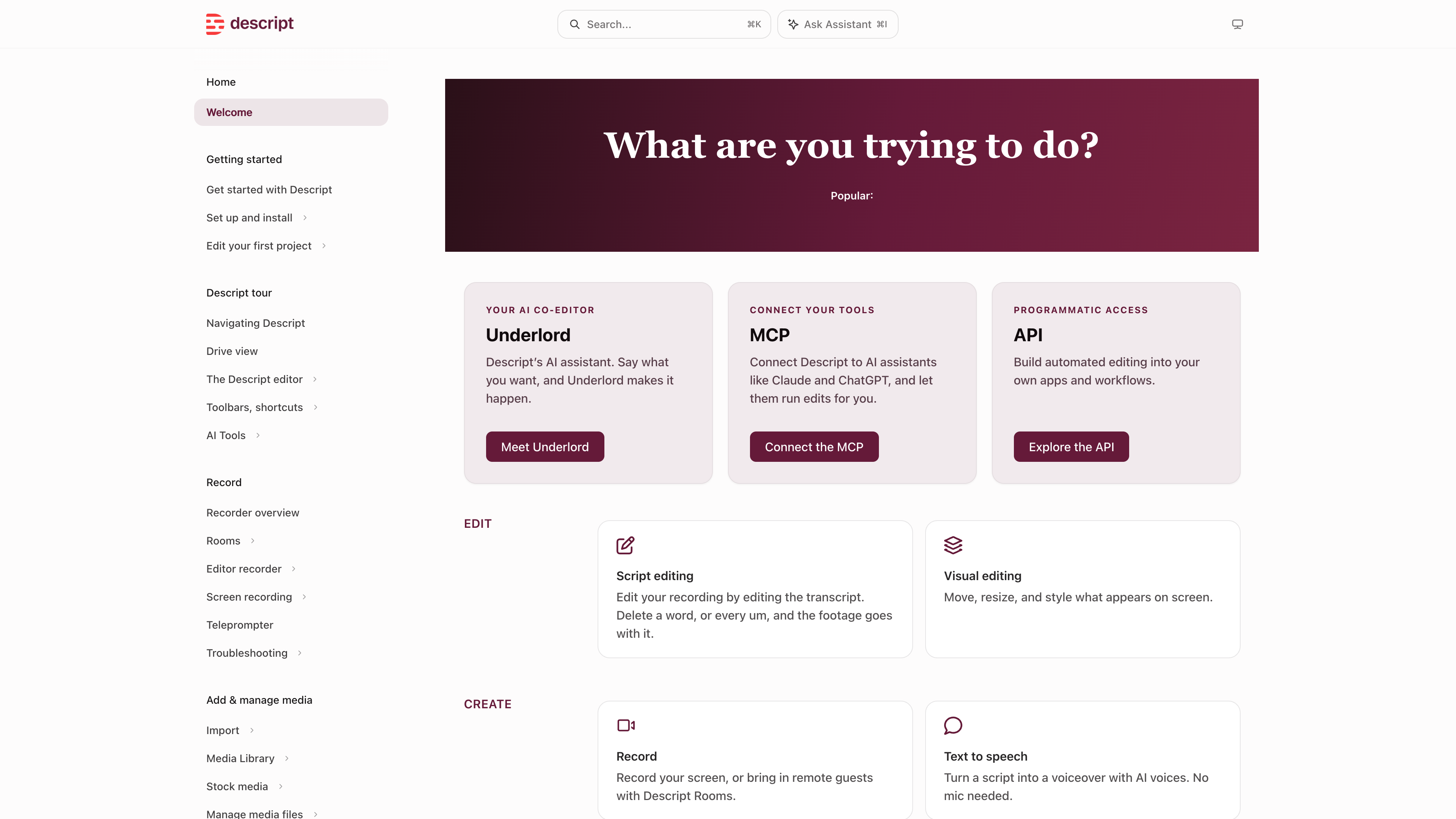
Descript exposes an HTTPS API (labeled early access): create projects, import media from a URL or local file (with automatic transcription), run Underlord edits (captions, filler-word removal, Studio Sound, and more), publish finished projects and receive signed download URLs, and export transcripts as text, Markdown, HTML, RTF, DOCX, or SRT. Each API token is scoped to a single Drive, calls draw down the account's media minutes and AI credits (requests return a 402 error once either runs out), and the company also ships an MCP server that connects Descript to assistants like Claude, ChatGPT, and Cursor, plus a Zapier integration and a CLI. Documented limitations: rendered files cannot be downloaded without publishing, YouTube URLs are not accepted as import sources, and job history is retained for 30 days (official API documentation, API product page).
Pricing and quotas
Descript meters usage on two tracks: media hours (imported or recorded media processed each month) and AI credits (consumption of AI features such as Underlord, Studio Sound, and Eye Contact); both can be topped up when exhausted. Prices below are as of 2026-09-16, per person per month with annual billing on the official pricing page (advertised as up to 35% cheaper than monthly billing):
| Plan | Price | Media hours / month | AI credits / month | Export | Seats | Cloud storage |
|---|---|---|---|---|---|---|
| Free | $0 | 1 | 100 (one-time) | 720p (watermark-free starts on paid tiers) | 1 | 5 GB |
| Hobbyist | $16 | 10 | 400 | 1080p, watermark-free | 1 | 100 GB |
| Creator | $24 | 30 | 800 | 4K, watermark-free | up to 3 | 1 TB |
| Business | $50 | 40 | 1,500 | 4K, watermark-free | up to 5 | 2 TB |
| Enterprise | Custom | Sized to team | Sized to team | Custom | Custom | Custom |
Business additionally includes translation and dubbing with proofread, custom avatars, Brand Studio, and priority support with an SLA; Enterprise adds audit logs, an option to opt out of AI training, custom data retention, and procurement support (pricing).
Voice ethics and data policy
Voice cloning is Descript's most misuse-prone capability, and the company publishes its guardrails: speech models can only be trained after verbal consent verification, so a voice model can only be created with the owner's authorization, and Descript is a member of the Content Authenticity Initiative (official ethics statement). On data, the pricing-page FAQ states that project content "is confidential, even from Descript," and Enterprise customers can opt out of AI training and set custom retention policies (pricing).
Who it's for
- Podcast and interview post-production: multitrack recording, automatic transcripts, filler-word removal, and one-click noise cleanup, all edited on the page.
- Talking-head, tutorial, and training video: gaze correction, a teleprompter, and template layouts lower the bar for presenters and producers alike.
- Marketing and content teams producing at volume: automatic highlight clips, translation and dubbing, and an API for automated pipelines.
- Text-first content creation: write a script and generate narration or avatar video without recording anything.
Limitations
- No Chinese, Japanese, or Korean transcription: none of the 25 supported transcription languages covers CJK (as of 2026-09-16, pricing feature table). Creators working primarily with Chinese-language recordings cannot use the core transcribe-then-edit workflow at all; what does support Chinese is the reverse direction — dubbing and AI voices — and the two should not be confused.
- English-only interface: neither the app nor the help center offers a localized UI.
- Dual metering: media hours and AI credits are tracked separately, so heavy AI usage or large volumes of source media can require add-on purchases beyond the subscription.
- Tight free tier: 1 media hour per month, 100 one-time AI credits, 720p export (watermark-free export starts on paid plans), 5 GB of cloud storage, and a 1 GB per-file upload cap — enough to test the workflow, not to produce in volume (pricing).
- Platform coverage: the desktop app supports macOS and Windows only — no Linux client — and while the web version works in a browser, the full experience is on desktop (install guide).
- Not a film-grade finishing tool: the product targets communication and talking-head video; complex color grading and effects work still mean exporting to Premiere or similar software (a reasonable inference from its feature set and positioning).
Comparable tools
- Adobe Premiere Pro / Final Cut Pro / DaVinci Resolve: conventional timeline editors with full finishing capabilities and steeper learning curves. The relationship is not purely competitive — Descript projects can be exported to these tools for further work.
- ElevenLabs: a dedicated voice-cloning and AI-dubbing provider; Descript's voice features are embedded in its editing workflow rather than offered as an API-first standalone product.
References
- Descript homepage (checked 2026-09-16)
- Descript pricing (checked 2026-09-16)
- Descript About page (checked 2026-09-16)
- Descript ethics statement (checked 2026-09-16)
- Descript Help Center: install and system requirements (checked 2026-09-16)
- Descript API documentation (checked 2026-09-16)
- TechCrunch: Descript raises Series C led by the OpenAI Startup Fund (2022-11-15)
- Contrary Research: Descript company profile (checked 2026-09-16)
- Product Hunt: Descript launch history (checked 2026-09-16)
- Podcast News Daily: Andrew Mason steps aside; Laura Burkhauser named CEO (2025-09-25)