DeepL is a language AI platform operated by DeepL SE, headquartered in Cologne, Germany. Its flagship product, DeepL Translator, is a neural machine translation service launched in 2017 that built a strong reputation for natural, human-like output, especially between European languages. The product family has since expanded to the DeepL Write writing assistant, DeepL Voice speech translation for meetings and conversations, and a developer-facing DeepL API. It earns a place in this directory for straightforward reasons: the free tier works without registration, its translation quality has consistently been regarded as top-tier among mainstream machine translation services, and the line between how free and paid data is handled is documented unusually clearly.
At a glance
- URL: https://www.deepl.com/
- Type: Machine translation and language AI (translator, writing assistant, voice translation, translation API)
- Cost: Free tier available without sign-up; paid Pro subscriptions (as of 2026-08-31, the US pricing page lists the Individual plan at $8.74/month billed annually; prices vary by region)
- Registration: Not required for the web translator; a free DeepL account raises limits and unlocks features such as file translation
- Interface languages: Available in many languages, including Simplified and Traditional Chinese
Background
DeepL grew out of Linguee, a Cologne-based bilingual concordance search service. The translation system was developed inside Linguee starting in 2016 by a team led by then-CTO Jaroslaw Kutylowski, and launched publicly as DeepL Translator on 28 August 2017 with seven European languages: English, German, French, Spanish, Italian, Polish, and Dutch (DeepL Translator - Wikipedia, which cites first-hand coverage by heise online, Slator, and others). With the launch, the company renamed itself from Linguee GmbH to DeepL GmbH, converted to a Societas Europaea (SE) in 2021, and Kutylowski became CEO in 2019.
Key product milestones: the DeepL Pro subscription arrived in March 2018; the DeepL Write assistant was unveiled in November 2022, entered public beta on 17 January 2023, and gained a business-oriented Write Pro tier in April 2024; the company's first speech translation product, DeepL Voice, launched on 13 November 2024 (DeepL press release via PRNewswire); and DeepL Agent, aimed at automating business workflows, followed in November 2025. In May 2024 DeepL announced a 2 billion valuation (official press release). As of 2026-08-31, the company's about page states it serves more than 200,000 business teams and employs around 900 people.
Translation quality and language coverage
DeepL Translator runs on proprietary neural network models — originally known for convolutional architectures, now described by the company as models specialized for language tasks, with a "next-generation" model option for certain language pairs (DeepL Help Center: About the language model). At launch, the company claimed blind-test and BLEU-score wins over Google Translate, Microsoft Translator, and others, and early reviews by TechCrunch, Le Monde, and others generally agreed the output read more naturally. Keep in mind those verdicts date from around 2017; more recent research suggests frontier large language models have started to outrank traditional machine translation systems on automatic metrics (see "Limitations").
Language support has grown steadily from the initial seven: Simplified Chinese and Japanese arrived in March 2020, followed by Korean, Ukrainian, Arabic, and many more. As of 2026-08-31, the Help Center language list covers more than 100 languages — Chinese is available as a target in both simplified and traditional forms, and English, French, Portuguese, and Spanish offer regional variants. The about page uses the same "over 100 languages" figure. Note that glossaries, formality control, and alternative translations only work for a subset of these languages.
Core capabilities
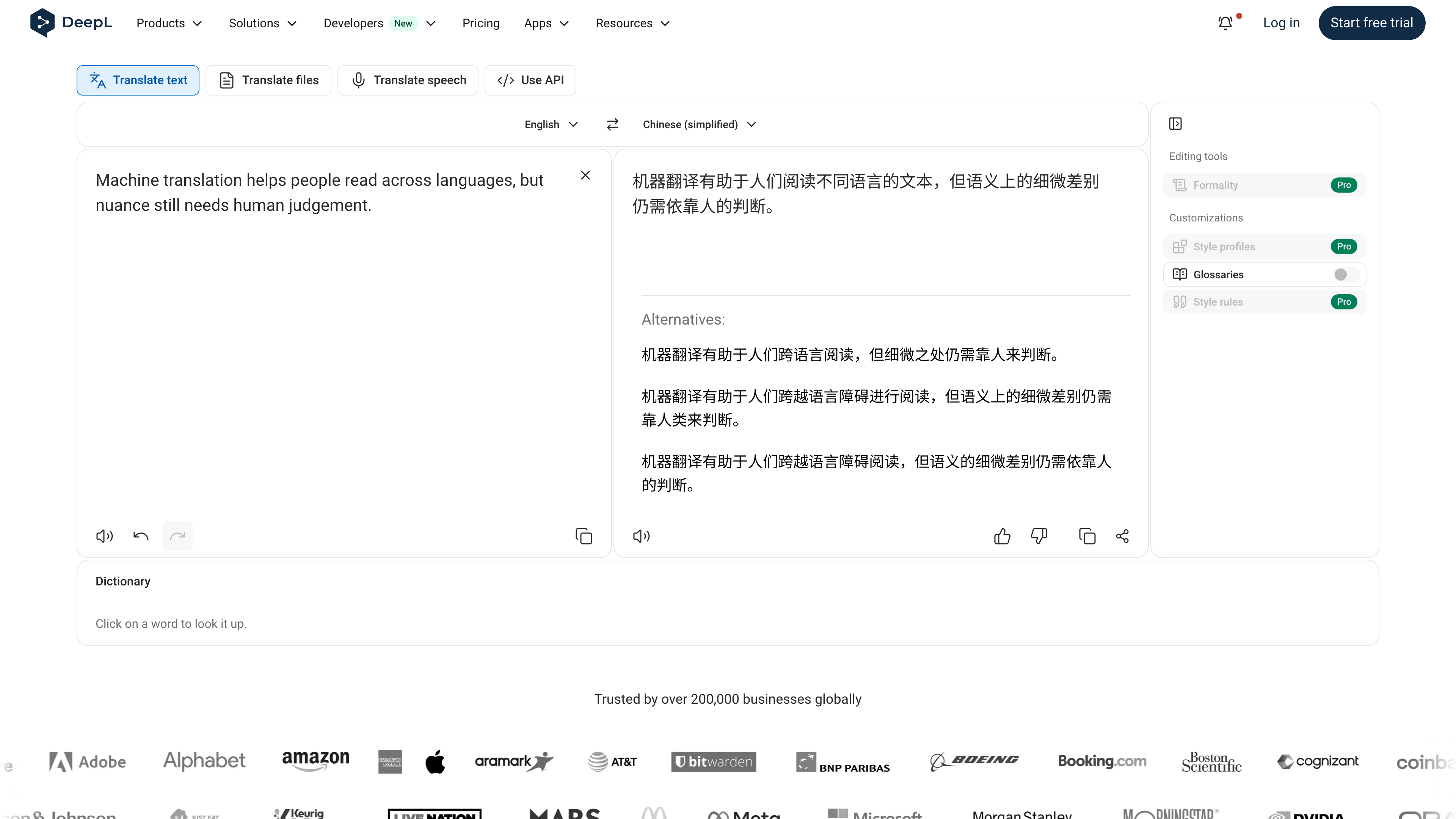
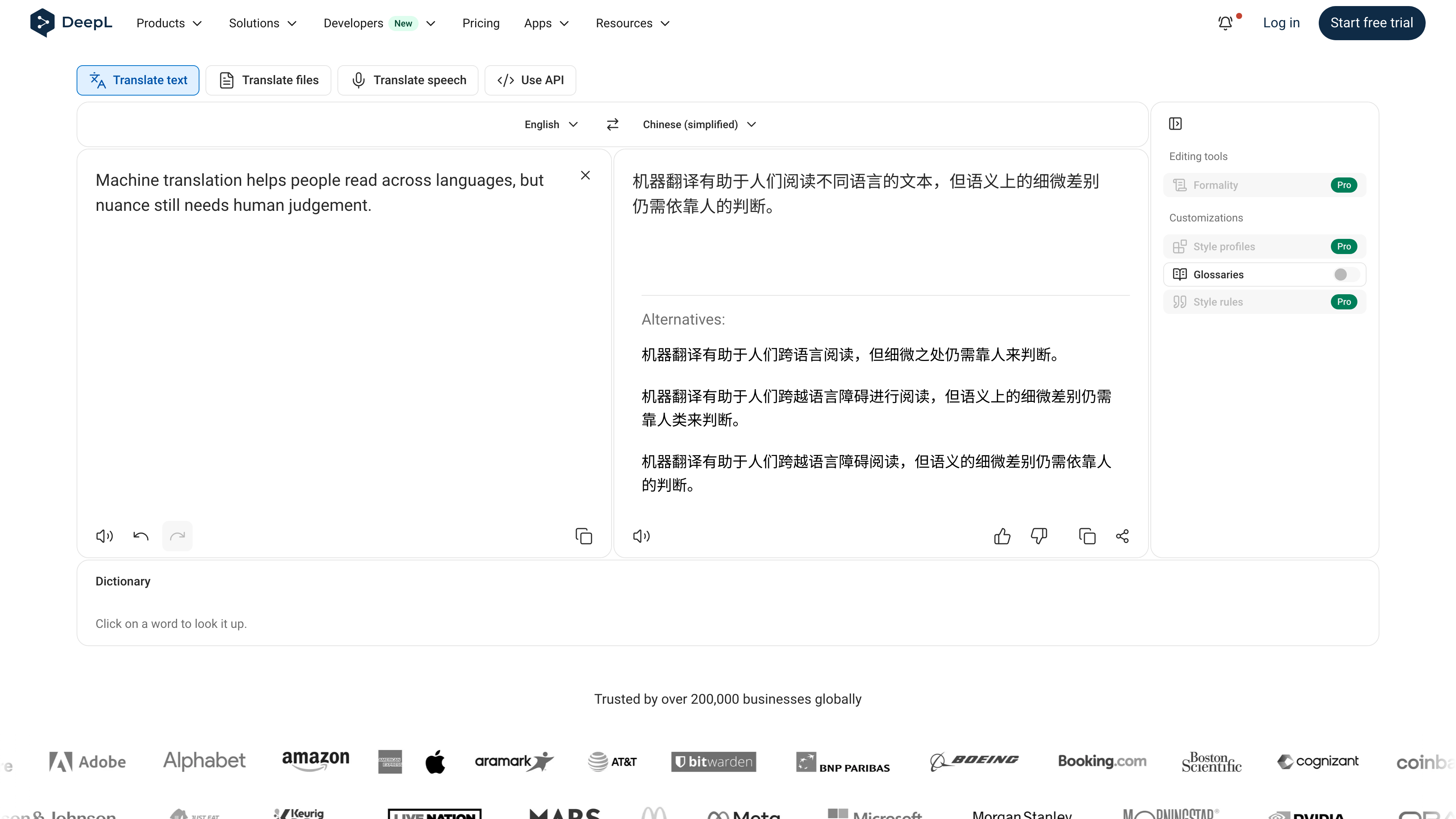
The web translator is where most people meet DeepL (shown above, captured 2026-08-31): a split source/target view with a word-level dictionary, sentence-level alternative translations, and text-to-speech. Its main capabilities:
- Text translation: automatic source-language detection, glossaries to pin down terminology, and formality/variant controls for select language pairs.
- Document translation: upload docx, pptx, pdf, xlsx, txt, html, xliff, srt, and other formats and get a translated file with layout preserved; size and character limits depend on the plan (Help Center: file formats). Files translated on a free account cannot be edited online.
- Image translation: PNG/JPG text recognition and translation, currently in beta and limited to one image per month without a subscription.
- DeepL Write: a writing assistant for English, German, French, Spanish, and more, fixing spelling and grammar and rewriting for style and tone.
- DeepL Voice: real-time translated captions for Microsoft Teams, Zoom, and Google Meet meetings, plus a mobile app for face-to-face conversations — aimed primarily at business subscribers.
- Platforms: Windows/Mac desktop apps, Android/iOS mobile apps, Chrome/Edge/Firefox browser extensions, and integrations with Microsoft 365 and CAT tools (Help Center: About DeepL Translator).
Accounts, pricing, and the API
You can use the web translator without an account, subject to per-request character limits that vary by entry point (the Help Center documents, for example, 1,500 characters for logged-out users and 5,000 for free logged-in users of the Gmail add-on), and glossaries are then stored only locally. A free DeepL account unlocks file translation, cloud glossaries, and higher limits.
As of 2026-08-31, the official pricing page (US region, annual billing) lists:
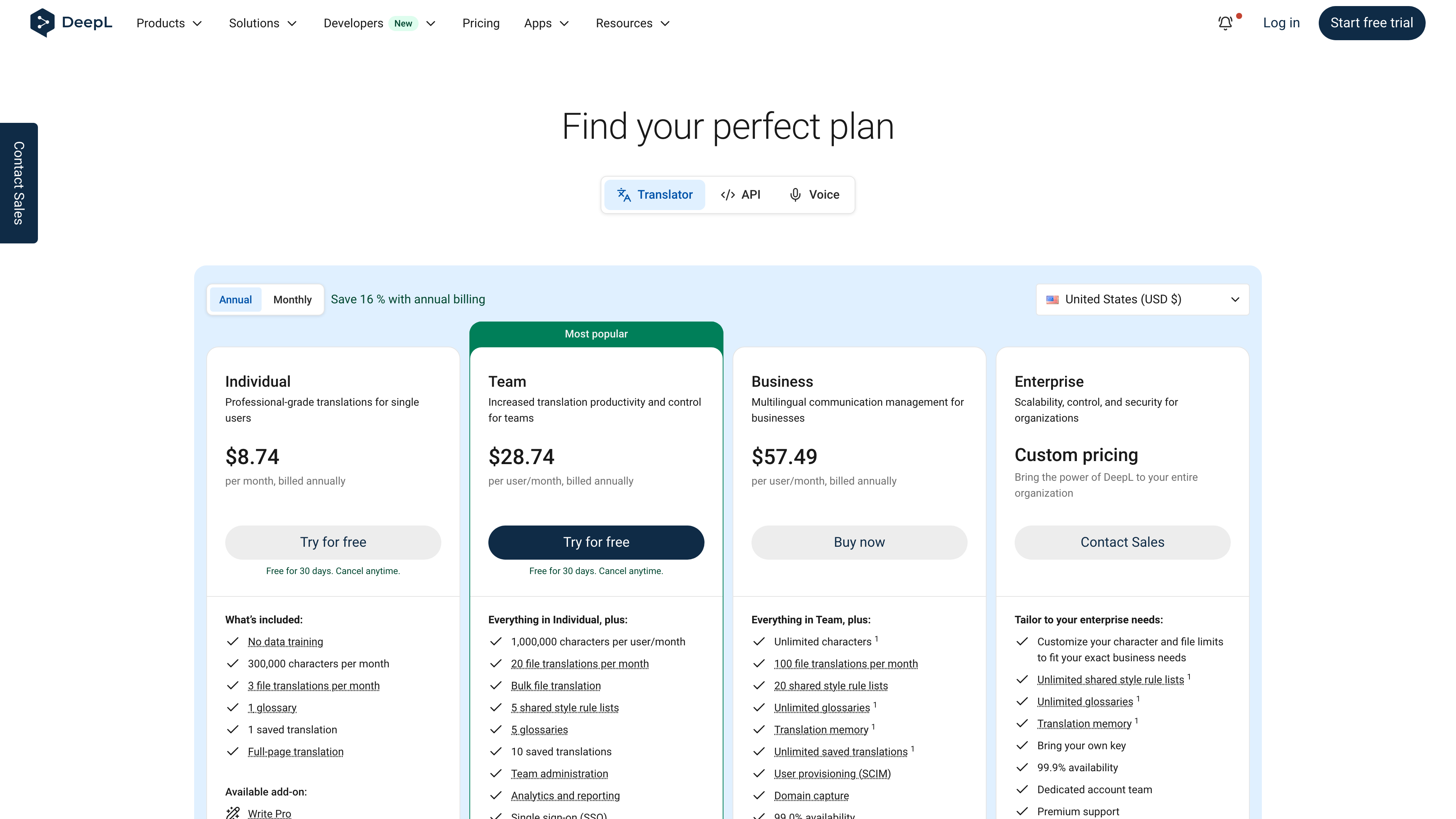
- Individual: $8.74/month, 300,000 characters and 3 file translations per month;
- Team: $28.74 per user/month, 1,000,000 characters per user/month, 20 file translations, team administration;
- Business: $57.49 per user/month, unlimited characters, 100 file translations, translation memory and unlimited glossaries;
- Enterprise: custom pricing. The free tier includes 50,000 characters per month. Annual billing saves about 16%, and paid plans come with a 30-day trial. Pricing varies by country and currency — check your local page before purchasing.
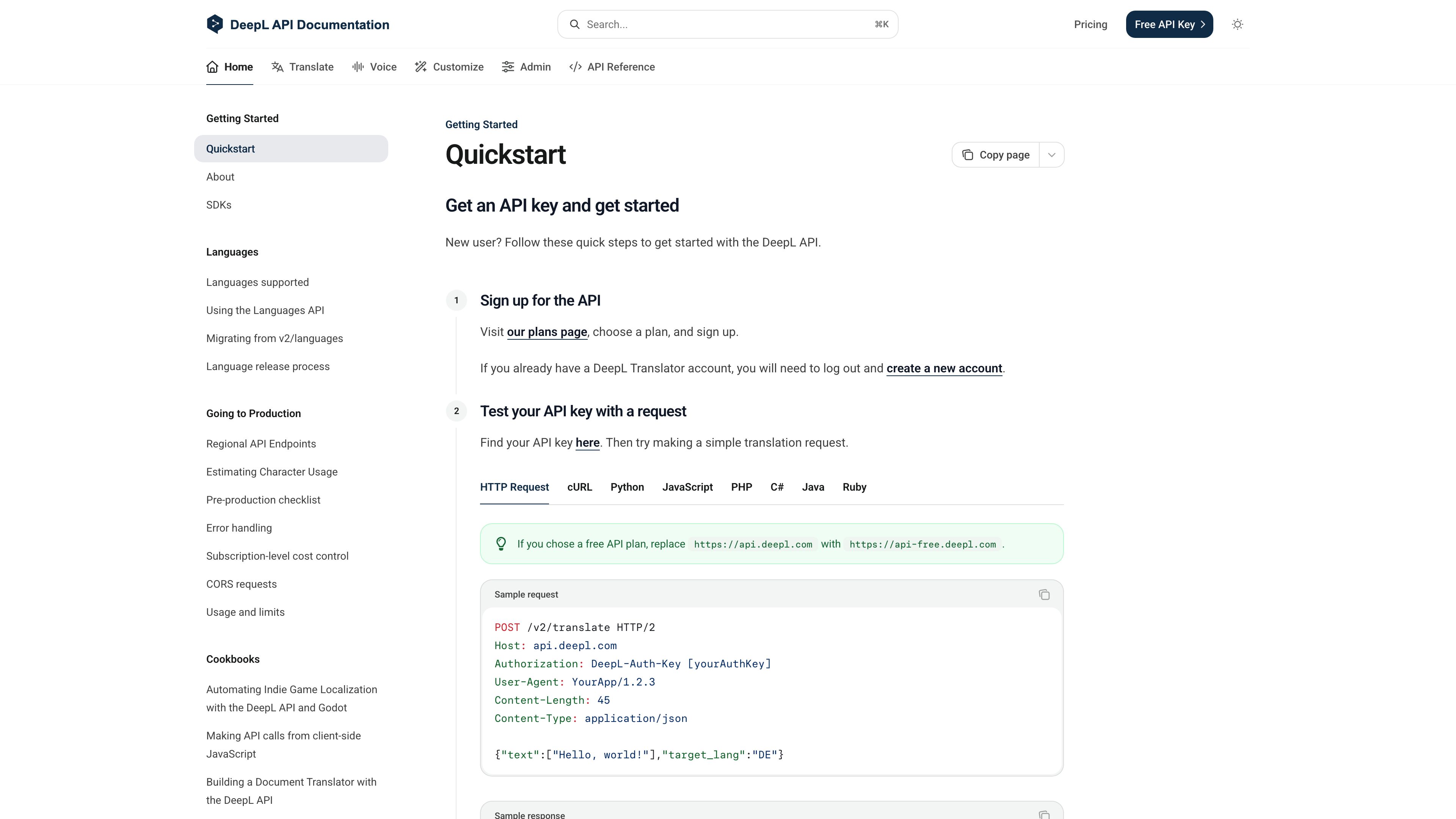
For developers, the DeepL API is a separate subscription line: API Free covers 500,000 characters per month at no cost (via the api-free.deepl.com endpoint), while API Pro/Growth is usage-based with configurable monthly cost limits. Official client libraries exist for Python, JavaScript, PHP, .NET, Java, and Ruby (see the developer documentation Quickstart below, captured 2026-08-31). Note that API subscriptions do not include web translator Pro features, and vice versa.
Privacy and data handling
The difference in data handling between the free and paid services is substantial, and it is the single most important factor when deciding whether DeepL fits your use case. According to the official privacy policy (checked 2026-08-31):
- Free version: submitted texts and their translations are processed "for a limited period of time" to train and improve DeepL's neural networks and algorithms, and the terms of use prohibit entering any text containing personal data into the free service.
- Pro / API Pro: submitted texts are not stored permanently, are kept only as long as needed to produce and deliver the translation, are deleted afterwards, and are not used to improve the service. Processing personal data requires a data processing agreement (DPA).
In short: do not paste confidential or personal information into the free translator; compliance-sensitive work calls for a paid plan or the enterprise offering.
Who it suits
- Reading foreign-language material: quick translation of web pages, emails, and documents, with full-page translation via the browser extensions.
- Writing across languages: polishing English (or other) emails and documents with DeepL Write, or translating a draft and then editing it manually.
- Professional translators and localization teams: glossaries, translation memory, CAT tool integration, and XLIFF support fit production workflows.
- Product and engineering teams: embedding translation through the API, with the free quota suitable for prototyping.
- International meetings: real-time translated captions via DeepL Voice (business-oriented).
Limitations
- A visibly constrained free tier: per-request character caps, a 50,000-character monthly quota, limited file translations, and customization features such as formality control and style rules marked Pro-only.
- Free-tier texts are used for training: the privacy policy states this explicitly, and the terms ban personal data in the free service — not the place for sensitive content.
- Not the broadest language coverage: 100+ languages covers mainstream needs but remains fewer than Google Translate (243 languages after its June 2024 expansion, per TechCrunch); less common languages and several features (glossaries, formality, alternatives) are not available for every language.
- The quality lead is not a settled fact: the "beats Google Translate" blind tests date from 2017, and the 2025 WMT24++ benchmark study found frontier LLMs from OpenAI, Anthropic, and Google ranking above traditional machine translation systems including DeepL on automatic metrics (the authors note the rankings are metric-based, with human evaluation still pending). Literary, legal, and medical texts still require human review.
- Regional availability of paid plans: the Help Center maintains a list of countries and regions where paid plans can be purchased; the API and web subscriptions are billed separately, which regularly confuses new customers.
- No offline use: all translation happens in the cloud, so the mobile and desktop apps need a connection.
Alternatives worth knowing
- Google Translate: free with broader language coverage (240+ languages), mature full-page and instant camera translation; output style is comparatively plain, and the free tier likewise uses submitted data to improve the service.
- Microsoft Translator: deep integration with Office and Edge, with full enterprise compliance options.
- General-purpose LLMs (ChatGPT, Claude, Gemini, etc.): style and domain can be steered with prompts, and long context windows are flexible, but per-conversation billing, hallucination risk, and terminology consistency need managing; a specialized service like DeepL still has its place for high-volume, stable, terminology-controlled work.
Sources
- DeepL About Us, checked 2026-08-31
- DeepL pricing, checked 2026-08-31 (US region)
- DeepL privacy policy, checked 2026-08-31
- Help Center: DeepL Translator languages, checked 2026-08-31
- Help Center: file formats and limits, checked 2026-08-31
- Help Center: DeepL API plans, checked 2026-08-31
- DeepL developer documentation, checked 2026-08-31
- DeepL announces 2 billion valuation (official press release, 2024-05-22)
- DeepL Translator - Wikipedia (history and press coverage leads, checked 2026-08-31)