Cursor (cursor.com) is an AI-native code editor developed by the US company Anysphere — more precisely, a coding-agent platform with an editor as its main entry point. It is a fork of the open-source Visual Studio Code, so the interface, keyboard shortcuts, and most extensions carry over with almost no migration cost. Rather than bolting an AI plugin onto an editor, Cursor builds large language models directly into the editing workflow: its agents can search across an entire codebase, edit multiple files at once, run terminal commands, and carry a task from planning through verification. The site's current self-description is "your coding agent for building ambitious software." It is also one of the fastest-commercializing developer tools on record: annualized revenue reached roughly 60 billion.
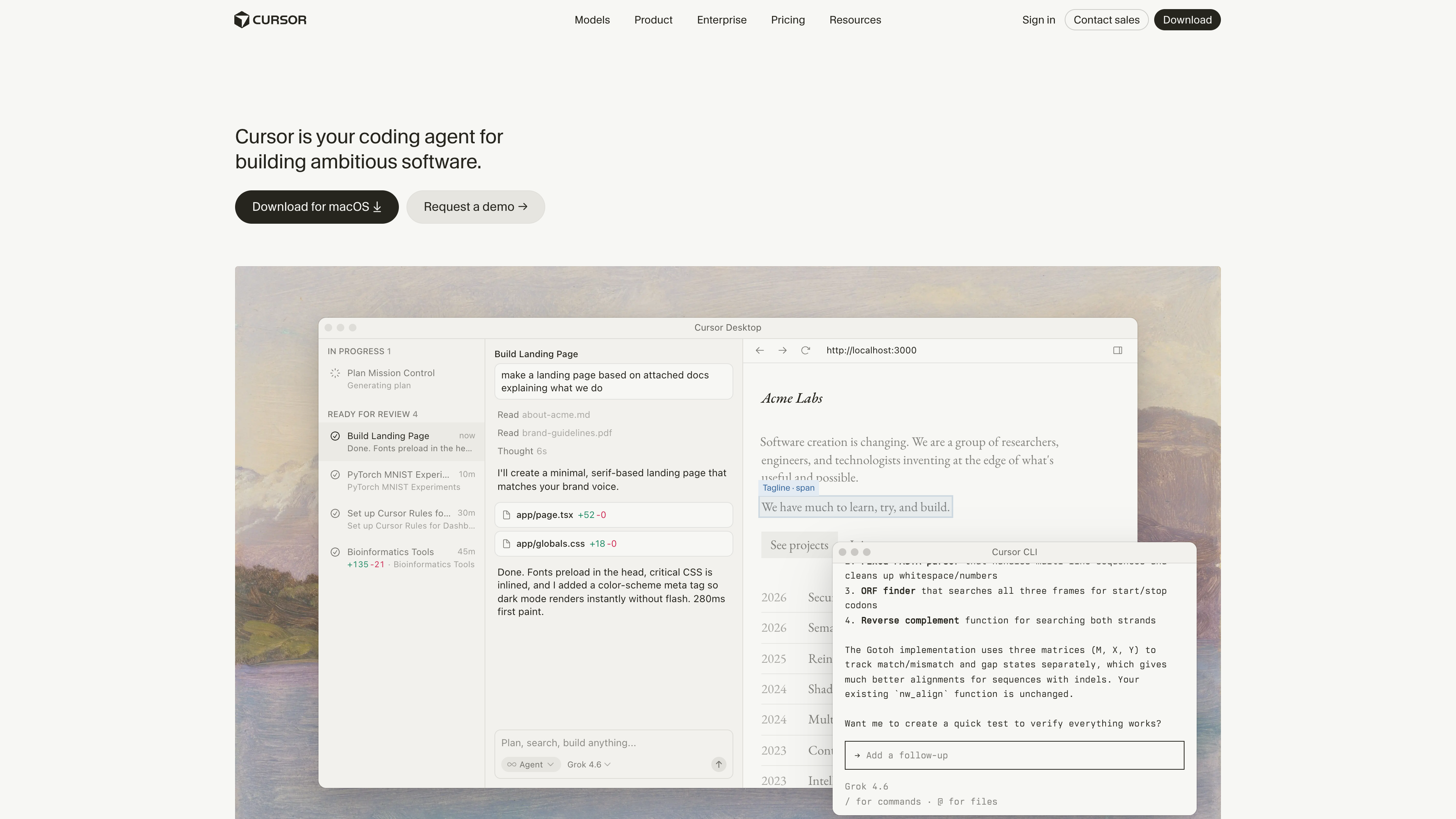
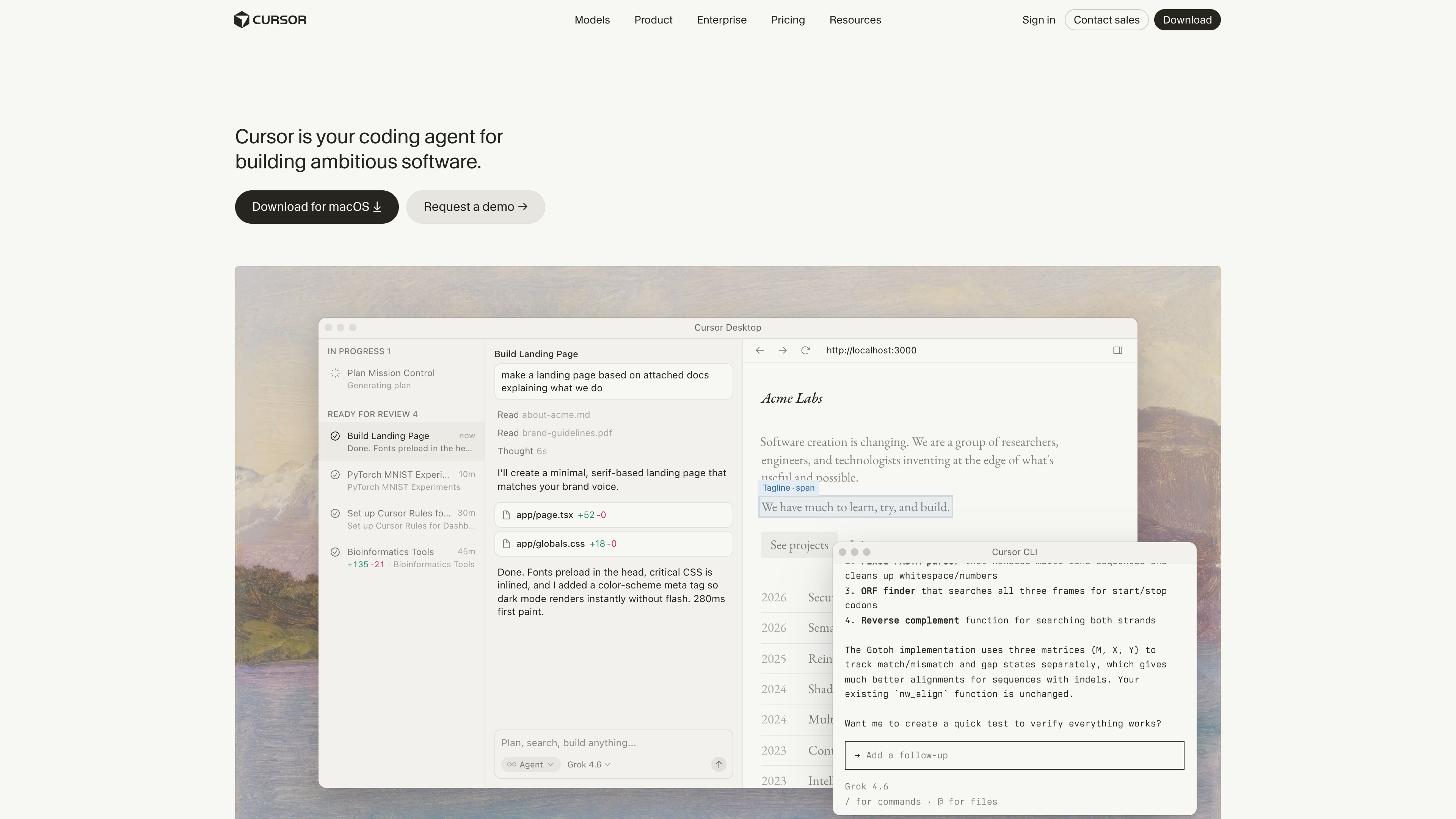
The screenshot above shows the Cursor homepage as of 2026-09-16. The hero presents both the desktop editor and the command-line interface, and the page narrative centers on agents that "work autonomously, run in parallel" on their own computers — building, testing, and demoing features for review.
At a Glance
- URL: https://cursor.com
- Type: AI-native code editor / coding-agent platform (closed-source commercial software built on the open-source VS Code fork)
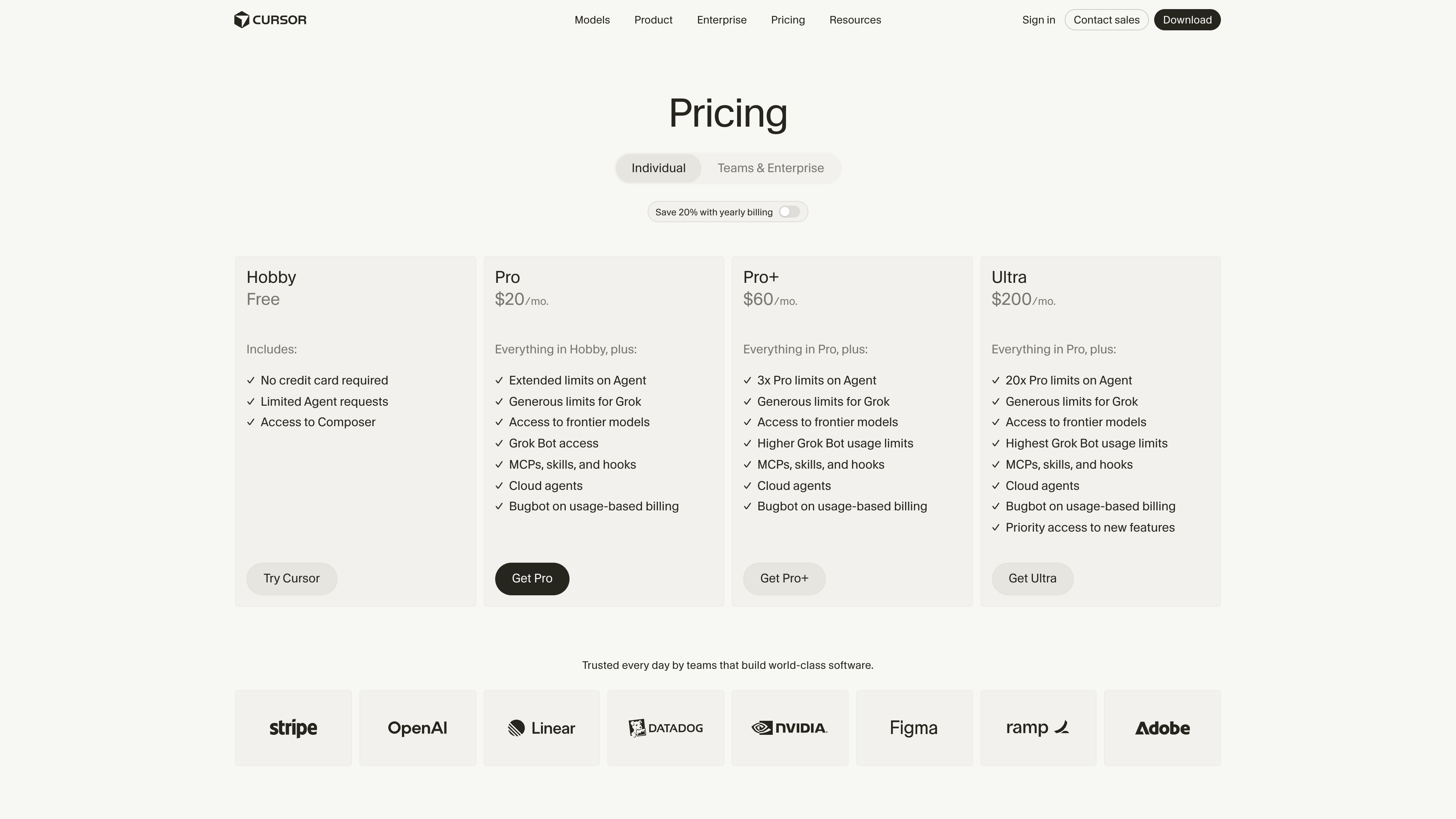
- Pricing: Hobby free; Pro 60/mo, Ultra 40/user/mo, Enterprise custom (as of 2026-09-16, per the official pricing page and pricing docs)
- Sign-up: Browsing the site and docs requires no account; the editor, CLI, and cloud agents all require a registered account. No credit card is needed for the free tier
- Interface language: The editor and website are English-only; the documentation site offers multiple languages including Chinese
- Platforms: Desktop apps for macOS, Windows, and Linux, plus a terminal CLI and cloud agents on web/mobile (per the official download page)
- Launch: Company founded in 2022; product publicly released in 2023. When TechCrunch covered it in October 2023, the company was about a year old with tens of thousands of users and over $1 million in ARR (TechCrunch)
Background: From an MIT Student Project to a SpaceX Subsidiary
Anysphere, Inc. (doing business as Cursor) was founded in 2022 by four MIT students — Michael Truell, Sualeh Asif, Arvid Lunnemark, and Aman Sanger — and is headquartered in San Francisco. The four met at MIT and set out to build a development environment that would speed up everyday programming work such as debugging (TechCrunch). Key milestones:
- October 2023: Announced an $8 million seed round led by the OpenAI Startup Fund, joined by angels including former GitHub CEO Nat Friedman and Dropbox co-founder Arash Ferdowsi (TechCrunch).
- November 2024: Acquired Supermaven, an AI code-completion startup, folding the team into Cursor (via the Wikipedia article, citing TechCrunch).
- June 2025: Confirmed a 9.9 billion post-money valuation, with ARR already past $500 million (TechCrunch).
- July 2025: Launched Bugbot, a GitHub-integrated code-review tool. The same month, a change to Pro plan metering drew widespread complaints about unexpected charges; the company apologized, rolled back the limits, and promised refunds (TechCrunch).
- October 2025: Released Cursor 2.0, adding parallel agents that run in separate git worktrees or on remote machines, alongside its in-house coding model Composer (official blog, via the Wikipedia article).
- November 2025: Closed a 29.3 billion valuation, with participation from Google and Nvidia; the company reported annualized revenue above $1 billion (via the Wikipedia article).
- December 2025: Agreed to acquire Graphite, a code-review startup (via the Wikipedia article, citing Fortune and TechCrunch).
- March 2026: Released Composer 2. It was subsequently shown to be trained on Moonshot AI's open-weights Kimi model, and Cursor acknowledged it had not disclosed the base model at launch (via the Wikipedia article, citing TechCrunch).
- April 2026: SpaceX announced it had secured the right to acquire Anysphere for 6 billion by the end of 2026.
- June 16, 2026: SpaceX announced it was exercising the purchase right in an all-stock acquisition of Anysphere. The deal closed on August 14, 2026: outstanding Anysphere shares converted into roughly 389.3 million SpaceX Class A shares, and Cursor became a wholly owned subsidiary inside a new SpaceXAI division (Yahoo Finance, citing the SEC Form 8-K; also via the Wikipedia article, citing The New York Times and Bloomberg Law). Cursor said the merger gives it access to GPU clusters including xAI's Colossus supercomputer for training its own models (Cryptopolitan).
The Editor and Agent Workflow
Cursor's desktop editor keeps the VS Code feel, but agents are first-class citizens: you describe a task in natural language, and the agent searches the codebase for relevant files, edits across files, runs terminal commands, and verifies the result. Plan mode has the agent lay out an implementation plan before touching code, and Agent Review centralizes the review of agent-produced changes. Since version 2.0 (October 2025), multiple agents can run in parallel, each in its own git worktree or remote machine so they never collide.
For completion, Tab offers AI-driven multi-line autocomplete, unlimited on paid personal plans (pricing docs). On models, Cursor trains its own Composer family optimized for low-latency coding (listed as Composer 2.5 in the docs as of 2026-09-16), and also offers third-party frontier models from Anthropic (Claude), OpenAI (GPT), Google (Gemini), and xAI (Grok); some support a Max mode that extends context to up to 1 million tokens (official docs model list).
Updates through 2026 push the product toward long-running work: Projects (in beta) introduces a coordinator agent that breaks large efforts — a feature, a migration, a full app — into tasks delegated to thousands of subagents while maintaining shared context over months; /goal keeps an agent working toward a long-lived objective; and cloud agents can subscribe to event sources such as PRs, Slack channels, or schedules, waking automatically when something happens (official changelog).
Desktop, Terminal, and Cloud: Multiple Ways In
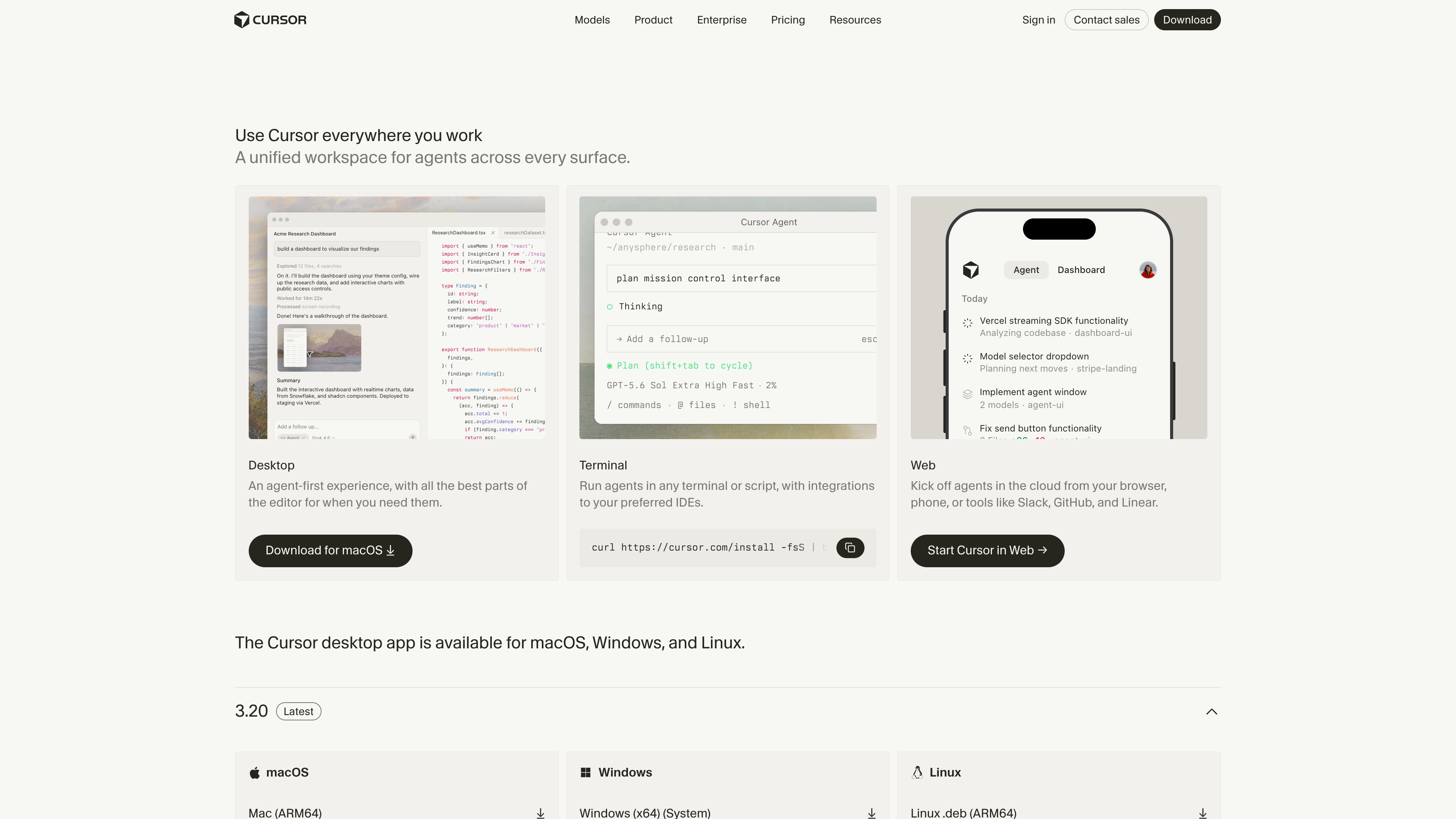
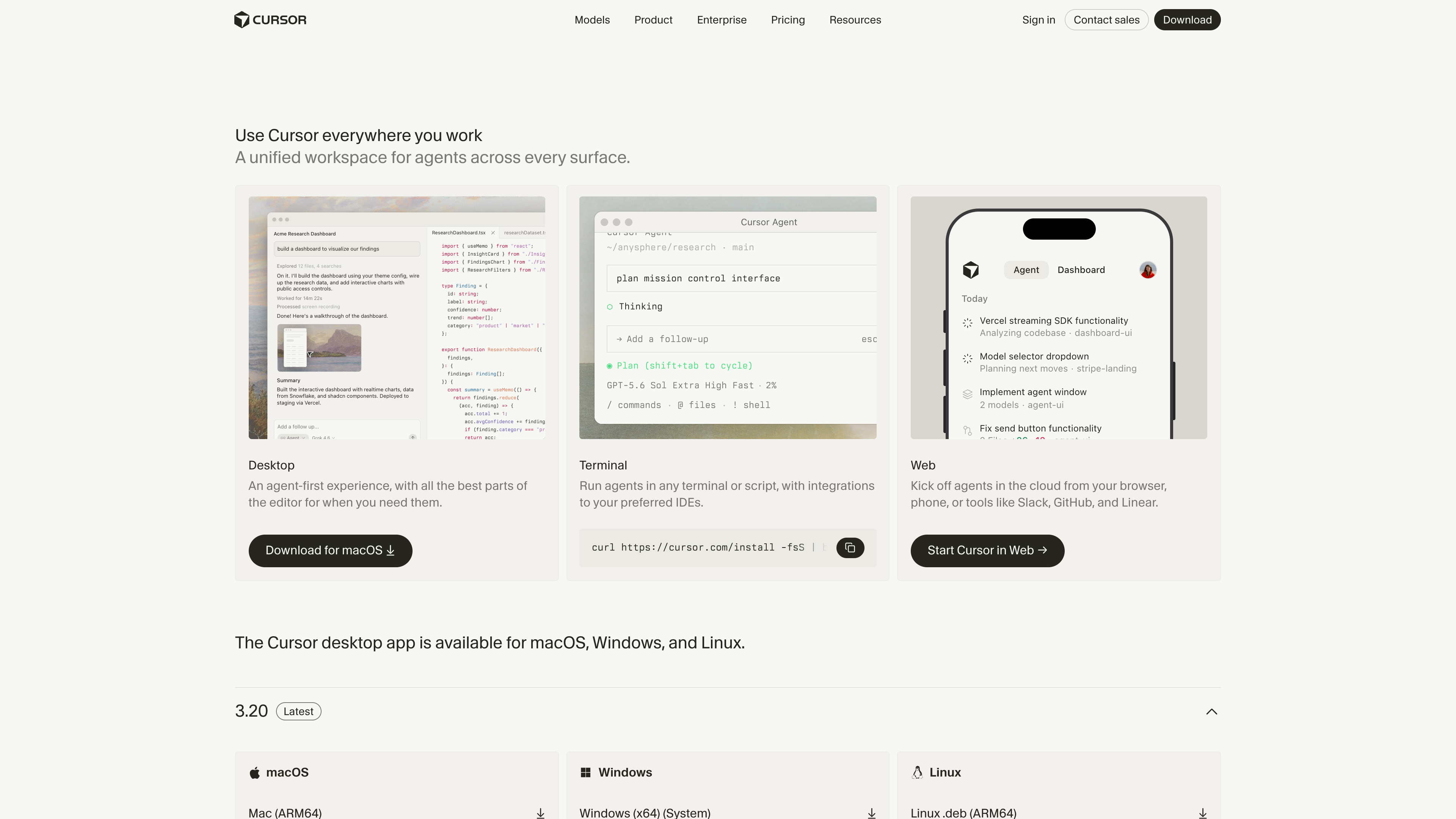
Cursor is more than a desktop editor (per the official download page):
- Desktop: Full editor-plus-agent experience on macOS, Windows, and Linux.
- Terminal CLI: Installed via
curl https://cursor.com/install -fsS | bash; runs agents in any terminal, script, or CI pipeline in headless mode, and integrates with other IDEs. - Web and cloud agents: Kick off tasks from a browser, phone, or tools like Slack, GitHub, and Linear; agents run in Cursor-hosted cloud environments, so closing your laptop doesn't stop them. Since 2026, agents can also be dispatched to an organization's own "self-hosted machines" so builds and secrets stay on internal infrastructure, and Cursor has begun rolling out Origin, its own code hosting (early beta, paid plans) (official changelog).
- Bugbot: Automated code review attached to GitHub pull requests, with one-click handoff to Cursor for fixes. It is billed separately from the editor subscription at $40/month (pricing docs).
- Integrations and APIs: The docs list integrations with Slack, Microsoft Teams, Jira, Linear, Notion, GitHub, GitLab, Azure DevOps, Bitbucket, JetBrains, and Xcode, plus TypeScript and Python SDKs (official docs).
Model Usage and Billing
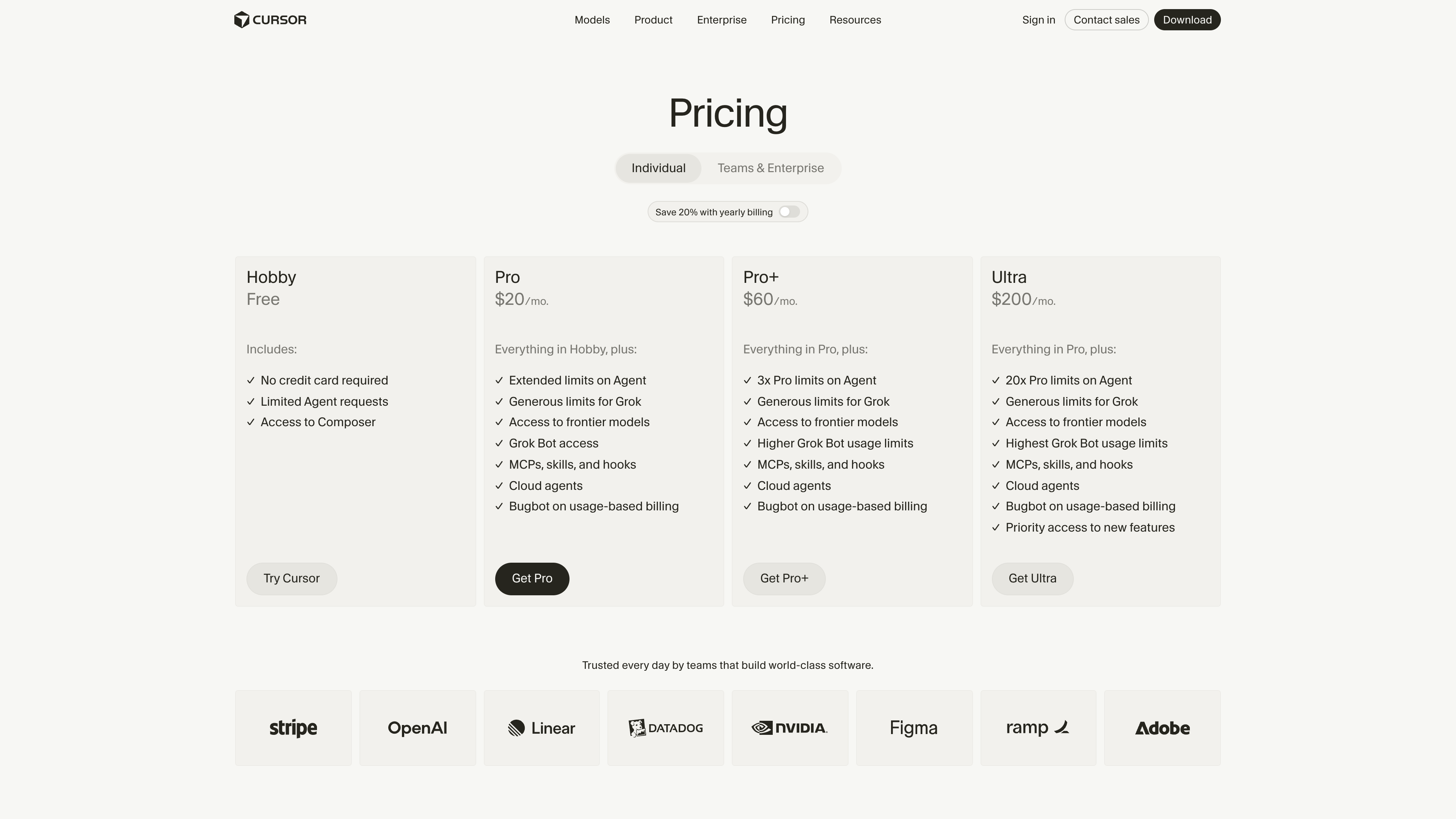
Cursor subscriptions follow an "included usage plus on-demand" model: each tier bundles a fixed amount of model API usage (Pro includes 70, Ultra 60–100 per month in total, while heavy users running multiple agents and automations exceed $200.
As of 2026-09-16, the official pricing page lists: Hobby free (limited agent requests, access to Composer, no credit card required); Pro at 60/mo (3x Pro agent limits); Ultra at 40/user/mo and adds enforced Privacy Mode, a usage dashboard, centralized billing, and SAML/OIDC SSO; Enterprise is custom-priced with pooled usage, invoicing, SCIM, and advanced security controls (pricing docs). Cursor also states that subscriptions are sold only through cursor.com with no authorized resellers, and accounts purchased elsewhere may be suspended (pricing page FAQ).
Privacy and Data Security
AI requests are routed through Cursor's backend to the various model providers, so code is not processed entirely on your machine. The key commitments on the official security page:
- Privacy Mode is available to everyone, including free users, and can be enabled in settings or enforced by a team admin. When enabled, Cursor commits to not training on your data — neither its own training nor its model providers' — backed by technical controls and contractual requirements. The converse matters: with Privacy Mode off, no such guarantee is made, so privacy-conscious users should switch it on.
- Compliance certifications include SOC 2 Type II, ISO/IEC 27001:2022, ISO/IEC 42001:2023, and AIUC-1, with reports available on request through its trust portal.
- Cursor states it does not use or maintain any infrastructure in China and does not use subprocessors headquartered there.
Documentation and Customization
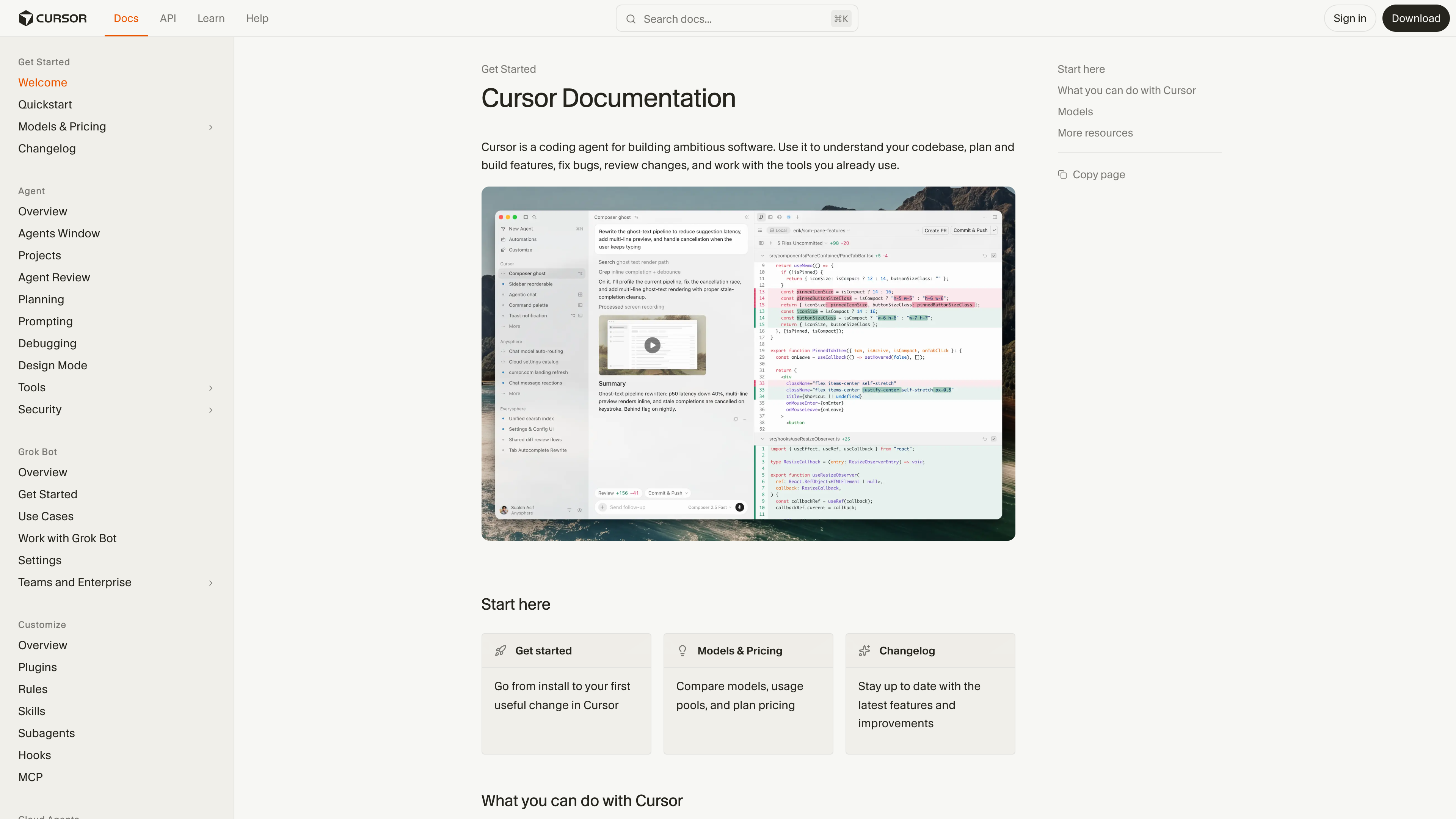
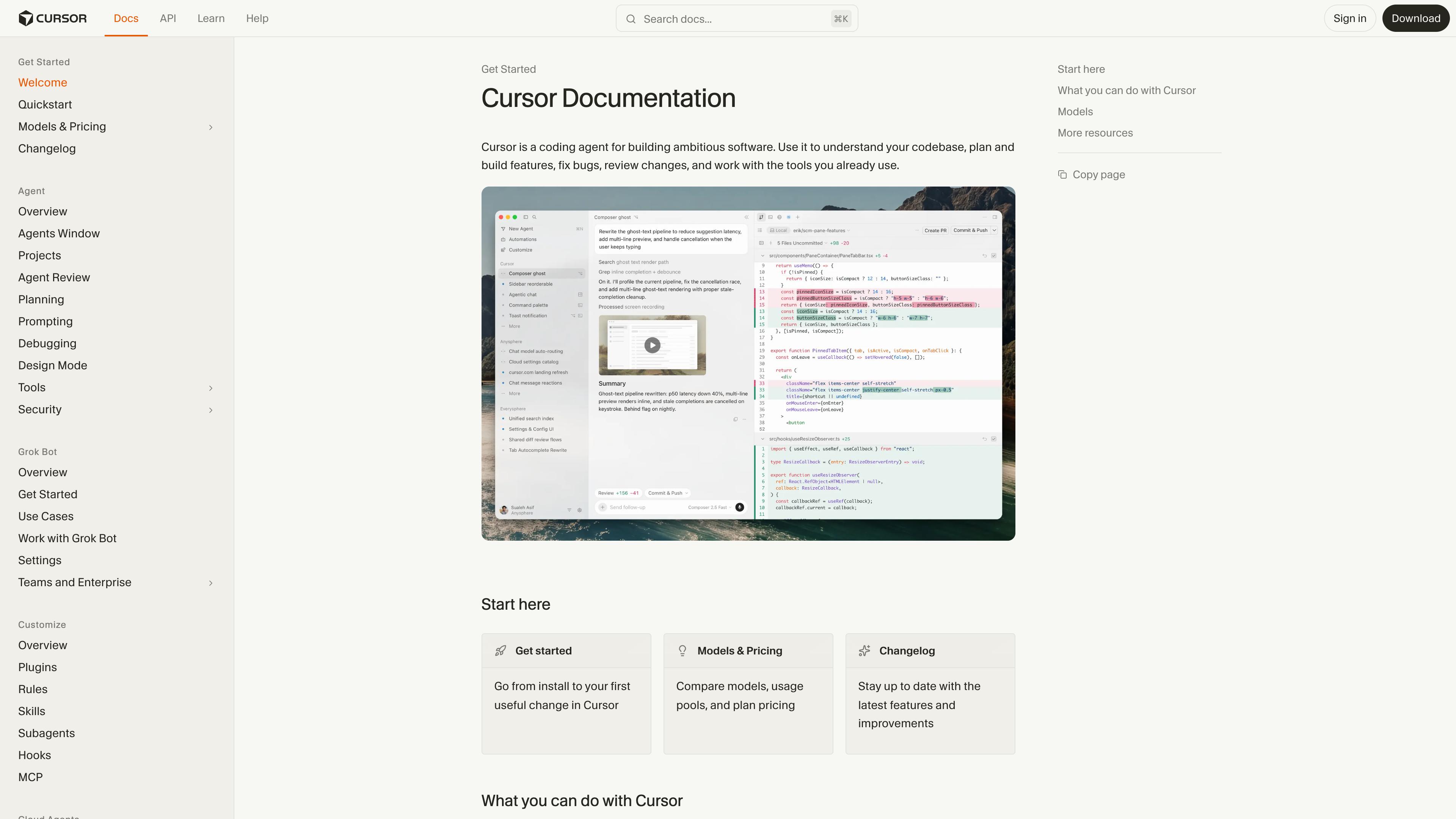
The documentation site (docs.cursor.com) is localized into multiple languages including Chinese, which lowers the barrier for users less comfortable with the English-only editor UI. The customization stack includes Rules that constrain agent behavior, reusable Skills, Subagents for parallel delegation, Hooks that insert deterministic scripts into the agent loop, and MCP for connecting external tools and data sources; customizations can be distributed within a team as plugins (official docs).
Who It's For
- Developers already on VS Code who want deep AI integration without changing their toolchain.
- Maintainers making cross-file, multi-step changes in large repositories — an agent can search, modify, and verify in one pass.
- Teams that want to hand repetitive work — fixing CI, addressing PR feedback, scheduled checks — to cloud agents.
- Organizations needing SSO, usage auditing, and enforced Privacy Mode (Teams/Enterprise).
- Anyone who wants to evaluate agent workflows at zero cost: the Hobby tier needs no credit card.
Limitations and Controversies
- Closed-source commercial software: The editor itself is not open source, and its AI capabilities depend on Cursor's cloud services — offline, it falls back to being a plain editor.
- Costs are not fully predictable: Usage-based billing means heavy agent use can push monthly spend well past the sticker price. The July 2025 metering change caused a backlash over unexpected charges, ending in an apology, rollback, and refunds (TechCrunch).
- English-only interface: Neither the editor nor the website offers an official localized UI; only the documentation is translated.
- Code passes through the cloud: AI requests are relayed by Cursor's backend to third-party model providers, and with Privacy Mode off the company does not commit to excluding your data from training.
- Model provenance dispute: Composer 2 (March 2026) launched without disclosing that it was trained on Moonshot AI's open-weights Kimi model; Cursor later acknowledged the omission (via the Wikipedia article, citing TechCrunch).
- Ownership transition: Since August 2026 the company sits inside SpaceXAI; product direction and pricing may shift with its new parent, and the long-term effects remain to be seen (a reasonable caution based on the acquisition).
- Limited free tier: Hobby caps agent requests, so sustained use requires payment.
Alternatives
- GitHub Copilot: Ships as a plugin inside VS Code, JetBrains, and other existing IDEs — the opposite of Cursor's standalone AI-native editor approach, and a fit for teams that don't want to switch editors.
- Anthropic Claude Code / OpenAI Codex: Terminal-first coding agents, better suited to scripted and CI-centric workflows.
- Windsurf: A direct competitor following a similar AI-native editor approach.
- VS Code itself: Free and open source; combining it with open-source or commercial AI extensions reproduces part of the experience.