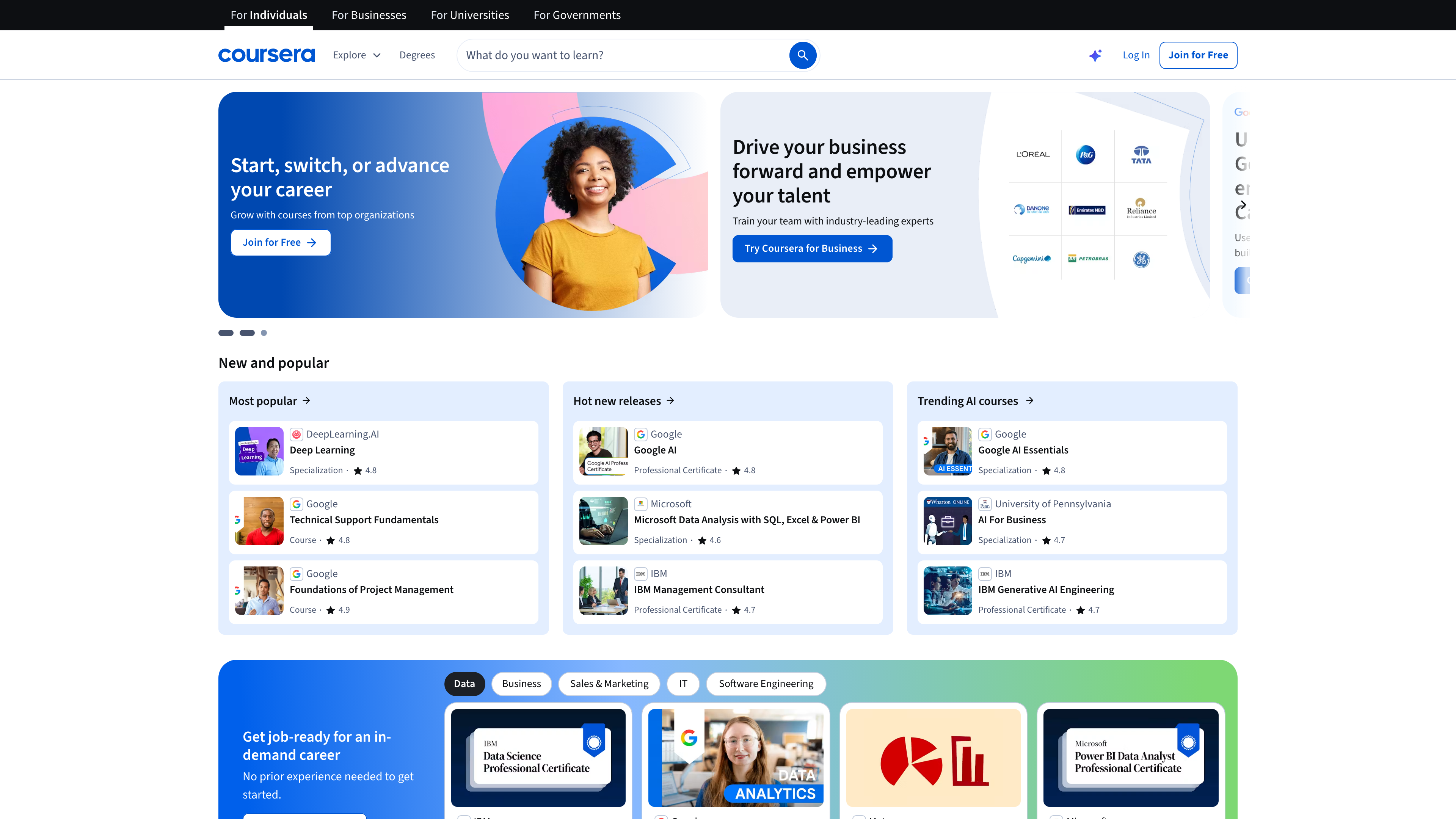
Coursera (coursera.org) is an online learning platform built on partnerships with universities and industry educators: universities such as Stanford, Yale, Duke and Michigan, and companies like Google, IBM, Meta and Microsoft publish courses on it, and learners can earn course certificates, professional certificates and even full online bachelor's and master's degrees. The problem it set out to solve is access — making real university coursework available to people outside campus (official About page). Its verifiable distinction from instructor-marketplace platforms is that content comes mainly from accredited universities and named companies, and certificates carry the issuing institution's brand.
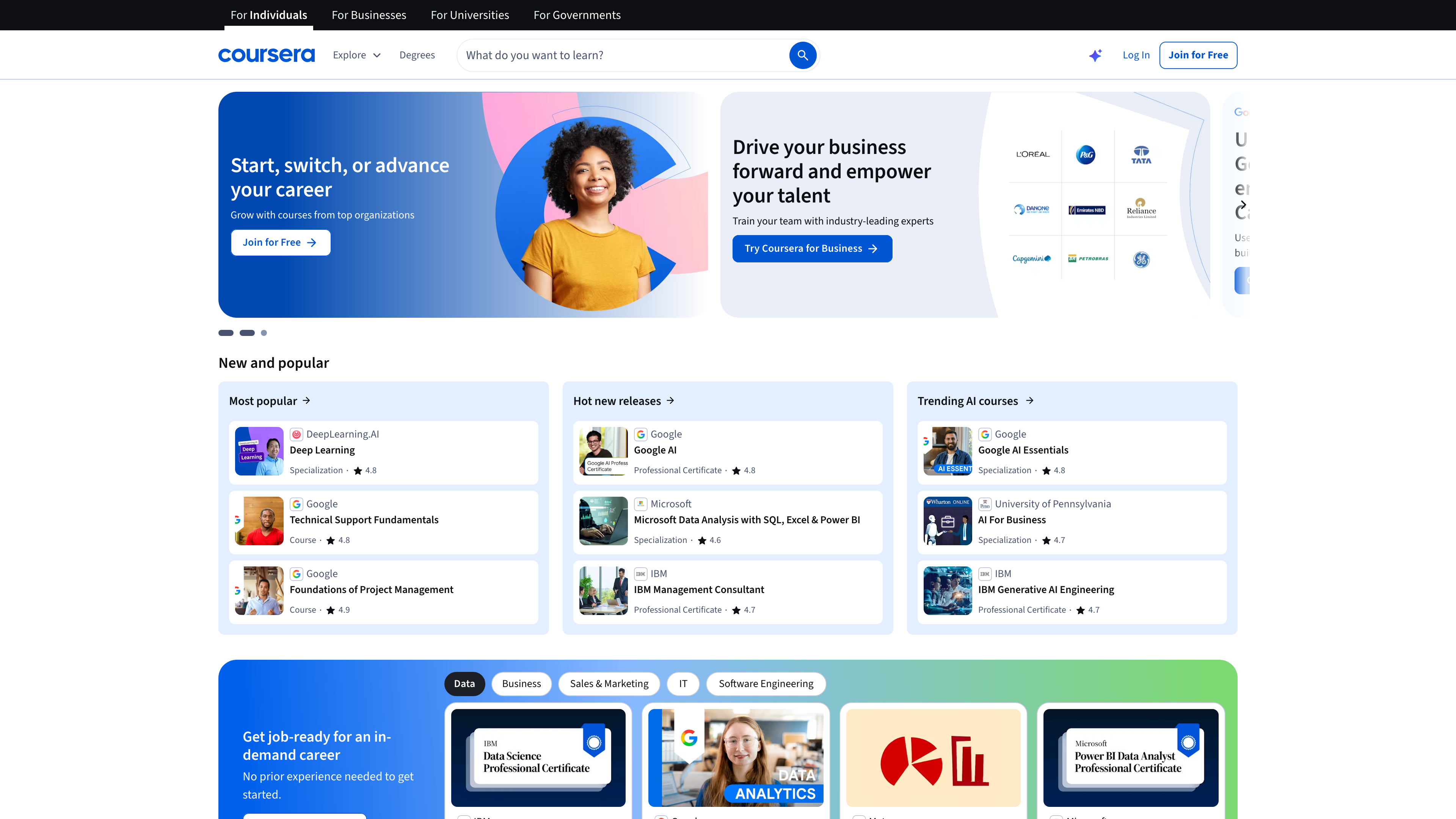 Browsing the catalog needs no account; enrolling requires a free sign-up. The interface is available in multiple languages including Chinese (verified working on 2026-09-02).
At a glance
- URL: https://www.coursera.org/
- Type: Online learning platform (Coursera, Inc., NYSE: COUR; a Delaware public benefit corporation and certified B Corp)
- Cost: Most individual courses can be audited free; certificates are paid; Coursera Plus is US399/year (US pricing, as of 2026-09-02)
- Account: Not needed to browse; free registration required to enroll
- Interface languages: Multiple, including Chinese; courses are primarily in English, some with Chinese subtitles
- Mobile: iOS and Android apps
Background
Coursera was founded in 2012 by Andrew Ng and Daphne Koller, then both Stanford computer science professors, and was among the first companies to turn massive open online courses (MOOCs) into a platform business (official About page; founders cross-checked against the SEC S-1 filing). It went public on the New York Stock Exchange on March 30, 2021, pricing shares at US$33 (official IPO announcement).
The most significant recent development is the merger with Udemy: announced on December 17, 2025, approved by both companies' stockholders on April 9, 2026, and completed on May 11, 2026, with Udemy becoming a wholly owned subsidiary and delisting from NASDAQ. Per the official announcement, the combined company spans 290 million learners, 95,000 instructors and 18,000 enterprise customers, with combined 2025 revenue above US$1.5 billion; Andrew Ng remains chairman of the board (official completion announcement).
Courses and credentials
Individual courses: topic-based, with video, quizzes and assignments. Most offer an audit track — free access to much of the material, without graded work or a certificate (official enrollment options).
Specializations and Professional Certificates: bundled course series; completing the paid track earns a shareable certificate for resumes and LinkedIn.
Online degrees: bachelor's and master's programs run with partner universities, priced separately by the university.
Coursera Plus: a subscription officially covering unlimited access to 10,000+ courses from 350+ partner institutions and unlimited certificates, with a 7-day free trial. US pricing is US399/year as of 2026-09-02 (consistent across the official page and third-party trackers; other regions see local-currency pricing, e.g. CN¥236/month in China).
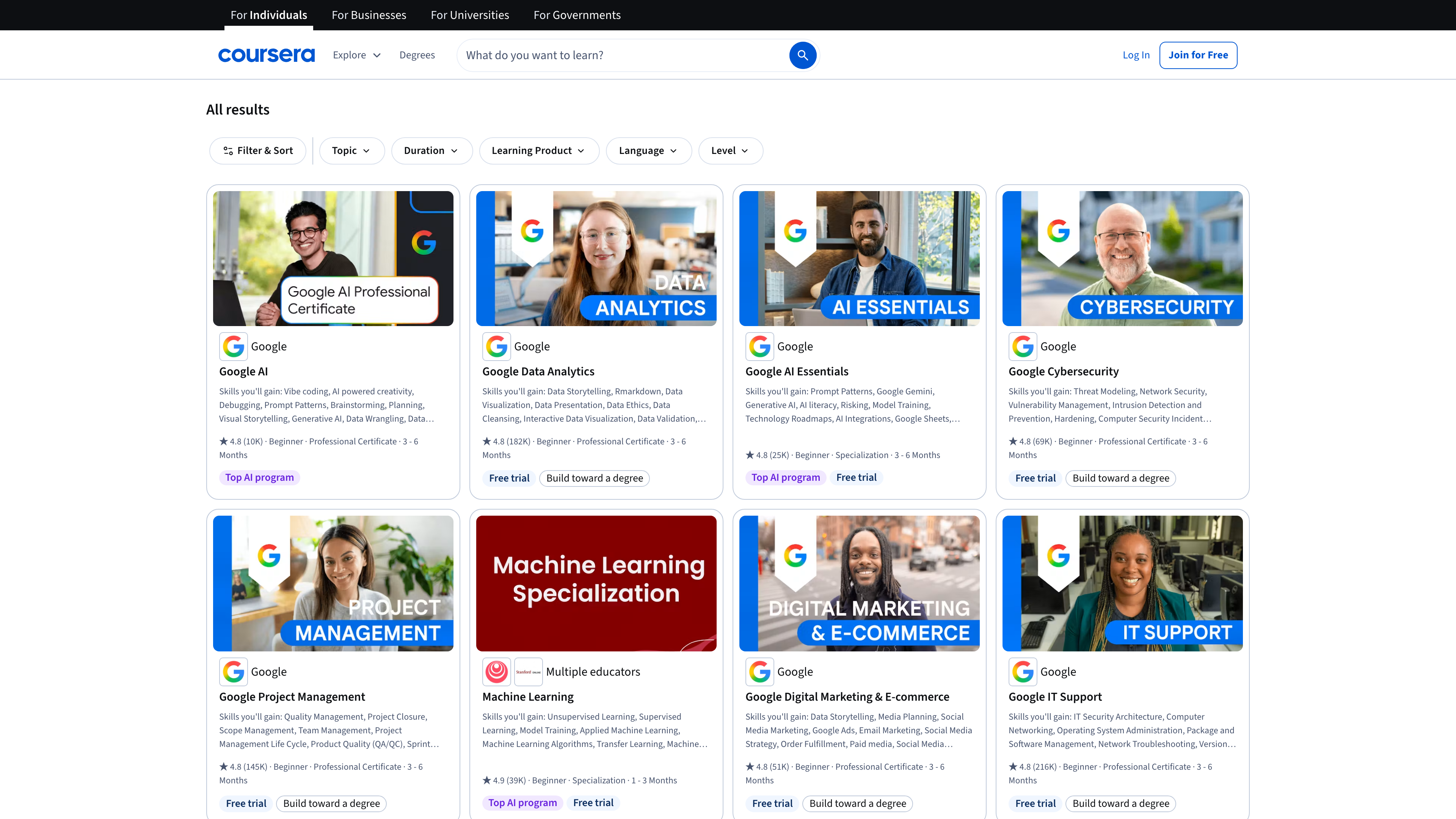
AI features: the About page lists a personalized Coach, Role Play and Course Builder, now woven into the learning flow.
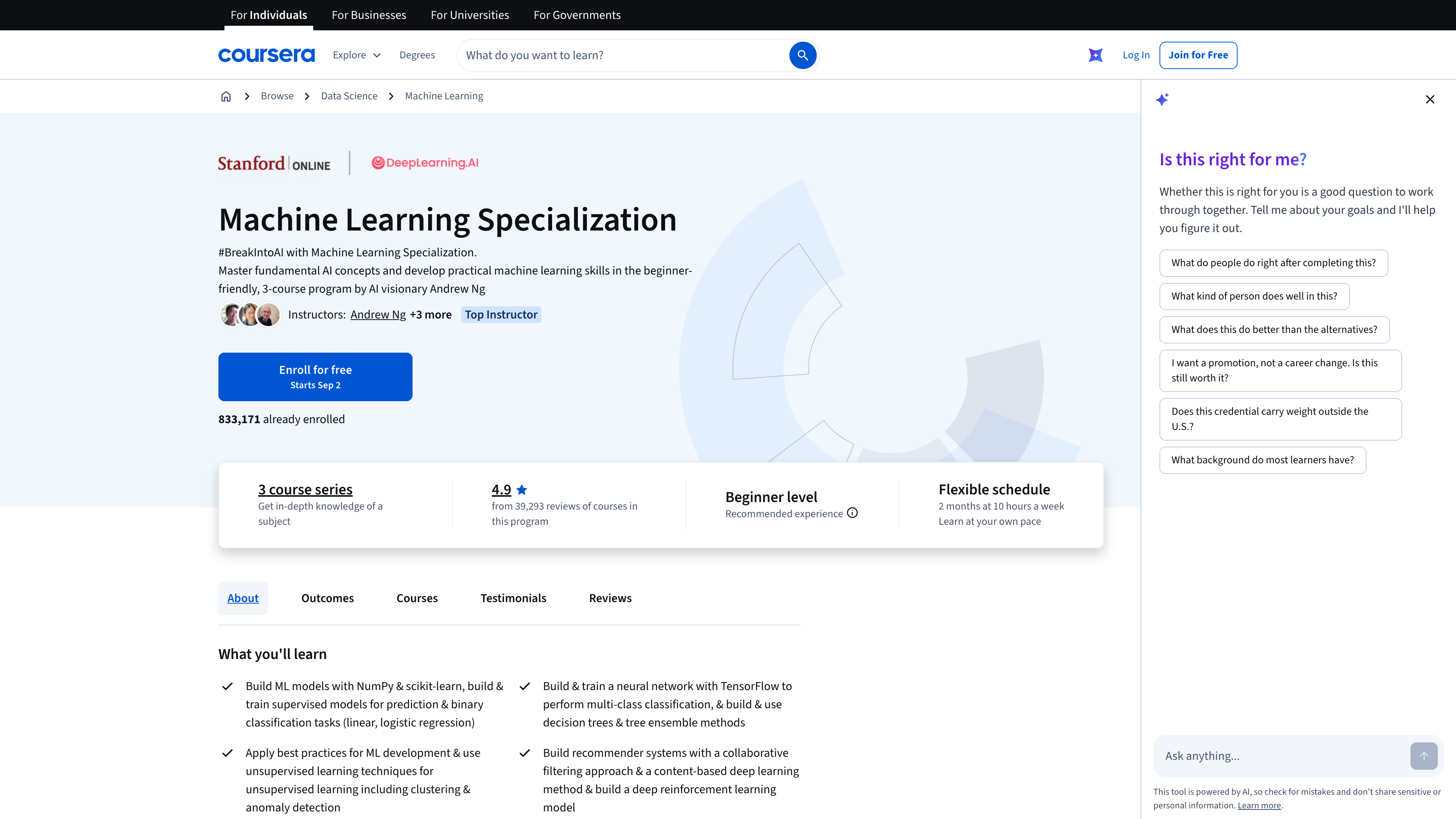
One illustrative data point: the Machine Learning Specialization (Stanford Online with DeepLearning.AI, taught by Andrew Ng himself) shows 833,000+ learners enrolled, a 4.9 rating, beginner level, and roughly two months at 10 hours a week, with an "Enroll for free" button to start (page figures as of 2026-09-02).
Good for
- Building job skills in data science, programming or business with institution-branded certificates
- Auditing university courses for knowledge without paying for the credential
- Preparing a career switch through structured Professional Certificate programs
- Earning an accredited online degree without leaving your job
Limitations
- Audit mode excludes certificates, graded assignments and some interactive components; Specializations, degrees and some popular courses cannot be fully audited.
- Subscriptions and course purchases renew automatically by default; cancel before the next billing period, and expect regional price differences.
- Course quality and update cadence vary by content partner (reasonable inference — Coursera does not produce the catalog itself).
- Courses are primarily in English; Chinese subtitle coverage varies course by course.
- The Udemy merger only closed in May 2026, so catalog, account and pricing integration is still evolving (reasonable inference; Coursera says learner-facing changes will be communicated over time).
Alternatives
edX is the other university-centric MOOC platform (now part of 2U); Khan Academy is a nonprofit offering free courses from K-12 through early college; Udemy is an instructor marketplace that has belonged to the same company since May 2026; Chinese-speaking readers can also consider China University MOOC.
Sources
- Coursera official About page (2012 founding, founders, public benefit corporation / B Corp status, Udemy combination; checked 2026-09-02)
- Coursera Plus official page (10,000+ courses, 350+ partners; checked 2026-09-02)
- Help Center: enrollment options (audit mode) (checked 2026-09-02)
- Official IPO pricing announcement (2021-03-30, NYSE: COUR)
- Official Udemy combination completion announcement (2026-05-11)
- SEC: Coursera S-1 (founder cross-reference)