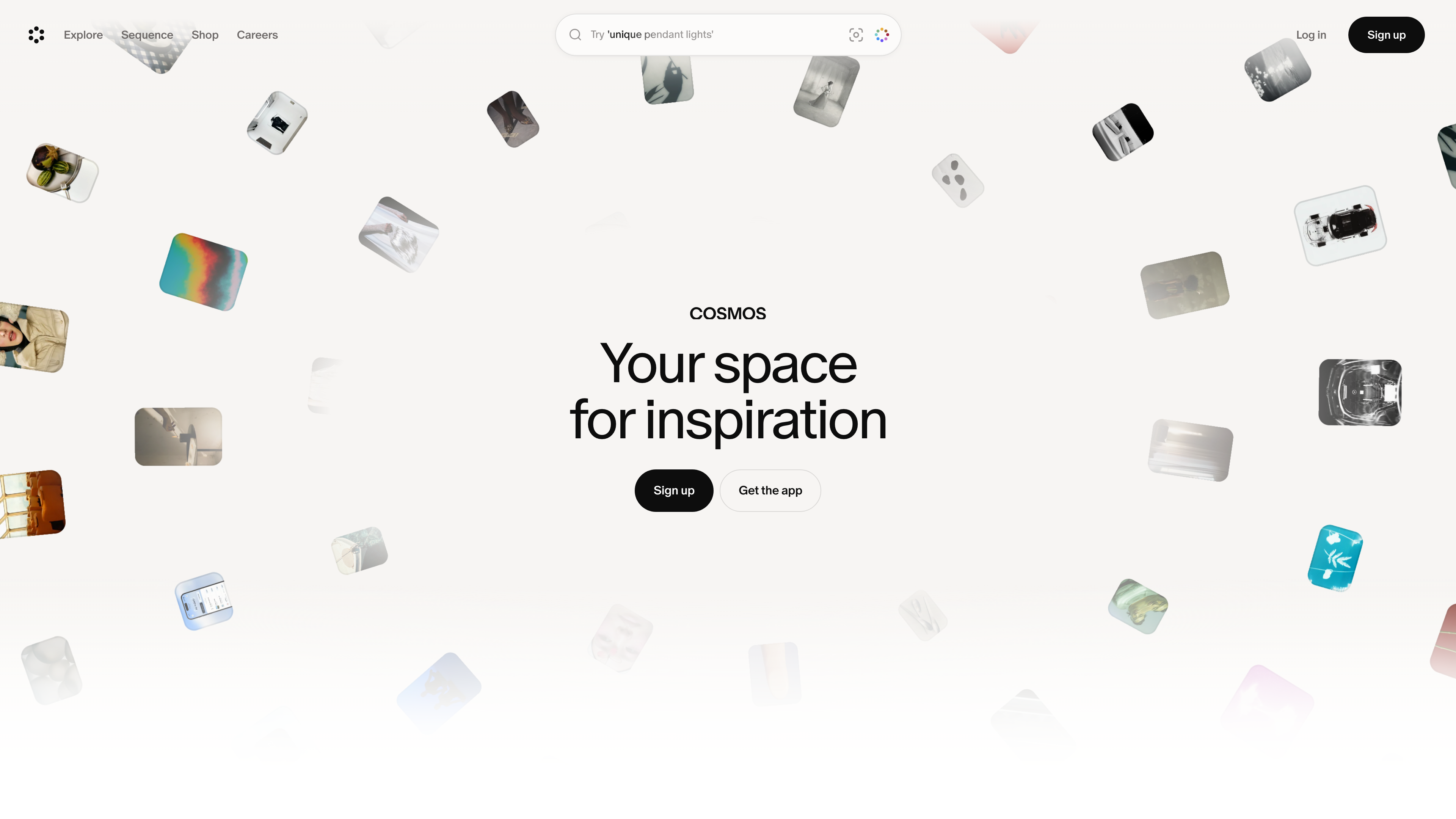
Cosmos (cosmos.so) is a visual-inspiration collecting and discovery platform built by Cosmos Entity, Inc. in New York. It addresses a specific problem: creatives keep their references scattered across Instagram saves, screenshot folders and burner Pinterest accounts, where nothing is findable and nothing carries its source. On Cosmos, images, videos, links and notes are saved as elements and organized into collections; there are no public like counts and, as of this writing, no feed ads. Its verifiable differences from Pinterest: search by hex color value and by image, AI-generated captions that identify an image's creator and origin, and user controls for filtering AI-generated content. The company says the platform sees more than 10 million saves per month and is used by creative teams at Nike, Chanel, A24 and Apple (company figures, as reported by WWD).
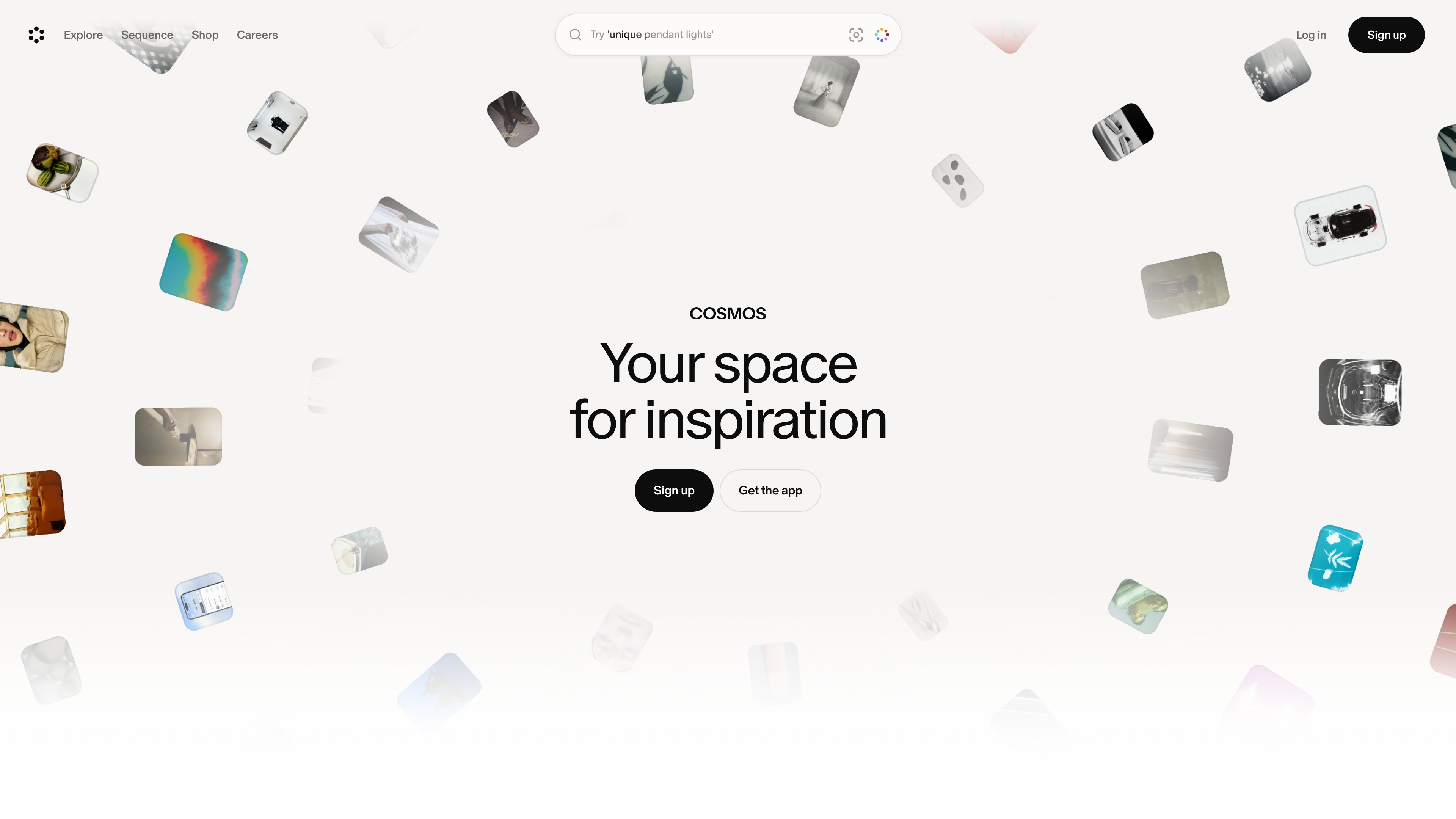
The screenshot above shows the Cosmos homepage: no feed on the first screen, just the “Your space for inspiration” line and a floating wall of saved images, with sign-up and search anchored at the top.
At a glance
- URL: https://www.cosmos.so (cosmos.so 301-redirects to the www host)
- Type: visual bookmarking / moodboard platform (UGC with editorial curation)
- Cost: free to use; optional Premium subscription, no public price on official pages (help center)
- Registration: the Explore page and Public Work are browsable without an account; saving anything requires one. Sign-up starts with an email address, then asks for name, age and a username. Must be 13 or older (Terms)
- Interface languages: the company lists 11 — English, Japanese, Korean, Spanish, Portuguese, French, Italian, German, Dutch, Simplified Chinese and Vietnamese (no Traditional Chinese; official FAQ)
- Platforms: web, iOS (first released July 2022, now requires iOS 18), Android (Google Play); saving extensions for Chrome, Safari and iOS
- Started: founded 2021; iOS app first listed on the App Store on July 13, 2022 (Apple's store metadata)
Background
Cosmos began in 2021 as a side project by Andy McCune and Luca Marra, born out of not having a central place to keep visual references. McCune previously co-founded Unfold, the Instagram-story template tool acquired by Squarespace in 2019. Reports disagree on the public launch year (anywhere from 2023 to 2025); the firmly verifiable date is the iOS app's first App Store release, July 13, 2022.
On funding, WWD and FinSMEs tell the same story: a 15M Series A in January 2026 co-led by Shine Capital and Matrix, with participation from GV, Accel, Plug and Play and Squarespace founder Anthony Casalena; angels include Scott Belsky, Joe Gebbia and Biz Stone, for $21M raised in total. The team works out of SoHo, New York, and the careers page says its members previously worked at Apple, Meta, Shopify, Coinbase, Squarespace and Tesla. In January 2026 McCune published a founder essay, The Future of Cosmos, laying out the product philosophy that your inputs determine your outputs.
Collecting, organizing and search
Cosmos keeps its information model to three layers: your profile, saved units of content called elements, and collections that group them (with nested subcollections). An element can be an image, a video (up to 100 GB per file), a link or a text note, uploaded manually or saved from any web page via the browser extension. New saves land in a private “all elements” archive first — organizing is a separate, later step (Elements and Collections docs). Collections are public by default, can be switched to private at any time, and inviting collaborators is a Premium feature.
Search is where the product invests most. Per the official docs, Cosmos supports keyword search, color search (type a hex value to find matching imagery) and visual search (right-click any image on desktop), and the three can be combined and scoped to a specific profile or collection. On the discovery side there is a personalized For You feed and a Discover page organized by categories like graphic design, architecture and fashion; opening any element surfaces similar elements and the other collections that include it, so you can follow someone else's curation deeper.
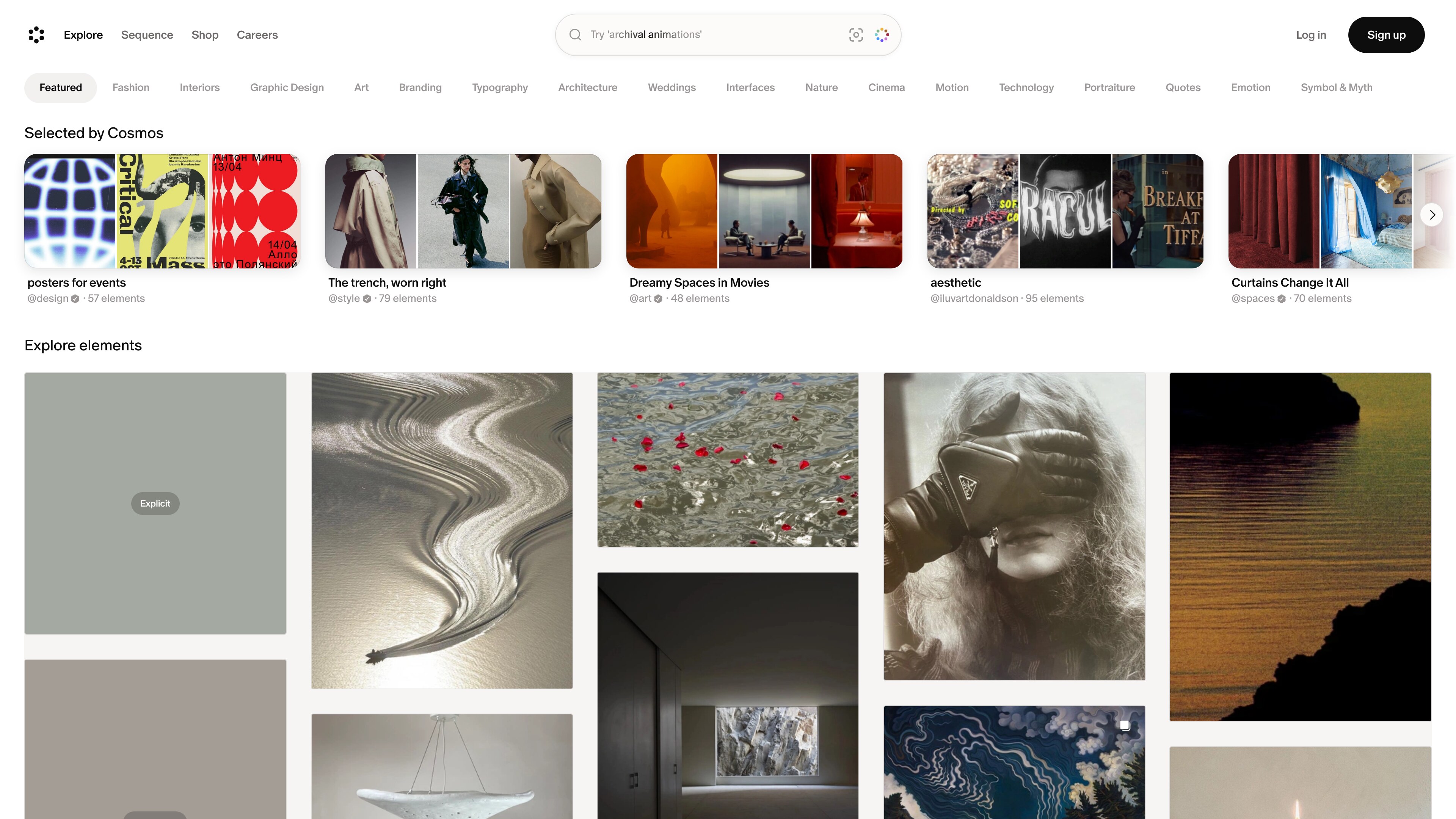
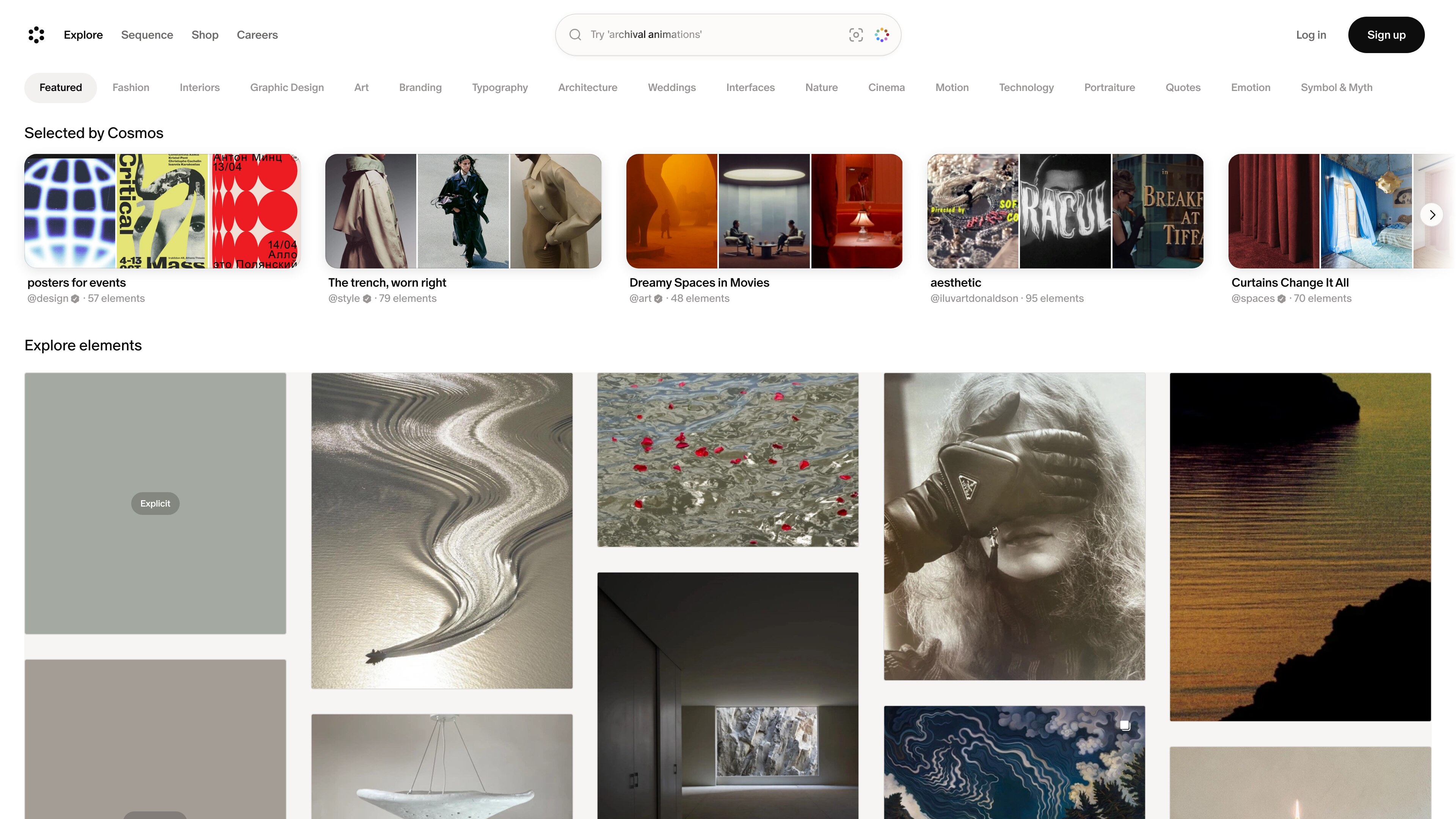
Above is the Explore page as seen without an account: category chips up top, editorial picks under “Selected by Cosmos” (cards show only the curator's handle and element count — no like counts), and a masonry feed below. One tile in the left column is labeled “Explicit” and blurred by default — the content filter working for anonymous visitors.
Image provenance and the AI stance
Cosmos's position on AI is to use it to repair what AI broke. On one side, the platform researches images with AI — identifying the creator, original source, publication date and style — and attaches clickable research captions (the homepage demo tags a staircase photo as Cranbrook Academy of Art, designed by Eliel Saarinen, 1925); clicking a creator or institution name leads to related work. Business of Home's hands-on found the captions broadly useful with occasional misattributions; the community can refine them, and users can report an inaccurate caption. On the other side, machine-learning scores image quality and de-ranks low-scoring content in search. AI-generated imagery is allowed on the platform but detected and labeled, and users can show, blur or hide AI, suggestive and explicit content independently in settings (content filtering docs).
Side projects: Public Work and Sequence
The same team runs two public-facing products. Public Work is a search engine for public-domain imagery — over 100,000 copyright-free works released by institutions like The Met and the New York Public Library — browsable without an account, with sign-up prompted when you search deeper or save. Sequence is the company's weekly publication across interviews, aesthetic studies, object essays and a weekly Editions column on design, fashion and internet culture; the company claims four million weekly readers (vendor figure).
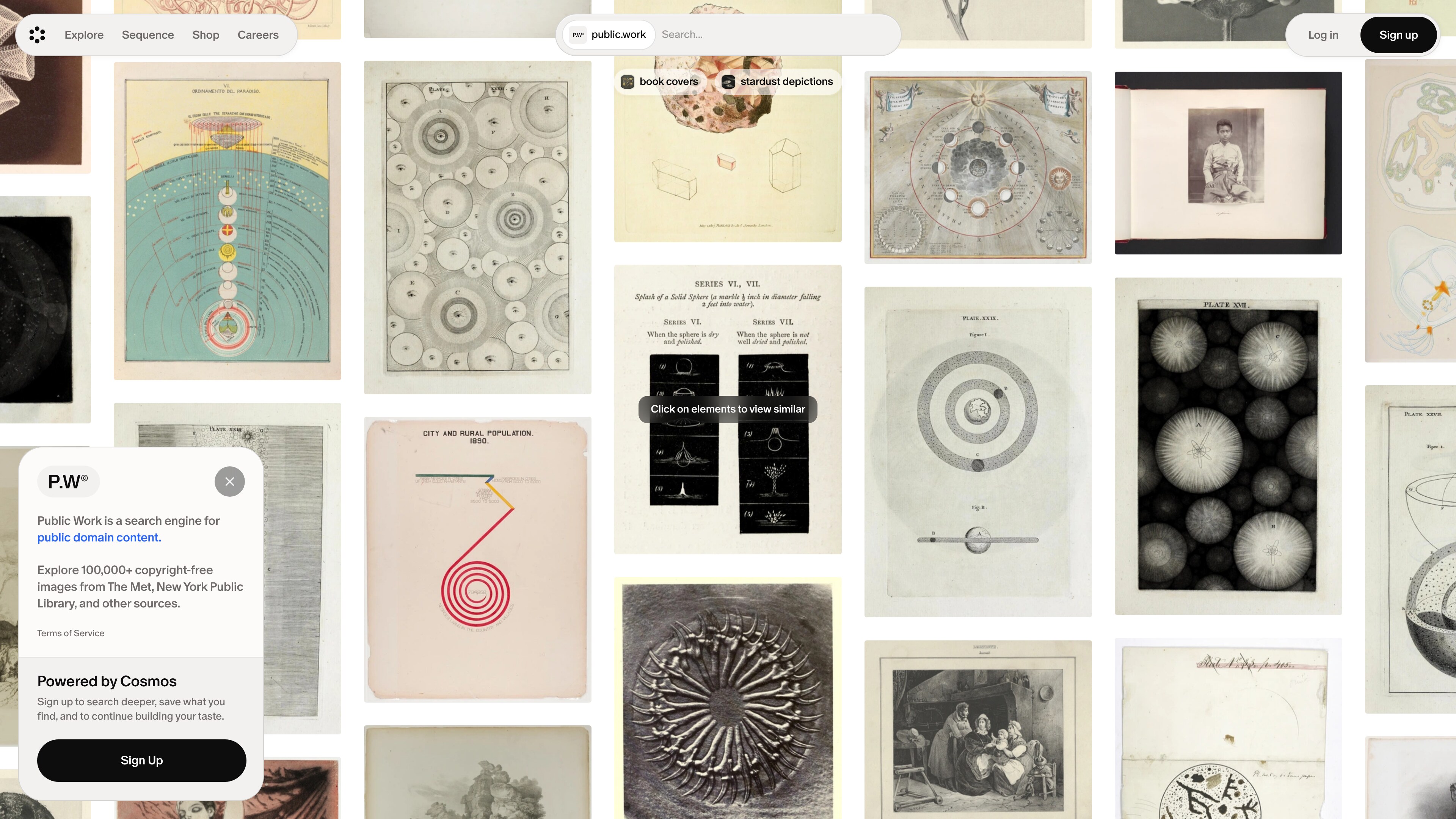
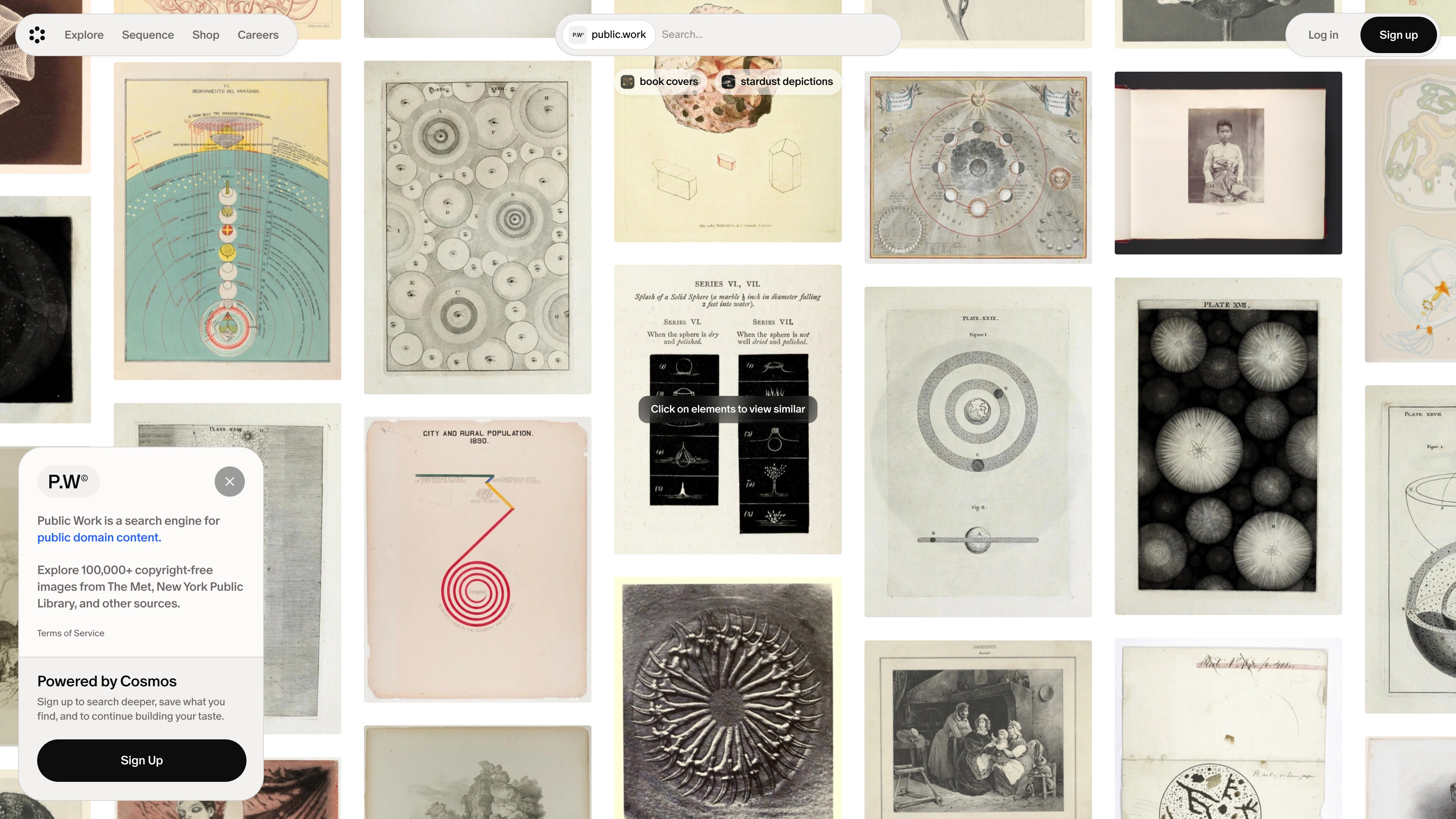
Above is Public Work in practice: a masonry grid of astronomical charts, scientific illustrations and other public-domain material, with an info card explaining what it is and that it is “Powered by Cosmos.”
Accounts and openness
Sign-up starts with an email address at /start (the same flow handles login), followed by name, age and username. Handles are unique, and short ones — four characters or fewer, first names, dictionary words — are reserved for Premium subscribers. Per the official docs, Premium adds: any available username, early access to new features, collection collaboration, bulk export of a collection as a zip (images only — text and links are not included), and customizable grid sizes. Subscriptions are managed under Settings > Subscription, or through the App Store / Google Play if subscribed there.
For migration, the browser extension can import public Pinterest boards, Are.na channels and Tumblr blogs in one click (Pinterest private boards, boards with sections, boards over 5,000 pins and video pins are unsupported; import docs). The weak spot in openness: there is no public developer API, and export is limited to the Premium zip. Long-term, your library lives at the platform's discretion.
Copyright and content policy
Cosmos is a UGC platform, and its copyright terms deserve attention. The Terms of Service state that Cosmos claims no ownership of user content, but uploading grants the company a non-exclusive, transferable, worldwide, royalty-free, sublicensable license covering modification, derivative works and public display — explicitly including promotional and marketing use; uploaders must warrant they hold the necessary rights. A DMCA policy is in place and repeat infringers are terminated. The official FAQ warns plainly that “we can't guarantee any element is copyright-free” and that any use beyond personal inspiration requires explicit permission from the rights holder. Prohibited content includes infringing, illegal, minor-sexualization, hateful and violent material, and the terms also ban scraping the service. On privacy, the Privacy Notice says Cosmos does not “sell” personal information (CCPA sense) but retains clauses for advertising cookies, may collect precise location, and does not honor Do Not Track; disputes fall under New York law with mandatory individual arbitration.
Where it fits
- Graphic designers, art directors, photographers, fashion and interior designers building a searchable reference library instead of the “screenshots plus burner Pinterest” sprawl.
- Moodboarding that needs palette-based or visual-similarity search (brand pitches, early campaign work).
- Research-minded users who care about provenance and want to trace images back to their makers.
- Anyone migrating an existing collection from Pinterest, Are.na or Tumblr (official importers exist).
- If you only need copyright-free material, Public Work works with no account at all.
Limitations
- Low but real account wall: browsing is free, but saving, collaboration and deeper search all require an account; Public Work's search prompts sign-up too.
- No public API, limited export: the only export is the Premium zip (images only), and there is no official API or self-hosting — long-term reliance on a single vendor.
- AI provenance captions are imperfect: both press and the platform acknowledge misattributions; verify before citing.
- Broad license grant: uploads come with a sublicensable license that includes marketing use, and the privacy policy keeps advertising clauses on the books — a gap between today's ad-free state and future monetization, which the founder frames as search-based commerce rather than feed ads.
- No Traditional Chinese: the interface offers Simplified Chinese but not Traditional.
- Key metrics are vendor-reported: user scale, “10M+ saves a month,” brand-team adoption and Sequence's “4 million weekly readers” all come from the company via press coverage, with no third-party audit. A claim repeated in several outlets that Apple named Cosmos one of its “25 apps of 2025” could not be matched against Apple's official awards lists and is not treated as fact here.
- Young platform: publicly available for only two to three years, with product concepts still shifting (the help center mixes “clusters” and “collections” across articles).
Alternatives
- Pinterest: the de facto standard for visual collecting, far larger in scale and inventory, but heavy on ads and weak on image provenance.
- Are.na: a member-supported, ad-free platform for collecting and connecting ideas, more text- and thinking-oriented; Cosmos's importer supports Are.na channels directly.
- mymind: a private AI-powered bookmarking tool with no social layer; Cosmos defaults to a public profile and community discovery.
References
- Cosmos homepage (checked 2026-09-25)
- Intro to Cosmos - official help center (checked 2026-09-25)
- Elements - official help center (checked 2026-09-25)
- Collections & Subcollections - official help center (checked 2026-09-25)
- Search - official help center (checked 2026-09-25)
- Content Filtering - official help center (checked 2026-09-25)
- Cosmos Premium - official help center (checked 2026-09-25)
- Use our Import Tools - official help center (checked 2026-09-25)
- FAQs - official help center (checked 2026-09-25)
- Cosmos Terms of Service (checked 2026-09-25)
- Cosmos Privacy Notice (checked 2026-09-25)
- Public Work (checked 2026-09-25)
- Sequence (checked 2026-09-25)
- Cosmos: Search & Discover - Apple App Store (checked 2026-09-25)
- Pinterest Alternative Cosmos Is Looking to Redefine Visual Inspiration for Creatives - WWD (checked 2026-09-25)
- Cosmos wants to be more than just a Pinterest for the cool kids - Business of Home (checked 2026-09-25)
- Cosmos Raises $15M in Series A Funding - FinSMEs (checked 2026-09-25)