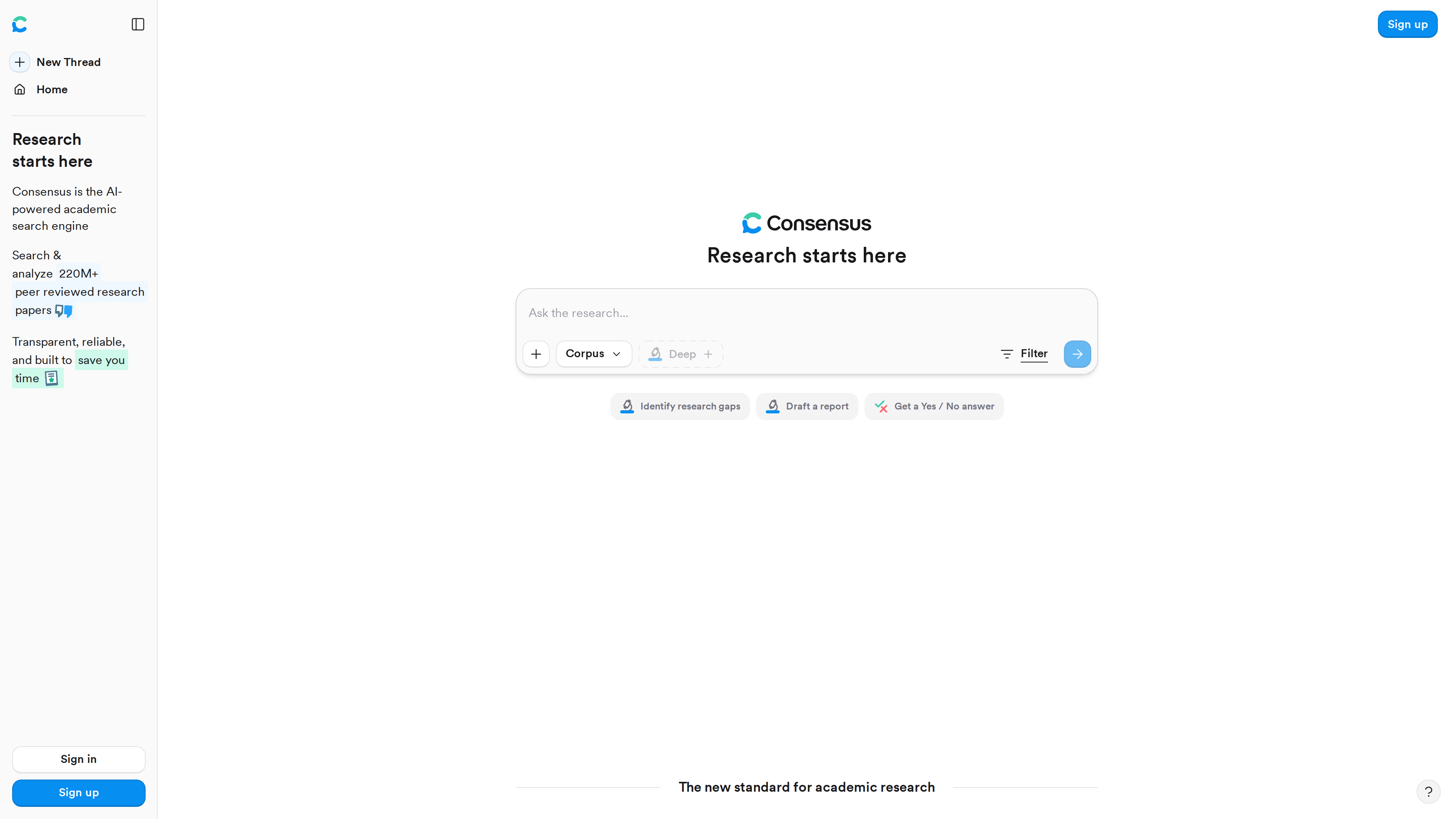
Consensus is an AI academic search engine, launched in 2021, that helps researchers, students, and clinicians find, understand, and synthesize scientific literature. It works by first retrieving real papers from a database of over 220 million peer-reviewed research papers, then having AI generate answers grounded in those papers with citations. The company describes its difference from general AI tools as "searching the scientific literature first and grounding its answers in real research papers," and states that it says so explicitly when the evidence is insufficient rather than filling gaps with outside information (How Consensus Works).
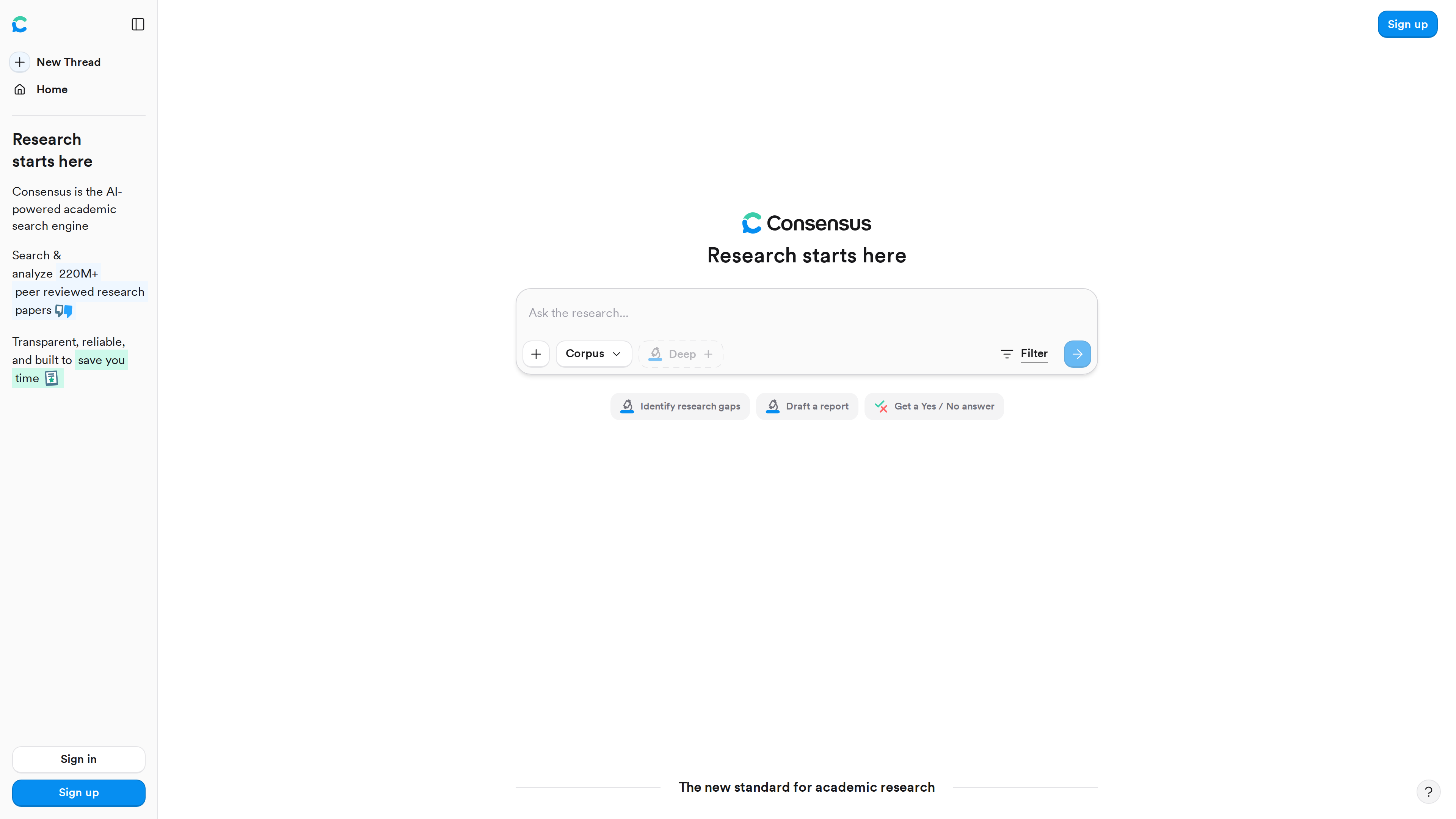
Site Overview
| Item | Details |
|---|---|
| URL | https://consensus.app/ |
| Type | AI academic research search engine (web application) |
| Pricing | Free tier 12/mo billed annually; Deep at $45/mo billed annually (as of 2026-09-30, details below) |
| Registration | The free tier assumes a registered account (pricing page CTA is "Try for free") |
| Interface language | English (the website, product UI, and help center are all in English; no official multilingual interface setting was found) |
Background
- Founding and team: Founded in 2021 by Christian Salem and Eric Olson, who were Division 1 athlete teammates and both come from families of scientists and teachers. Olson is CEO and Salem is CPO; the site lists roughly 25 team members across engineering, search, machine learning, and growth. The company began as remote-first and is now headquartered in San Francisco.
- Funding: The About page discloses $45M raised from Union Square Ventures, GreatPoint Ventures, Nat Friedman, and Daniel Gross; no rounds or dates are disclosed.
- Advisors: Nicholas Christakis (Yale University), Layne Norton (evidence-based health), Stephen Wolfram (Wolfram Alpha), Jevin West (metascience), and Konrad Kording (deep learning) (source).
- Scale (as of 2026-09-30, official figures): over 10 million researcher, student, and clinician users from 12,500+ universities; 20M+ papers shared and 150M+ research questions processed. The homepage also states that more than 170 university libraries partner with Consensus to provide access. Note: the pricing page testimonial section still says "Over 5 million researchers," which is inconsistent with the homepage/About figures and appears to be outdated copy (pricing page).
Core Capabilities
AI Paper Search with Cited Synthesis
- Search methods: Hybrid retrieval supporting natural-language questions, keywords, Boolean operators, titles, authors, and DOIs. The official workflow is: broad retrieval → refinement by quality signals (relevance, citations, journal impact, recency) → re-ranking of the top 20 papers, which AI then reads, extracts from, compares, and synthesizes (How Consensus Works).
- Data sources: A base layer of abstracts and metadata from Semantic Scholar, OpenAlex, and PubMed (including the full PubMed corpus of 37M+ biomedical records); a middle layer of all open-access full text; and a top layer of licensed paywalled full text from partner publishers, plus Consensus's own crawling. The database is updated weekly. The company says it "covers all domains and fields of science—from astronomy to sociology to biochemistry." Two official figures exist for corpus size: 220M+ in the help center versus 250M+ in homepage marketing copy (as of 2026-09-30).
- Traceable citations: Every AI synthesis carries citations; citation cards show the exact cited sentence from the paper and highlight it in the PDF. "Checker models" verify paper relevance before summaries are generated (Responsible AI & Limitations).
- Copyright handling: Licensed paywalled full text is used only for in-platform AI analysis (summaries, tables, etc.); reading or downloading the original article still depends on the user's own institutional or personal subscription—the platform does not bypass paywalls. Retracted papers carry a "⚠️RETRACTED" badge and are never used in analysis or summaries (Consensus Research Database).
Consensus Measurement and Deep Review (Consensus Meter / Deep Review)
- Consensus Meter: For yes/no questions, AI classifies the conclusions of the top 20 papers returned by a single search into a visual breakdown of Yes / No / Possibly / Mixed. A "Consensus Meter Snapshot" summarizes the positions on each side with four quality metrics (The Consensus Meter).
- Deep Search / Deep Review: Deep Search builds a comprehensive search strategy—expanding key terms, identifying conflicting arguments, and exploring the citation graph. Deep Review performs an in-depth synthesis of 50–100 papers and is metered per month in the subscription tiers (source).
Research Toolchain and Recent Updates
- Key features listed in the help center include: Research Agent (a multi-step research agent), My Library (paper collections), Advanced Search Filters (specify date ranges, populations, and study designs in prompts), Chat with Full Text (Q&A over a single paper, a collection, or uploaded documents), and Citation Graph (How Consensus Works).
- Medical filtering: results can be restricted to about 50,000 clinical guidelines and 8 million articles from the top 1,000 medical journals.
- September 2026 official blog activity: figures from cited papers shown directly in results (Sep 24); launch of Research Gaps Matrix (Sep 22); a partnership announcement with AAAS (Sep 21); and a "Summer '26" product update roundup (Sep 9) (Consensus blog).
Accounts and Open Capabilities
Subscription Pricing (as of 2026-09-30)
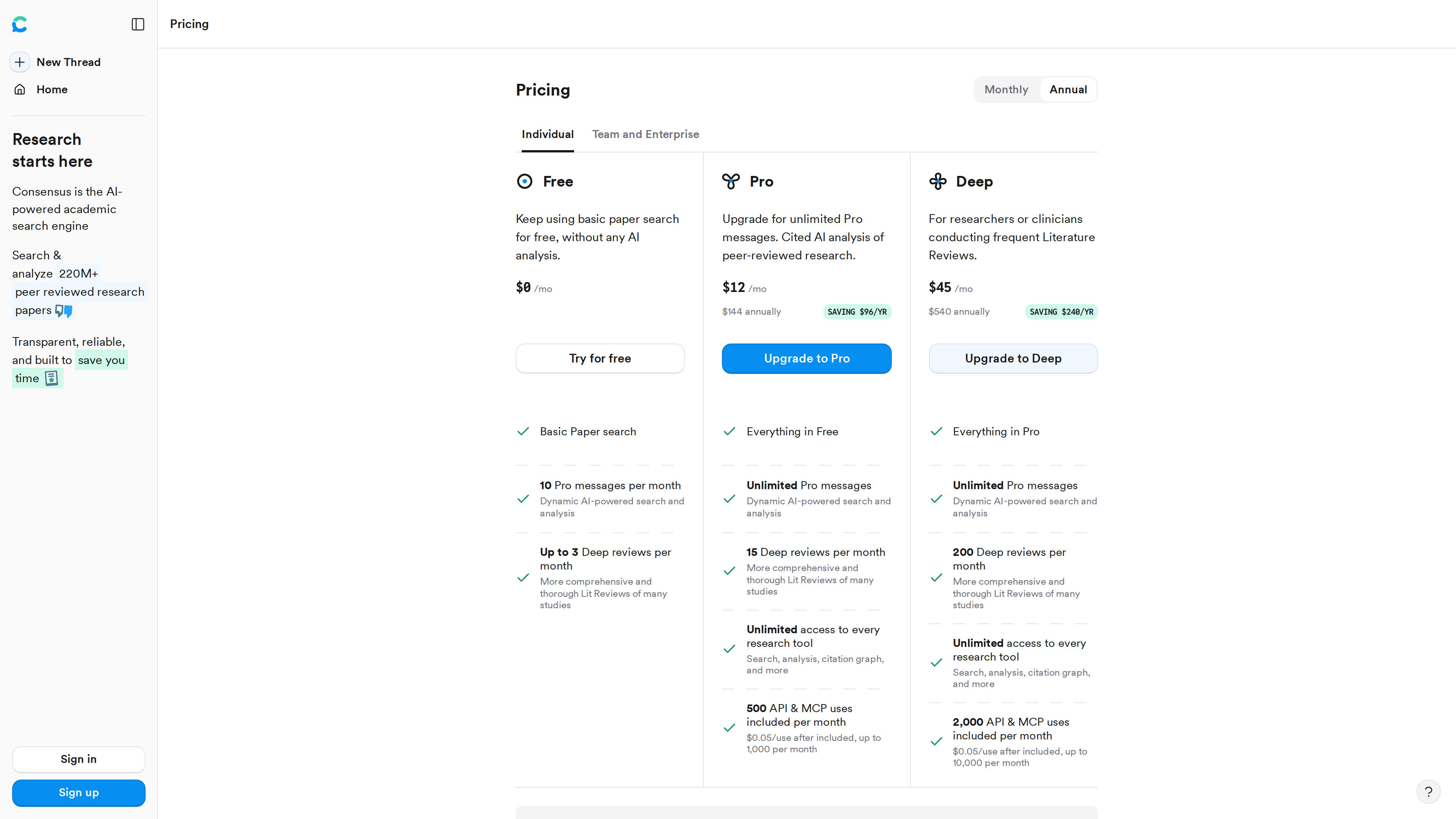
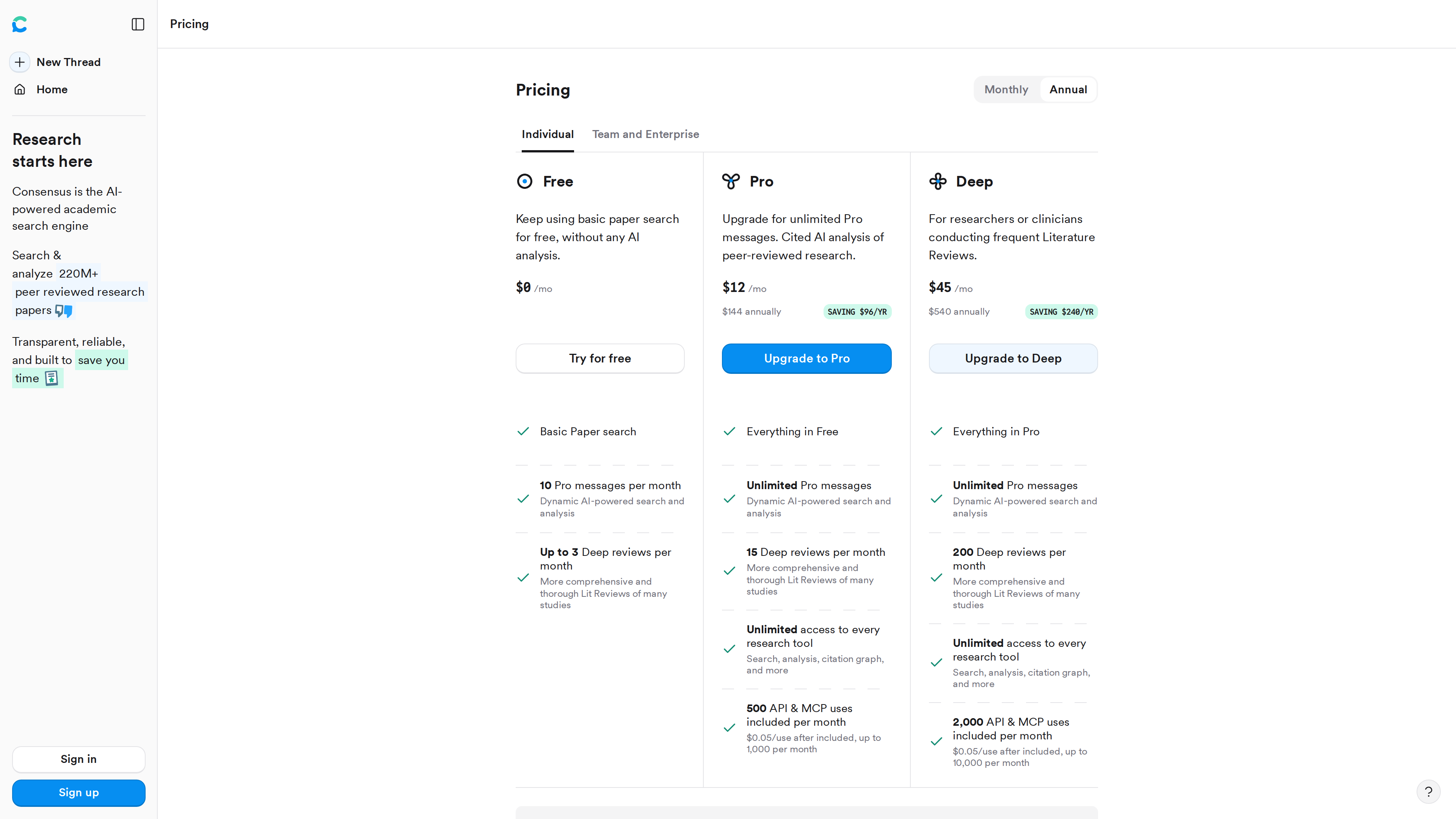
The following are the annual-billing (Annual) rates from the Individual tab of the pricing page:
| Tier | Price | Main allowances |
|---|---|---|
| Free | $0/mo | Basic paper search (no AI analysis); 10 Pro messages per month; up to 3 Deep reviews per month |
| Pro | 144/yr, labeled "Saving $96/yr") | Unlimited Pro messages; 15 Deep reviews per month; unlimited access to all research tools; 500 API & MCP calls per month ($0.05/call beyond, capped at 1,000/month) |
| Deep | 540/yr, labeled "Saving $240/yr") | 200 Deep reviews per month; 2,000 API & MCP calls per month ($0.05/call beyond, capped at 10,000/month); aimed at researchers or clinicians who run frequent literature reviews |
- Education/healthcare discounts: Students and faculty with a valid school email, and US healthcare professionals with a valid NPI number, can get up to 40% off a subscription; .edu/.ac email verification or manual email verification is supported.
- Teams/Enterprise: Official copy says Teams plans offer volume discounts for up to 200 seats; larger deployments or enterprise features require contacting sales (pricing page).
API, MCP, and Third-Party Integrations
- API and MCP: Paid tiers include "API & MCP uses" quotas (see table above). API keys can be created in the product, with usage tracking and API documentation. Each call covers at most 100 papers; additional papers are billed as one call per 100 papers (pricing page).
- ChatGPT integration: Consensus runs as an app inside ChatGPT, letting users search the paper corpus and generate cited reviews in conversation. The company says it works on all ChatGPT plans and is compatible with the Consensus free tier; it can also serve as a data source for ChatGPT Deep Research (a different feature from the in-site Deep Review) (Consensus in ChatGPT).
- Claude and Microsoft 365 Copilot: A September 14, 2026 blog post announced that Consensus runs inside ChatGPT, Claude, and Microsoft 365 Copilot (Consensus blog).
- Platform: The core product is a web application.
When It Fits
- Quick evidence checks on yes/no questions: For questions like "does this intervention work," Consensus Meter shows the distribution of conclusions across the top 20 papers, with a Snapshot summarizing positions and quality metrics.
- Getting started on a literature review: Deep Review synthesizes 50–100 papers at once, useful for scoping a topic or the early stage of a systematic review; precise retrieval via DOI, author, and Boolean operators is supported throughout.
- Medical and clinical lookup: Results can be restricted to clinical guidelines and top medical journals, fitting evidence-based medicine Q&A scenarios.
- Searching literature inside existing AI workflows: Users already working in ChatGPT, Claude, or Microsoft 365 Copilot can invoke Consensus directly in conversation.
- Programmatic access: Developers can wire paper search and analysis into their own systems via the API/MCP, billed per call (each call covers up to 100 papers).
Limitations
- Non-exhaustive coverage: The company explicitly acknowledges "we do not have access to ALL research," and describes the 220M+ corpus as "a snapshot of relevant research, not a complete review of all research on a question" (Responsible AI & Limitations).
- AI misreading risk: The company cautions that "no AI is perfect… Sometimes a model can misinterpret a paper and summarize it incorrectly," so claims should still be checked against the original text (source).
- Limited full-text access: Not every paper has full text available; without it, analysis relies on abstracts and metadata only. Reading paywalled originals still requires the user's own institutional or personal subscription (Consensus Research Database).
- Consensus Meter sample size: Its classification is based only on the top 20 papers from a single search; the official documentation includes a dedicated "Limitations" section (The Consensus Meter).
- Inconsistent official figures: Corpus size appears as both 220M+ (help center) and 250M+ (homepage); user counts appear as 5M+ (pricing page) and 10M+ (About page). When citing numbers, note which page they come from.
- Interface language: The website, product UI, and help center are all in English; no official multilingual interface setting was found.
Comparable Services
This profile only verified Consensus's official pages and did not crawl competitor sites. The points below are limited to positioning differences supported by Consensus's own materials; competitor-side facts were not verified.
- Versus general AI tools (e.g., ChatGPT used directly): Consensus's distinction is "search the literature first, then generate," with answers anchored to real, citable peer-reviewed papers and explicit acknowledgment when evidence is insufficient; at the same time, Consensus itself runs as an app inside ChatGPT (How Consensus Works).
- Versus traditional academic search (Google Scholar, Semantic Scholar): Consensus layers AI synthesis (Pro messages), literature reviews (Deep Review), consensus visualization (Consensus Meter), a citation graph, and full-text Q&A on top of retrieval, and charges subscription fees based on AI usage (Free/Pro/Deep). Semantic Scholar is also a data partner rather than a pure competitor—Consensus's abstract/metadata layer and full PubMed ingestion come via Semantic Scholar and its publishing partners (Consensus Research Database).
- Versus AI literature tools such as Elicit: Competitor-side claims were not verified in this round, so no comparison conclusion is offered.
References
- Consensus homepage: https://consensus.app/
- About page: https://consensus.app/home/about-us/
- Pricing page: https://consensus.app/pricing/
- How Consensus Works: https://help.consensus.app/en/articles/9922673-how-consensus-works
- Consensus Research Database: https://help.consensus.app/en/articles/10055108-consensus-research-database
- The Consensus Meter: https://help.consensus.app/en/articles/10069920-understanding-the-consensus-meter
- Consensus in ChatGPT: https://help.consensus.app/en/articles/10059020-consensus-in-chatgpt
- Responsible AI & Limitations: https://help.consensus.app/en/articles/10083353-responsible-ai-limitations
- Consensus blog: https://consensus.app/blog/