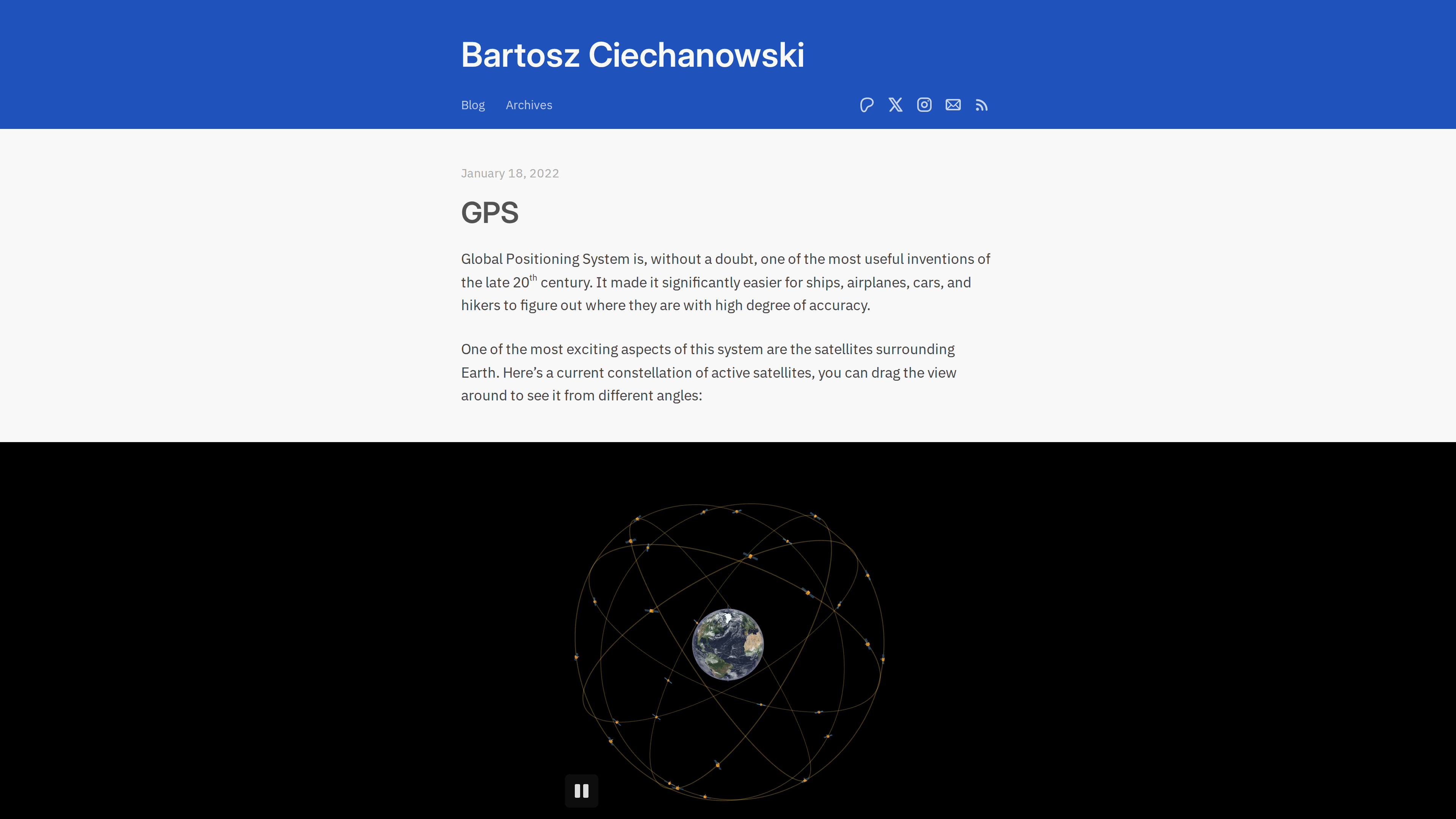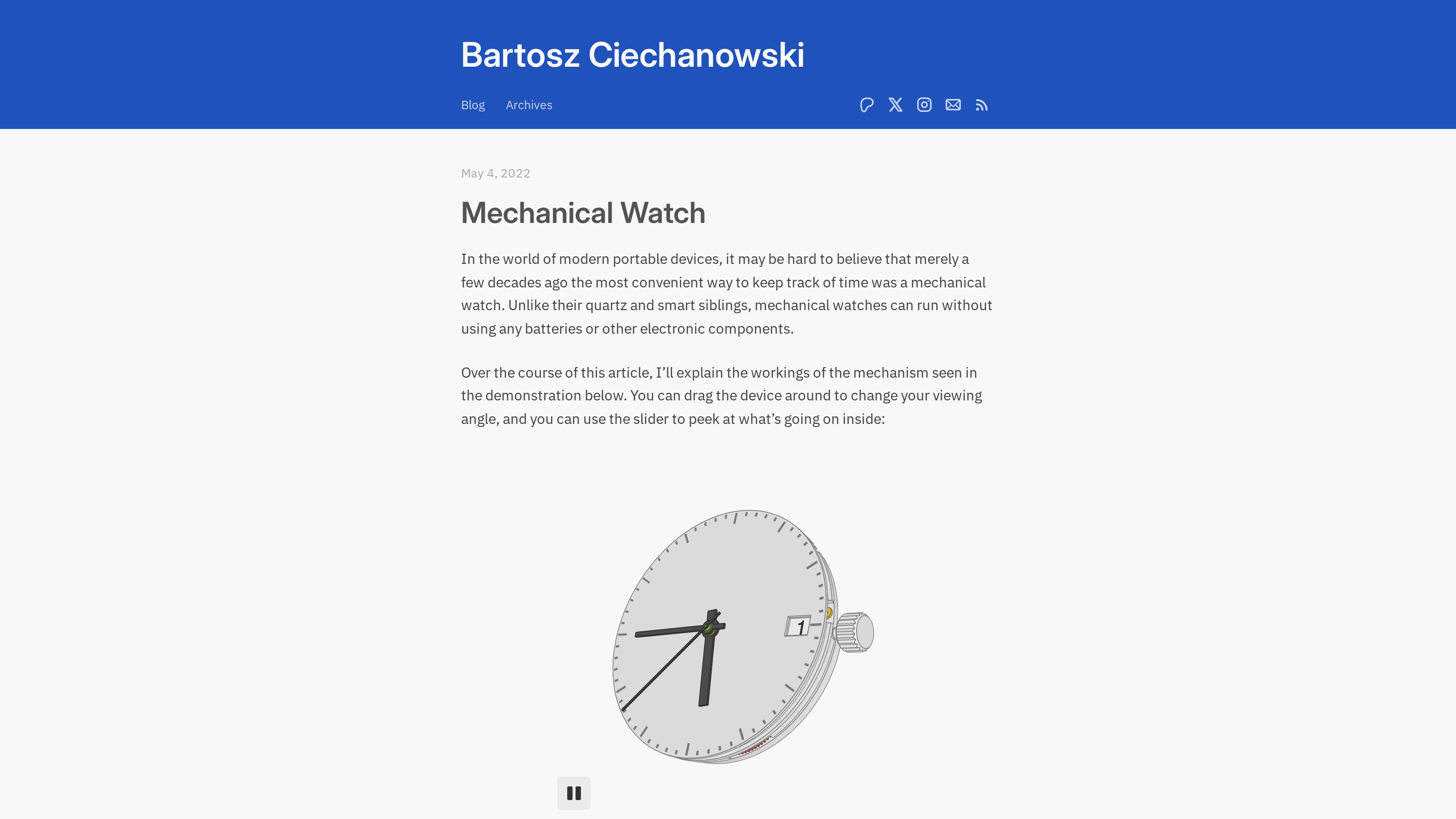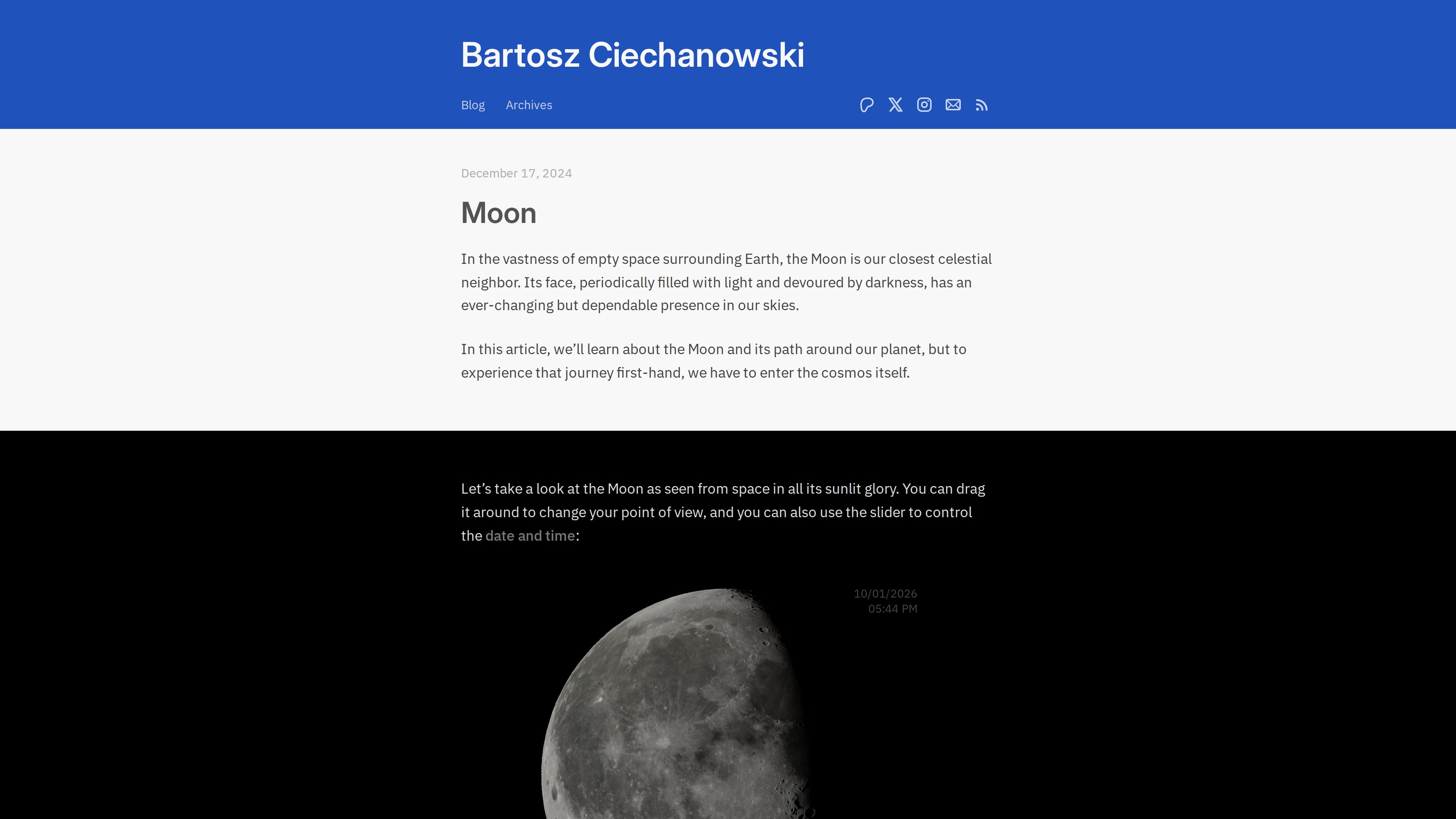
Bartosz Ciechanowski is the personal site of a Polish software engineer who publishes long technical essays built around interactive simulations. Unlike conventional illustrated explainers, nearly every concept here comes with a simulator you can manipulate directly: a mechanical watch movement you can rotate and disassemble, a model of the Moon you can scrub through time, a live constellation of GPS satellites. According to the official archive, the site has been publishing since January 2014, with more than twenty long-form essays as of December 2024.
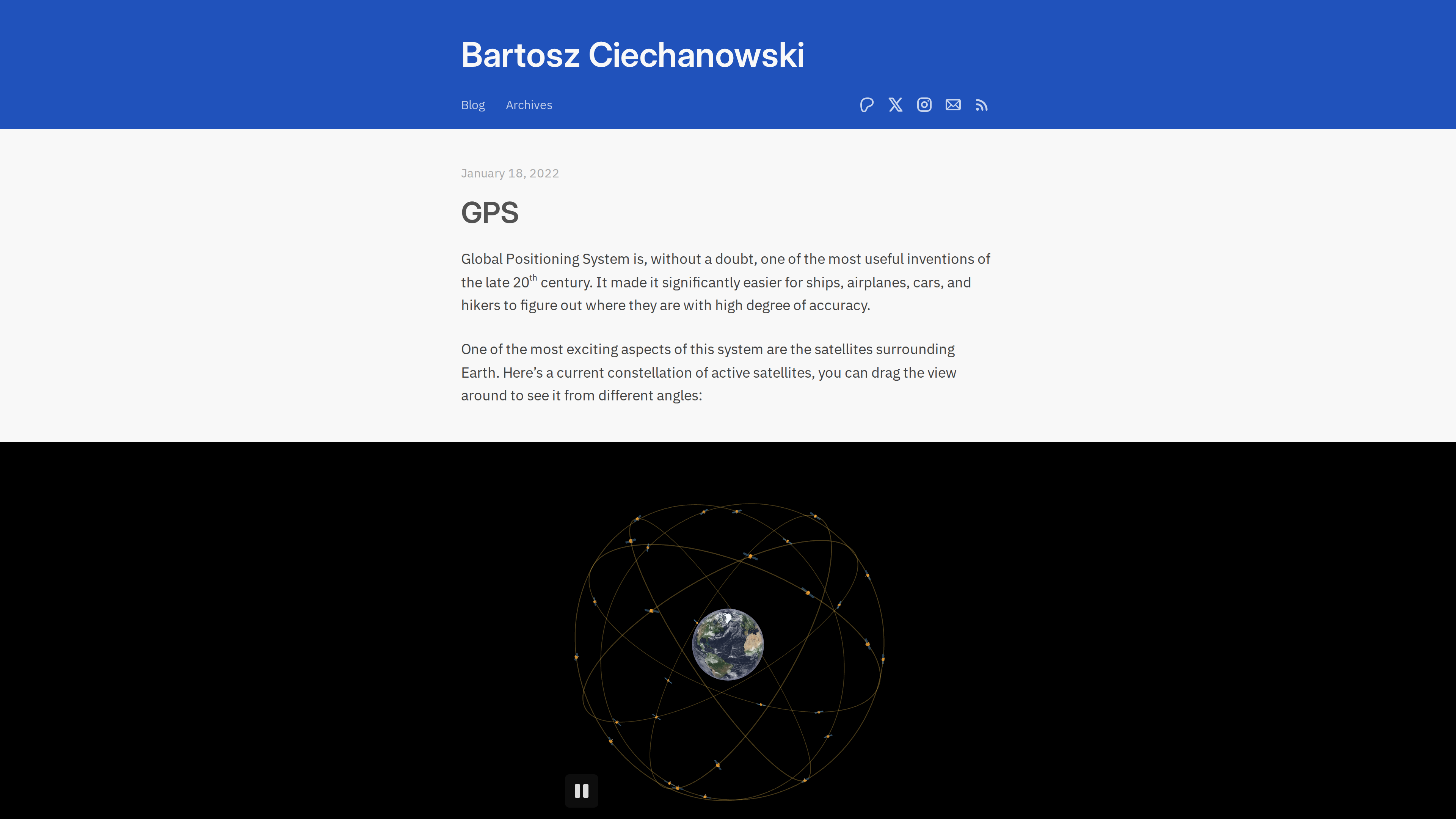
At a Glance
| Item | Details (as of 2026-09-30) |
|---|---|
| URL | ciechanow.ski |
| Type | Personal interactive technical essays |
| Cost | Free; the author accepts voluntary support via Patreon |
| Account | None required |
| Language | English only |
Background
Bartosz Ciechanowski is a Polish software engineer. The site's earliest posts (around 2014) dissected iOS/macOS internals such as the implementation of NSMutableArray. From 2019 it shifted toward interactive explainers for a general audience — the breakout piece was the January 2019 floating-point exposé. The current style pairs narrative prose with custom-built WebGL/Canvas simulations so readers can verify each idea by playing with it. The author is supported by readers on Patreon, where he also publishes post-mortems on how each article was made.
Content and Reading Experience
The archive lists every essay by year. Recent highlights include:
- GPS (2022-01): from satellite constellations and signal travel to trilateration and error sources;
- Mechanical Watch (2022-05): a watch taken apart into mainspring, gear train and escapement;
- Internal Combustion Engine (2021-04): the four-stroke cycle, valve train and ignition timing in 3D;
- Sound (2022-10): vibration, waveforms, sampling and the Fourier transform;
- Moon (2024-12): phases, tides and eclipses, with a sky simulation that can be localized to your coordinates;
- Bicycle (2023-03) and Airfoil (2024-02): bicycle dynamics and wing lift.
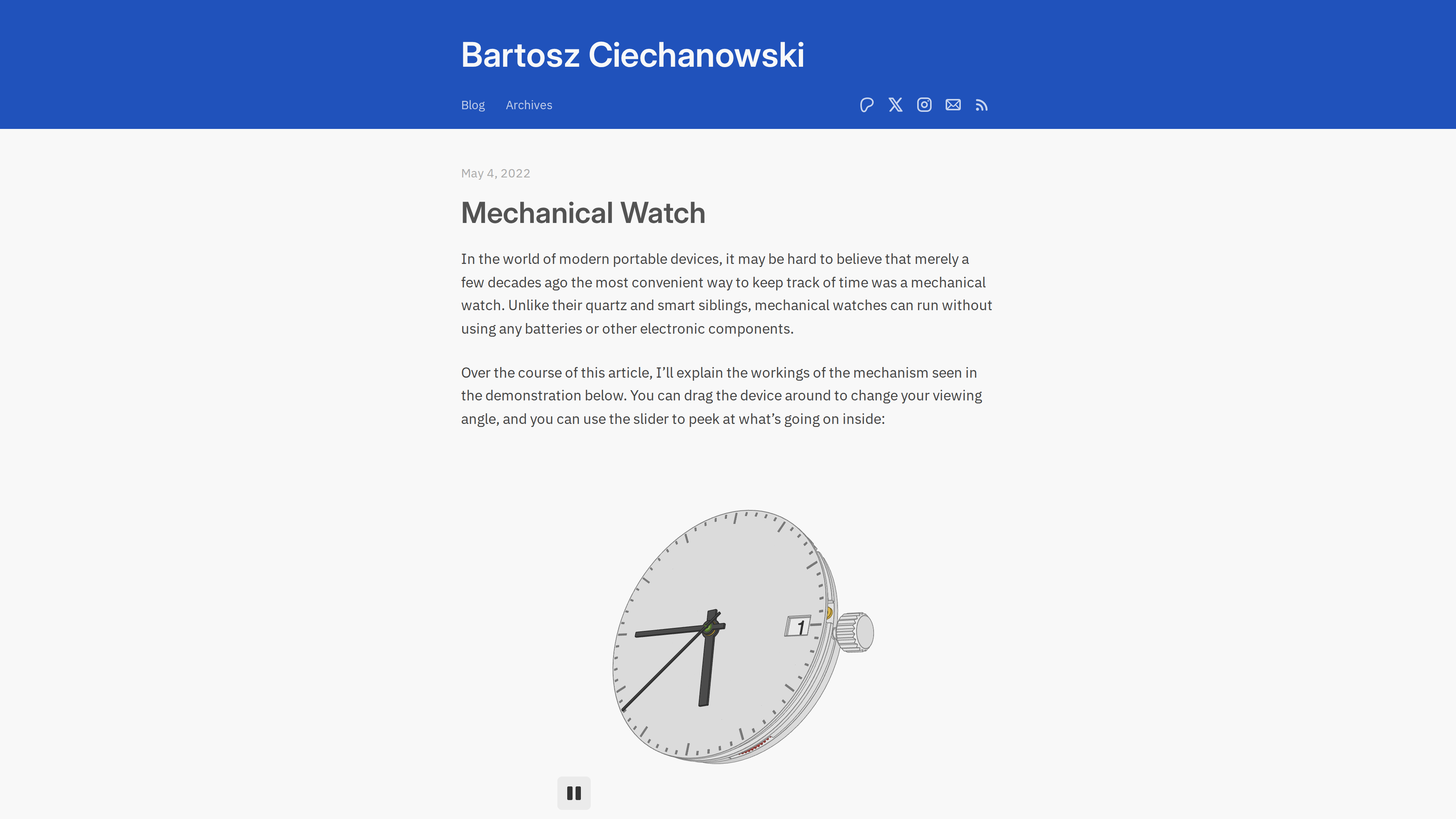
Everything is free, account-free and runs in the browser — nothing to install.
Good For
- Readers who want to genuinely understand an everyday system (GPS, watches, engines) rather than memorize vocabulary;
- Teachers and creators looking for high-quality visualization references and explanatory patterns;
- Front-end and graphics developers studying the craft of interactive explanation.
Limitations
- Slow cadence: roughly one or two essays per year recently — not a site to follow for frequent updates.
- English only, and the essays are long with dense terminology.
- The real-time 3D simulations demand reasonable GPU power; older phones may struggle (an inference from how the pages are built, not tested on low-end hardware).
- No comments or community features.