Carrd is a no-code platform for building one-page websites. Without even creating an account, you can open the editor, start from a template or a blank page, drag elements into place, and publish a site that adapts to phones and desktops automatically — hosted on a Carrd subdomain or your own domain. Unlike full-featured builders such as Wix or Squarespace, Carrd deliberately does just one page: personal profiles, landing pages, signup forms, small portfolios. The payoff is a near-flat learning curve and unusually low pricing — the free plan covers three sites, and paid Pro plans start at $9 per year (as of 2026-09-29, source: Go Pro!). The platform is operated by US company Carrd Inc., launched in March 2016, and is still actively maintained (latest changelog entry: 2026-09-28, source: Changelog).
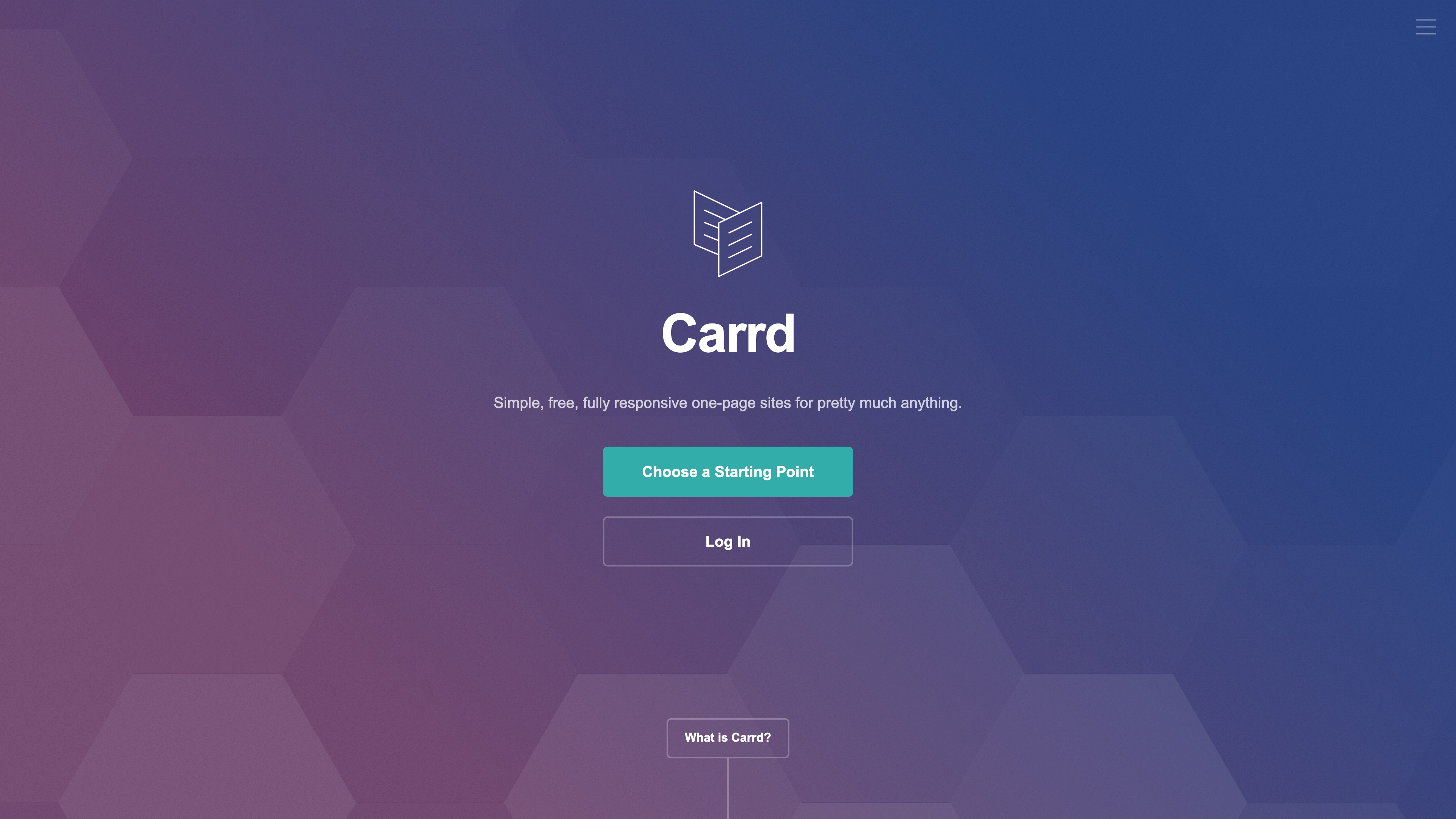
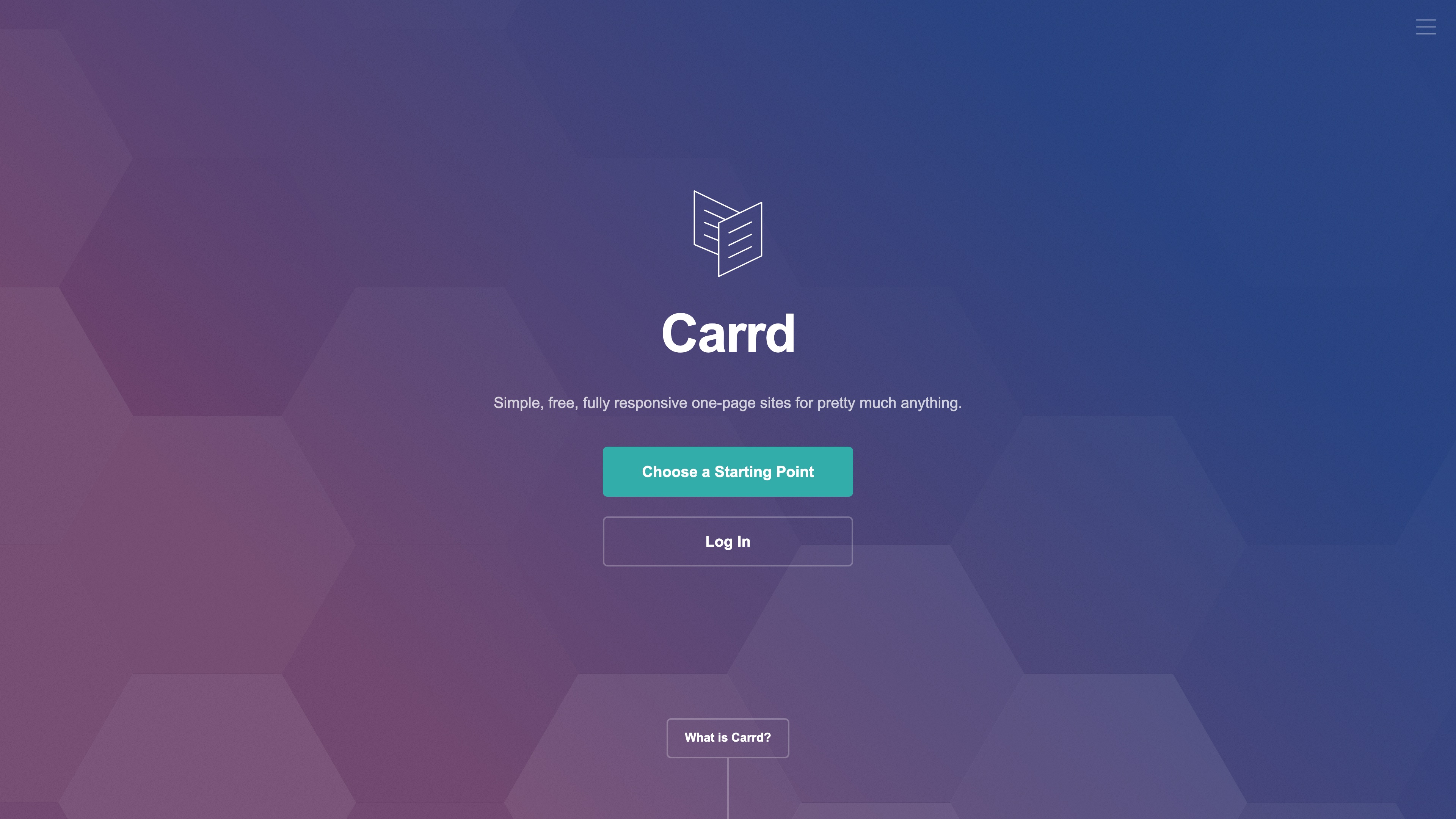
The screenshot above shows Carrd's homepage (captured 2026-09-29). It makes the whole pitch in one line — "Simple, free, fully responsive one-page sites for pretty much anything" — with two ways in: "Choose a Starting Point" takes you straight into the template picker with no signup required; registration only becomes necessary when you actually publish a site.
At a Glance
- URL: https://carrd.com/ (carrd.co now redirects to carrd.com; published user sites still live on carrd.co and other Carrd subdomains)
- Type: No-code one-page website builder and hosting platform (SaaS)
- Cost: Free for up to 3 sites with a "Made with Carrd" footer; Pro Lite from 19/yr, Pro Plus from $49/yr (as of 2026-09-29)
- Signup: Not required to try the builder; publishing requires an account (email + password). You must be 18 or older to register; ages 13–17 require a parent or guardian's approval; under 13 may not use the service (source: Terms of Use)
- Interface language: English only (the language of the sites you build can be set separately in the publish settings)
- Operator: Carrd Inc., a Delaware corporation; founder AJ is based in Nashville, Tennessee
Background
Carrd is the work of indie developer AJ (@ajlkn), previously known for the free template site HTML5 UP and the paid template marketplace Pixelarity. He started Carrd around 2015 as a side project. Knowing a solo developer could never match Wix or Squarespace feature for feature, he deliberately narrowed the scope to a single niche: one-page personal profile sites (source: Carrd: The Making Of).
Key milestones:
- March 7, 2016: AJ launched Carrd with a tweet; on March 16, 2016 it was featured on Product Hunt and finished the day as the #1 tech product with over 1,000 upvotes (sources: Carrd: The Making Of, AJ's pinned tweet).
- March 2017 (one year in): 10,000+ sites, 10,000+ users, and 900+ Pro upgrades (source: Carrd: The Making Of).
- 2020: Carrd surged with the "link in bio" trend — the single URL people put in their social media profiles. The Verge reported in September 2020 that Carrd was running 1 million sites, with 80,000 sign-ups in three months tied to Black Lives Matter resource pages alone.
- April 2021: In an Indie Hackers AMA, AJ reported 2.5 million sites created by 1.6 million users, over $1M in annual recurring revenue, and more than 10,000 new sites per day. By then Carrd had become Carrd Inc. and taken on some VC funding, while the team remained just two people: AJ (development and product) and Doni (operations).
No newer scale figures have been published since, but the changelog shows steady iteration: between July and September 2026 alone, Carrd added four templates (#321–#324), an elements panel, and IFRAME embedding controls for published sites.
Templates and the Builder
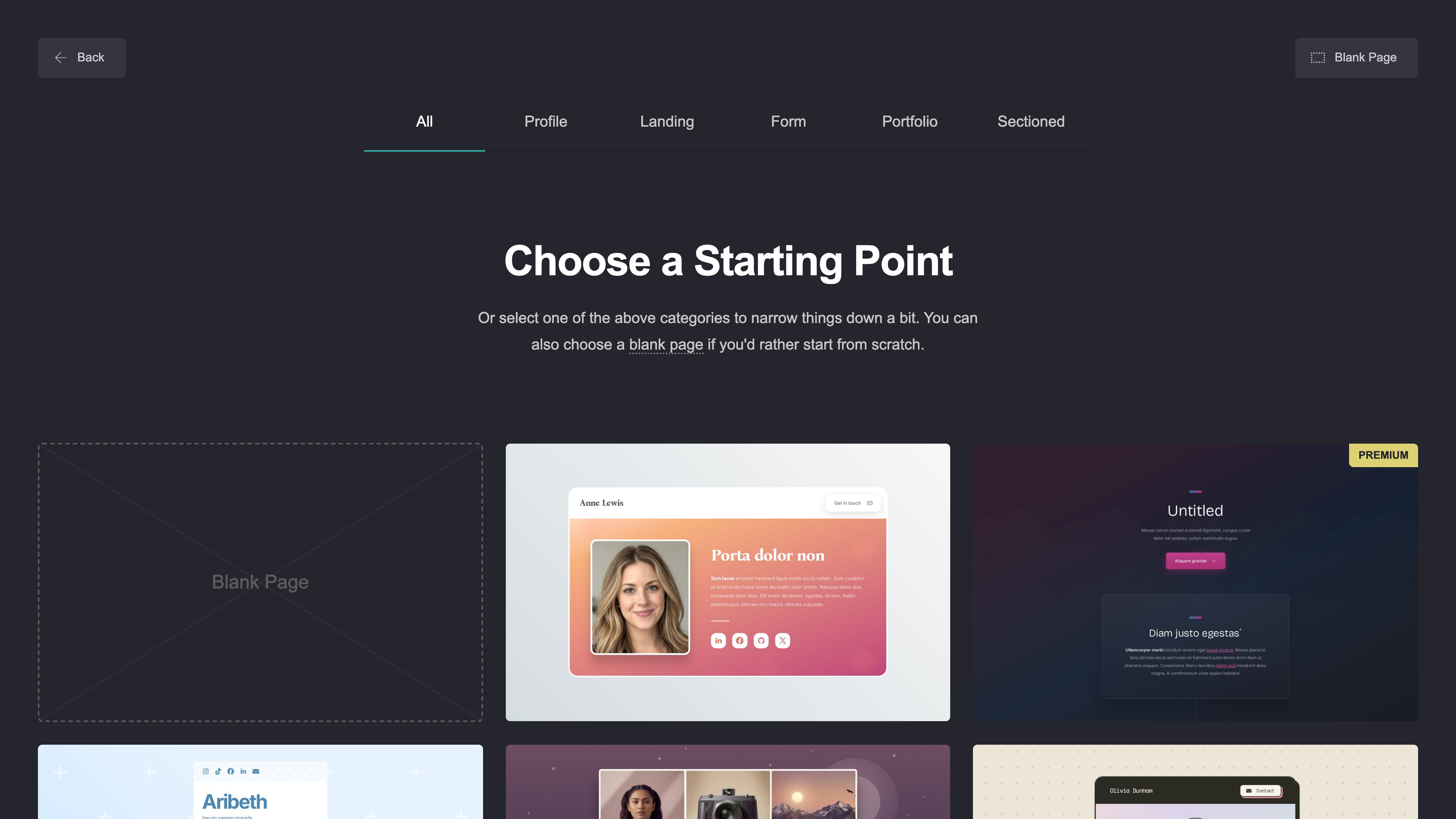
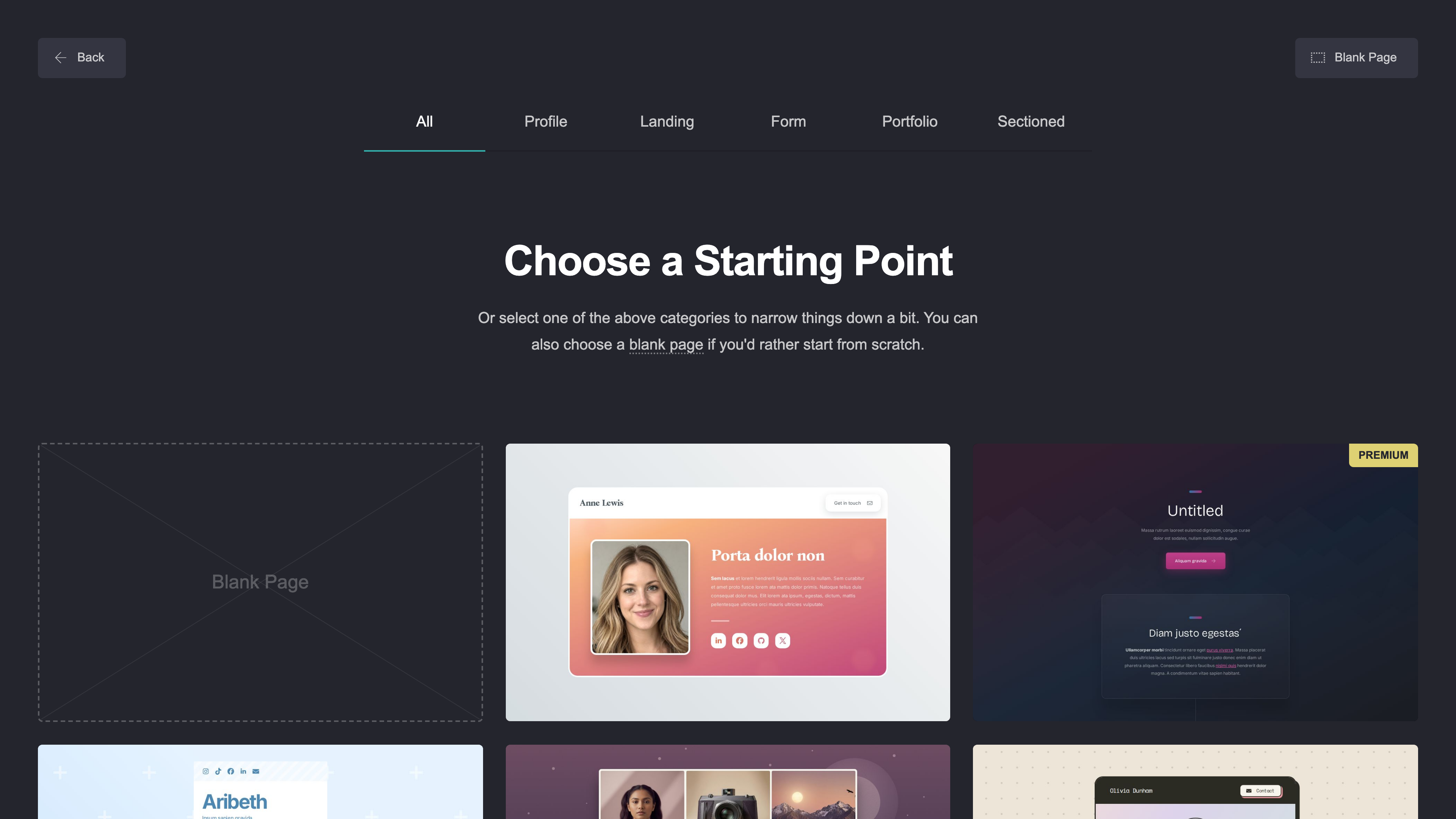
Every site starts from a "starting point." The screenshot above shows the template gallery (captured 2026-09-29): as of that date it held 324 templates in five categories — Profile (146), Landing (102), Form (34), Portfolio (27), and Sectioned (15) — plus a blank page for starting from scratch. Templates with a "PREMIUM" badge are Pro-exclusive; either way, a template is just an initial layout, and every element can be changed or removed.
The builder itself has three parts (source: Builder Overview): a live-preview canvas, a properties panel that appears when you click an element (content, appearance, animation, and advanced settings), and a menu bar for actions. Element types cover text, images, icons, buttons, up to four-column layouts, galleries, slideshows, audio, video, forms, and dividers; the site background can be a solid color, gradient, image, or video. Text supports Markdown formatting, and a page can be broken into Sections that act like pseudo-pages with anchor-style navigation via scroll points — Carrd's way of simulating a multi-page site within its one-page constraint.
Forms, Embeds, and Publishing
Forms are what lifts Carrd beyond a static business card, though they require a paid plan:
- Signup forms (Pro Standard and up): send visitor names and emails straight into 21 email marketing services, including Mailchimp, Kit, beehiiv, Brevo, Buttondown, EmailOctopus, GetResponse, Ghost, HubSpot, Klaviyo, Loops, MailerLite, Mailjet, Omnisend, Resend, Sender, SendFox, SendGrid, Sendy, and ActiveCampaign (source: Setting up a Signup Form).
- Payment-enabled forms (Pro Plus and up): insert a Stripe Checkout step into form submission, enabling order pages or paid newsletters (source: Setting up Payments).
- Third-party embeds (Pro Standard and up): custom HTML/CSS/JS, IFRAMEs, and widgets from services like Stripe, PayPal, Gumroad, and Typeform.
For publishing, free sites live on Carrd subdomains — the terms list the domain extensions carrd.co, carrd.com, crd.co, drr.ac, ju.mp, and uwu.ai. Pro Lite unlocks less Carrd-branded extensions such as crd.co; pointing a custom domain at a site, with SSL certificates handled via Let's Encrypt, requires Pro Standard or higher (sources: Terms, Go Pro!). Pro Plus can also download a site's unminified HTML/CSS/JS for hosting elsewhere (source: Sites documentation).

The screenshot above shows the official demo site johnsmith-demo.carrd.co (captured 2026-09-29) — a typical Carrd product: a full-screen background photo with a name, a one-line bio, a short paragraph, and social icon links.
Free vs. Pro
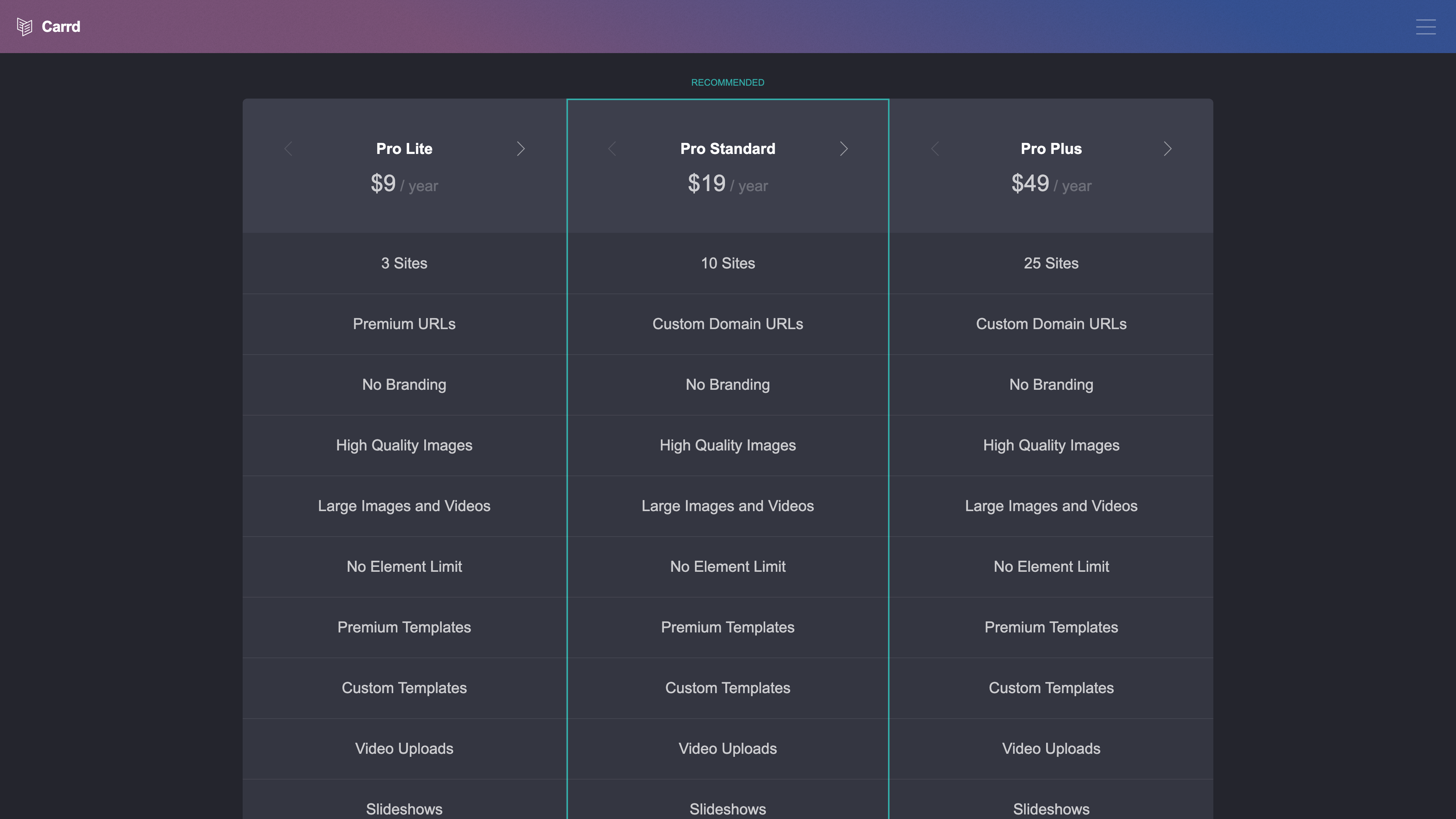
The screenshot above shows the plan comparison table (captured 2026-09-29). The full pricing structure as of that date (source: Go Pro!):
- Free: 3 sites, core features, "Made with Carrd" branding, Carrd subdomains only.
- Pro Lite: 14/yr (10), $29/yr (25). Removes branding and unlocks higher-quality images, larger uploads (16MB images/GIFs, 64MB videos), unlimited elements, premium and custom templates, video uploads, slideshows, site icons, share images, QR codes, and site transfers/sharing — but not custom domains, forms, or embeds.
- Pro Standard: from 599/yr (1,000 sites). Adds custom domains, forms, widgets and embeds, optional site analytics (Google Analytics, Plausible, Matomo, and more), meta tags, and locally served fonts.
- Pro Plus: from 999/yr (1,000 sites). Adds payment-enabled forms, advanced element settings, site source downloads, redirects, password protection, Variables for dynamic content, custom site files, IFRAME framing controls, and canonical URL settings.
Pro comes with a 7-day free trial — no credit card required. Payment is via PayPal or any major credit/debit card, with automatic yearly renewal or pay-as-you-go manual renewal (source: Go Pro!). Note that the Terms of Use state that account balances cannot be withdrawn and refunds are generally not offered unless required by law.
Accounts and Extensibility
Registration takes just an email address and a password (protected by reCAPTCHA). Within an account, sites can be organized into folders, archived, cloned, shared with other Carrd users for collaboration, or transferred to a different owner outright. Carrd does not offer a public developer API (as of 2026-09-29, the official documentation has no API section); extensibility comes from custom code embeds, third-party integrations, shareable custom templates, and site source downloads (Pro Plus). There is no official mobile app, but the builder itself is responsive and works in a phone browser.
Copyright and Content Policy
Under the Terms of Use (last updated 2024-07-31), users retain all rights to the content they upload, granting Carrd only the license needed to host and display it; a DMCA process is in place for copyright complaints (registered agent in Franklin, Tennessee). The Content Policy prohibits unlawful, threatening, defamatory, privacy-invading, and IP-infringing material. Pornographic content is generally not allowed, with an exception for adult-oriented artwork posted by the artist on their own site (for example, in a portfolio). "Thin affiliate sites" — pages with little original content that exist mainly to funnel visitors through affiliate links — are explicitly banned, as is hoarding or reselling Carrd subdomain URLs. Sites that violate the rules are marked Offline; owners can fix the issue and request a manual review.
Two further legal points worth knowing: disputes are governed by Tennessee law and subject to binding arbitration, and the Privacy Policy (last updated 2024-01-18) makes clear that each site owner — not Carrd — is responsible for the privacy practices of the sites they publish.
Good For
- Personal profile / business-card pages: one page with a bio, work links, and every social account — a more flexible alternative to dedicated link-in-bio tools;
- Landing pages for products, apps, or events: pair with a signup form to collect emails, or a payment form for simple checkout;
- Small portfolios for photographers and illustrators, with lightbox galleries built in;
- One-off information hubs: event pages and resource roundups (the thousands of BLM resource cards in 2020 were largely built on Carrd);
- Simple pages that need to stay online for free indefinitely: three free sites, no card required, and no signup needed just to try.
Limitations
- One page only. There is no native blog, CMS, or true multi-page structure — Sections are a visual workaround. Sites that need frequent content updates or deep page hierarchies are a poor fit.
- English-only interface, with no other language versions.
- The free plan is visibly constrained: 3 sites, official branding in the footer, and no custom domains — those start at Pro Standard ($19/yr).
- E-commerce stops at Stripe payment forms and third-party widgets; there is no cart, order management, or real store functionality.
- Templates are starting points, not switchable themes; there is no documented way to swap a site's template after building, so restyling is manual work.
- No official mobile app; editing on a phone relies on the browser.
- Refunds are generally not offered, and account balances cannot be withdrawn (source: Terms).
Comparable Services
- Linktree: focused purely on link-in-bio list pages; simpler to start with, but far less design freedom than Carrd (the same Verge report covers the industry context for both).
- Wix / Squarespace: full-featured multi-page website platforms with blogs, e-commerce, and marketing suites — an order of magnitude more expensive and complex than Carrd, and the better choice when you need more than one page.
References
- Carrd official site
- Go Pro! (pricing and plan comparison)
- Choose a Starting Point (template gallery)
- About Carrd
- Carrd: The Making Of (founder's retrospective)
- Carrd Documentation
- Content Policy
- Terms of Use
- Privacy Policy
- Changelog
- Link in bio: the scrappy startups that power them - The Verge
- AJ's Indie Hackers AMA (April 2021)