Capacities (capacities.io) is a note-taking and personal knowledge management app built by Capacities Labs GmbH, a small company in Freiburg, Germany. Its pitch is "a studio for your mind." The verifiable difference from Notion, Obsidian, and similar tools is the organizational model: in Capacities, everything you save is an object — a person, a book, a project, a meeting — and every object has a type, properties, and templates. Objects link to each other in any direction, forming a connected network of knowledge rather than a hierarchy of folders. The app has a genuinely usable free tier (the company promises in writing that the core product stays free forever), while the paid Pro plan adds an AI assistant, calendar integration, task management, and more. As of 2026-09-16, the homepage claims 50,000+ knowledge workers use it, alongside a Discord community of 10,000+ members and a Product Hunt Product of the Day win.
At a glance
- URL: https://capacities.io/
- Type: Object-based note-taking / personal knowledge management (PKM); available on macOS, Windows, Linux, iOS, Android, and the web (download page)
- Cost: Basic is free; Pro is 119.88/year (14.99/month or 12.49/month); the Plus AI add-on is about $8.33/month billed annually (official pricing as of 2026-09-16)
- Sign-up: An email account is required (terms require age 16+); content syncs through the cloud
- Interface languages: English and German only (official FAQ)
- Launched: Development started in 2020; the public changelog has run continuously since January 2022, and the product launched on Product Hunt in May 2023
Background
Capacities was founded by Steffen Bleher and Michael von Hohnhorst (surnames per the Impressum and the company's Crunchbase profile). The two met at university in Germany, studying computer science and electrical engineering, and were struck by the gap between the technologies they were learning about and the ones they were learning with — file exchange, monolithic documents, and folder hierarchies that don't match how people think. In 2020 they decided to build a better tool from scratch (founder's blog post, March 2024). The company, Capacities Labs GmbH, is registered in Freiburg im Breisgau, with Bleher as managing director.
How the company is run is a deliberate part of the product story. The principles page (November 2024) states the founders own 100% of the company, take no outside investment, and are "already 100% sustainable and funded by you" — the site footer additionally notes early support from Media Lab Bayern. The team page lists seven people working fully remote across Europe. In June 2024 the company even published a post answering "What if Capacities was gone tomorrow?" — promising that full data export will always be possible, and noting open-sourcing as a conceivable path (while explicitly making no promises).
On shipping cadence: the changelog has passed 70 numbered releases between January 2022 and September 2026, and the mobile apps arrived in July 2024 (Product Hunt record). The homepage also cites press coverage including Fast Company.
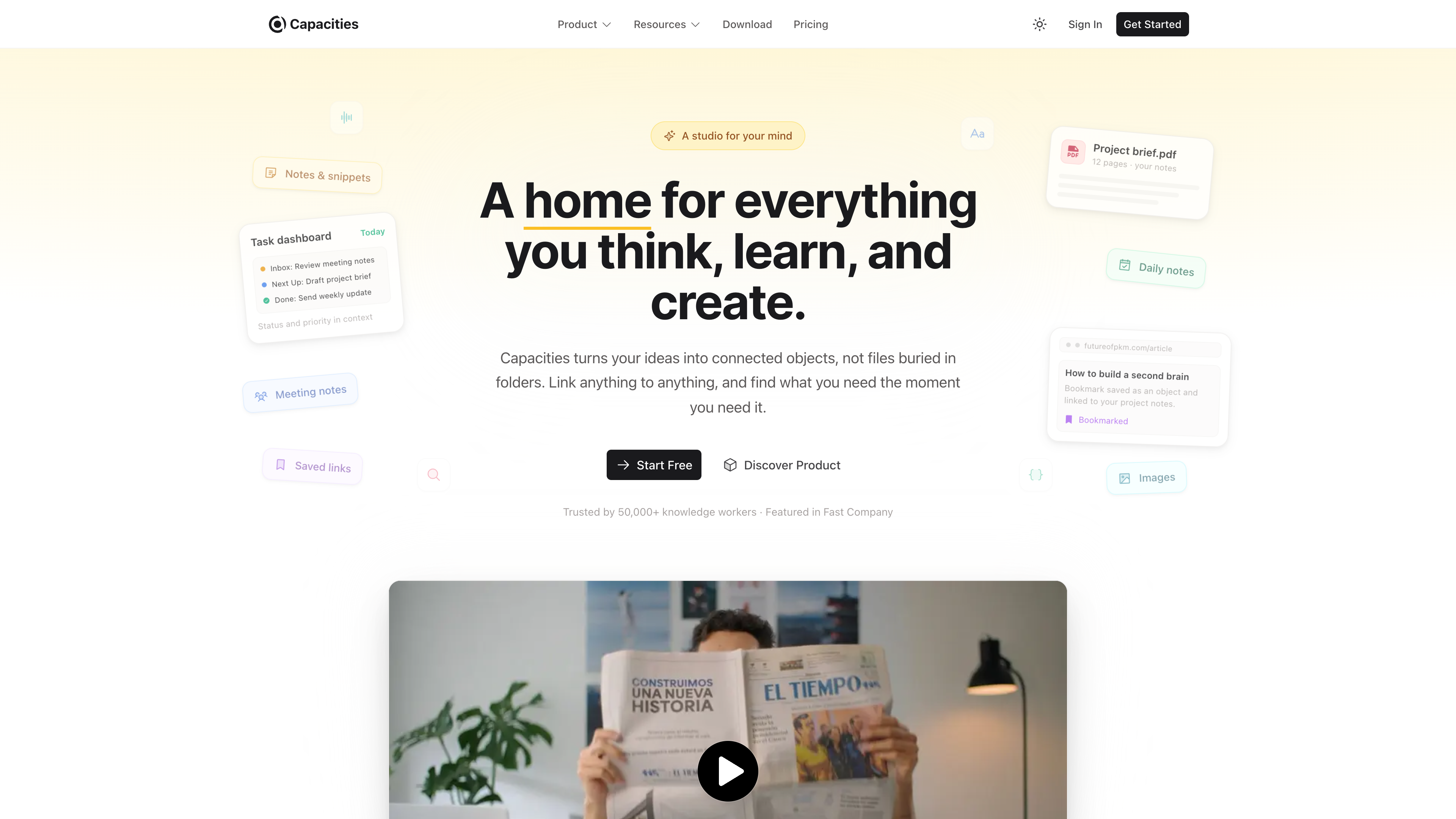
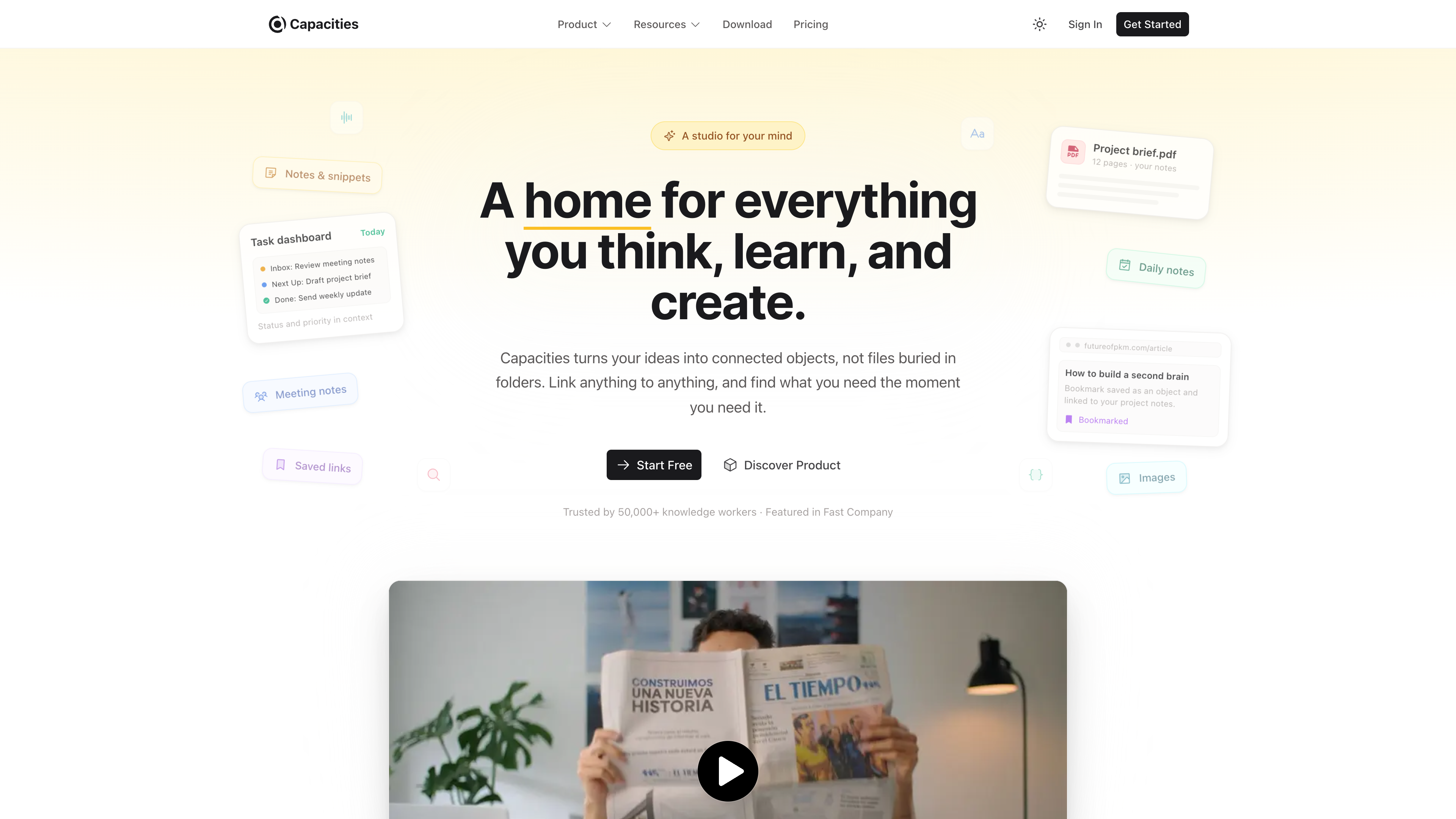
The homepage (captured 2026-09-16) states the positioning up front: a home for everything you think, learn, and create, where "ideas become connected objects, not files buried in folders." The floating cards around the hero — task dashboard, daily notes, PDF, weblinks, images — correspond to real object types in the app.
Core model: everything is an object
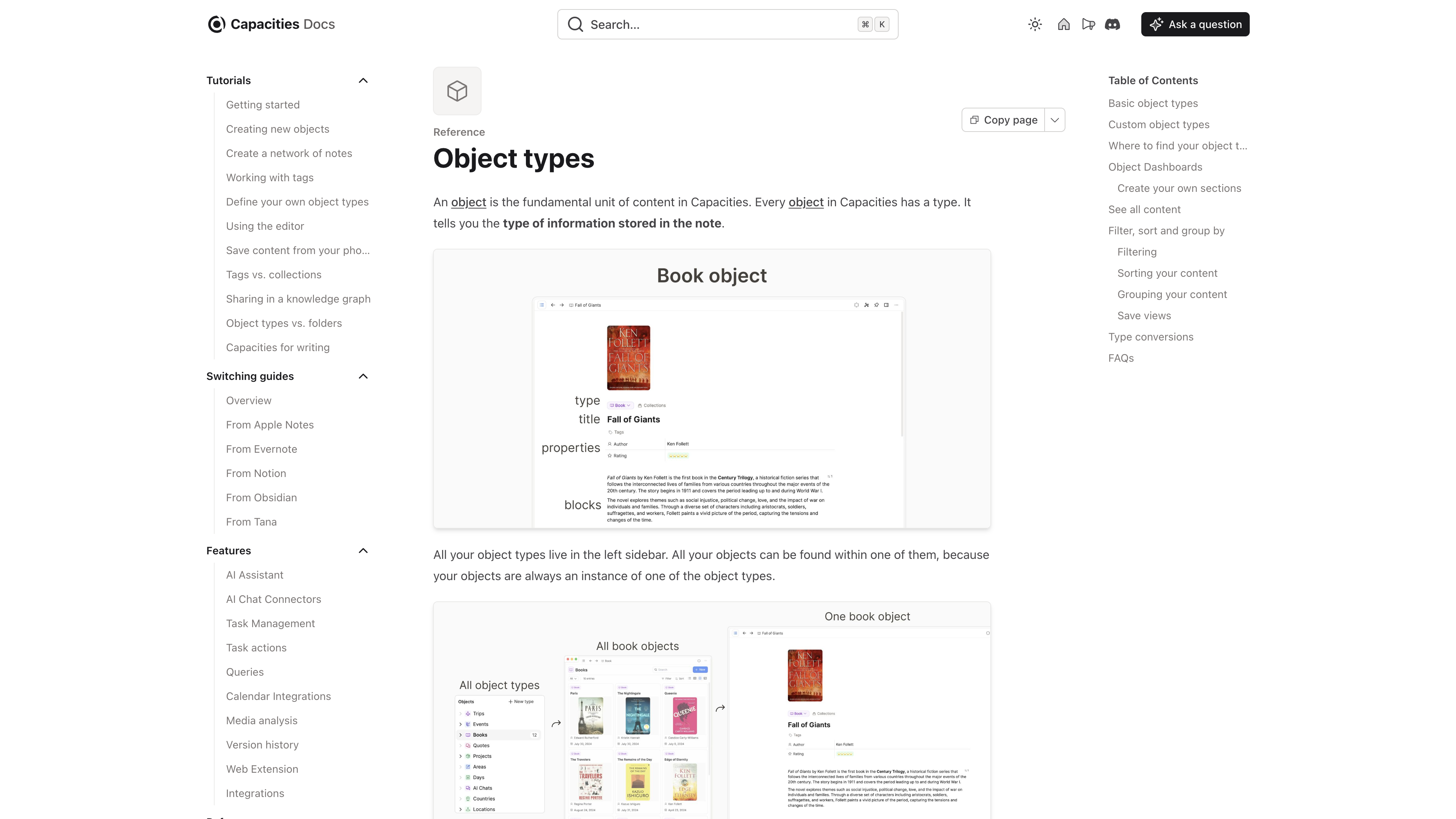
The object model is what separates Capacities from file-based note tools. You don't create "documents"; you create instances of a type: a Book, a Person, a Meeting. The type defines the object's structure — properties (author, rating, date, links…) and a block-based body — and objects connect to each other freely through links.
- Basic and custom object types: Built-in basic types include Page, Tag, Image, Weblink, Audio, PDF, File, Tweet, AI Chat, Query, and Table. Custom types are unlimited (even on the free plan): define an Author and Rating property for Books, an Attendees property for Meetings, and save the layout as a template. Each type can be browsed as a list, gallery, table, or card wall.
- Bidirectional links and graph: Any object can link to any other object, and a backlinks panel shows everything that references the one you're viewing. A graph view renders the network interactively. Tags work across the entire space rather than being siloed per database.
- Daily-note-driven capture: Each day starts with a Daily Note as the default inbox — write first, link as you go. You can also send content straight into your daily note via WhatsApp, Telegram, or email (included in the free plan).
- Block editor: Markdown shortcuts, code blocks with highlighting for 100+ languages (plus Mermaid diagrams), TeX math, and media embeds — no special syntax to memorize.
- Collections and queries: Collections group objects by theme; queries (a Pro feature) gather content dynamically by rules — "all books rated 4+ stars" — and can be embedded in any page, staying up to date automatically.
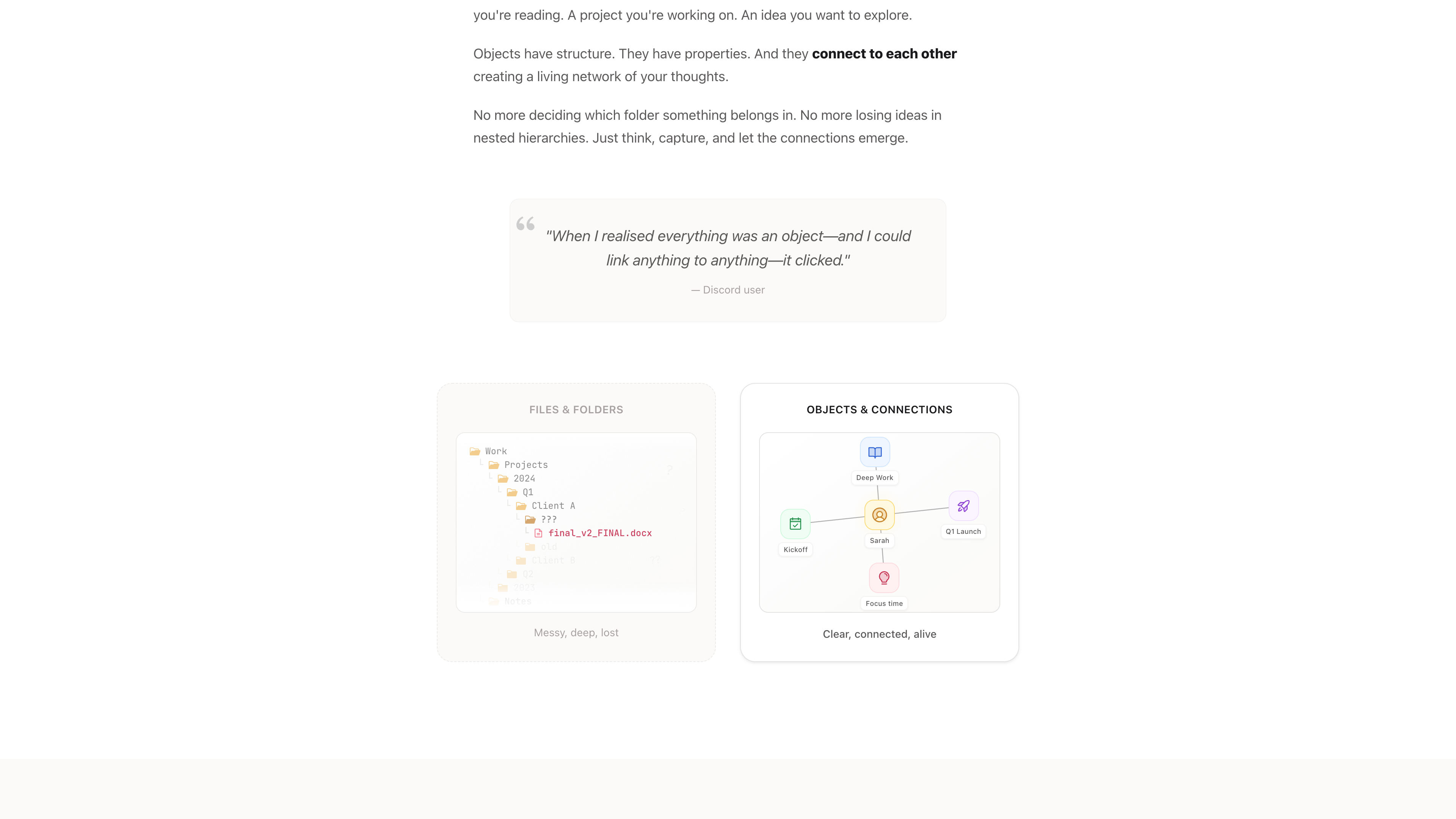
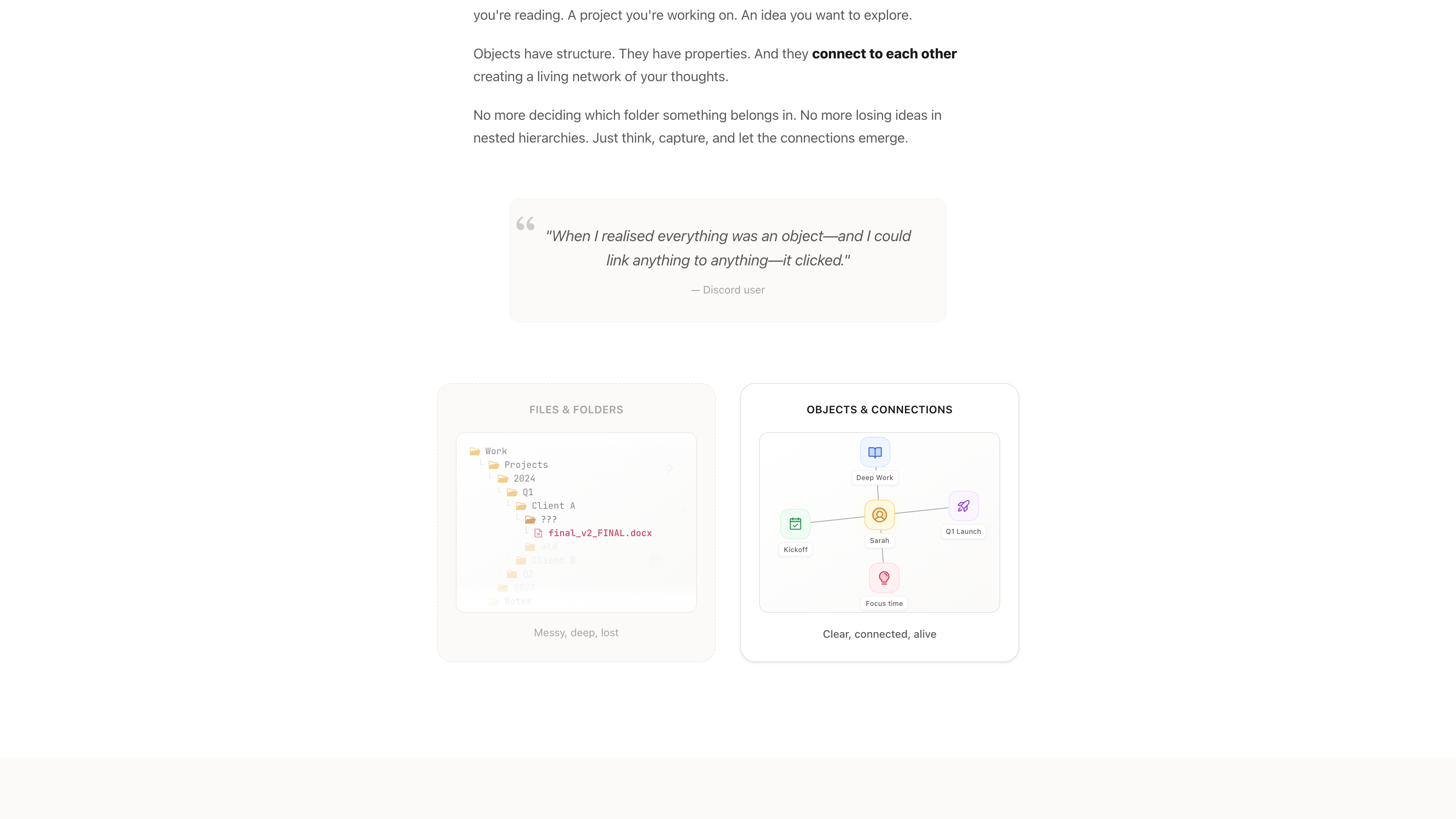
The site explains its philosophy with the comparison above: on the left, the familiar end state of file management — nested hierarchies and final_v2_FINAL.docx; on the right, a Capacities object network where Sarah (a person), Deep Work (a book), and Q1 Launch (a project) are directly connected. Below it sits a user quote: "When I realised everything was an object—and I could link anything to anything—it clicked."
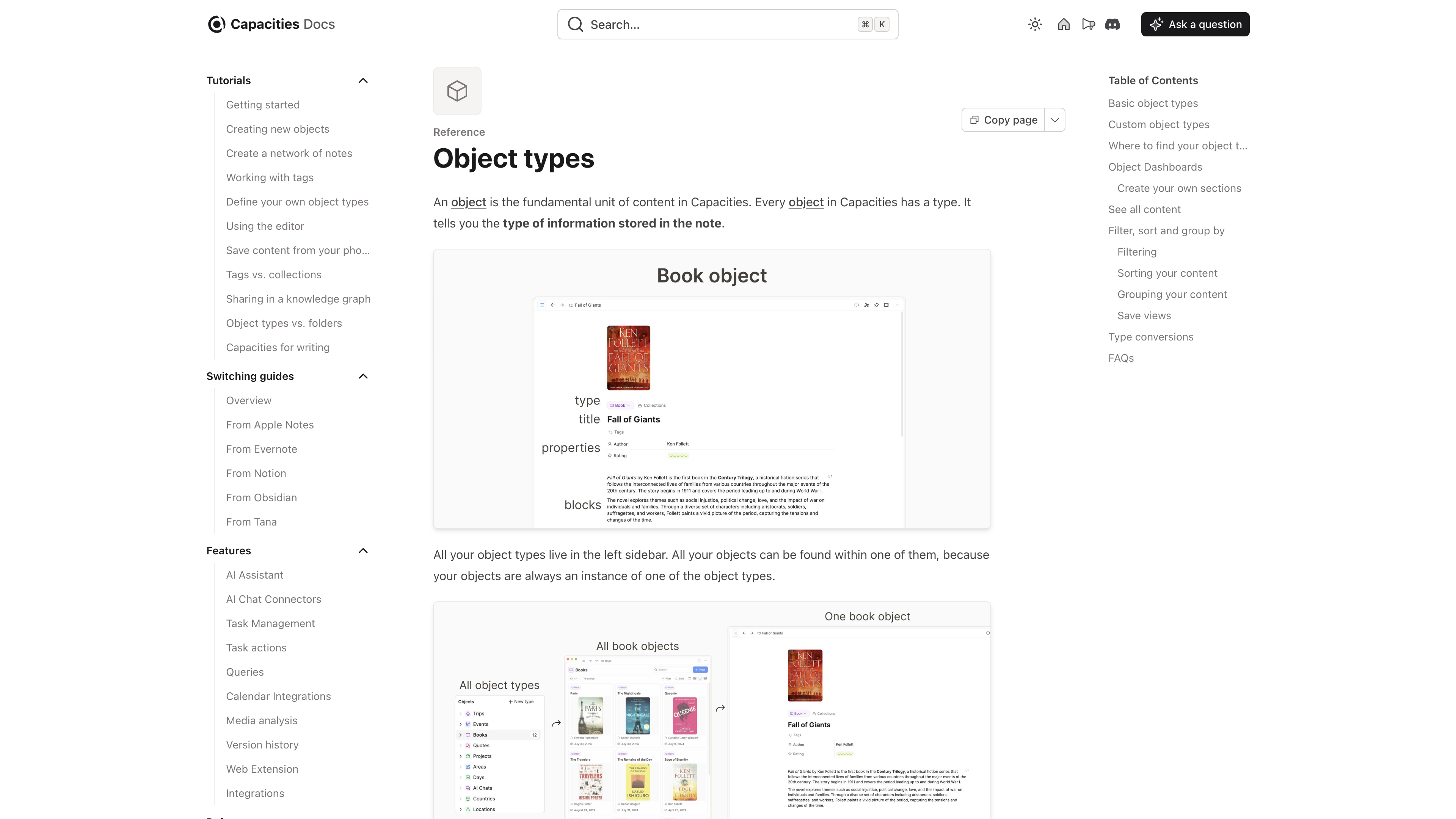
The official documentation diagrams the model using a Book object: the type determines its properties and content blocks. The result behaves like a lightweight database you design for your own information — more structured than plain-text notes, but not table-centric like a Notion database.
Pro features: AI, calendar, tasks, and queries
The free Basic plan covers the full core experience: unlimited spaces, objects, and blocks; sync across all devices; unlimited custom types; import/export; full-text search; and offline support. Pro layers a set of power features on top:
- AI assistant: Chat with any note, auto-fill object properties (create a Movie and AI fills in director, cast, and synopsis), run summarize/translate/continue commands, and get suggestions for tags and collections. Media analysis — image OCR, audio transcription, weblink analysis — is part of the same AI surface. Pro and Believer include a monthly AI budget sized for light daily use; heavy users can add the Plus add-on. The company's developer blog (August 2026) describes a multi-provider, agent-based backend.
- Calendar integration: Google, Outlook, Apple, and CalDAV calendars (e.g., Nextcloud, Fastmail) appear next to your daily note; events can become Meeting objects linked to attendees, agendas, and action items.
- Task management: Create tasks anywhere, with built-in Inbox/Today/Scheduled/Kanban views, deadlines, and recurring tasks. Open a project or person to see their related tasks in context.
- Smart queries and search: Combine conditions across types, properties, tags, and dates; Smart Search across the whole space; plus version history, table formulas, and Related Content, which surfaces notes you wrote about something but never linked.
- Reading and capture integrations: Sync Readwise highlights, email in Kindle highlights, and capture via WhatsApp, Telegram, email, a web clipper extension, and Raycast.
- API: A new developer platform (developers.capacities.io) launched in 2026 with a REST API, OAuth, and SDKs for reading and writing objects; API access is a Pro feature.
Accounts and pricing
Capacities requires an account (email and name; the terms set a minimum age of 16). As of 2026-09-16, the pricing page lists:
| Plan | Price (USD) | What you get |
|---|---|---|
| Basic | Free | Full core functionality; media uploads up to 5 GB total, then 100 MB/month |
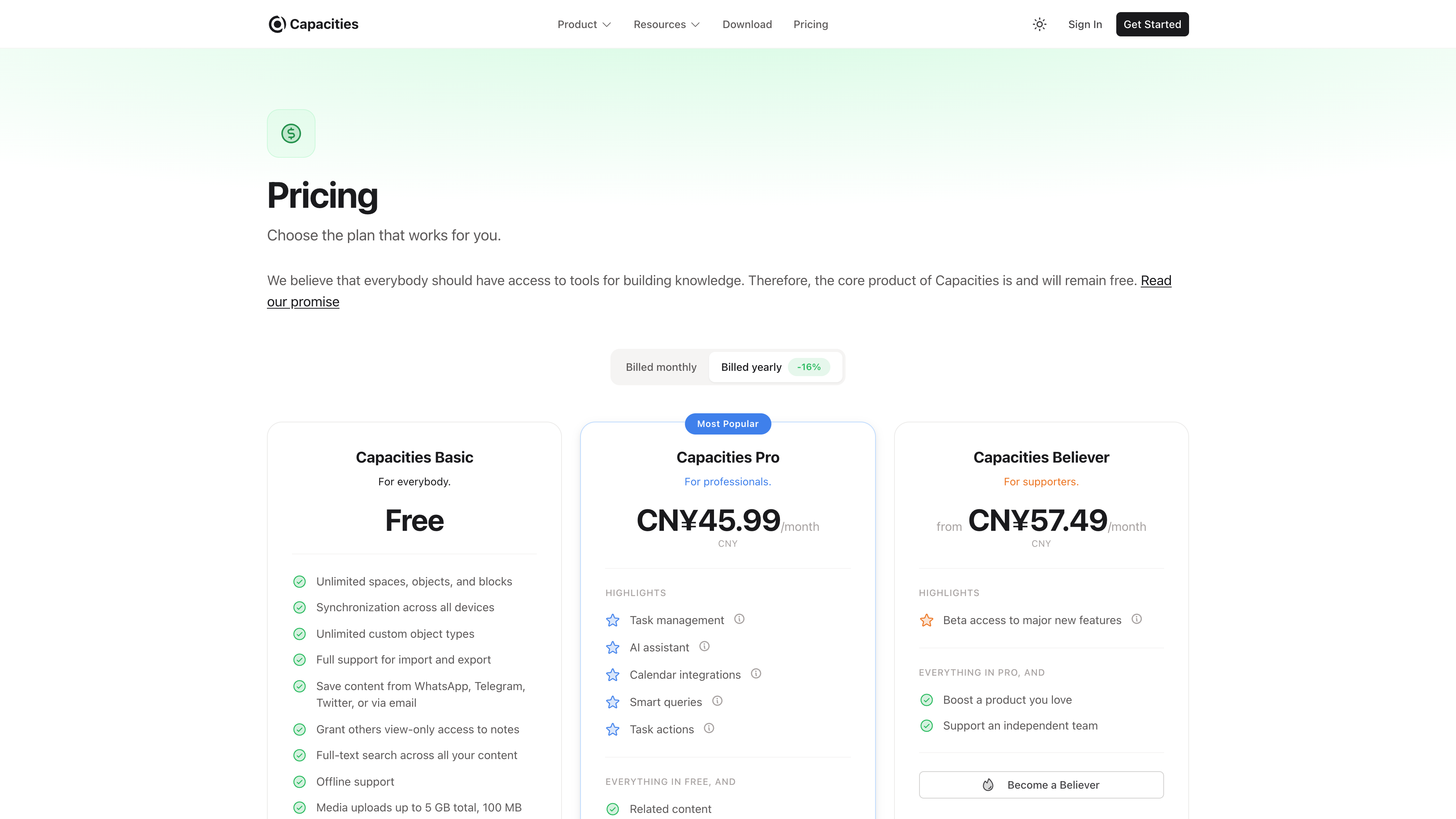
| Pro | 119.88/year (~$9.99/mo) | Tasks, AI assistant, calendar, queries, version history, unlimited media uploads (fair use), API access, and more |
| Believer | 149.88/year (~$12.49/mo) | Everything in Pro plus beta access to major new features — positioned as supporting the independent team |
| Plus (AI add-on) | ~$8.33/mo, billed annually | Stacks on Pro/Believer (making Pro+/Believer+) with a much larger monthly AI budget and optional top-ups |
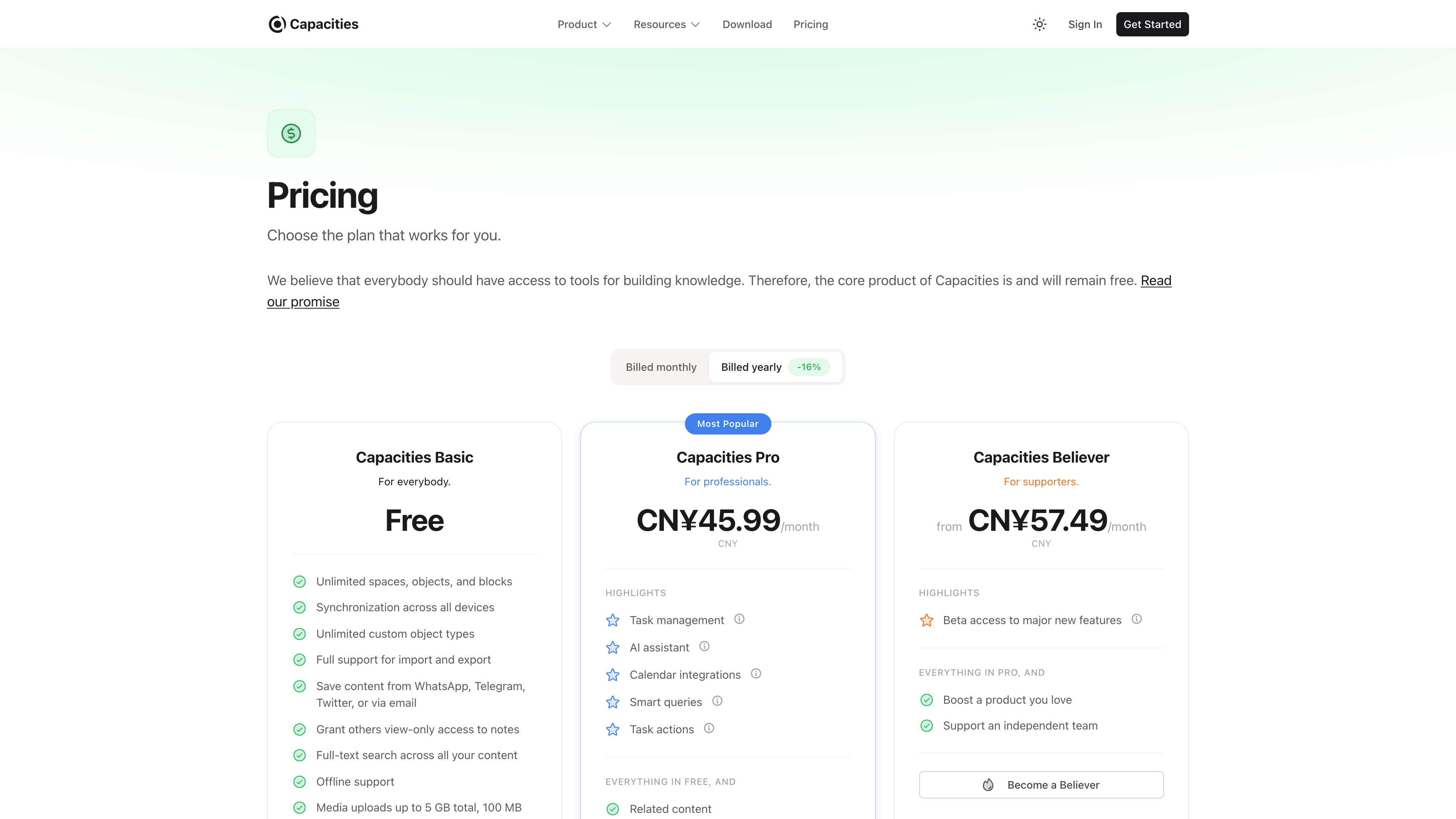
Two things stand out. First, the pricing page localizes currency by region: as the screenshot shows, visits from mainland China see CNY regional pricing (Pro at CN¥45.99/month billed yearly, Believer at CN¥57.49), and the currency cannot be switched manually. Second, the company is unusually candid about its pricing philosophy: the essay Why this pricing? states plainly that it refuses venture funding and aggressive growth, "cannot be aggressively priced at the lower end of the market," and runs on subscriptions. Payments go through Paddle (credit card, PayPal, Apple Pay, Google Pay); Pro offers a free trial with no credit card required; you can cancel anytime and drop back to Basic without losing any content. Students can apply for 40% off Pro; Believer has no discounts, and there are no non-profit discounts or team plans.
Security and privacy
Capacities is a cloud service. Data lives on encrypted disks in certified EU data centers, transfers over TLS 1.2+, and is backed up daily to multiple European locations; accounts support two-factor authentication (product page and the data protection memo). The privacy policy promises never to sell user data, uses self-hosted fully anonymized analytics, and physically isolates production systems from development machines. GDPR rights are extended to all users worldwide, not just EU residents. Note that the German originals of the terms and privacy policy are the legally binding versions; the English texts are marked as non-binding translations.
One deliberate trade-off: no end-to-end encryption. A dedicated explainer argues that E2EE would make the API, AI assistant, and calendar integrations impossible, so the company chose encryption in transit and at rest instead; partial encryption of specific objects may come later. The same page frankly advises users for whom E2EE is a hard requirement to pick a different tool. For AI, sections 7–9 of the privacy policy state that AI processing is consent-based and can be switched off entirely in settings; content sent as context goes to external AI providers but is not used to train models and is stored only temporarily.
Portability is the other standing promise: export to Markdown, Word, HTML, and LaTeX, dump databases to CSV, and run manual or automatic full-space exports at any time (Our Promise).
Who it's for
- People tired of filing documents who'd rather organize knowledge by things: researchers, writers, and students can model papers, books, people, and concepts as types and let relationships emerge.
- Daily-note-driven workflows: Daily Note + calendar + tasks keep a day's meetings, ideas, and to-dos in one place.
- Read-and-retain workflows: Readwise/Kindle highlights become linkable objects, which suits deep learning over hoarding.
- Privacy- and portability-conscious users: EU hosting, GDPR rights, full export, and a written no-lock-in promise.
Limitations
- No Chinese interface (and none planned soon): the app ships in English and German only (FAQ), and the docs and community are English-centric — a real barrier for non-English speakers; RTL language support is also on the not-next list.
- Cloud-first by design: unlike local-first tools such as Obsidian, your notes live on the vendor's servers, which means trusting a seven-person company. Offline mode works for browsing, creating, and editing, but integrations and AI need connectivity, and the offline-first rebuild is still in progress (official post).
- No end-to-end encryption: a hard drawback for sensitive content (the company itself points E2EE absolutists elsewhere).
- No collaboration: Capacities is individual-first; collaboration and team plans are on hold indefinitely, and sharing is limited to view-only links. It is not a team wiki.
- No plugins, closed source: extensibility comes from official integrations only — there is no community plugin ecosystem like Obsidian's, and the company says it won't build one; there is also no lifetime license, and handwriting and flashcards are not on the near-term roadmap.
- Limited free media quota: after the initial 5 GB, only 100 MB per month — heavy PDF/audio/image users will effectively need Pro.
Alternatives
- Obsidian: local-first Markdown notes stored on your own devices with a huge plugin ecosystem — the opposite architectural bet.
- Notion: the cloud all-in-one workspace with strong collaboration; Capacities has the more explicitly typed object model but does no collaboration at all.
- Anytype: also object-based, but local-first, end-to-end encrypted, and open source.
- Heptabase: visual, whiteboard-centric learning notes for people who think spatially.
References
- Capacities homepage (checked 2026-09-16)
- Product overview / Capacities Pro (checked 2026-09-16)
- Pricing / Our Promise / Why this pricing? (checked 2026-09-16)
- Official FAQ / Download (checked 2026-09-16)
- Our principles / Team / Impressum (checked 2026-09-16)
- Why did we decide to build Capacities? — company blog (2024-03-13) (checked 2026-09-16)
- What if Capacities was gone tomorrow? — company blog (2024-06-08) (checked 2026-09-16)
- Why Capacities will become offline-first — company blog (2024-05-02) (checked 2026-09-16)
- AI systems at Capacities — developer blog (2026-08-11) (checked 2026-09-16)
- What's new (changelog) / What's not next (checked 2026-09-16)
- Object types — Capacities Documentation (checked 2026-09-16)
- Data Protection and Security / Why Capacities is not end-to-end encrypted (checked 2026-09-16)
- Privacy Policy (English) / Terms & Conditions (English) (checked 2026-09-16)
- Capacities — Crunchbase (checked 2026-09-16, founder names cross-check)
- Capacities — Product Hunt (checked 2026-09-16, launch date cross-check)