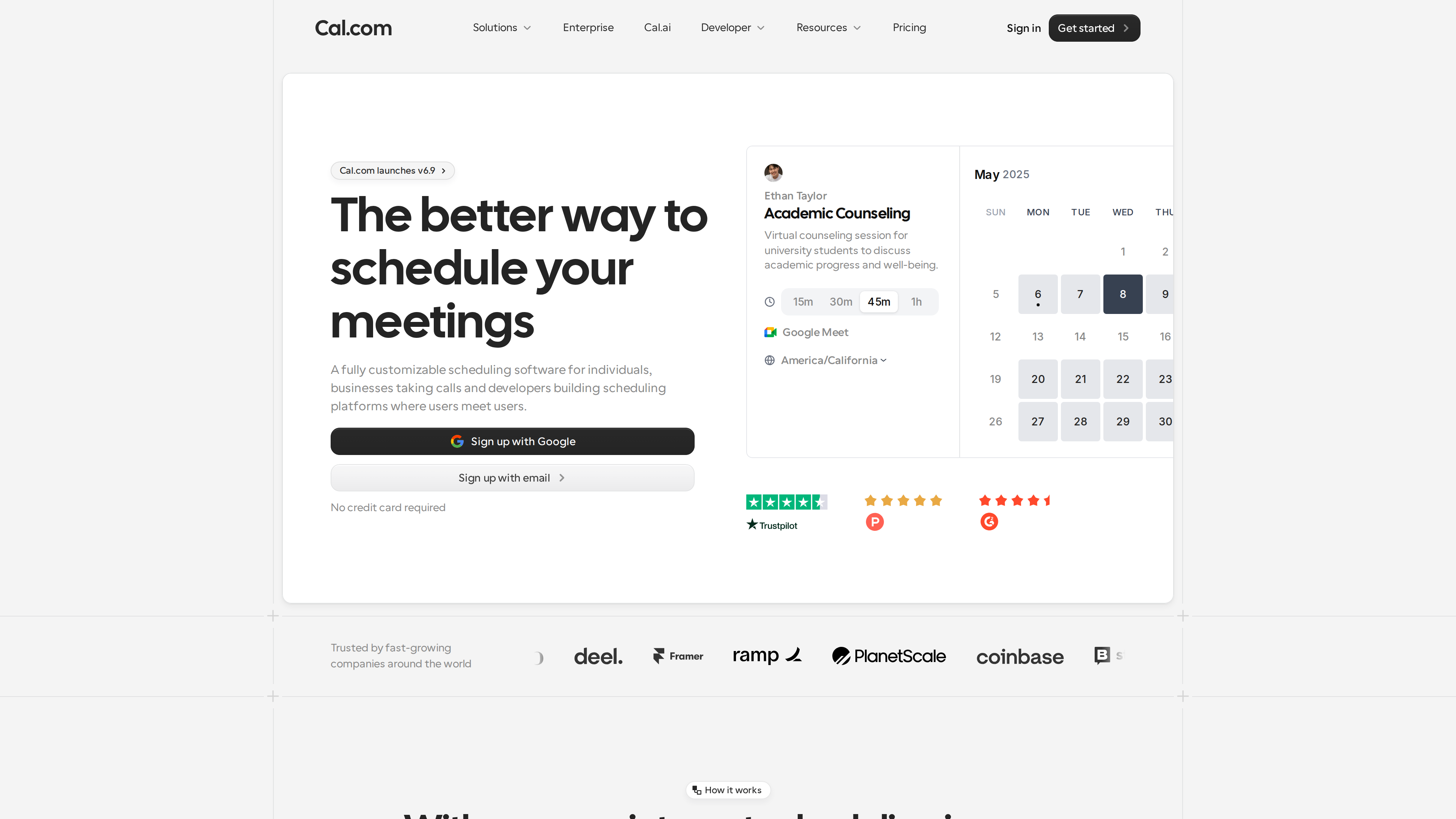
Cal.com (cal.com) is an online scheduling platform: you set your availability, share a booking link, and invitees pick a slot directly on your calendar—no back-and-forth emails. The free individual plan includes unlimited event types and bookings; paid tiers add team features such as round-robin assignment, collective events, routing forms and automated reminder workflows; developers can integrate scheduling into their own products through the API, webhooks, embed components or self-hosting. The company describes it as "a fully customizable scheduling software for individuals, businesses taking calls and developers building scheduling platforms" (homepage, checked 2026-10-01).
One thing needs to be stated clearly up front, because the site's identity has changed: Cal.com began in 2021 as Calendso, which became popular as "the open-source Calendly alternative," and it operated for years under a dual AGPLv3 + commercial license. In April 2026 the company announced that the commercial product is going closed source. The former public repository was renamed Cal.diy and relicensed under MIT as a community edition with the enterprise features removed (see "Cal.diy and the license change" below). So any statement about whether "Cal.com is open source" today has to distinguish between the closed-source commercial cloud and the MIT-licensed self-hosted community edition.
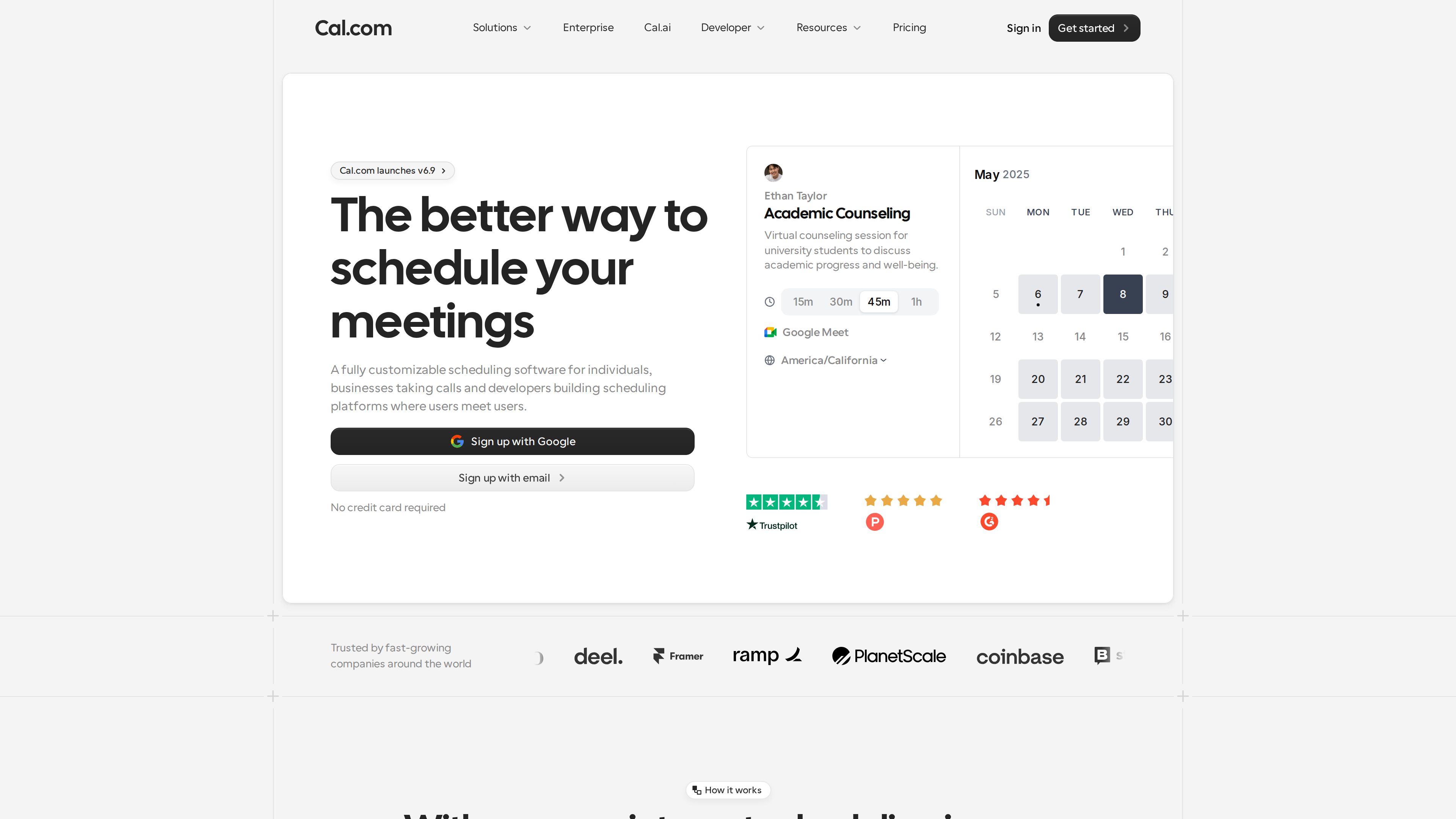
The screenshot above shows the homepage as of 2026-10-01: sign-up via Google or email (no credit card required), a demo booking widget offering 15/30/45/60-minute durations with Google Meet and timezone selection, and a launch pill indicating the commercial product has reached v6.9.
At a Glance
| Item | Details |
|---|---|
| URL | https://cal.com/ |
| Type | Scheduling platform (SaaS) plus the self-hostable open-source community edition Cal.diy |
| Pricing | Individuals free; Teams 12 billed annually); Organizations 28 billed annually); Enterprise custom; self-hosted Cal.diy free (pricing page, as of 2026-10-01) |
| Sign-up | Cloud version requires an account (Google or email, no credit card); invitees book without an account; self-hosting requires your own server |
| Interface languages | The app officially claims support for 65+ languages (homepage); the marketing site is in English with German/French/Dutch/Portuguese/Spanish/Italian versions |
| Clients | iOS/Android apps, macOS/Windows/Linux desktop apps, Chrome/Safari/Edge/Firefox browser extensions (footer download section) |
| Launched | Predecessor Calendso launched on Product Hunt in April 2021; renamed Cal.com in September 2021 (official announcement) |
Background
- Origins: Calendso started as a side project by Peer Richelsen and Bailey Pumfleet, positioned as an open-source Calendly alternative; it took off after its April 2021 Product Hunt launch. The GitHub repository was created on March 22, 2021 (official Series A memo, GitHub).
- Rebrand: In September 2021, about five months after the Product Hunt launch, Calendso rebranded to Cal.com and shipped the v1.0 release candidate. The company acquired the cal.com domain and introduced a free plan for the first time (the alpha had offered only a $12/user/month paid plan) (official announcement).
- Funding: According to the official blog, the company raised a 25M Series A led by Alexis Ohanian's Seven Seven Six with Obvious Ventures, OSS Capital, Jack Altman, Tobi Lutke, Daily.co and others—announced together with v1.5, which introduced the App Store, the API and the in-house Cal Video conferencing service (announcement, published at the product's 12-month mark, i.e. April 2022).
- Operating style: The company runs as an Open Startup, publishing core metrics at cal.com/open and practicing open salaries; the team is fully distributed with no physical headquarters (About page). Its stated mission is "to connect a billion people by 2031 through calendar scheduling."
- The 2026 closed-source move: On April 14, 2026, co-founder Bailey Pumfleet announced that the commercial product is going closed source, arguing that AI tooling has made vulnerability discovery against public codebases dramatically faster and that "continuing as open source would put our application, our customers, and the sensitive data we handle at significant risk." The announcement notes the production codebase has diverged significantly (with rewrites of core systems such as authentication and data handling), and that Cal.diy was released to the community under the MIT license as the remaining open option (official announcement).
Core Capabilities
- Individual scheduling: customizable short links (cal.com/username), unlimited event types and calendar connections, availability rules (buffers, minimum notice, daily/weekly/monthly frequency and duration caps), automatic timezone detection and conflict checking, cancellation/rescheduling/reassignment, private links, seated events that let multiple people book the same slot, and Stripe/PayPal payments (pricing feature list).
- Team scheduling: round-robin assignment (by weight/priority, in groups, or with a fixed host), collective events with multiple hosts, admin-controlled managed event templates, dynamic group links that merge several members' availability on the fly (cal.com/john+jane), and recurring events (pricing feature list).
- Routing Forms: leads answer a form before booking and are routed to the right person based on their responses; supports attribute-based weighted routing, CRM ownership routing via Salesforce and similar tools, plus routing analytics (Routing page).
- Workflows: triggers (booking created, cancelled, N minutes/hours/days before start) paired with actions (email or SMS to host, attendee or a specific number), with custom templates for reminders and follow-ups (Workflows page).
- Video and calendar integrations: the in-house Cal Video (powered by Daily.co) plus Zoom, Google Meet, Microsoft Teams and "20+ other conferencing tools"; on the calendar side, Google Calendar, Outlook, Apple Calendar, Zoho and more, syncing free/busy status in real time to prevent double bookings (pricing feature list).
- App Store: even the free plan integrates with "100+ apps," including Slack, Salesforce, HubSpot (two-way sync with ownership-based routing), Zapier and Make (pricing page, Workflows page).
- More: Cal.ai, an AI phone agent (commercial feature with its own nav entry); booking-page embeds (inline/popup/floating button) with a JS Embed SDK; booking limits, blocklists, out-of-office markers and the like.
Pricing (as of 2026-10-01)
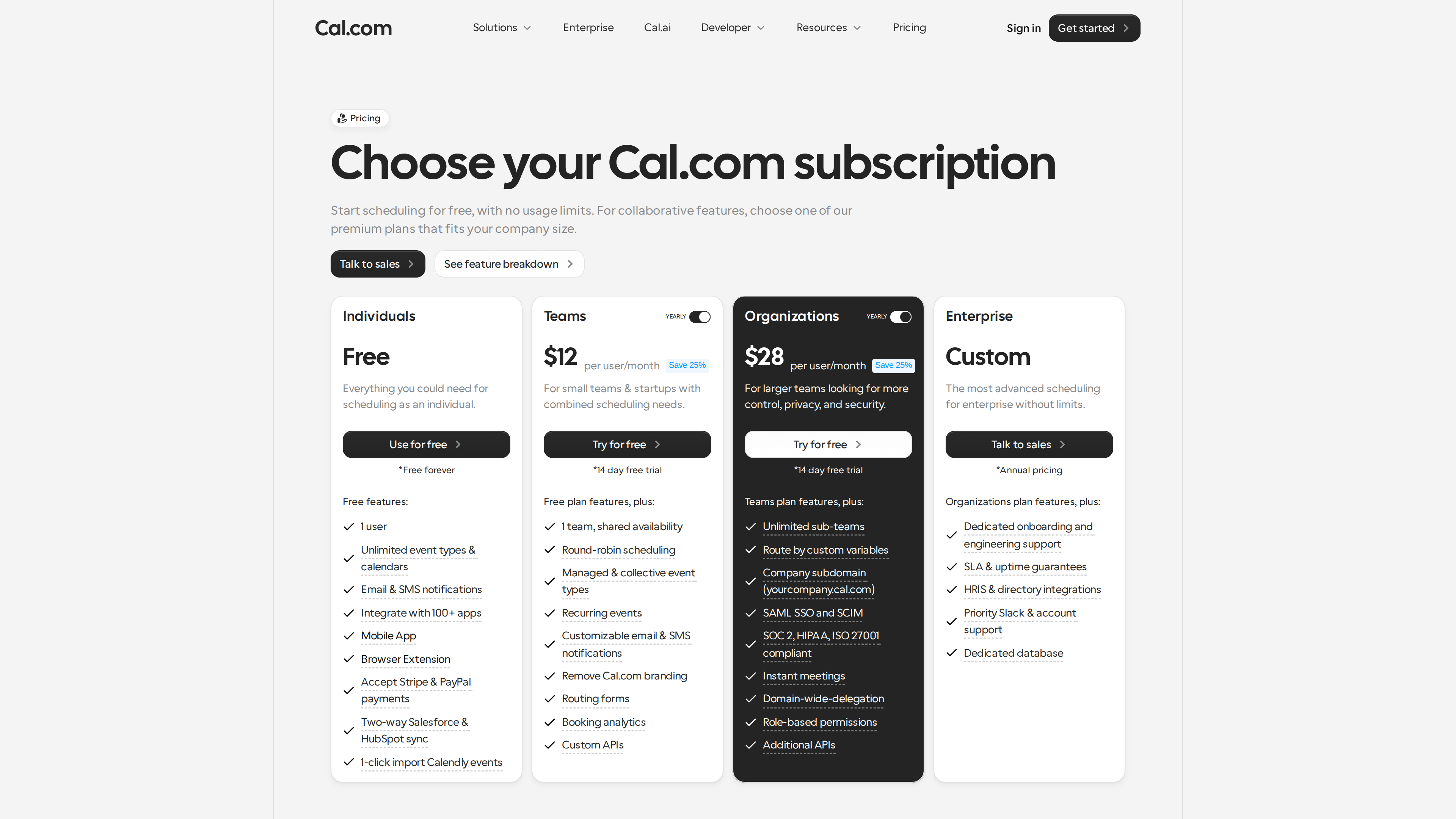
Prices below come from the pricing page, verified by toggling the page's monthly/yearly switch (annual billing works out to roughly 25% off, matching the page's "Save 25%" label):
| Plan | Monthly | Annual (per month) | Highlights |
|---|---|---|---|
| Individuals | Free ("Free forever") | — | 1 user; unlimited event types & calendars; email & SMS notifications; 100+ app integrations; mobile app & browser extension; Stripe/PayPal payments; two-way Salesforce & HubSpot sync; one-click Calendly import |
| Teams | $16/user | $12/user | 1 team with shared availability; round-robin; managed & collective event types; recurring events; custom notifications; remove Cal.com branding; routing forms; booking analytics; custom APIs. 14-day free trial |
| Organizations | $37/user | $28/user | Unlimited sub-teams; routing by custom variables; company subdomain (yourcompany.cal.com); SAML SSO & SCIM; SOC 2, HIPAA, ISO 27001 compliance; instant meetings; domain-wide delegation; role-based permissions; additional APIs. 14-day free trial |
| Enterprise | Custom (annual contract) | Custom | Dedicated onboarding and engineering support; SLA uptime guarantees (99.9%, with a 99.99% option per the enterprise page); HRIS & directory integrations; priority Slack support; dedicated database; optional US/EU data residency |
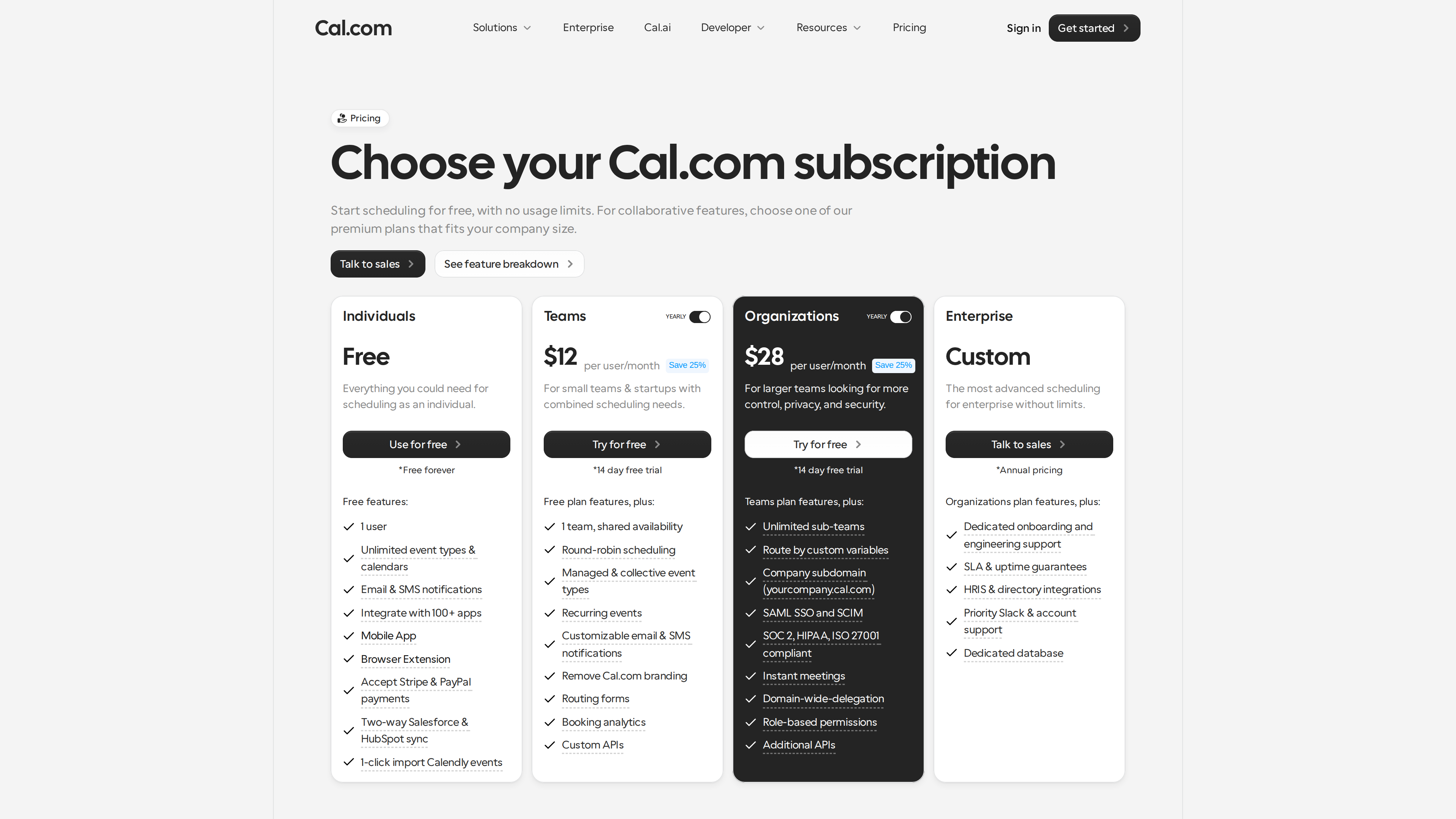
The screenshot above shows the pricing page in annual view as of 2026-10-01: four tiers side by side, with a YEARLY toggle on the Teams and Organizations cards (switching it reveals the 37 monthly prices), and the Organizations tier listing SOC 2, HIPAA, ISO 27001 compliance and SAML SSO/SCIM.
Cal.diy and the License Change
This section matters most for understanding the site today; every claim below was verified against repository files and official announcements (as of 2026-10-01):
- Historical license: the original calcom/cal.com repository was long dual-licensed under AGPLv3 + a commercial license: enterprise directories such as
packages/features/eefell under the commercial license while everything else was AGPLv3 (per the LICENSE file as of its 2024-03-26 revision). - The 2026-04-15 change: the public repository was renamed to calcom/cal.diy (the old URL now 301-redirects there), and the same commit (PR #28903) removed enterprise functionality—Teams/Organizations, routing forms, workflows, SAML/SSO, Insights, API v1—and switched the license from AGPL-3.0 to MIT. The LICENSE file in the repository today is the standard MIT text, copyright Cal.com, Inc. (official technical announcement, repository LICENSE file).
- What Cal.diy is: officially "the open source community edition of Cal.com," keeping the full scheduling engine, app-store framework and booking infrastructure. It is self-hosted only, with no managed version; the README and docs state it is "strictly recommended for personal, non-production use," and Cal.com, Inc. does not guarantee its security. It is maintained by former Cal.com interns who became official maintainers, while the Cal.com engineering team focuses on the commercial product (Cal.diy docs, official technical announcement).
- Self-hosting requirements: Node.js (≥18; version 18 recommended), PostgreSQL (≥13 per the README), yarn and Git; Docker is supported, with one-click deployments for Azure, GCP, Railway, Render, Vercel and Elestio (installation docs, repository README). The self-hosting docs formerly hosted under cal.com now 301-redirect to the cal.diy site.
- Feature differences: Cal.diy keeps event types, recurring/seated/paid bookings, private links, all availability features, calendar integrations (Google, Outlook, Apple, CalDAV, Exchange, Zoho, Lark, Feishu, ICS feeds), video (Cal Video, Zoom, Meet, Teams, Webex, Jitsi), webhooks, Zapier/n8n/Make, embeds and API v2/OAuth clients. It lacks Teams/Organizations and their event types, routing forms, workflows, SAML SSO/SCIM, Insights analytics, instant meetings and video recordings (official feature comparison).
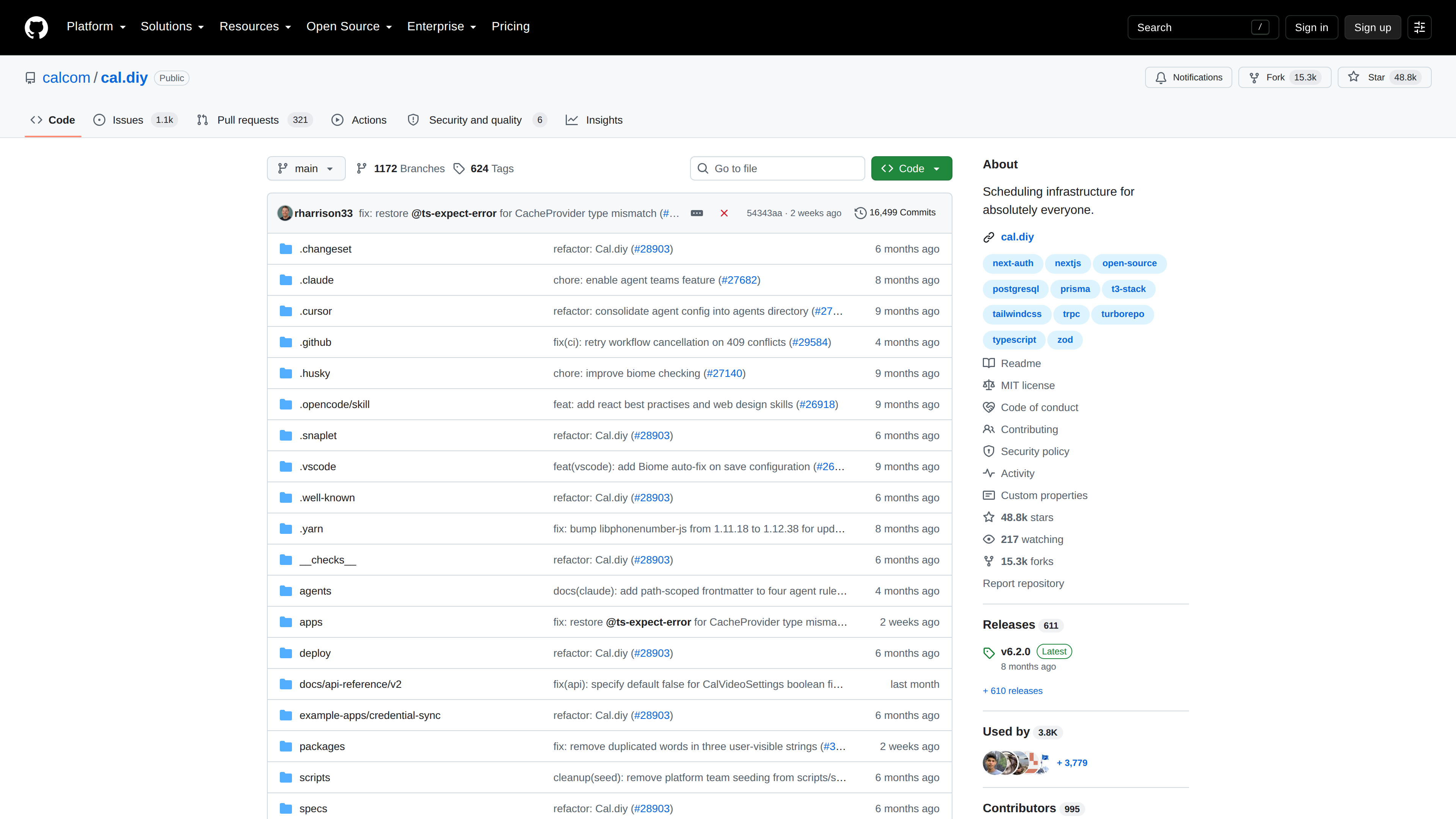
- Repository stats: as of 2026-10-01 the repository has roughly 48.8k stars, 15.3k forks and 995 contributors; the latest release is v6.2.0 (2026-03-01, the last release line before the split), while the main branch still sees active commits (most recent push 2026-09-26). The commercial cloud product has since reached v6.9 (GitHub, homepage).
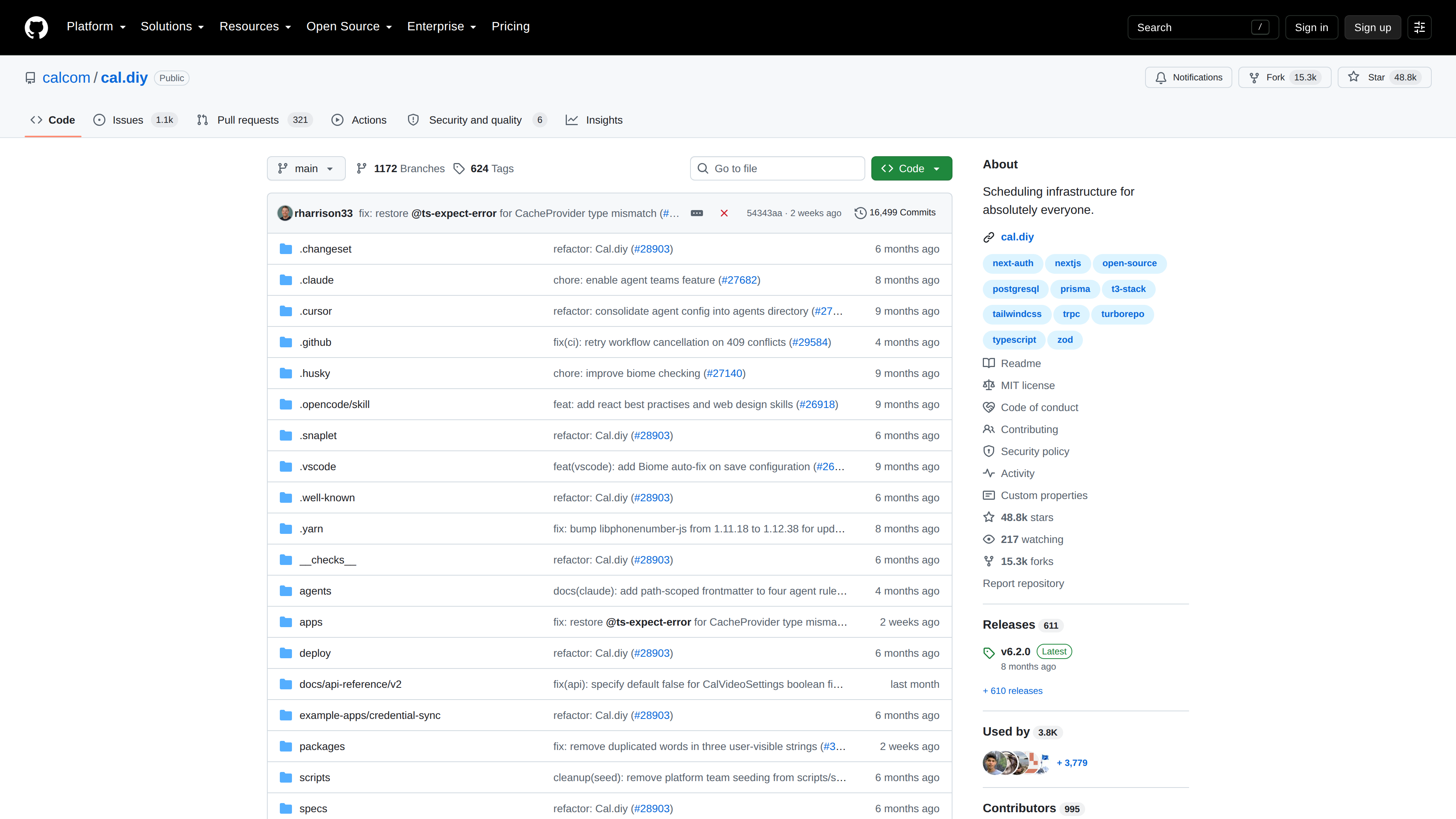
The screenshot above shows the repository page as of 2026-10-01: visiting github.com/calcom/cal.com redirects to calcom/cal.diy, the About sidebar lists the license as MIT, the latest release remains v6.2.0, and recent commits are visible.
Developer and Platform Capabilities
- API v2 (REST): covers bookings, schedules, slots, event types, routing forms, workflows, webhooks, teams and organizations; authentication via OAuth clients or API keys (
cal_test prefix,cal_live_live prefix); default rate limit of 120 requests per minute, raiseable on request (API docs). - Embeds and components: an Embed SDK (inline/popup/floating button) and Cal.com Atoms, an official React component library (
@calcom/atoms) with atomic components for calendar connections, availability settings and booking flows, enabling fully self-branded booking UIs (Integrate page). - Webhooks: real-time pushes to your own systems when bookings are created, updated or cancelled (pricing feature list).
- Platform product change: the Platform plan for marketplaces/white-label embedding was restructured on December 15, 2025 and no longer accepts new sign-ups; existing customers continue to be supported (API docs).
- Ecosystem: the official App Store lets developers publish integrations; the docs navigation also lists an MCP server entry.
Security and Data Policy
- The security page states the company has achieved ISO 27001, SOC 2 Type II, HIPAA, GDPR and CCPA compliance, and offers downloads of its DPA, SOC 2 Type II report, ISO certificate and penetration-test report; it runs annual third-party penetration tests and operates a Bugcrowd vulnerability disclosure program scoped to its QA environment (security page).
- Privacy policy (effective 2026-08-20) highlights: for booking data, the user (or their organization) is the controller and Cal.com the processor; the company says it never sells personal data; AI features are opt-in and nothing is used to train anyone's models; subprocessors are listed in its Trust Center; self-serve export and deletion are available; the product itself sets no third-party cookies (the marketing site is accounted for separately) (privacy policy).
Who It's For
- Individuals and freelancers who want a free, unlimited booking link (Calendly's free tier allows only one event type; Cal.com's free plan is unlimited on event types).
- Sales, recruiting and customer-success teams that need round-robin assignment, lead routing forms and CRM integration.
- Organizations with compliance requirements (healthcare HIPAA, enterprise SSO/SCIM, US/EU data residency) evaluating the Organizations or Enterprise tiers.
- Self-hosters who want full control over data and code and can accept the maintenance burden of the "personal, non-production use" MIT-licensed Cal.diy.
- Developers embedding scheduling into their own products (API v2, Atoms, Embed)—though the white-label Platform plan is closed to new customers.
Limitations
- The commercial product is now closed source: since April 2026 the Cal.com cloud codebase is no longer public, so the long-standing "open-source Calendly alternative" reputation applies only to the MIT community edition, Cal.diy. Users who valued code auditability need to reassess.
- Cal.diy's narrowed scope: it is officially recommended for personal, non-production use with no security guarantee, and lacks teams/organizations, routing forms, workflows and other enterprise features. The cloud and community editions have clearly diverged, and Cal.diy's releases stopped at the pre-split v6.2.0 (as of 2026-10-01).
- Team features sit behind a paywall: round-robin, routing forms and brand removal all require the Teams plan (from $12/user/month billed annually); the Organizations tier starts considerably higher.
- Platform plan closed: since 2025-12-15 the white-label/marketplace Platform plan no longer accepts new sign-ups (existing customers only); new developers can use the regular API/OAuth and embed components instead.
- Unclear Chinese-language support: the company claims 65+ app languages but publishes no definitive list, so the quality of Chinese localization needs to be confirmed after signing up.
Alternatives
- Calendly: the closed-source incumbent that Cal.com compares itself against directly (the site navigation includes a "Cal.com vs Calendly" entry); Cal.com's unlimited free event types are a common point of comparison.
- Cal.diy: the MIT community edition from the same codebase, suited to self-hosting individuals; its relationship to commercial Cal.com resembles a community/commercial edition split.
- Other open-source self-hosted scheduling tools (Easy!Appointments, Rallly, etc.) can serve as alternatives for self-built setups, while Cal.com's app store and API ecosystem remain more developed than most open-source peers.
References
- Homepage · Pricing · About · Open Startup
- Rebrand announcement: Calendso rebrands to Cal.com · Seed announcement · Series A and v1.5
- Closed-source announcement (2026-04-14) · Technical changes announcement (2026-04-15)
- calcom/cal.diy repository · Cal.diy self-hosting docs · Feature comparison
- API v2 docs · Integrate / Atoms · Routing · Workflows
- Security page · Privacy policy