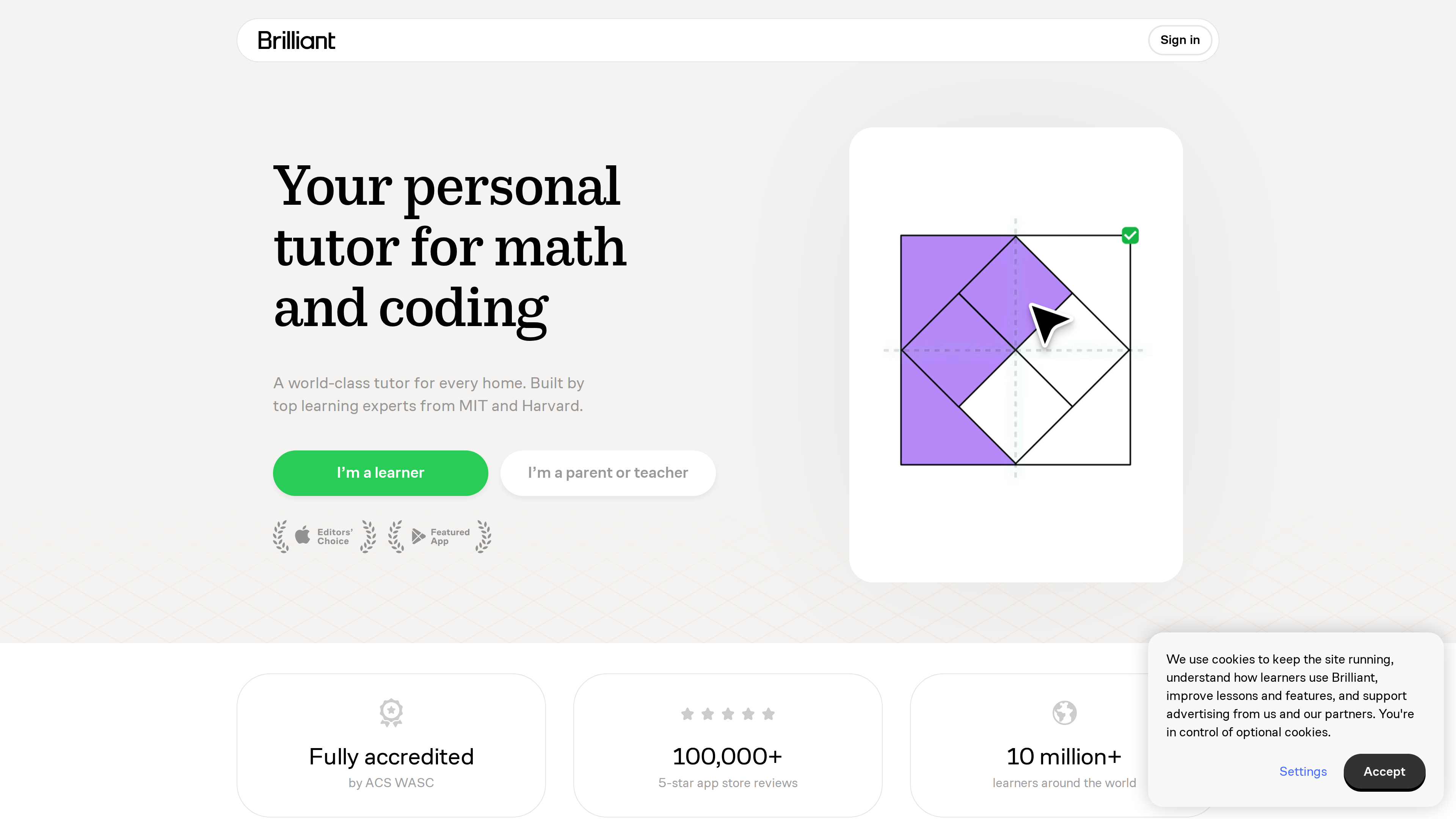
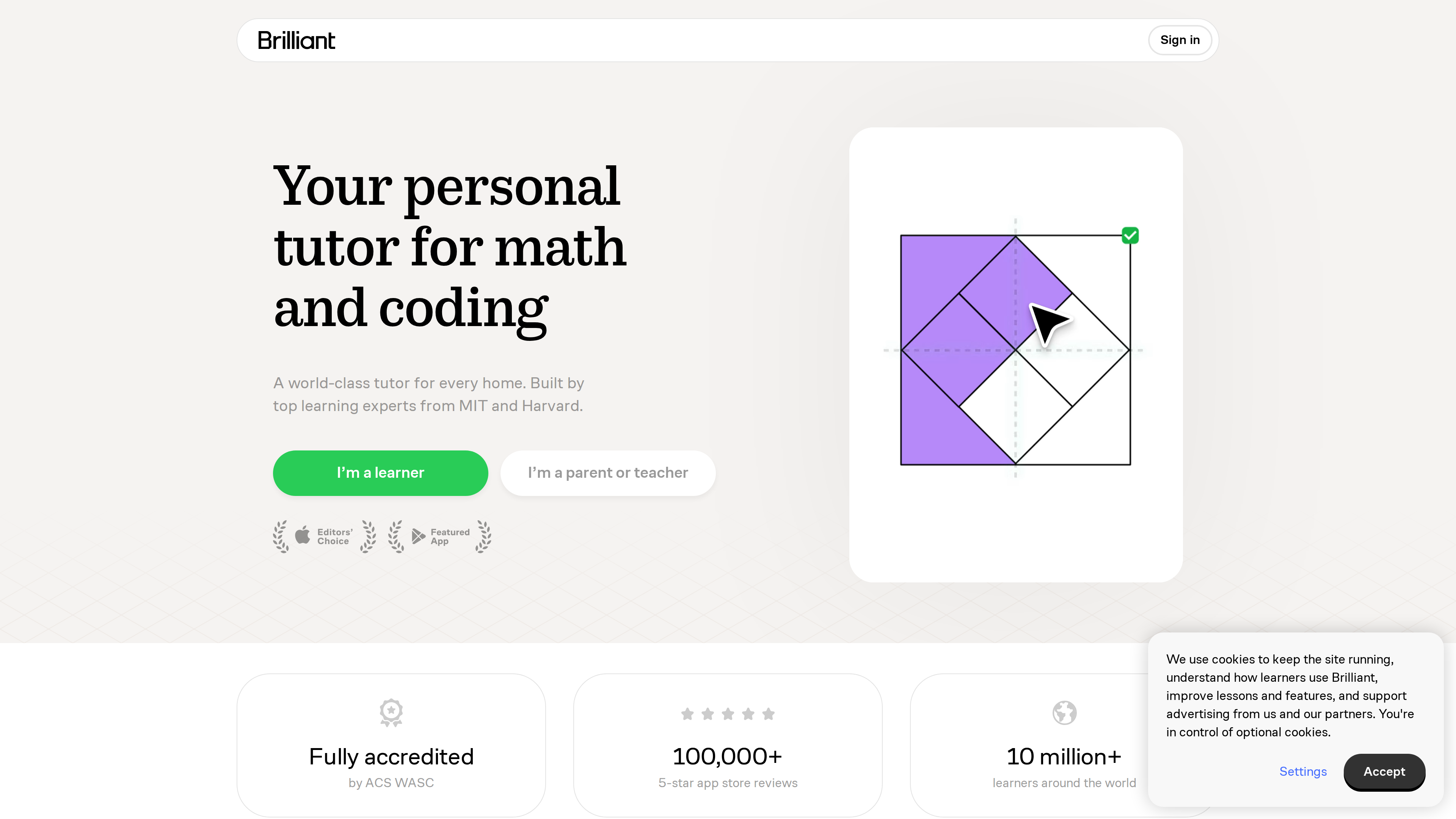
Brilliant (brilliant.org) is an online learning platform built around interactive problem solving, officially positioned as "Your Personal Tutor for Math and Coding." Aimed at learners from roughly age 10 through college and beyond, it addresses a common gap in STEM study — understanding an explanation but being unable to solve problems: lessons don't use video lectures; learners work directly on manipulable interactives and receive instant, custom feedback on every answer. Verifiable traits that distinguish it from peers: a built-in AI tutor named Koji that guides learners on a shared canvas by drawing and hinting while "never giving away the answer"; all courses produced in-house; and a platform that explicitly offers no certificates, credits, or degrees.
At a Glance
| Item | Details (as of 2026-09-30) |
|---|---|
| URL | https://brilliant.org/ |
| Type | Interactive STEM learning platform (limited free tier + subscription) |
| Cost | Free accounts limited to 2 lessons per day; the US subscribe page shows Individual at 40/mo (6 seats, billed annually), while embedded page data lists additional tiers — 161.88 annual, $749.99 lifetime. Actual price follows what the subscribe page displays |
| Registration | Free sign-up required for learning content (email / Google / Apple account); course catalog and help center are browsable without an account; users under 18 need parental consent |
| Interface language | English only |
| Platforms | Web, iOS, Android with cross-device progress sync; internet connection required, no offline mode |
Background
Brilliant was co-founded in 2012 by Sue Khim, who serves as CEO (per Wikipedia, a secondary source, as below). The same source records: institutional investment in 2013 from Social+Capital Partnership, 500 Startups, Kapor Capital and others, with Khim named to Forbes 30 Under 30 (Education) that year; a $50 million valuation in April 2019; and the December 2022 acquisition of children's interactive content company Hellosaurus. The corporate entity is Brilliant Worldwide, Inc., headquartered in San Francisco, USA (per the address in its Terms of Use).
During 2025–2026 the site repositioned around the Koji AI tutor, changing its homepage title to "Your Personal Tutor for Math and Coding"; its earlier community-era features (the wiki, daily challenges) have been retired or kept only as archives. Officially claimed scale figures (as of 2026-09-30): 10 million+ learners worldwide and 100,000+ five-star app store reviews, plus full ACS WASC accreditation and kidSAFE certification. The stated target range is "grade 5 to college and beyond" (the help center says most children can start around age 10, beginning with advanced arithmetic), alongside a separate free K–5 Math Practice (beta) library.
Interactive Courses and the Koji AI Tutor
Lesson structure. Each lesson focuses on a single concept: visual explanations and manipulable interactives build intuition first, followed by problem solving. The platform uses a pretest-first design, and every interactive question returns instant, custom feedback based on the learner's answer. The official FAQ claims interactive learning is "shown to be 6x more effective," but no independent study is cited — treat this as a marketing claim.
Koji AI tutor. Koji can see the problem and interactive elements on the learner's screen and draw on the canvas to illustrate. Its features include knowledge modeling, real-time intervention, mastery assessments, and targeted practice generation; free users get only a limited trial allowance.
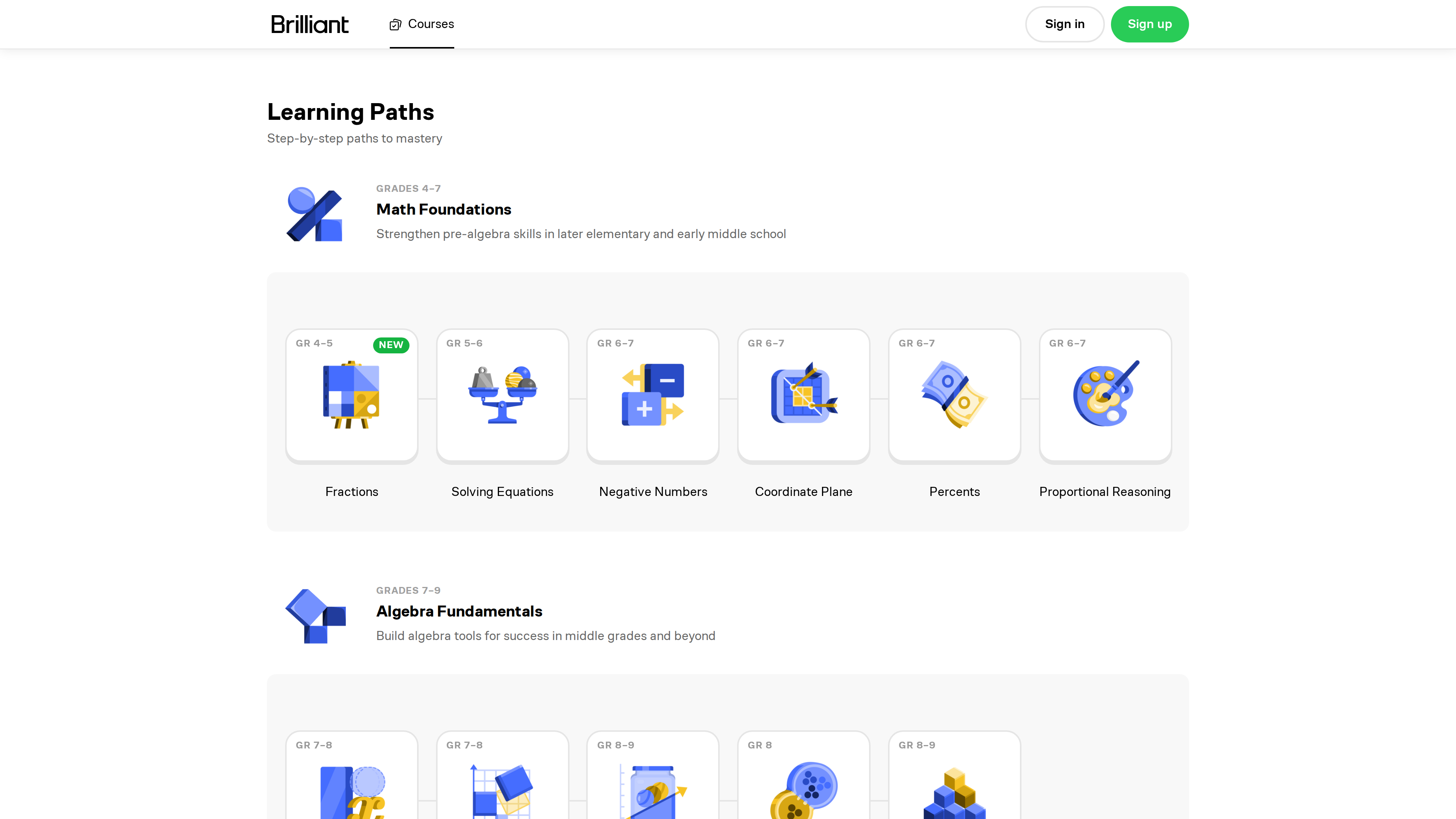
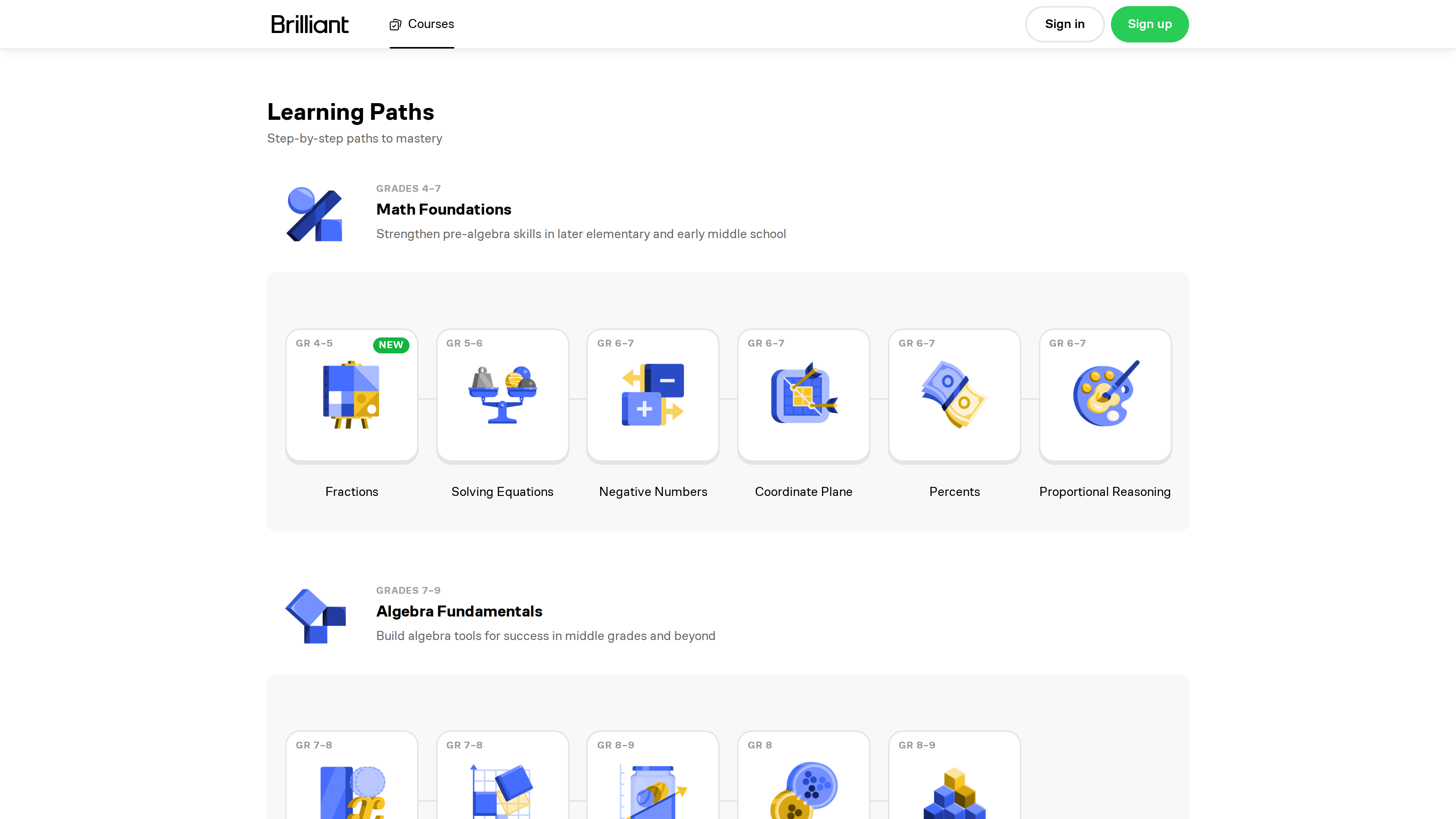
Course coverage (as of 2026-09-30). The subscribe page groups courses into four Guided paths: Math (Fractions, Quadratics, Derivatives, etc., with "28 additional courses" noted), Computer Science (Thinking in Python, Algorithmic Thinking, Introduction to Neural Networks, etc., with "7 additional courses"), Science (Scientific Thinking, Circuits, Digital Circuits, Quantum Computing — 4 courses), and Data Analysis (Exploring Data Visually, Regression, Clustering & Classification, etc.). Official course counts are inconsistent: the subscribe page says "40+ interactive courses," the educator program page says "50+ curated courses," and the course sitemap lists 69 course URLs. The help center also lists 13 Learning Paths segmented by grade band, such as Math Foundations (G4–7), Algebra Fundamentals (G7–9), Advanced Algebra (G11–12), Python, and Data Analysis.
Habit mechanics. Streaks, Leagues (leaderboards), and XP keep learners on a routine, with progress dashboards and periodic notifications for parents and learners. A "Daily Challenges" feature existed historically; as of 2026-09-30 it no longer appears on the homepage, in the help center, or in any sitemap.
Accounts and Access Tiers
Free account. Registration unlocks the full course catalog but with clear limits: 2 "keys" per day (unlocking 2 lessons or practice sessions, resetting at local midnight), mandatory sequential learning with no skipping, ads between lessons, and limited Koji access. Streaks, XP, and Leagues remain available to free users. Sign-up supports email, Google, and Apple accounts.
Premium subscription (US, as of 2026-09-30). Visible prices on the subscribe page are Individual at 40/mo (6 seats), with a footnote reading "Billed as one payment. Renews annually" and a "Save 33%" annual-billing badge. Structured data embedded in the same page lists further tiers: Premium at 161.88 annually (about 749.99 lifetime, plus a PRO tier at 240/yr. The coexistence of visible text and embedded tiers indicates regional and A/B testing differences, and the help center does not list prices directly — the price shown at checkout on the subscribe page prevails. Gift subscriptions and team plans are also offered on the same page.
Family and child accounts. The Family Plan is a fixed price for up to 6 seats; each member gets their own Premium account, and the admin invites members by email through Family Management, adding or removing seats at any time. A Single Child plan lets one parent supervise one linked child without occupying a seat themselves, and young children can join without an email address. Age terms: users under 18 require parent/guardian consent, and users under 13 require the verifiable parental consent mandated by COPPA (Terms of Use).
Educator program. Brilliant for Educators is a free, grant-funded program for in-school K-12 teachers: teachers and students receive full Premium access, 50+ curated courses, class management, and Google Classroom integration, with no daily limits or ads for students. A school email address is required to apply; the program explicitly excludes homeschoolers, private tutors, universities, and adult programs, and district pricing is available on request.
Copyright and Content Policy
All current courses are produced in-house: the About page states the curriculum is "crafted by award-winning teachers, subject-matter experts, and learning designers," naming team members including IMO medalists and PhDs from MIT, Caltech, Stanford, and Harvard, and says review problem sets are human-reviewed before release. The content library is updated regularly (new courses and practice, improved explanations and interactives).
UGC (user-generated content) has been largely wound down: the community-built wiki is no longer maintained and survives only as an archive, while the Terms of Use retain a "User Submission(s)" clause as a legal remnant of the community era. In practice, the learning content on the platform today consists of official courses; there is no open user-submitted course channel.
Certificate policy: Brilliant explicitly does not offer completion certificates, course credits, academic degrees, or professional certifications — only progress records and personal achievement tracking such as streaks and XP. Its full ACS WASC accreditation is an independent endorsement of course quality, but Brilliant is not a degree-granting institution and provides no college or transferable credit. Brilliant itself directs users who need formal credentials to MOOCs with verified certificates, such as Coursera and edX.
Best-Fit Use Cases
- Learners (roughly grade 5 through college and beyond) who want to build math or coding fundamentals by doing, especially those who find video lectures inefficient and prefer solving problems hands-on.
- Self-learners who want guided practice from an AI tutor that gives hints rather than answers.
- Parents looking for a supervised math-learning tool with progress dashboards for children around age 10 and up (Family / Single Child plans, kidSAFE certification).
- In-school K-12 teachers, who can apply for the free educator program for classroom use.
Limitations
- English-only interface and courses, a high barrier for non-English users.
- No offline mode: lessons require an internet connection and cannot be downloaded.
- No certificates or credits, making it unsuitable for users who need academic or professional credentials.
- Lopsided subject coverage: the official focus is math and coding; science has only 4 courses, and the About page notes that geometry, probability, and calculus content only began development in 2026 after algebra coverage was completed — parts of the math catalog are still being filled in as of the review date.
- Restrictive free tier: 2 lessons per day, forced sequential learning, ads, and limited Koji access.
- Mediocre price transparency: the help center doesn't list prices, the subscribe page shows multiple experimental tiers, and regional differences are not publicly documented.
- Narrow educator program: limited to in-school K-12 teachers, excluding homeschoolers, universities, and adult programs.
Comparable Sites
- Khan Academy: a nonprofit founded by Sal Khan in 2008, free at its core, built around short video instruction plus interactive exercises and assessments, covering a broader range of subjects (including humanities, economics, and test prep), and sustained mainly by philanthropy (per Wikipedia). Brilliant's own comparison page (note: a first-party perspective) frames the difference as interactive, guided problem solving focused on math and coding with a daily-limited free tier, versus video/text instruction followed by practice with a free core library.
- Coursera: a for-profit MOOC platform founded in 2012 by Stanford professors Andrew Ng and Daphne Koller, partnering with 375+ universities and companies (2025 figure) and offering roughly 7,000 courses (2024 figure), centered on university video courses, paid verified certificates, and online degrees (per Wikipedia).
In one line: Brilliant offers in-house interactive problem-solving courses (subscription, no certificates); Khan Academy offers free nonprofit video-plus-practice (no degrees); Coursera offers university- and company-produced video MOOCs (paid certificates and degrees). Users who need formal credentials are advised — by Brilliant itself — to use Coursera or edX instead.
References
- Official pages: Homepage, About, Subscribe, FAQ, Help center, Terms of Use, Free-tier access, Pricing explanation, Family Plan, Brilliant for Educators, Certificate policy, ACS WASC accreditation, Offline use, Wiki archive note
- Third-party sources: Wikipedia: Brilliant (website), Wikipedia: Khan Academy, Wikipedia: Coursera