Boot.dev (https://www.boot.dev/) is a self-paced, gamified online coding education platform. Its FAQ describes it as "a self-paced, gamified online learning platform for back-end web development," stressing that it is "not a 50,000 university degree." The problem it targets is "tutorial hell": students learn by writing large amounts of code instead of watching videos. Its verifiable differentiators versus broader competitors: a curriculum that goes deep on back-end, computer science, DevOps, and data analytics (the site explicitly says it does not teach HTML/CSS/JS front-end frameworks), RPG-style mechanics (XP, loot chests, boss fights), and an AI tutor, Boots, that is deliberately designed not to hand out answers.
At a Glance
| Item | Details |
|---|---|
| URL | https://www.boot.dev/ |
| Type | Online coding education platform (subscription, with free content) |
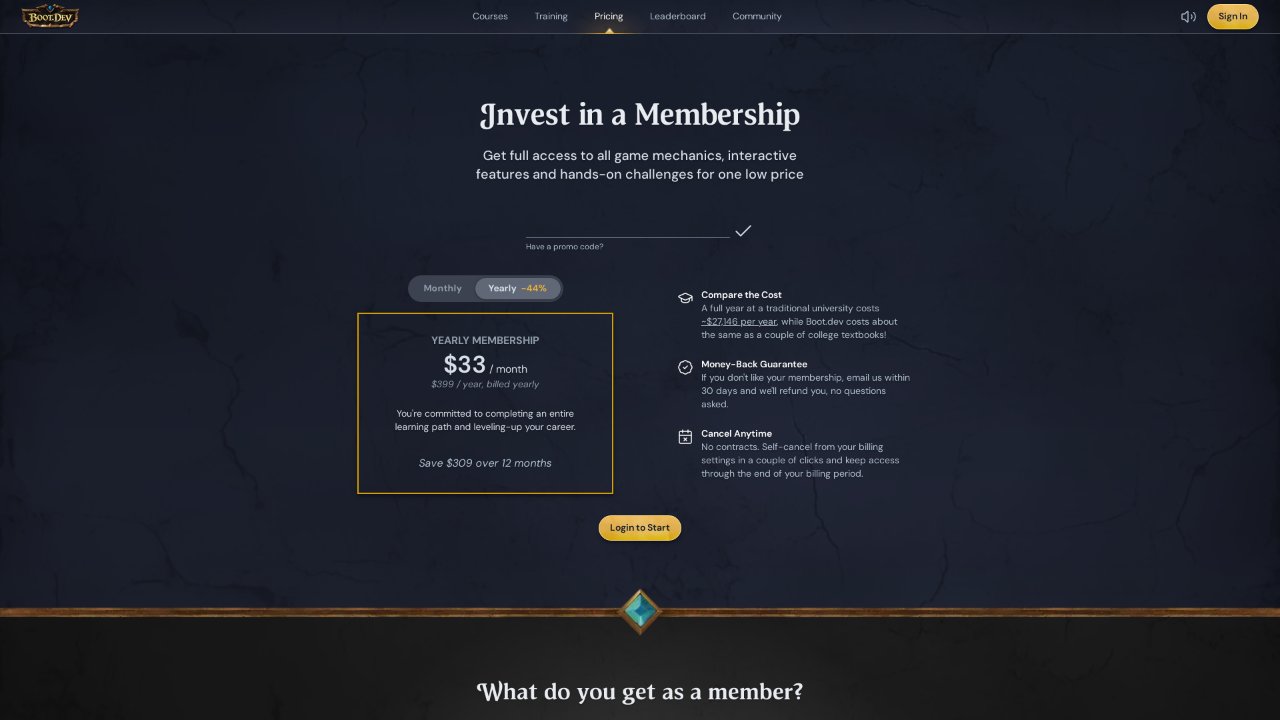
| Cost | All course content free to read; interactive features require membership: 399/year (as of 2026-09-30) |
| Sign-up | No account needed to demo the first chapters of each course; a free account unlocks full interactivity for those chapters |
| Interface language | English only |
| Platform | Web-only (learn and code in the browser); no native mobile app |
Background
Boot.dev was founded by Lane Wagner. In an official blog post he wrote "since I launched in the summer of 2020," dating the platform's launch to summer 2020. The About page says he originally built the curriculum for his wife, an X-ray technician transitioning into software engineering, who became the first student. The platform was formerly named Qvault; an April 2022 announcement moved it to Boot.dev and described the company as "bootstrapping" (self-funded). No funding announcements appear on the site or blog as of 2026-09-30. The careers page describes "a small team of developers," and the team handbook documents remote, asynchronous work. Instructors listed on the homepage include The Primeagen, TJ DeVries, and Sarah Schulte; the site says courses are taught by engineers who have worked at companies such as Netflix, SourceGraph, and Reputation.
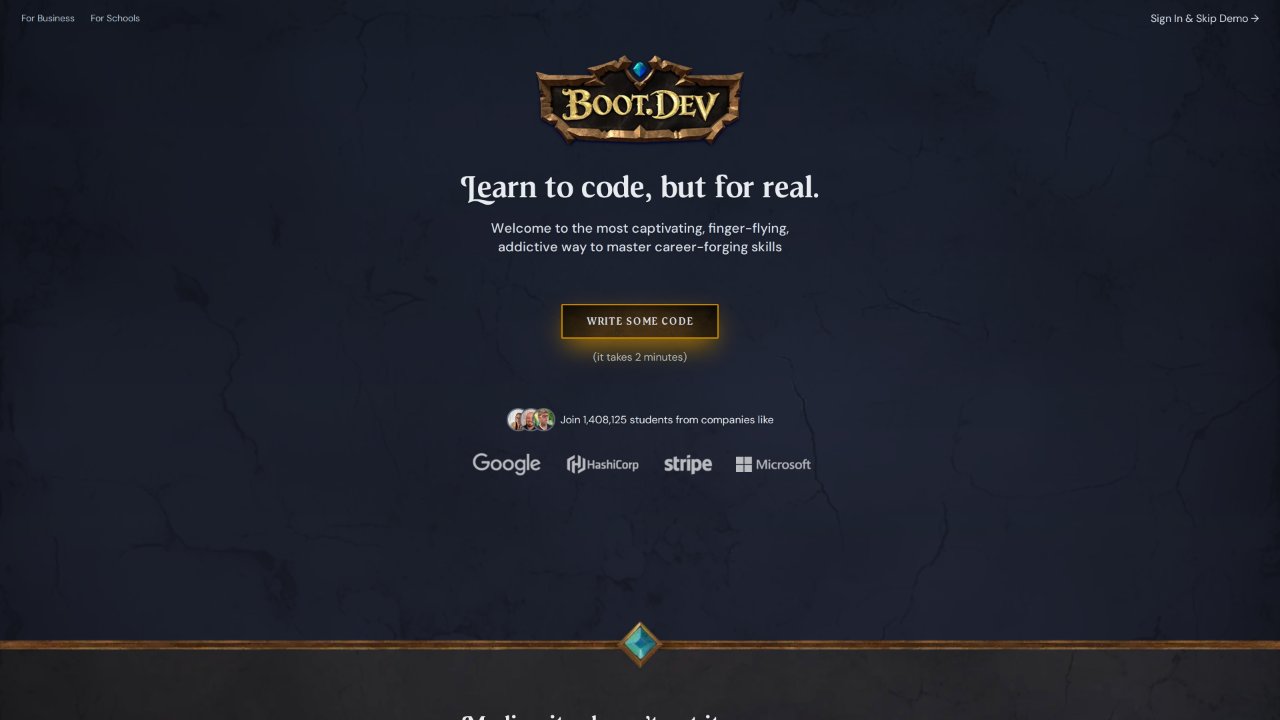
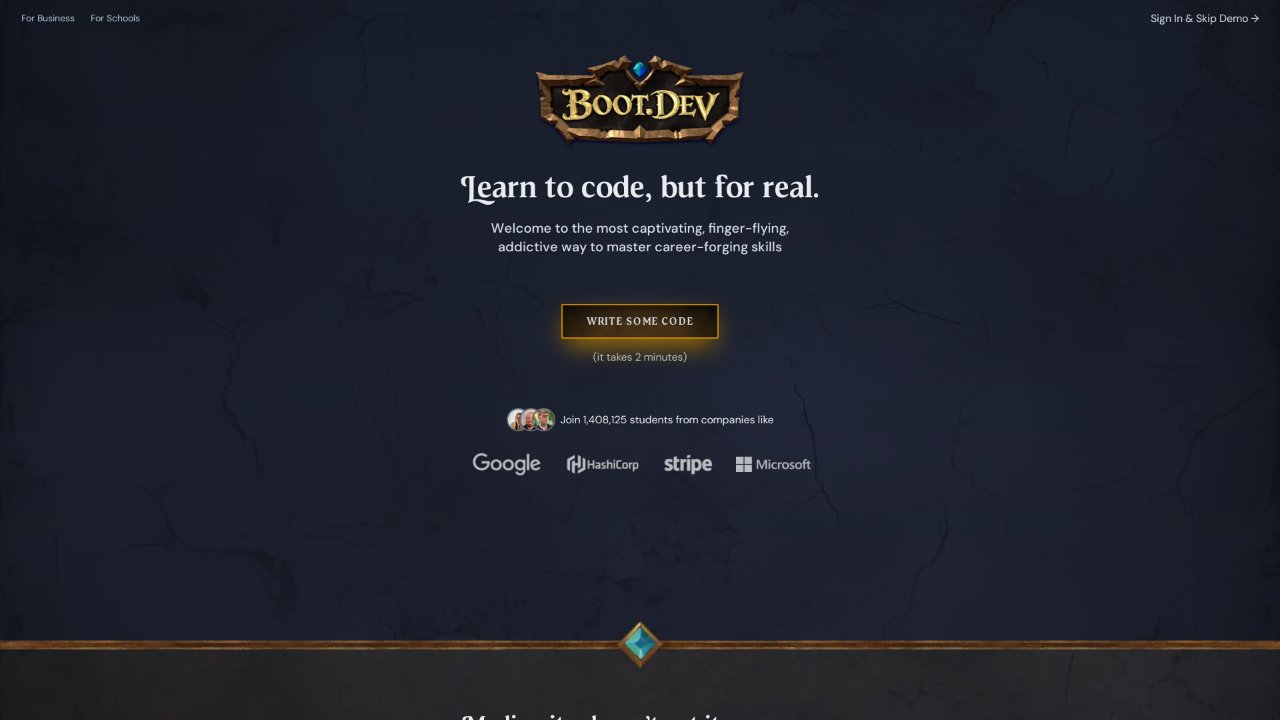
Live counters on the homepage (as of 2026-09-30; self-reported, no third-party verification): 1,408,125 students, 61.6M lessons completed, 404K courses completed, 12.5B XP awarded, and 7,122 user reviews.
Core Capabilities
Gamified back-end development courses
The homepage offers three career learning paths: Backend Path (Python/Go or Python/TS), DevOps Path, and Data Analyst Path. The course catalog lists 51 courses and projects (as of 2026-09-30), covering Python, Go, TypeScript, JavaScript, and SQL, plus topics such as Linux, Kubernetes, Git, Docker, RabbitMQ, data structures and algorithms, and cryptography. The most-enrolled course is Learn Python for Beginners (856,308 enrolled, 168 lessons, about 30 hours). The company says completing a full career path takes roughly 12 months of part-time study and cites 2025 Stack Overflow survey salary data to argue for back-end demand.
In-browser coding with automatic grading
Exercises are completed in a built-in browser code editor and graded automatically. According to the September 2026 official changelog, Python course grading was migrated from an in-house runner to pytest (nearly 500 files updated), the editor gained font, word-wrap, and Vim-mode settings, and the Go environment was upgraded to Go 1.27.
RPG mechanics and Boots, the AI tutor
XP, achievements, and quests are member features; official updates describe a loot-chest system (Rare/Mythic chests and various items) and boss fights reworked in August 2026. The site also has a Leaderboard and Guilds. Boots, the AI tutor, is a "wizard bear that codes" mascot: per the official wiki, each lesson's explanation, prompt, and solution are preloaded as context, and Boots is instructed to use Socratic questioning rather than giving answers directly. A gamified constraint applies: asking Boots for help costs a "Baked Salmon" item, otherwise the exercise's XP reward is cut by 50% — the company says this is deliberate so students use it "only when truly needed." Voice input for talking to Boots was added in September 2026.
Companion tools and community
The platform also includes Training Grounds (challenge mode), a Playground (online runtime), Spellbooks (interactive cheat sheets), instructor solutions, and progress/portfolio tracking. The community runs on Discord and Guilds, alongside the Backend Banter podcast and YouTube/X accounts. Content is written by the Boot.dev team and collaborating instructors; a monthly "The Boot.dev Beat" post discloses new courses and patches, and the catalog notes each course's release or major-update date (e.g., Learn Python "Last updated Sep 2026").
Pricing and Membership Benefits
- Free tier: the company states that all course content is free (lessons, explainer videos, and starter code, not just the first chapters); however, interactive features are free only for the first few chapters of each course, after which the account enters read-only mode (no submissions, quizzes, or interactive features).
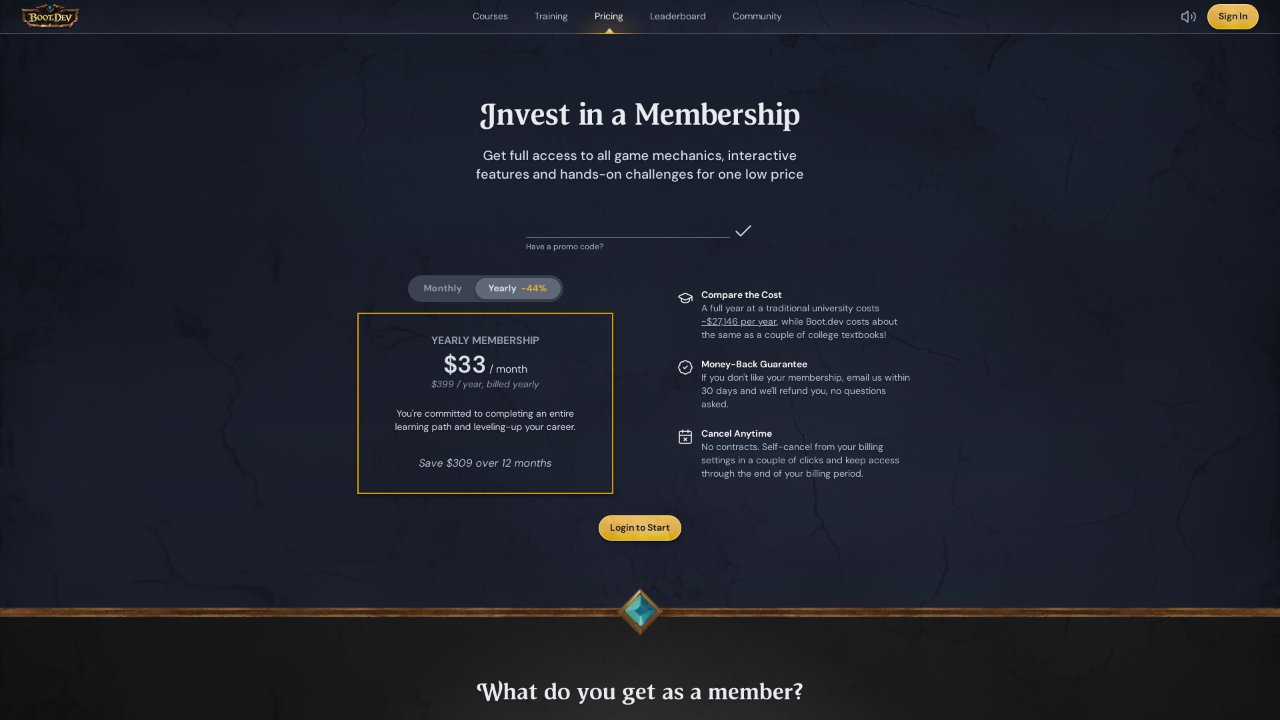
- Paid tiers (as of 2026-09-30, pricing page): monthly at 399/year](https://www.boot.dev/pricing), displayed as 309 over 12 months" labels, billed annually.
- No lifetime plan: the company explains that interactive features such as AI conversations carry ongoing costs, so lifetime purchases "don't really make sense."
- Refunds and cancellation: email refund within 30 days, "no questions asked"; self-serve cancellation from billing settings at any time, no contracts.
- Purchasing power parity (PPP): the FAQ confirms country-based PPP pricing; an official update says discounts apply automatically in about 90 countries.
- Other purchase options: gift codes (one-time, expire at term end), team/organization plans (For Business / For Schools), and employer expensing; payments run through Stripe, and the entity is US-based.
- Membership includes certificates of completion; free/read-only users cannot earn them because completion cannot be verified.
Accounts and Access
- Guest demo: the FAQ states guests can demo the first few chapters of each course; the homepage offers an instant coding demo that "takes 2 minutes."
- Free account: signing up is free and unlocks full interactivity (grading, quizzes) for the opening chapters; unpaid accounts then drop to read-only mode.
- Paid membership: unlocks all interactive features, gamification mechanics, and certificates.
- Organization accounts: team plans for businesses (For Business) and schools (For Schools).
- Platform: web-only; no App Store or Google Play links were found on official pages as of 2026-09-30. The company continues to improve the mobile browser experience, such as unhiding editing tools on small screens and adding voice input.
Good Fit For
- Learners who want a structured path into back-end development, DevOps, or data analytics and prefer writing code over watching video lectures.
- People who rely on gamified external motivation (XP, leaderboards, guilds) to keep studying.
- Learners comfortable reading English (interface and courses are English-only).
- Self-taught learners who accept a roughly 12-month part-time timeline and will build and deploy their own portfolio; also businesses or schools buying training in bulk.
Limitations
- English-only interface and courses, with no Chinese or other language versions (no hreflang tags or language switcher found as of 2026-09-30).
- No front-end framework (React/Vue) career path — the company explicitly says it does not teach HTML/CSS/JS frameworks because such resources are already abundant, so it is a poor fit for aspiring front-end developers.
- Certificates are completion certificates, not degrees or accredited credentials: an official blog post calls them an "informal CS certification", and no accreditation claims appear on the site.
- The free tier is effectively read-only: grading, quizzes, XP, Boots, and certificates all require payment, so free users cannot verify their learning.
- No native mobile app; phones rely on the mobile browser.
- The 29.99); the company offsets this with the yearly discount and PPP pricing.
- No job guarantee; the company says reaching "job ready" on the back-end path typically takes about 12 months but depends on individual effort.
Comparable Sites
- freeCodeCamp: a 501(c)(3) charity (founded by Quincy Larson in 2014), donation-supported and 100% free, including free verified certifications (about 300 hours each); project-driven, covering front-end through full-stack, with a multilingual website (including Simplified Chinese). Key differences from Boot.dev: free vs. subscription, charity vs. commercial company; neither offers accredited credentials.
- Codecademy: a commercial company under Skillsoft. Free Basic plan plus subscriptions: Plus at 29.99/month, Pro at 39.99/month, and a $54.99/month (annual) tier with live bootcamps; paid tiers include certificates. It covers a wider range of subjects (AI, data, programming, cybersecurity, front-end web development, interview prep), including live bootcamps/workshops. Versus Boot.dev: Boot.dev has the lower annual total and deeper back-end focus with gamification; Codecademy has the lower monthly entry price and broader catalog.
- Exercism: funded by community donations and philanthropic grants, advertised as "100% free, forever"; positioned around practice plus mentoring, with exercise tracks in 83 programming languages (per the about page; the homepage navigation says 65+) and human mentoring, not a structured career curriculum. Versus Boot.dev: Exercism emphasizes exercise volume and mentor feedback with no career-path or certificate narrative; Boot.dev offers linear career paths with gamification.
Note: Boot.dev's own blog hosts a "Boot.dev vs Codecademy" comparison post; it reflects the company's own position and should be read with that conflict of interest in mind.
References
- Boot.dev homepage / FAQ / About / Course catalog / Pricing / Careers
- Are Boot.dev Courses Free?
- All Coding Courses on boot.dev Are Now Free to Audit
- Qvault is moving to Boot.dev
- The Boot.dev Beat. September 2026 / Boot.dev Beat. February 2023
- Boots, a Wizard Bear that Codes / Boot.dev Team Handbook
- Certificates vs Diplomas in Computer Science
(All pages above were checked on 2026-09-30.)