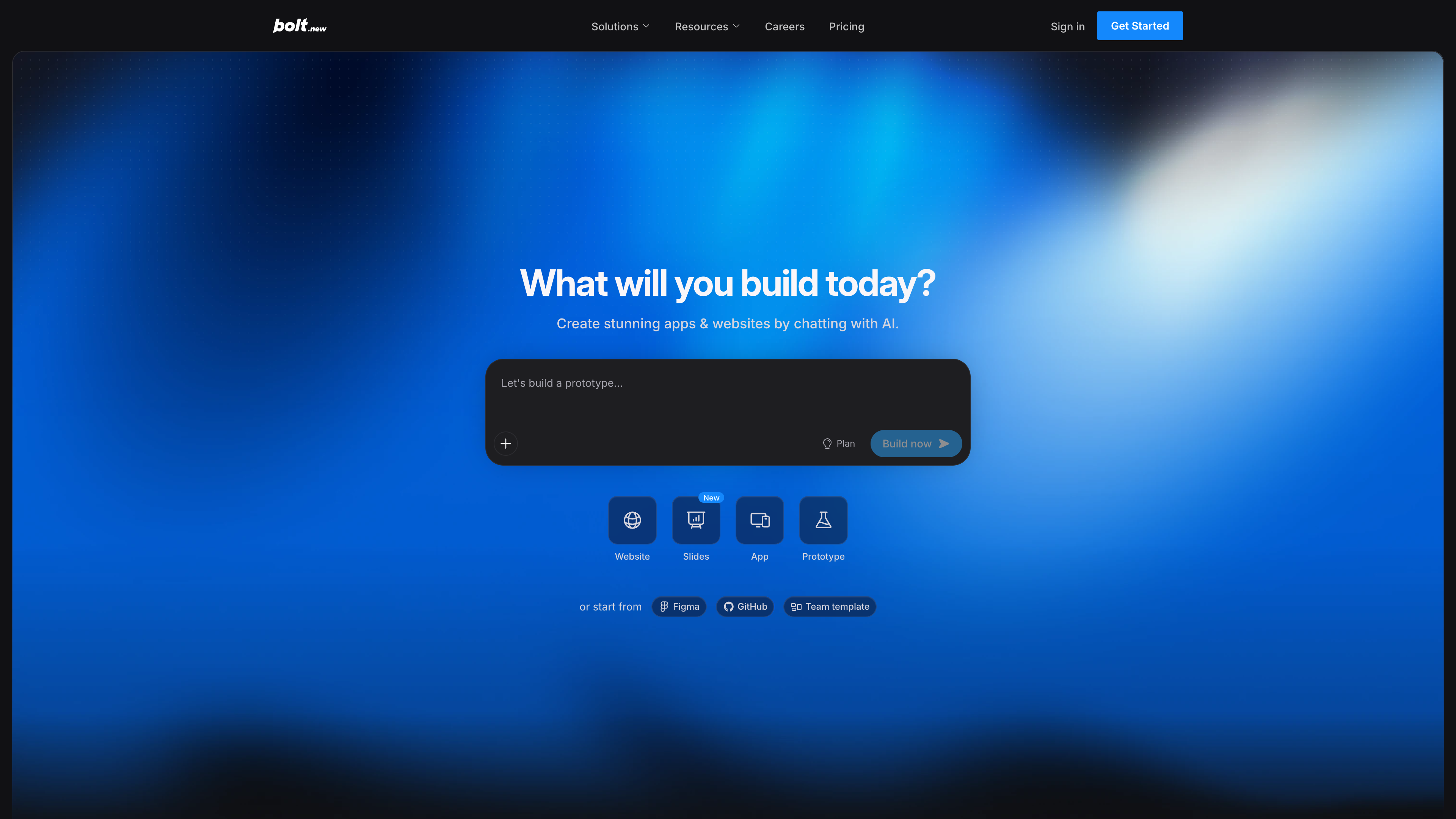
Bolt (bolt.new) is an AI app-building platform launched in October 2024 by StackBlitz, a San Francisco company: you describe what you want in plain language, and an AI agent generates, runs, debugs, and deploys a complete full-stack web application — entirely in the browser, with no local setup. Its verifiable difference from "AI that writes code snippets" tools is the underlying technology: StackBlitz's own WebContainers run a real Node.js runtime natively inside the browser's security sandbox, so the AI doesn't just write code — it installs npm packages, starts dev servers, reads terminal errors, and fixes them itself in a closed loop. After launching on October 3, 2024, Bolt went from zero to roughly $40M in ARR within five months (per the company), making it one of the fastest-growing products in the prompt-to-app category. It's listed here for its representativeness in browser-based AI full-stack development, and because its turnaround and growth are unusually well documented in first-hand sources.
At a Glance
- URL: https://bolt.new/
- Type: In-browser AI full-stack app builder (agentic dev environment + built-in backend and hosting)
- Pricing: Free tier (300K tokens/day, 1M tokens/month); Pro 30/member/month; Enterprise custom; plus Bolt Lite at $9/month (limited-time enrollment, closes 2026-10-14). As of 2026-09-19, see the official pricing page
- Account: A Bolt account is required; the free tier works immediately after signing up. Free users get community support via Discord; paid plans get email support (official help center)
- Interface language: English only; no other languages observed
- Launched: October 3, 2024 (Business Insider)
Background
Bolt comes from StackBlitz, founded in 2017 by Eric Simons and Albert Pai. The company spent its early years building browser-based online IDEs, and in May 2021 unveiled its core technology, WebContainers — a WebAssembly-based runtime that runs Node.js entirely inside the browser, booting in milliseconds with all execution confined to the browser sandbox (official announcement). Commercial traction, however, eluded it for years: according to an in-depth Business Insider report from May 2025, the company ended 2023 with only about $80K in annual revenue, and the board issued an ultimatum that December.
The turning point came in June 2024, when Anthropic released Claude 3.5 Sonnet — the first model whose coding ability cleared the practical bar. A team of roughly ten built Bolt on top of WebContainers in about three months, and the CEO launched it with a single tweet on October 3, 2024. What followed is documented in company statements and reporting:
- First month: ARR went from zero to about $4M; paying customers grew from ~600 to over 14,000 (Business Insider, citing the CEO's investor email).
- December 2024: ~$20M ARR (Business Insider).
- January 2025: a $105.5M Series B led by Emergence Capital and GV (official announcement).
- March 2025: $40M ARR, 3M registered users, ~1M monthly actives, with a team of just 15–20 (Lenny's Podcast interview with the CEO).
- May 2025: the CEO said registered users had reached 5M and the company was profitable (Business Insider). From late May through June, Bolt ran the "World's Largest Hackathon" with $1,037,500 in prizes and 128,334 participants (Devpost event page).
- October 2, 2025: Bolt v2 shipped with a multi-agent architecture plus built-in database, hosting, auth, and payments (official announcement).
- May 5, 2026: a Microsoft partnership brought Bolt to the Microsoft Marketplace, Azure deployment, and Microsoft 365 / Teams integration (official announcement).
- September 14, 2026: Bolt launched Forge, an agent running exclusively on open-source models, and Bolt Lite, a $9/month plan (official explainer, Bolt Lite page).
Core Capabilities: A Closed Loop from Prompt to Production
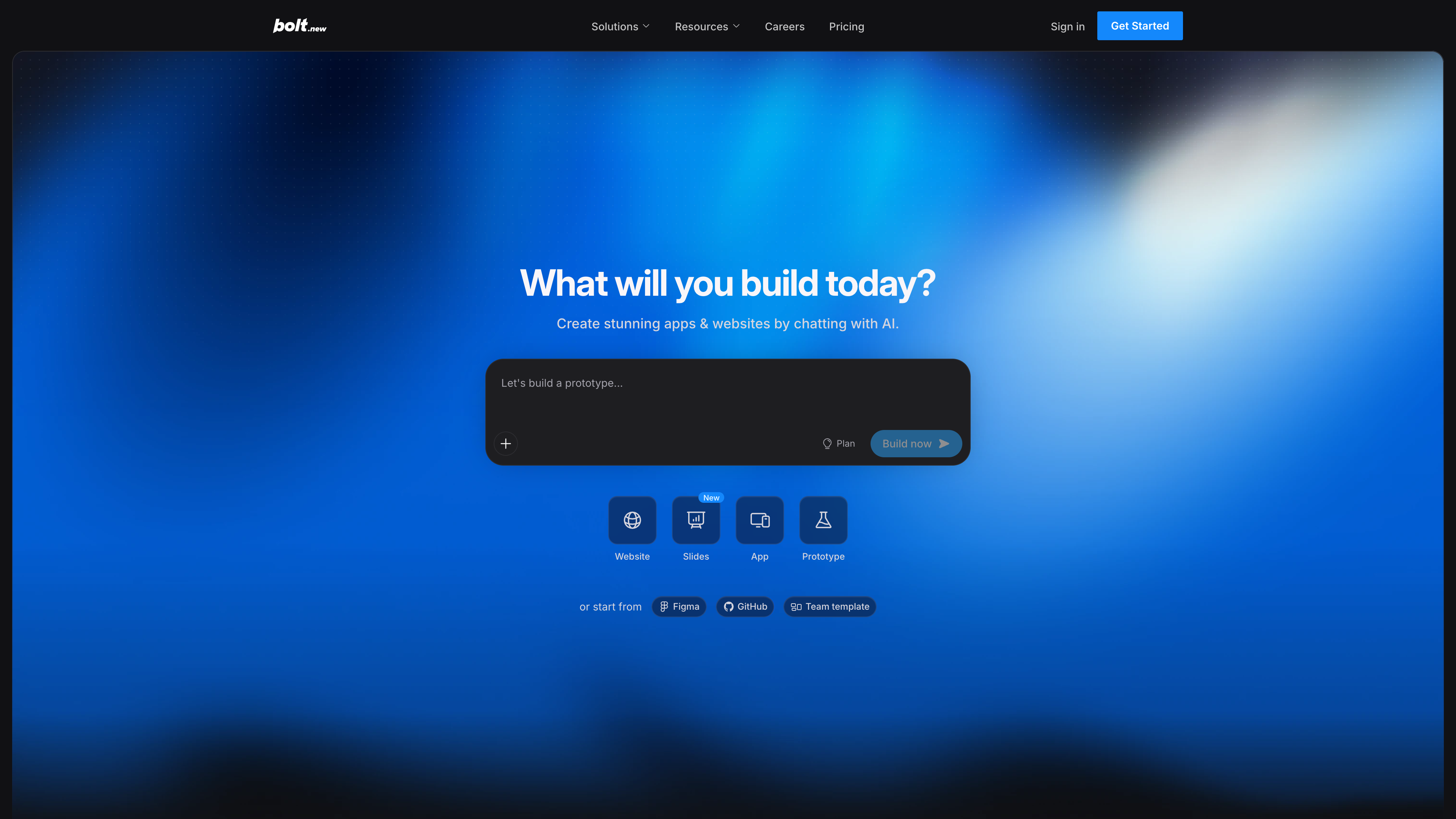
The homepage above: describe what you want to build in the input box, or start from a Figma design, a GitHub repo, or a team template. The four quick-start chips — Website, Slides, App, Prototype — map to sites, presentations, apps, and prototypes.
The AI agent controls the whole environment. Unlike tools that only emit code, Bolt's agent operates the entire dev environment: the filesystem, the Node server, the package manager, the terminal, and the browser console (GitHub repo description). It installs dependencies, runs builds, reads errors, and iterates on fixes by itself; the company claims v2's autonomous debugging cuts error loops by 98% and handles projects roughly 1,000x larger (company claim, see the Bolt v2 announcement). As of September 2026, the agent picker offers Standard, Max, and Forge agents, and Bolt also routes each task to a model automatically.
The WebContainers browser runtime. Project code runs as real Node.js inside the browser sandbox — millisecond startup, no cloud VM per build — and can install and run mainstream JavaScript toolchains like Vite, Next.js, and Astro, with direct Chrome DevTools debugging (WebContainers announcement). This is Bolt's main architectural difference from competitors that spin up cloud containers per project.
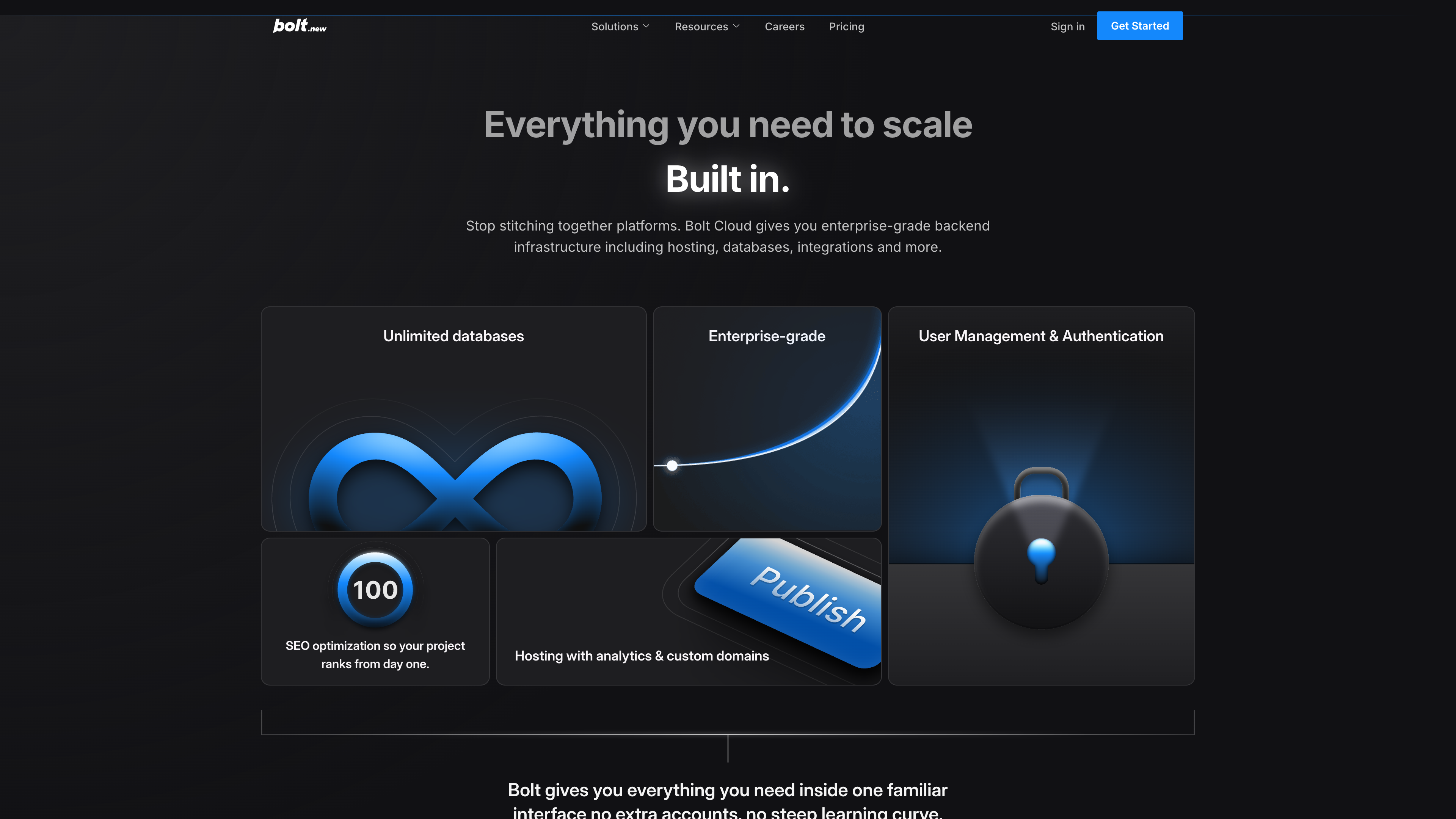
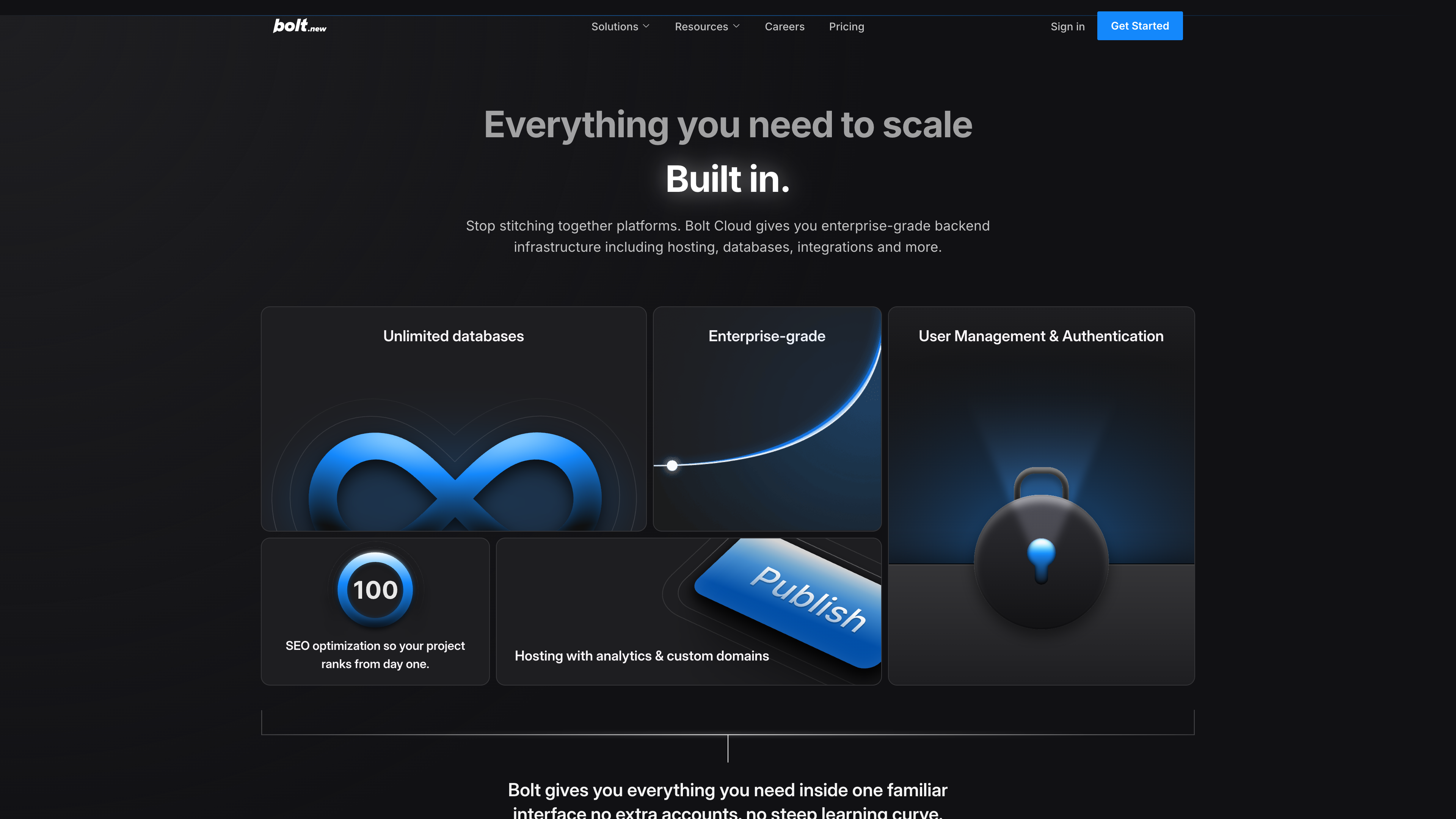
Built-in backend and hosting (Bolt Cloud). Since v2, Bolt integrates databases, user authentication, file storage, hosting, SEO pre-rendering, and Stripe payments into the same interface: the agent can provision a database and tables as needed, set up sign-in, and publish to a bolt.host domain or a custom domain (Bolt v2 announcement, homepage section above). The integration ecosystem also covers Supabase, GitHub version sync, Figma import, and Expo for generating React Native mobile apps.
Templates and collaboration. Bolt operates the Bolt Templates marketplace — dashboards, storefronts, portfolios, and other starting points you can fork — and the Teams plan adds shared workspaces, centralized billing, and admin controls (official help center).
Pricing and Accounts
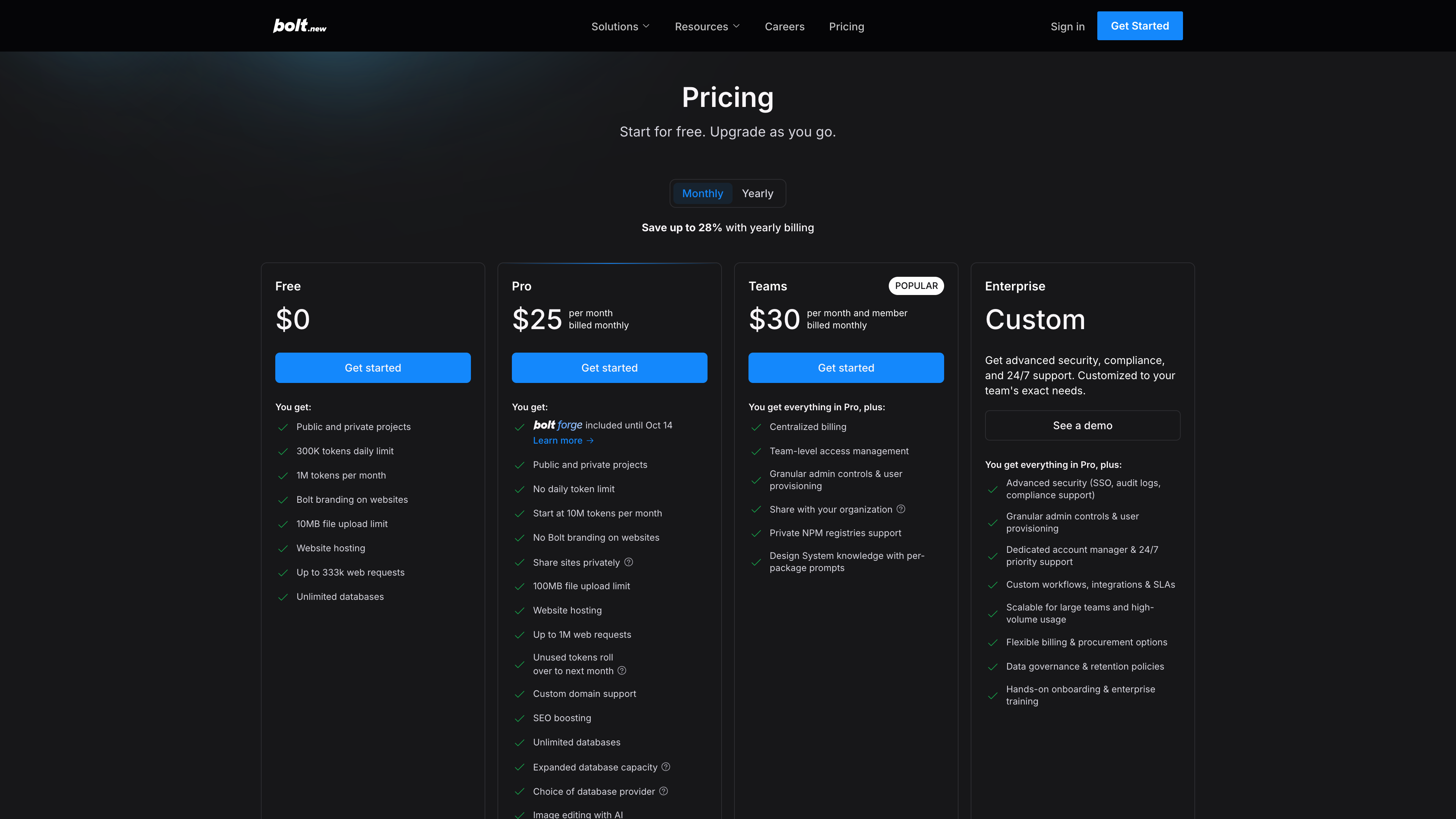
Bolt bills by subscription tier plus AI token usage. Per the official pricing page as of 2026-09-19:
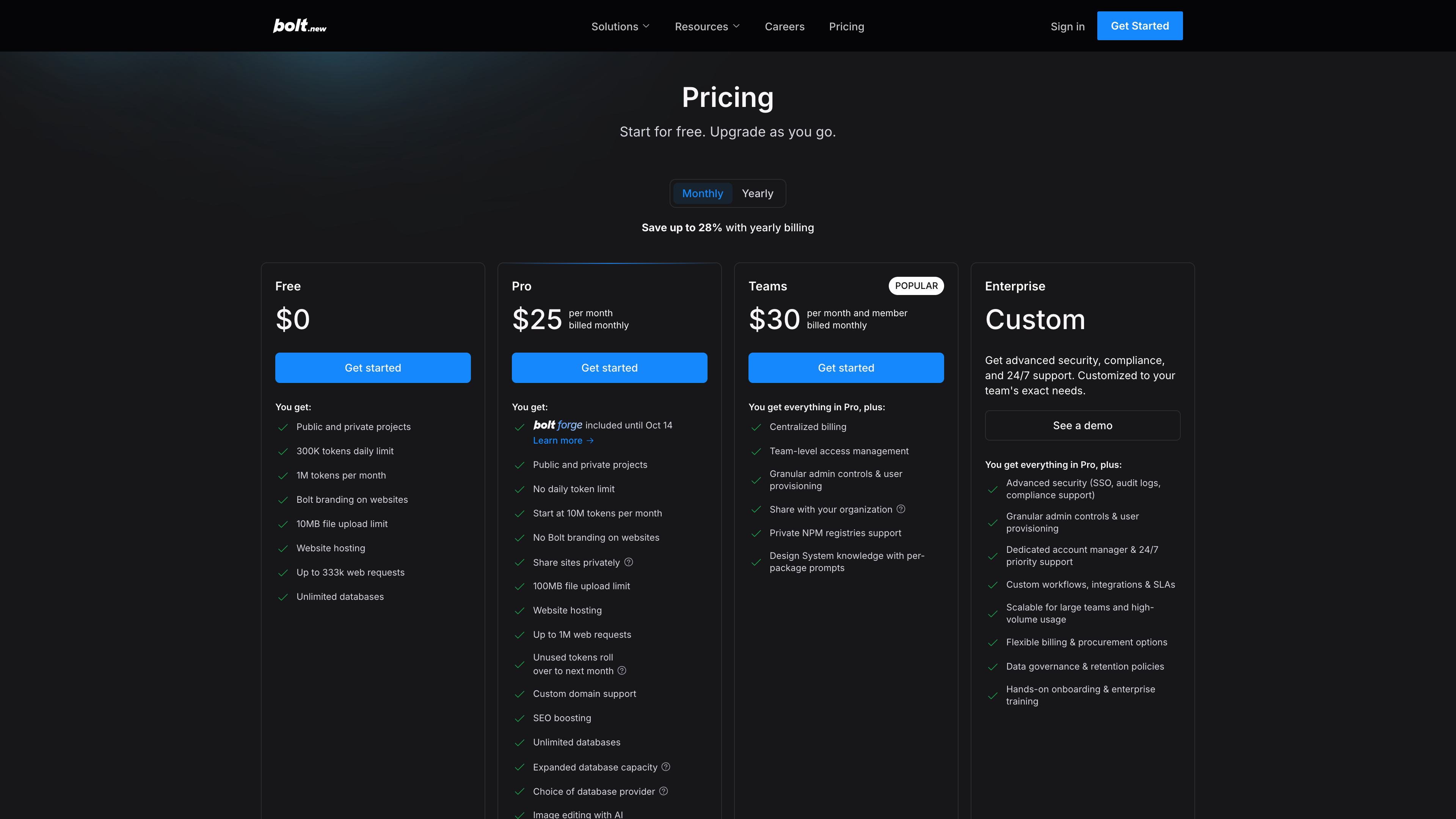
- Free ($0): 300K tokens per day and 1M per month; public and private projects; Bolt branding on published sites; hosting and unlimited databases included. Suitable for evaluation and small experiments.
- Pro ($25/month billed monthly; yearly billing saves up to 28%): no daily cap, starting at 10M tokens per month; no branding, custom domains, SEO boosting, private sharing, 100MB upload limit; unused tokens roll over for one additional month.
- Teams ($30 per member/month): everything in Pro, plus centralized billing, team access management, org-wide sharing, private NPM registry support, and design-system knowledge; token allotments are per member and not shared.
- Enterprise (custom): SSO, audit logs, compliance support, a dedicated account manager, 24/7 support, and more.
- Bolt Lite ($9/month): an entry plan introduced in September 2026, powered by the open-model Bolt Forge mode; enrollment closes 2026-10-14 and access is released in waves via waitlist (Bolt Lite page).
Two things about the token model are worth understanding before paying (official pricing FAQ): first, most token usage comes from syncing your project's filesystem to the AI, so the larger the project, the more each message costs; second, since July 1, 2025, unused tokens from a paid subscription roll over for one additional month (valid for up to two months total), but an active paid subscription is required to use rolled-over tokens. On the free tier, hitting the token limit pauses AI interactions until the daily reset.
Open Source and Platform Access
Bolt's launch codebase was open-sourced under MIT at stackblitz/bolt.new (16.6K stars as of 2026-09-19), but the repo hasn't been updated since December 2024 — it's effectively an early snapshot and far behind the live product. The officially maintained community fork, [stackblitz-labs/bolt.diy](https://github.com/stackblitz-labs/bolt.diy) (19.9K stars), is actively developed and lets you run locally with API keys for any LLM. Note that the underlying WebContainers runtime itself is proprietary, licensed through the WebContainers API and StackBlitz Enterprise (WebContainers announcement).
For enterprises, Bolt is now listed on the Microsoft Marketplace, can deploy generated apps into your own Azure tenant, and can be invoked from Microsoft 365, Copilot, and Teams (official partnership announcement).
Who It's For
- Founders and PMs validating ideas fast: turn a PRD or a one-line idea into a running full-stack prototype — database, sign-in, and payments included — before committing engineering resources.
- Developers who want instant scaffolding: start from a prompt on a familiar JavaScript/TypeScript stack (Next.js, Astro, Vue, etc.), then take over the code and keep working via GitHub sync.
- Marketing and campaign pages: templates + prompt generation + built-in hosting and SEO pre-rendering cover the "landing page live today" need.
- Students and learners: a complete full-stack workflow with zero local setup; the free and $9 tiers lower the barrier (English-only UI).
- Teams with procurement and compliance requirements: Microsoft Marketplace purchasing, own-tenant Azure deployment, SSO, and audit logs make an enterprise evaluation path feasible.
Limitations
- Token burn scales with project size, and costs are hard to predict. The official FAQ acknowledges that most tokens go to syncing project files, so larger projects cost more per message; the community is full of reports of rapid token drain and fix-it loops. As of 2026-09-19, reviews on Trustpilot skew heavily toward 1 star, with complaints centered on token consumption, charges after cancellation, slow support, and unstable output — though some long-term users report good results with precise prompting and GitHub checkpoints. This is an aggregation of user feedback; individual experience varies.
- JavaScript/TypeScript ecosystem only. WebContainers run Node.js in the browser; native runtimes for Python, Ruby, and other languages aren't supported. npm packages touching system-level calls or native binaries may not work, and browser memory bounds very large projects.
- Unstable generation quality is a category-wide problem. Past a complexity threshold, AI builders — Bolt included — can produce apps that work in preview but fail after deployment. The "98% fewer error loops" figure for v2 is the company's own metric without third-party verification; serious projects still need human review of code and architecture.
- The open-source repo has diverged from the product. The bolt.new repository on GitHub stopped updating in December 2024; keeping up with new capabilities means using the closed-source hosted service or the bolt.diy community fork.
- English-only interface (observed), with English-only documentation — a barrier for non-English speakers.
- Forge mode's data trade deserves attention. Bolt Forge exchanges "up to 50x free usage" for opted-in, de-identified build sessions used to train open models (off by default; Teams/Enterprise workspaces and sessions from the EEA, UK, and Switzerland are excluded). If you care about where your code data flows, keep the default off (official explainer).
Alternatives
- Lovable: a peer in prompt-to-app, oriented more toward non-technical users, with deep Supabase integration by default.
- v0: Vercel's generator focused on React/Next.js UI components, tightly coupled to Vercel deployment, without a full backend.
- Replit: a cloud IDE at its core, supporting 50+ languages and full Linux environments, with agent capabilities across a broader range of stacks.
References
- Bolt homepage (checked 2026-09-19)
- Bolt official pricing page and FAQ (checked 2026-09-19)
- Bolt help center (checked 2026-09-19)
- Bolt v2 announcement: The vibe coding revolution enters its next phase (2025-10-02, checked 2026-09-19)
- Bolt × Microsoft partnership announcement (2026-05-05, checked 2026-09-19)
- Bolt Forge official explainer (2026-09-14, checked 2026-09-19)
- Bolt Lite page (checked 2026-09-19)
- StackBlitz blog: Introducing WebContainers (2021-05-20, checked 2026-09-19)
- Business Insider: The inside story of how Silicon Valley's hottest AI coding startup almost died (2025-05-18, checked 2026-09-19)
- Lenny's Podcast: Inside Bolt: From near-death to ~$40M ARR in 5 months (2025-03-13, checked 2026-09-19)
- StackBlitz Series B announcement (X) (January 2025, checked 2026-09-19)
- World's Largest Hackathon official event page (Devpost) (May 30 – June 30, 2025, checked 2026-09-19)
- GitHub: stackblitz/bolt.new (MIT, launch-era open-source snapshot) (checked 2026-09-19)
- GitHub: stackblitz-labs/bolt.diy (official community fork) (checked 2026-09-19)
- Trustpilot: bolt.new user reviews (checked 2026-09-19)