BoardGameGeek (BGG) is an online board game database and hobbyist community. Anyone can look up ratings, reviews, photos, rules questions and secondhand listings without an account; a free account unlocks rating games, tracking a collection, posting in the forums, and trading. The site was founded in January 2000 by Scott Alden and Derk Solko and is operated by BoardGameGeek, LLC. Unlike publisher-run catalog pages, BGG's entries, ratings and content are contributed almost entirely by players. As of 2026-09-02, the database covers more than 150,000 games and the site has roughly 4 million registered users; the BGG Rank computed from those ratings is quoted by players, media and academic papers alike, and The New York Times called BGG "the hub of board gaming on the internet" in 2019.
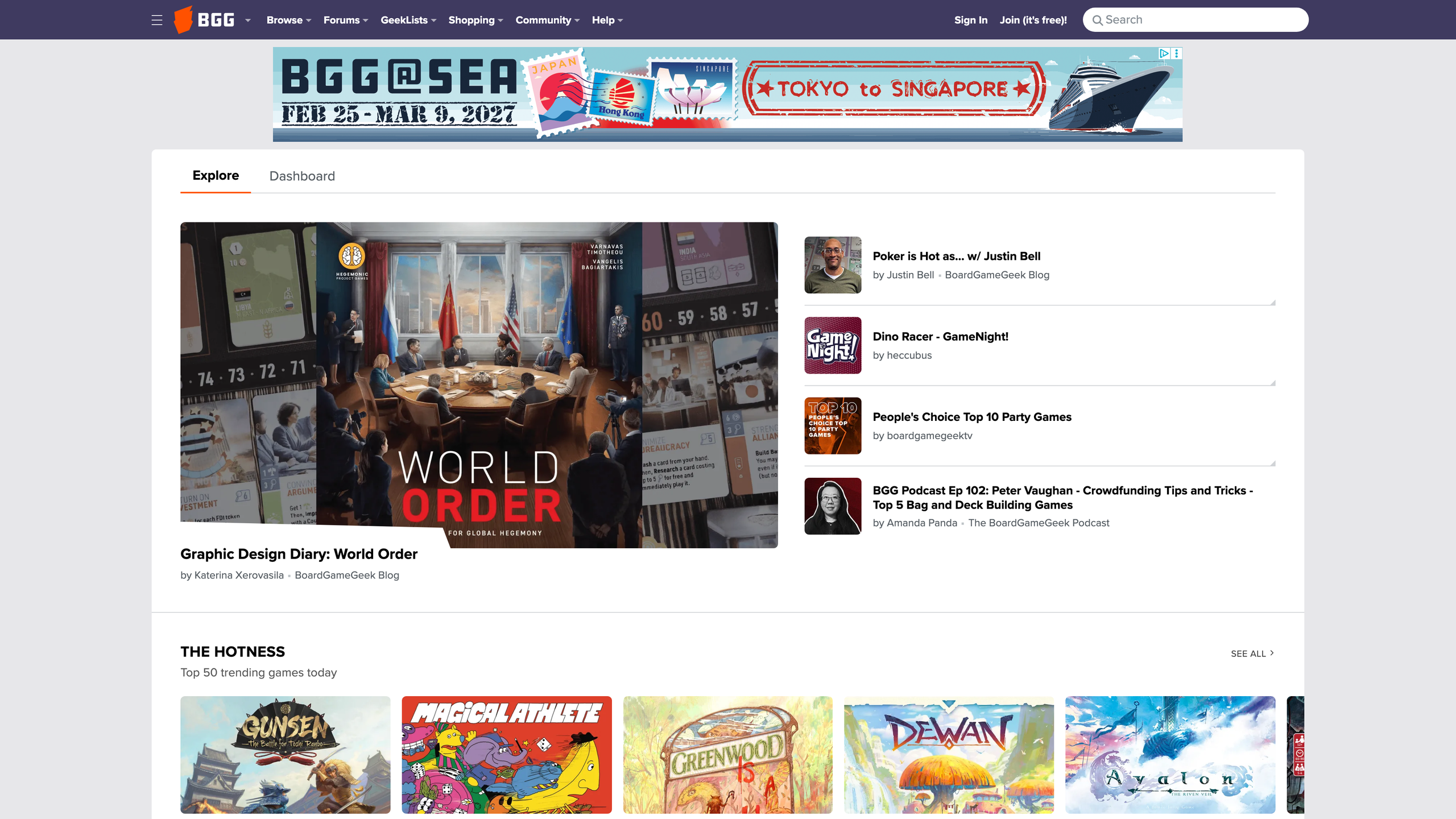
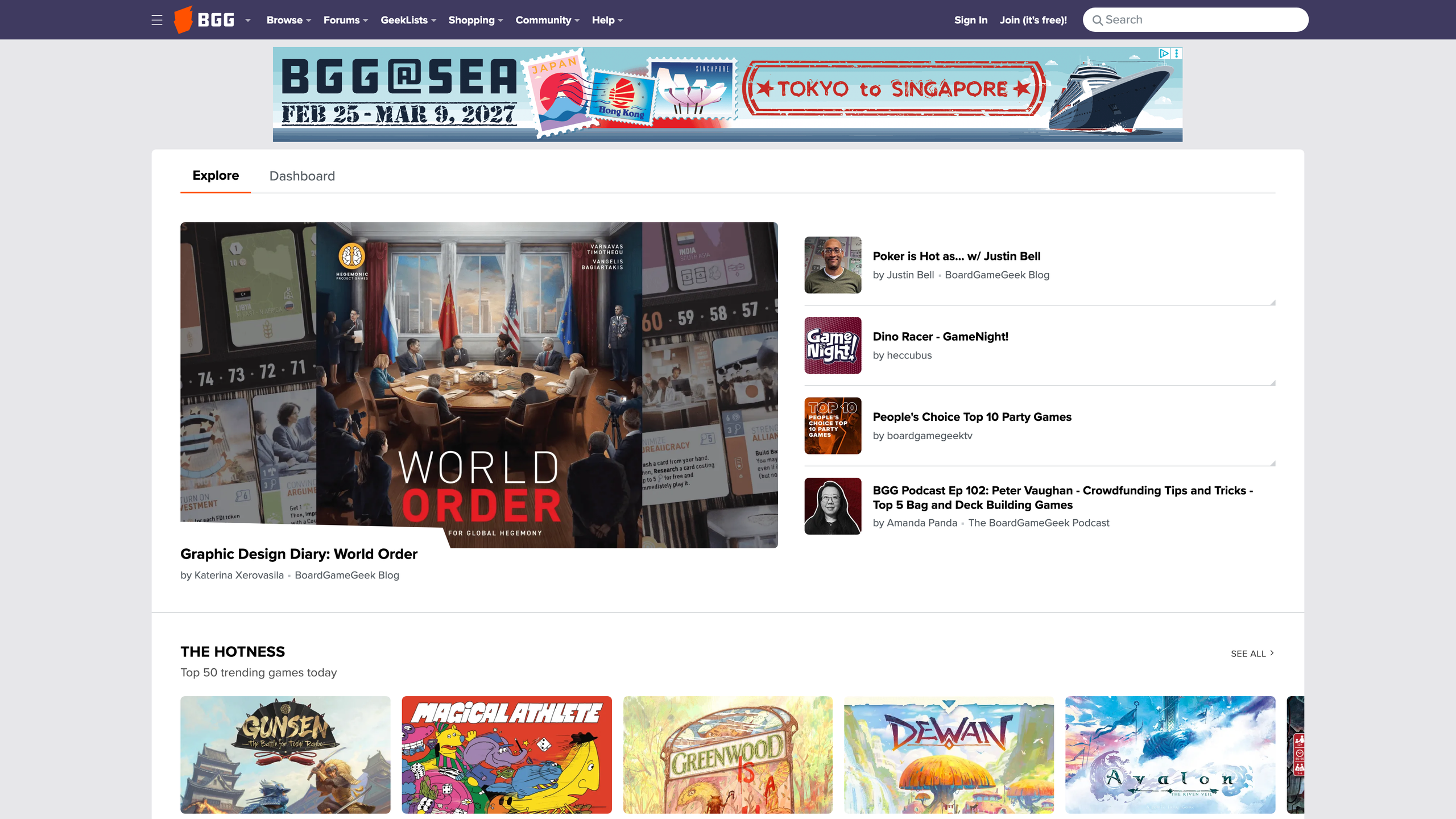
The homepage (captured 2026-09-02) shows how the site is organized: the top navigation splits into Browse (the database), Forums, GeekLists, Shopping (marketplace and store), Community and Help. Below featured blog and podcast posts sits "The Hotness — Top 50 trending games today", a daily trending chart. The banner at the top advertises BGG@SEA, the site's cruise event (Tokyo to Singapore, February 25 – March 9, 2027). Database, community content and offline events: all three sides of BGG are visible from the front page.
At a glance
- URL: https://boardgamegeek.com/
- Type: Board game database + user-generated community (forums, lists, secondhand market)
- Cost: Free. The site pledges it "will always be free for everyone" and is funded by ads, shopping commissions and user patronage (ad-free browsing from a $25/year support level)
- Registration: Not required for browsing; rating, posting, uploading and trading require a free account; the Terms of Service require account holders to be 18 or older
- Interface language: English only
- Launched: January 2000
- Operator: BoardGameGeek, LLC (founder Scott Alden is also the designated DMCA copyright agent)
- Sister sites: RPGGeek (tabletop RPGs) and VideoGameGeek (video games)
Background
BGG grew out of 3DGameGeek, a discussion site about 3D-graphics video games that Scott Alden had run since 1996. In January 2000, Alden and Derk Solko launched BoardGameGeek with the ambition of building the "worldwide definitive resource for board games"; Alden went full-time on the site in 2005, the same year the annual BGG.CON convention began. Since 2006 the site has presented the annual Golden Geek Awards, nominated and voted on by registered users and announced around March. (Sources: Wikipedia, BGG wiki)
BGG received the Diana Jones Award in 2010 and was inducted into the Origins Award Hall of Fame in 2020. In 2019 the site replaced its long-running mascot logo with a human "game flame" silhouette. In June 2025 it welcomed its 4,000,000th registered user.
The database and its ratings
At BGG's core is a cross-referenced database: games, expansions, designers, artists, publishers, families and mechanisms all interlink, and each game page aggregates publication data, player count and play time, a complexity "weight", images, files and discussions. According to figures cited by Wikipedia, the database held cross-referenced entries for 65,000 games and 18,000 designers by 2014, and passed 150,000 games in 2024.
Registered users rate games on a 1–10 scale, and the all-time BGG Rank is ordered by the Geek Rating. Per BGG's official FAQ as quoted and analyzed by recommend.games, the Geek Rating adds artificial "dummy" votes to the raw average so that games with very few ratings cannot shoot to the top; the exact algorithm is kept secret. Beyond the overall chart there are per-category rankings (strategy, family, party, wargames and more), plus "The Hotness", a daily trending list fixed to the homepage and sidebar.
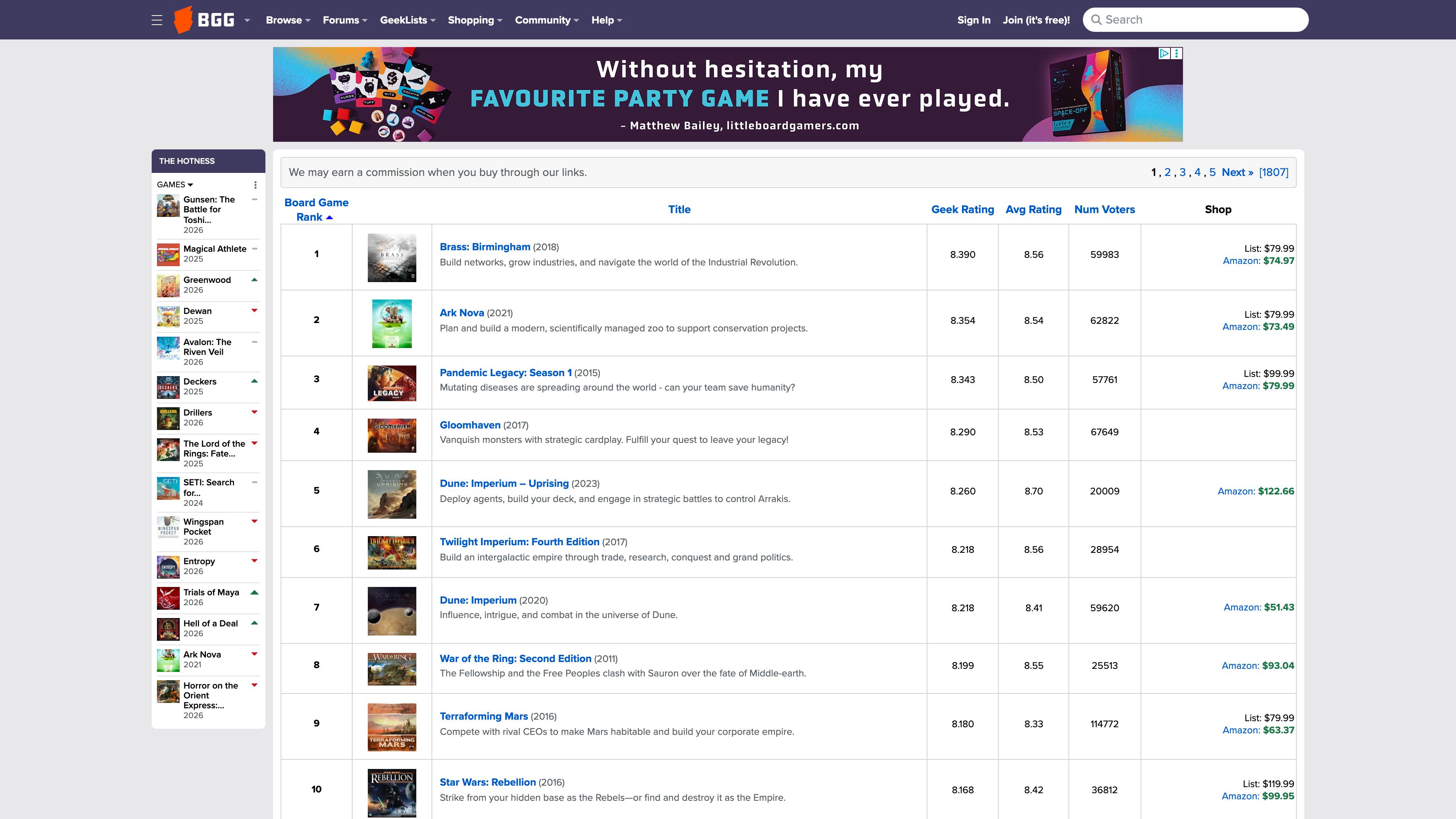
The overall ranking page on 2026-09-02 (above) was led by Brass: Birmingham, Ark Nova and Pandemic Legacy: Season 1, with Gloomhaven — the chart-topper for years — at number 4. The table shows the Geek Rating alongside the plain average rating and the number of voters, and a right-hand column lists retail prices and shopping links; a notice at the top states "We may earn a commission when you buy through our links."
Users also maintain personal collection lists (own, want to play, for trade) and log individual plays, data that doubles as both a personal archive and part of the site's statistics and API.
Community, lists and trading
- Forums: each game has its own subforum, where rules questions, session reports, reviews and variants are the staple content. The official welcome page describes the site as updated in real time by a "large and still growing user base".
- GeekLists: user-curated game lists ranging from beginner recommendations to a history of every number-one game — the site's native curation format.
- Geek Market and trades: members list games for sale and run large coordinated math trades; the welcome page says nearly a hundred trades pass through members' hands every day. An official merch store, BGG Store, also exists.
- Offline events: the annual BGG.CON convention (since 2005), the BGG@Sea cruise, and the Golden Geek Awards — per the official winners list, the 2025 Light/Medium/Heavy Games of the Year were Hot Streak, The Lord of the Rings: Fate of the Fellowship and Galactic Cruise.
Accounts and how the site is funded
Registration is free. On its support page BGG pledges that BoardGameGeek, RPGGeek and VideoGameGeek "will always be free for everyone", funded by a mix of advertising and community patronage: 25/year removes ads and unlocks extras such as historical trend charts. GeekGold, the site's virtual currency, is also earned by contributing images and files, and buys cosmetic badges and avatar frames. On top of that, shopping links on ranking and game pages carry an affiliate commission for the site.
The XML API
BGG has long published a public XML data API (the current version is XML API2) with read-only endpoints for things (game details including ratings and ranks), search, collections, plays, users, guilds, forums and threads, hot items and geeklists. A full-database CSV dump (names, IDs, ranks and average ratings) is also offered, and both are common data sources for board game analytics and academic research.
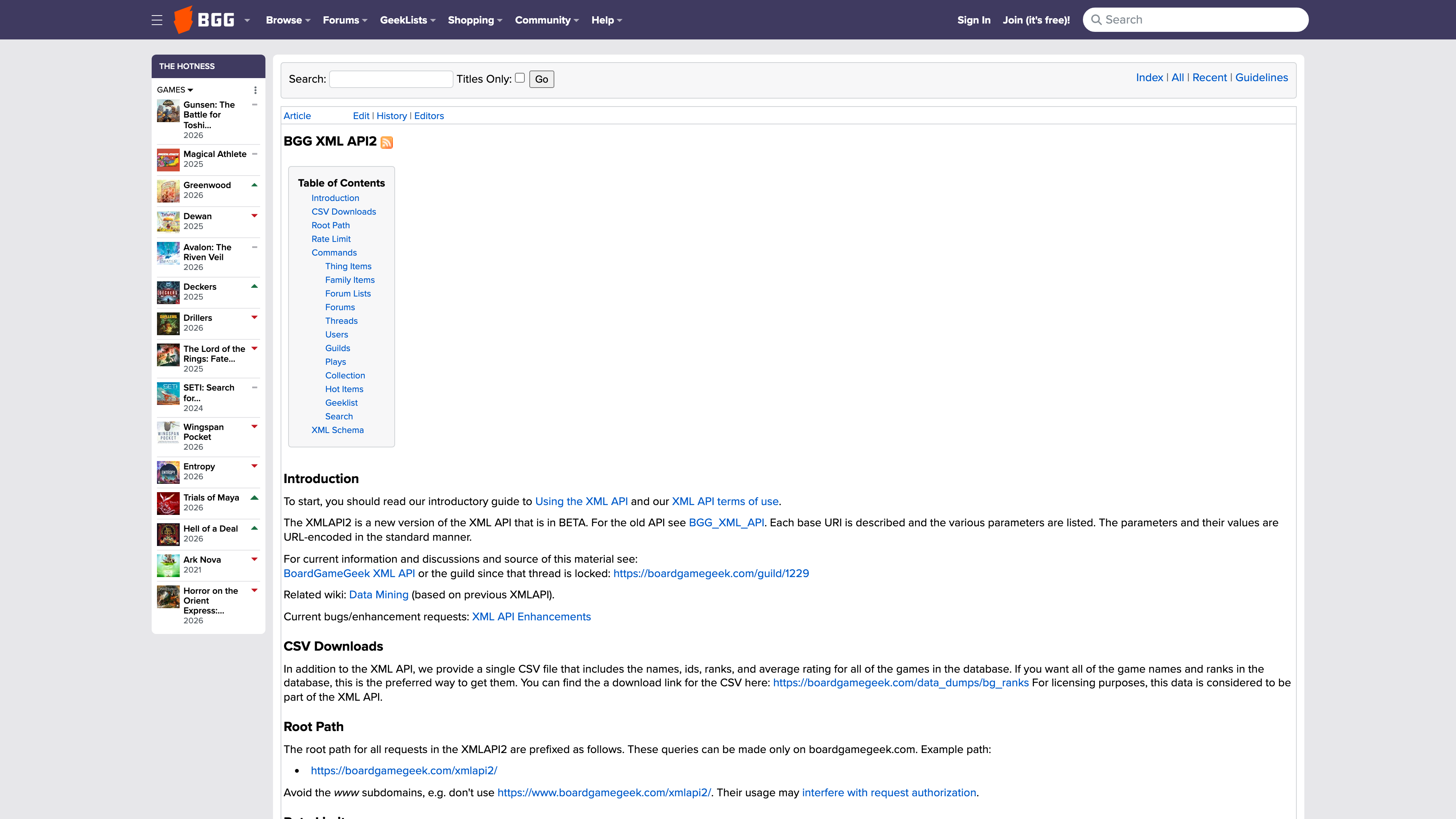
Above is the official XML API2 documentation: the table of contents lists every command, and the body explains the CSV dump and its licensing.
Note that BGG tightened the API's terms in 2025. Per the official guide dated 2025-07-02, nearly all API use now requires registering an application at boardgamegeek.com/applications (approval can take a week or more) and sending an Authorization: Bearer token with each request; narrow exceptions cover downloading your own collection or the CSV dump while logged in. Non-commercial licenses are generally free, while commercial licenses are priced case by case (with free tiers for small apps). Public-facing apps must credit BGG and display a "Powered by BGG" logo, and no technical support is provided. The XML API Terms of Use explicitly prohibit using the API — or any site data — to train AI or large language models, and ban services that resell access to the data.
Copyright and content policy
As a user-generated-content site, BGG's Terms of Service state that users keep ownership of their submissions (reviews, session reports, GeekLists, images, files, ratings and more), but uploading grants BGG a worldwide, non-exclusive, royalty-free, perpetual, sublicensable and transferable license, and grants other users a license to access and use the content through site features. Uploaders must warrant they hold the necessary rights; BGG may remove content without notice and may retain server copies of deleted submissions. Section 11 sets out a DMCA takedown process, with Scott Alden (dmca@geekdo.com) as the designated copyright agent.
One related fact worth knowing: the terms state that BGG "is not affiliated with or responsible for any mobile apps based on the Geek Websites" — there is no official BGG app, and every client in the app stores is a third-party product built on the XML API.
Where it fits
- Checking ratings, complexity weight and player-count fit before buying a game, plus reviews and rules answers
- Tracking the hobby's pulse: The Hotness, rank movements and the Golden Geek Awards
- Managing a personal collection and play history, and trading games secondhand
- Data analysis and research via the XML API or the full-database CSV (subject to license terms)
Limitations
- English only: entries and discussion are overwhelmingly in English; other languages need a translation tool.
- Ratings skew heavy: academic work (cited via Wikipedia) finds BGG users prefer longer, more complex games, so the overall chart systematically underrates light family and party titles.
- No official mobile app: on phones you rely on the website or third-party clients.
- Higher API barrier: since 2025, registration and approval are required, there is no official support, and licenses can be revoked — a policy risk for products built on BGG data.
- Platform-friendly content terms: uploads grant BGG a perpetual, transferable license and deleted content may persist in server copies; think twice before uploading original work you care about.
- Dense interface: the layout has changed little over the years and takes some getting used to.
References
- Welcome to BoardGameGeek (official wiki) (checked 2026-09-02)
- Terms of Service and Privacy Policy
- Support BGG (funding model and the "4 million of you" figure)
- Using the XML API (version 2025-07-02), BGG XML API2, XML API Terms of Use
- BoardGameGeek Golden Geek (official winners list)
- BoardGameGeek on Wikipedia
- BoardGameGeek Reaches 4,000,000 registered users (TableTok, June 2025)
- Reverse engineering the BoardGameGeek ranking (recommend.games; quotes and analyzes the official FAQ on the ranking algorithm)