bilibili (哔哩哔哩, nicknamed "B Site" / B站) is a Chinese video community whose defining feature is danmaku — viewer comments that scroll directly across the video as floating subtitles. Videos uploaded by creators (called "UP hosts," UP主) coexist with licensed anime, films, documentaries, and variety shows on the same site, alongside live streaming, mobile game publishing, and e-commerce. The site was founded in 2009 by Xu Yi under the name "Mikufans," is headquartered in Shanghai, and is dual-primary-listed on Nasdaq (BILI) and the Hong Kong Stock Exchange (9626). As of Q2 2026, it reported 371 million monthly active users, 116.5 million daily active users (+7% year over year), and an average daily time spent of 113 minutes (figures checked 2026-09-02). Compared with YouTube-style platforms, its most verifiable differences are the danmaku culture, a quiz-gated membership system, and a long-standing public pledge by management — so far broadly kept — not to put pre-roll ads in front of videos.
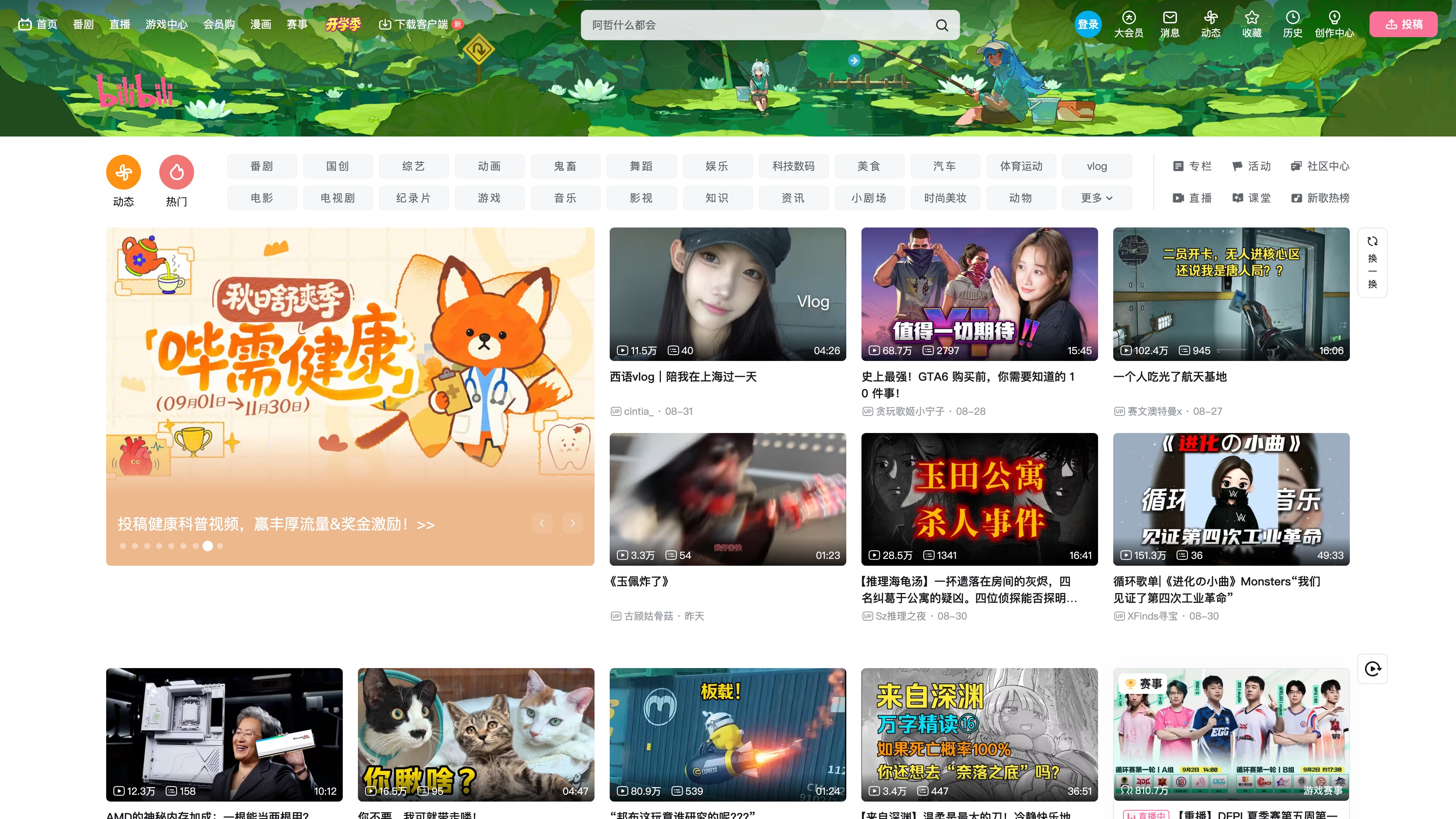
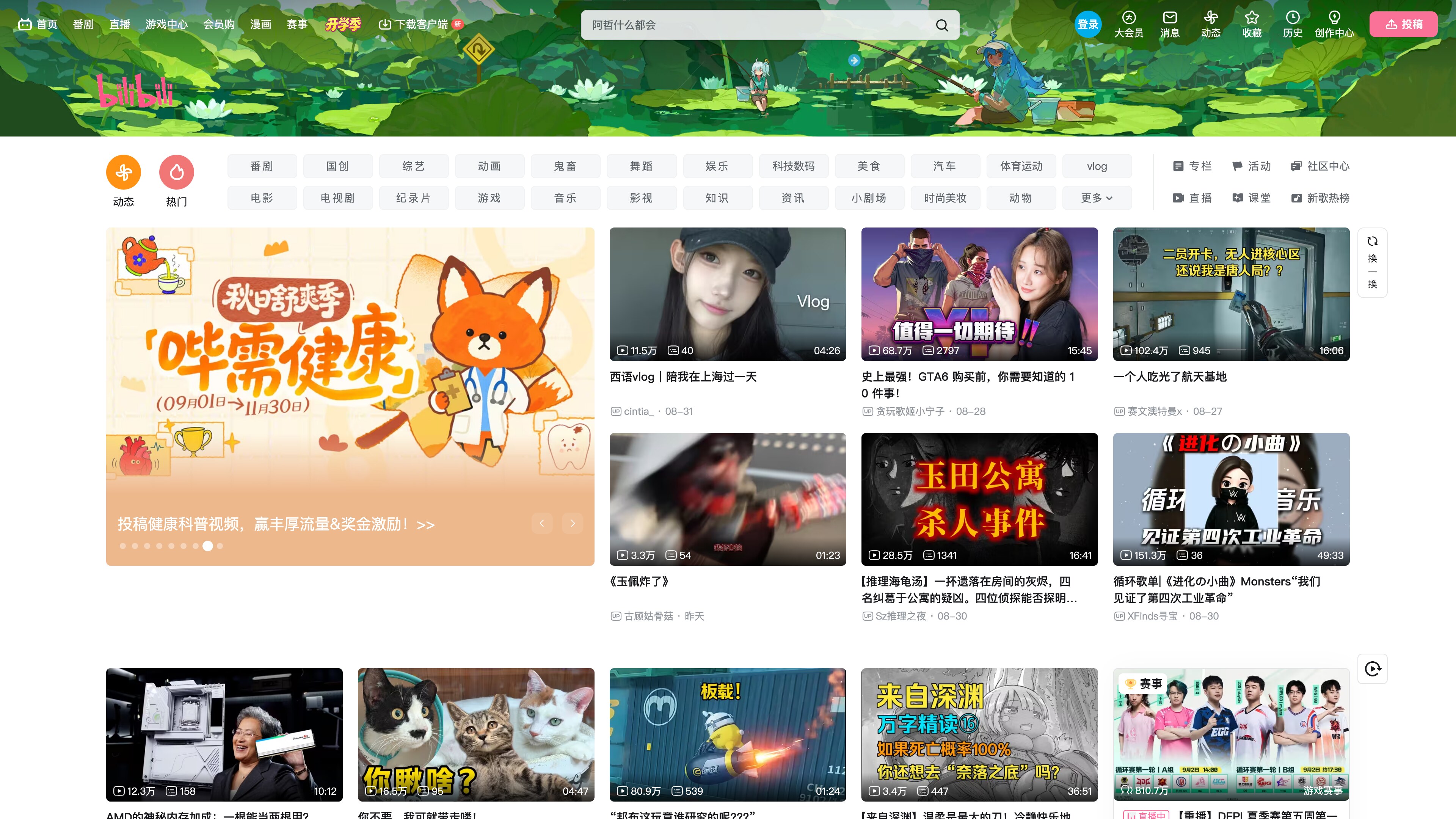
The screenshot above shows the bilibili homepage on 2026-09-02 (logged-out view): entries for anime, live streaming, the game center, member shopping, and comics across the top, two rows of content channels (anime, Chinese animation, "kuso" remixes, tech, knowledge, and more) below, and a personalized video feed in which every card displays its view count and danmaku count (e.g., "68.7万" views and "797" comments). Most content can be browsed and played without an account.
At a glance
- URL: https://www.bilibili.com/
- Type: danmaku video community (UGC/PUGV at its core, plus licensed OGV content, live streaming, and game publishing)
- Cost: most content is free; some licensed titles and top-quality playback tiers require the paid "Big Member" (大会员) subscription
- Registration: not required for viewing; posting danmaku, commenting, or uploading requires an account that has passed a membership quiz; signup requires a phone number, and uploading requires real-name verification
- Interface language: Simplified Chinese only (the main site has no multilingual UI; a separate international edition, bilibili.tv, serves Southeast Asia with a different catalog)
- Launched: June 26, 2009 (as Mikufans); renamed bilibili in January 2010
- Operator: Bilibili Inc., Shanghai; dual primary listing on Nasdaq (BILI) and HKEX (9626)
Background
In the first half of 2009, AcFun — then China's main danmaku site — suffered about a month of downtime amid internal disputes. During that window, early AcFun user Xu Yi (handle "⑨bishi") created Mikufans.cn, a Hatsune Miku fan community, on June 26, 2009. The site soon pivoted to video sharing and was renamed "bilibili" on January 14, 2010, after the nickname of Mikoto Misaka, the heroine of the anime A Certain Scientific Railgun; site features such as coin tossing and "charging" borrow from the same reference.
In November 2014, early community member and investor Chen Rui became chairman and CEO and led the company's corporatization. Milestones since: Nasdaq listing on March 28, 2018, a secondary listing in Hong Kong on March 29, 2021, and conversion to dual-primary listing on both exchanges effective October 3, 2022.
On monetization, Q2 2026 total revenue was RMB 7.94 billion (+8% YoY): advertising RMB 3.13 billion (+28%), value-added services RMB 2.97 billion, mobile games RMB 1.39 billion, IP derivatives and others RMB 0.45 billion, with net profit of RMB 339 million. The pre-roll ad question deserves a note: in 2016, at a licensor's request, bilibili attached skippable pre-roll ads to a handful of simulcast anime titles, triggering a user backlash; Chen Rui publicly apologized on Zhihu and pledged that licensed simulcast titles would "never carry pre-roll ads". That pledge has largely held — ads exist as feed placements and influencer marketing via the "Sparkle" (花火) platform, but not as mandatory pre-rolls on user videos — though the "pause ads" introduced around April 2026 renewed community debate.
Content ecosystem and how danmaku works
Content falls into two broad buckets: PUGV uploads by UP hosts across dozens of channels (knowledge, tech, lifestyle, food, gaming, remix/"kuso" culture, and more), and OGV licensed or produced by the platform — Japanese simulcast anime, Chinese animation, documentaries, films, and variety shows. Around these sit live streaming (including virtual YouTubers), mobile game publishing (it operates the mainland China editions of Fate/Grand Order and Azur Lane), the "member purchase" e-commerce arm, and a comics service. Company filings describe bilibili as having "pioneered the bullet chatting feature"; more precisely, the format originated with Japan's niconico, and bilibili popularized it in the Chinese-speaking internet.
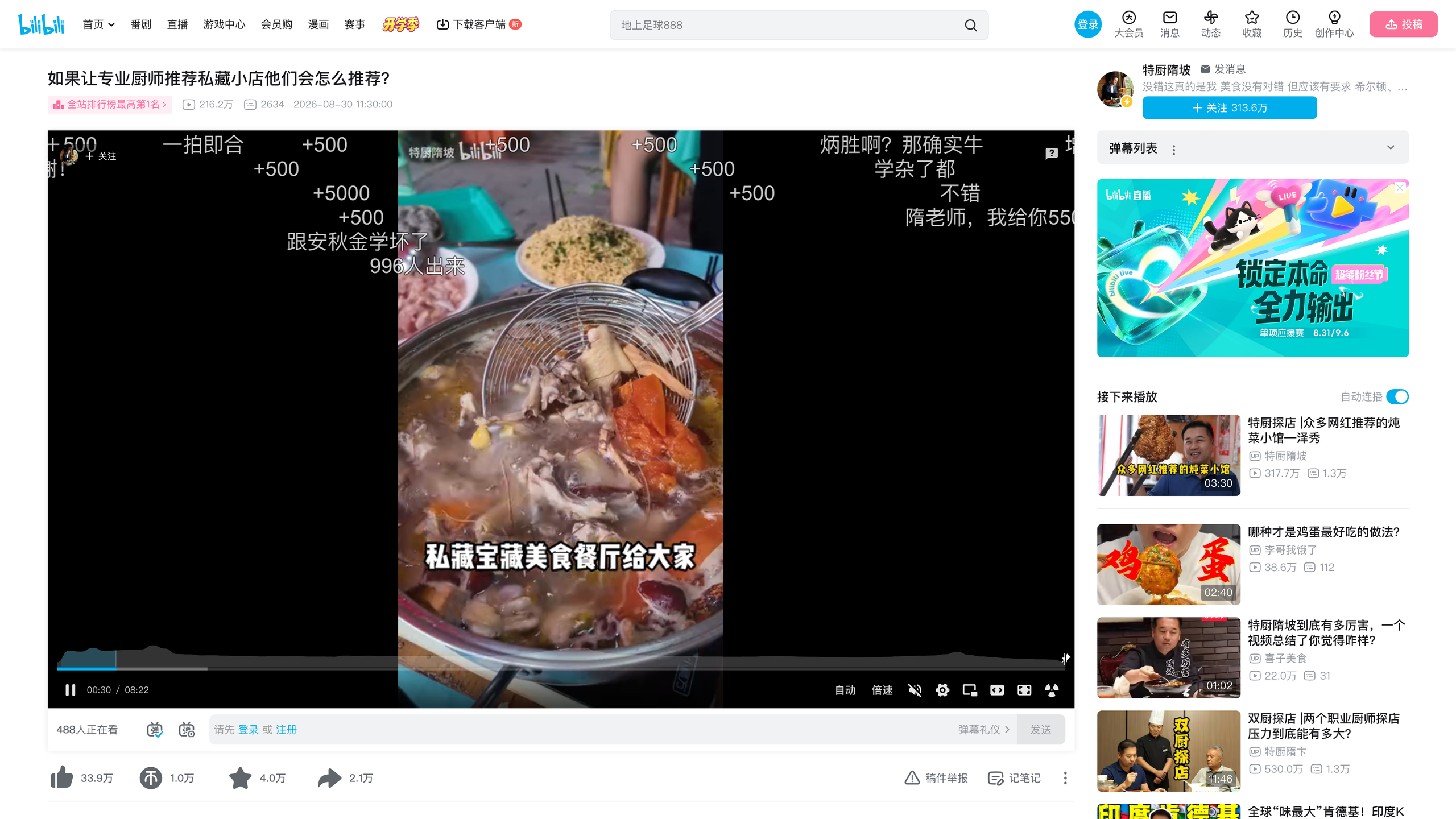
Above is the day's No. 1 ranked video page (logged-out view, 2026-09-02): the texts flying right-to-left across the picture ("+500", "一拍即合") are real-time scrolling danmaku. Below the player: 488 people watching now, 339K likes, 10K coins; on the right, the danmaku list and autoplay queue. Danmaku comes in scrolling, top-pinned, and bottom-pinned styles; viewers can filter by type or turn them off entirely, and UP hosts may delete danmaku on their own videos (mechanics per the Bilibili article).
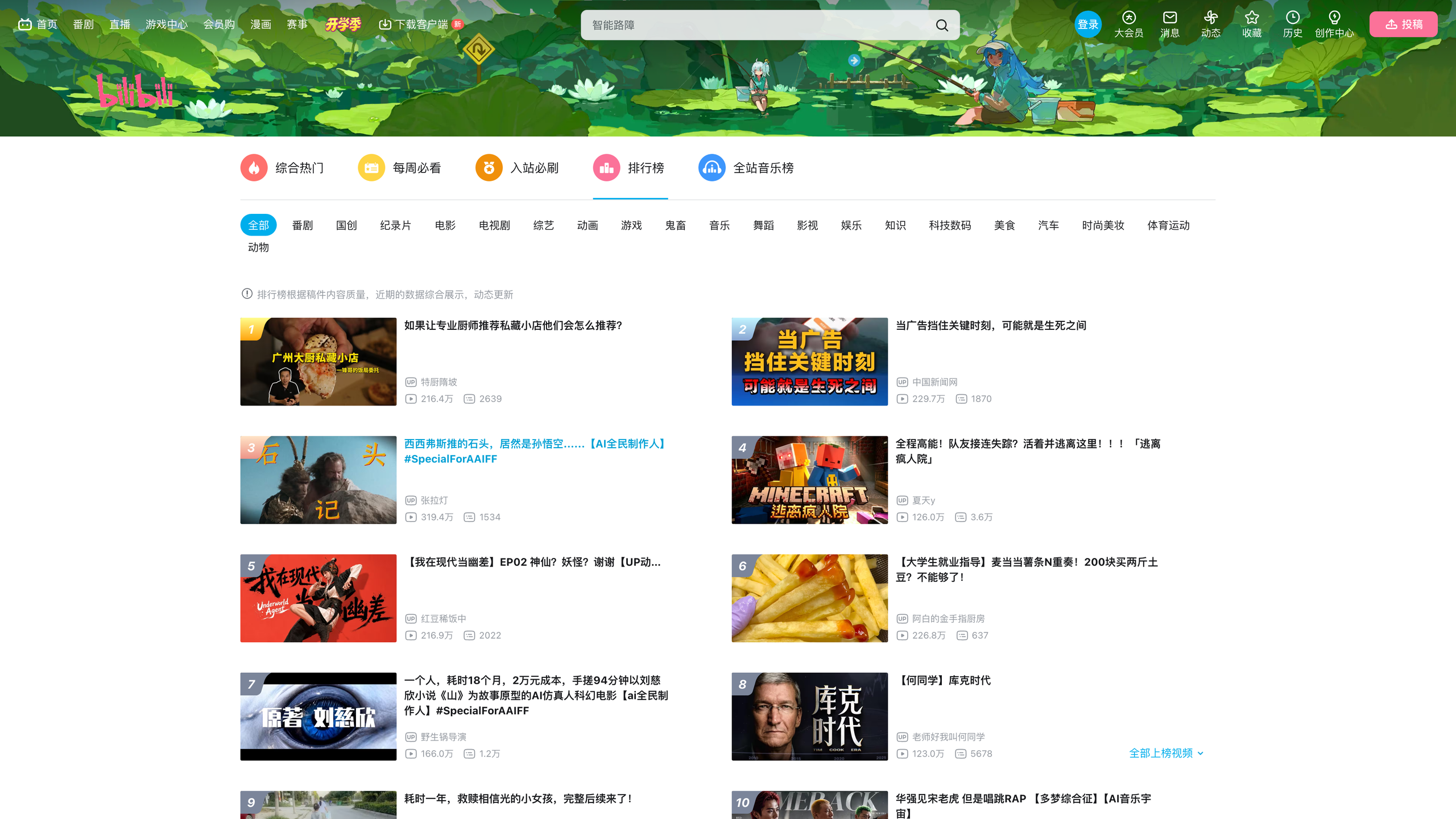
Above is the same day's all-site ranking: tabs for trending, weekly picks, all-time classics, and the music chart, with channel filters; entries are ranked by a blend of views, danmaku, coins, and other signals, each credited to its UP host. The chart also shows how far content has moved beyond ACG — that day's leaders included food reviews, science explainers, and an AI-produced live-action sci-fi short.
Accounts and community governance
bilibili's gatekeeping design is unusual among platforms of its size:
- Membership quiz: a newly registered account is only a "provisional member." To become a full member — unlocking danmaku posting, comments, and uploads — you must pass a quiz on community rules and your chosen interest areas (100-point scale, 60 to pass). The question count and format have been revised several times (it was once a fixed 100-question test that included danmaku etiquette). (Source: Bilibili article)
- Levels and currencies: full members accumulate levels LV0–LV6 through activity. Engagement earns "coins" (硬币) spent to support videos; "B coins" (B币) are purchased with money and used for things like sponsoring anime titles and tipping creators.
- Discipline Committee: a community arbitration system launched in June 2017, where eligible users vote on reported cases.
- The "black room": a public wall of banned accounts, backed by the Community Rules and the Black Room Penalty Regulations, with sanctions ranging from timed suspensions to permanent bans.
- Real-name rules and content red lines: since July 5, 2017, uploading requires real-name verification (a mainland China phone number for domestic users, ID documents for overseas ones); since February 2017, individual users may not upload current-affairs or political content — that category is reserved for certified organizations. (Sources: Bilibili article, Jiemian news flash)
Paid membership, creator monetization, and open platform
Big Member (大会员), launched in October 2016, is the paid subscription: free and early access to part of the licensed catalog, high-bitrate/high-frame-rate playback, exclusive profile decorations, and more; a "Super Big Member" tier extends coverage to TV apps. As of 2026-09-02, list pricing is roughly RMB 168/year (about RMB 148 on auto-renewal), with discounts near RMB 100 common during shopping festivals (IT Home, May 2026); check the official page for current pricing. Average monthly paying users reached 33 million in Q2 2026.
For creators, bilibili runs several monetization tracks: the "Creative Incentive Program" shares revenue based on views and content value (eligibility requires an "electromagnetic force" creativity-or-influence score of 55+ and a credit score of at least 80); the "Sparkle" (花火) marketplace brokers brand deals; "charging" lets viewers tip directly. For developers, open.bilibili.com offers OAuth-based account authorization and a live-streaming open platform (danmaku, gifts, and interactive widgets), but no public search API over the full video catalog.
Copyright and content policy
As a UGC platform, bilibili's copyright and moderation stack includes:
- Infringement reporting: every video, comment, and danmaku has a report entry; rights holders can also file complaints via customer-service tickets. The company publishes monthly infringement-complaint handling reports disclosing volumes. The User Agreement sets out the IP complaint and counter-notice process.
- UP host copyright protection program: an opt-in service that monitors other platforms for re-uploaded ("pirated") copies and helps creators enforce their rights — among the earliest proactive programs of its kind on a Chinese UGC platform.
- Upload licensing terms: uploading grants the platform a license for online distribution, and uploaders must warrant originality or authorization; campaign submissions are additionally governed by the Creative Convention.
- Content review: a pre-publication review regime (machine plus human), supplemented by the Discipline Committee's community arbitration and the black room's public bans; political and film/TV copyright categories carry extra upload restrictions.
- Privacy: the Privacy Policy (September 2023 edition) states that personal information is stored within mainland China and provides channels for access, correction, deletion, and account cancellation.
Historically, bilibili's early years — when users freely re-uploaded others' content — accumulated substantial copyright disputes (including a 2012 administrative penalty for unlicensed anime streaming). After corporatization the platform shifted to licensed acquisition; today its catalog is largely authorized, though disputes over user-made "clips" and derivative works versus rights holders still surface regularly.
Good fits
- Viewers who follow Japanese simulcast anime, Chinese animation, and licensed documentaries and enjoy watching with a live comment overlay
- Learning-oriented viewing: knowledge, tech, and lecture-style PUGV content is dense, and danmaku often adds useful context
- Chinese-language creators starting out: incentives, brand-deal brokerage, and tipping form a relatively complete monetization path, and the community has a tradition of surfacing newcomers
- Anyone studying Chinese internet subcultures: remix culture, memes, and danmaku etiquette are themselves the subject
Limitations
- Language and signup friction: the UI is Simplified Chinese only; signup requires a phone number (overseas country codes supported); uploading requires real-name verification, with ID documents for overseas creators — a high bar for non-Chinese users.
- Regional restrictions: parts of the licensed catalog are playable only in mainland China per licensing scope; the international bilibili.tv is a separate product with a different catalog.
- Paywall and quality tiers: some licensed titles and early access are Big Member-only; the highest playback quality tiers are unavailable to logged-out or regular accounts.
- Content red lines: individuals may not upload current-affairs or political content; complaints about over-removal and mistaken takedowns are not uncommon in the community.
- Variable comment quality: danmaku and comment quality varies widely by video; flame wars and spoilers are managed through user-side filters and reporting.
- Shifting ad formats: newer formats such as pause ads (from April 2026) sit in visible tension with the platform's long-standing "no pre-roll" pledge and remain a recurring point of debate.
Comparable sites
- niconico: the Japanese site where danmaku comments originated, and the direct inspiration for bilibili's early model.
- AcFun: mainland China's first danmaku video site and bilibili's original sibling rival, now part of the Kuaishou ecosystem.
- YouTube: the global UGC video giant — no danmaku culture, monetized mainly through pre-roll ads and subscriptions, a useful business-model contrast.
References
- bilibili homepage and all-site ranking (channel structure, chart formats; checked 2026-09-02)
- Bilibili Inc. Investor Relations (dual-primary listing status; Q2 2026 DAU/MAU/MPU/time spent; checked 2026-09-02)
- Bilibili Q2 2026 financial results (full text via GlobeNewswire) (revenue mix, net profit, official "pioneered bullet chatting" wording)
- Bilibili (English Wikipedia) (Mikufans origin, renaming, leadership, listing timeline, quiz/real-name/political-content/Discipline Committee dates and mechanics)
- Bilibili IR: News & Events (2018 Nasdaq listing; 2022-10-03 HKEX main-board primary listing announcement)
- Jiemian: bilibili's "pause ads" draw complaints (the 2016 pre-roll incident and Chen Rui's pledge; 2026 pause ads)
- Jiemian news flash: real-name requirement for uploads (real-name verification from 2017-07-05)
- Creative Incentive Program rules (electromagnetic-force and credit-score thresholds)
- Infringement complaint handling report (February 2025) (reporting and complaint entries)
- Community Rules, Black Room Penalty Regulations, User Agreement, Privacy Policy
- bilibili Open Platform (OAuth and live-streaming open platform)
- IT Home: Big Member promotion pricing (2026-05-28) (membership price reference; checked 2026-09-02)