Bandcamp is an online record store and music community: artists and labels sell digital music, vinyl, CDs, cassettes, and merch directly to fans, who buy releases to own them permanently. What sets it apart from subscription streaming is where the money goes — the official pricing page lists a 15% revenue share on digital sales (dropping to 10% once an artist passes 1.79 billion](https://bandcamp.com/about) through Bandcamp, including 15.8 million digital albums and 1.6 million vinyl records in the past year alone.
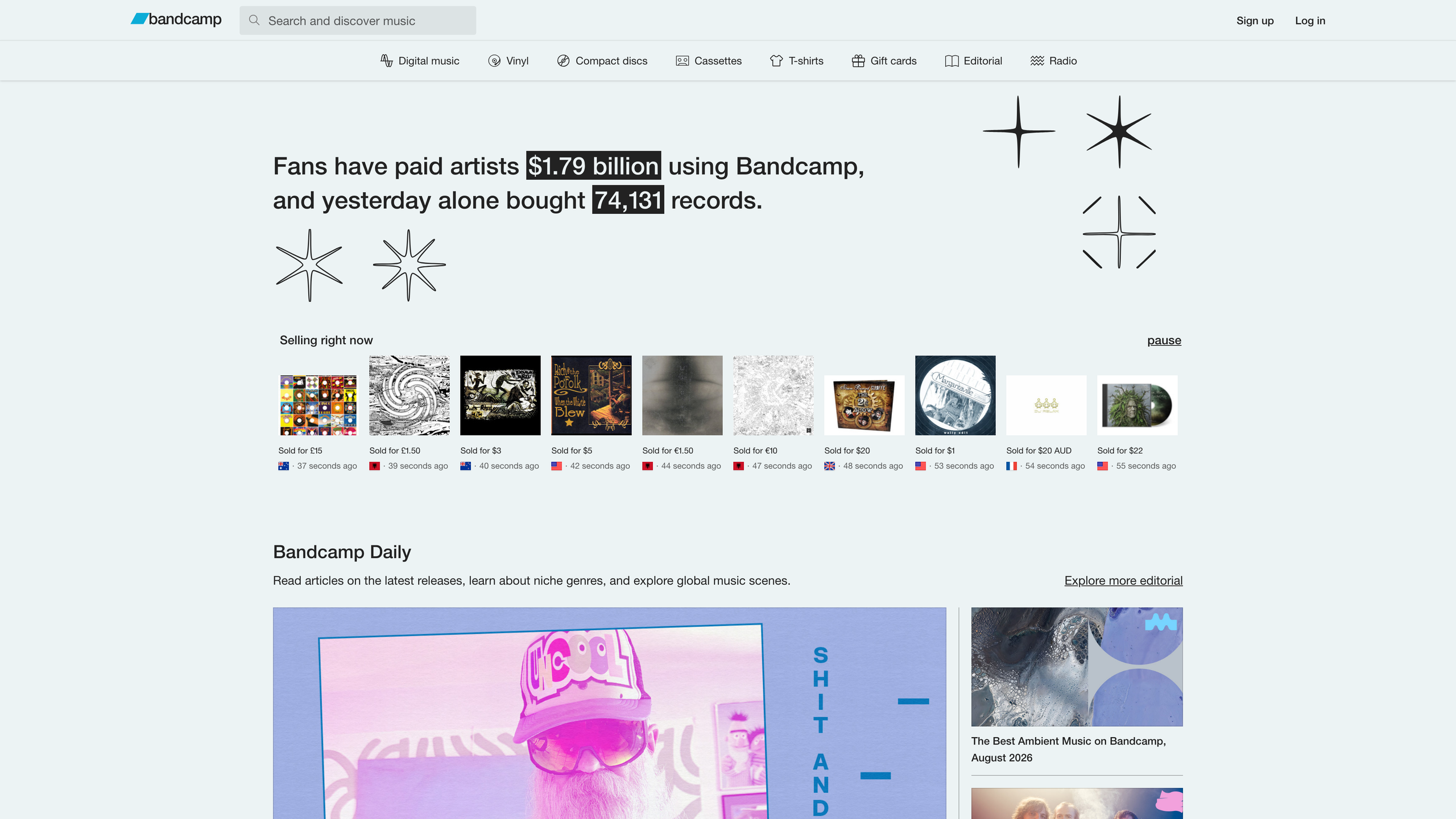
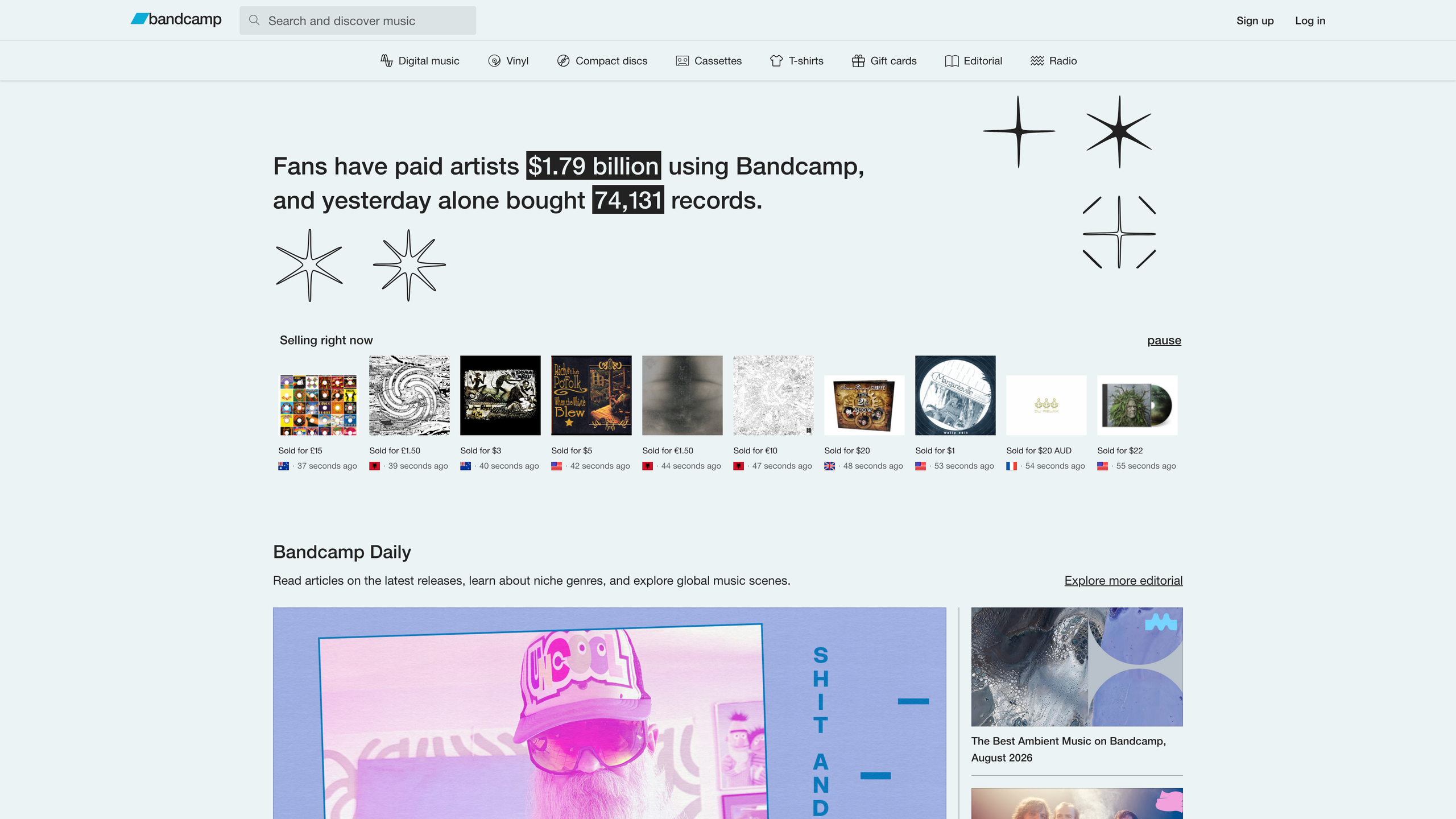
The screenshot above shows the Bandcamp homepage on September 2, 2026: a live counter at the top reads "Fans have paid artists $1.79 billion using Bandcamp, and yesterday alone bought 74,131 records." Below it, the "Selling right now" feed shows individual purchases as they happen, each tagged with price, currency, and time — a direct view of how transactional the platform is. Further down sits the entry point to Bandcamp Daily, the site's editorial publication.
At a Glance
- URL: https://bandcamp.com/; artist pages follow the pattern
artist.bandcamp.com - Type: Direct-to-fan music marketplace (digital downloads + physical records + merch), with streaming and community features
- Cost: Browsing and previewing are free; fans pay the artist's listed price to own a release; artist accounts are free, with the platform taking a revenue share (15%→10% digital, 10% physical); Bandcamp Pro costs $10/month
- Sign-up: No account needed to browse or listen; checkout only requires an email address, while a free fan account collects purchases in one place for unlimited re-downloads and app streaming
- Interface language: English only
- Operator: Songtradr, Inc. (acquired from Epic Games in 2023)
Background
Bandcamp was founded in 2008 by Ethan Diamond (co-founder of Oddpost) together with programmers Shawn Grunberger, Joe Holt, and Neal Tucker, and is headquartered in Oakland, California. (Source: Wikipedia)
On March 2, 2022, Bandcamp announced it was joining Epic Games, the maker of Fortnite. Barely a year and a half later, on September 28, 2023, Epic announced layoffs and the sale of Bandcamp to music-licensing company Songtradr; roughly half of Bandcamp's staff were not retained after the deal closed. The platform has operated normally since: the current Terms of Use (effective May 7, 2026) still name Songtradr, Inc. as the operating entity, and neither the revenue-share structure nor Bandcamp Fridays have changed. The same terms disclose, under the EU Digital Services Act, an estimated 4 million average monthly active recipients in the EU (updated November 2024).
A Record Store First: Pricing, Formats, and Buying
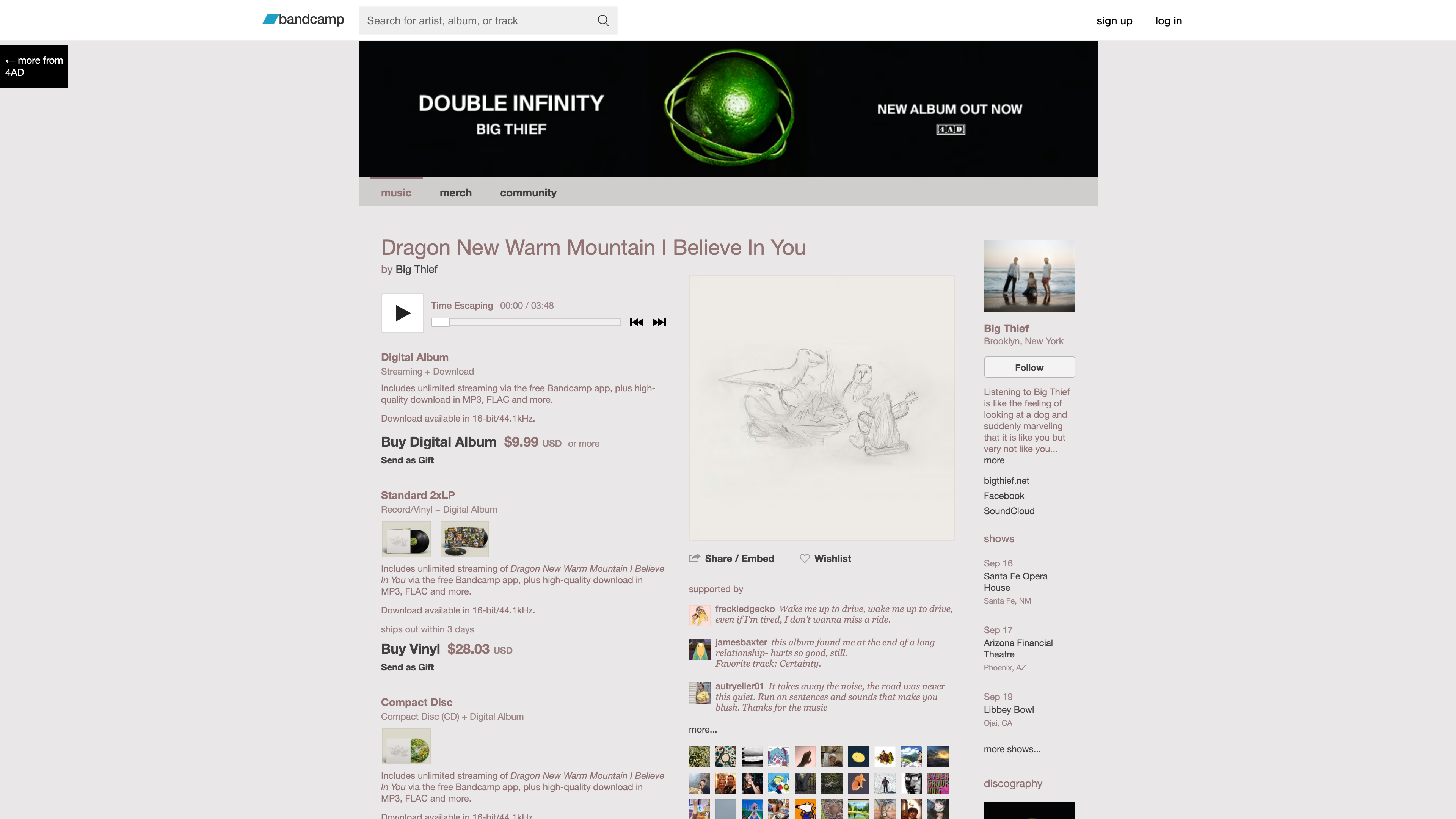
The Big Thief album page above captures how buying works on Bandcamp. On the left is a player for full-track previews. The digital album is priced at 28.03) and a CD, both including the digital version. Every item offers "Send as Gift," and the right-hand column shows supporter avatars, artist updates, and tour dates.
Artists control their own pricing: a fixed price, a minimum with pay-what-you-want on top (Bandcamp says fans pay more than the minimum 50% of the time), or a free download in exchange for an email address. Purchased music streams unlimited times in the free iOS, Android, and Sonos apps, and downloads are available in MP3 V0, MP3 320, FLAC, AAC, Ogg Vorbis, ALAC, WAV, and AIFF — with FLAC, WAV, and AIFF preserving the bit depth and sample rate of the original upload. Before buying, each track can be streamed in full only a few times (the default is 3 plays, which artists can raise or remove entirely) before a purchase prompt appears. Physical goods are packed and shipped by the artists or labels themselves; Bandcamp provides the marketplace and order-management tools but never touches the logistics.
Revenue Share and Bandcamp Fridays
The key numbers from the official pricing page (checked September 2, 2026):
- 15% revenue share on digital items, dropping to 10% once sales exceed $5,000 in the trailing 12 months
- 10% on physical items and merch (shipping and taxes are excluded from the calculation)
- Payment processor fees are separate and typically run 4–6% of the transaction
- For high-priced items (deluxe packages, beat licenses), the revenue share applies only to the first $100 of each item
Bandcamp Friday is a standing tradition: launched in March 2020 when the pandemic halted touring, it waives Bandcamp's own revenue share for a full day (midnight to midnight, Pacific Time) so artists keep more of every sale (payment processing fees still apply). The official blog reports that Bandcamp Fridays have contributed more than $150 million to independent musicians over five years. The event survived both ownership changes and has even expanded to eight dates in 2026: February 6, March 6, May 1, August 7, September 4, October 2, November 6, and December 4 — as of September 2, 2026, the next one is September 4.
Finding Music
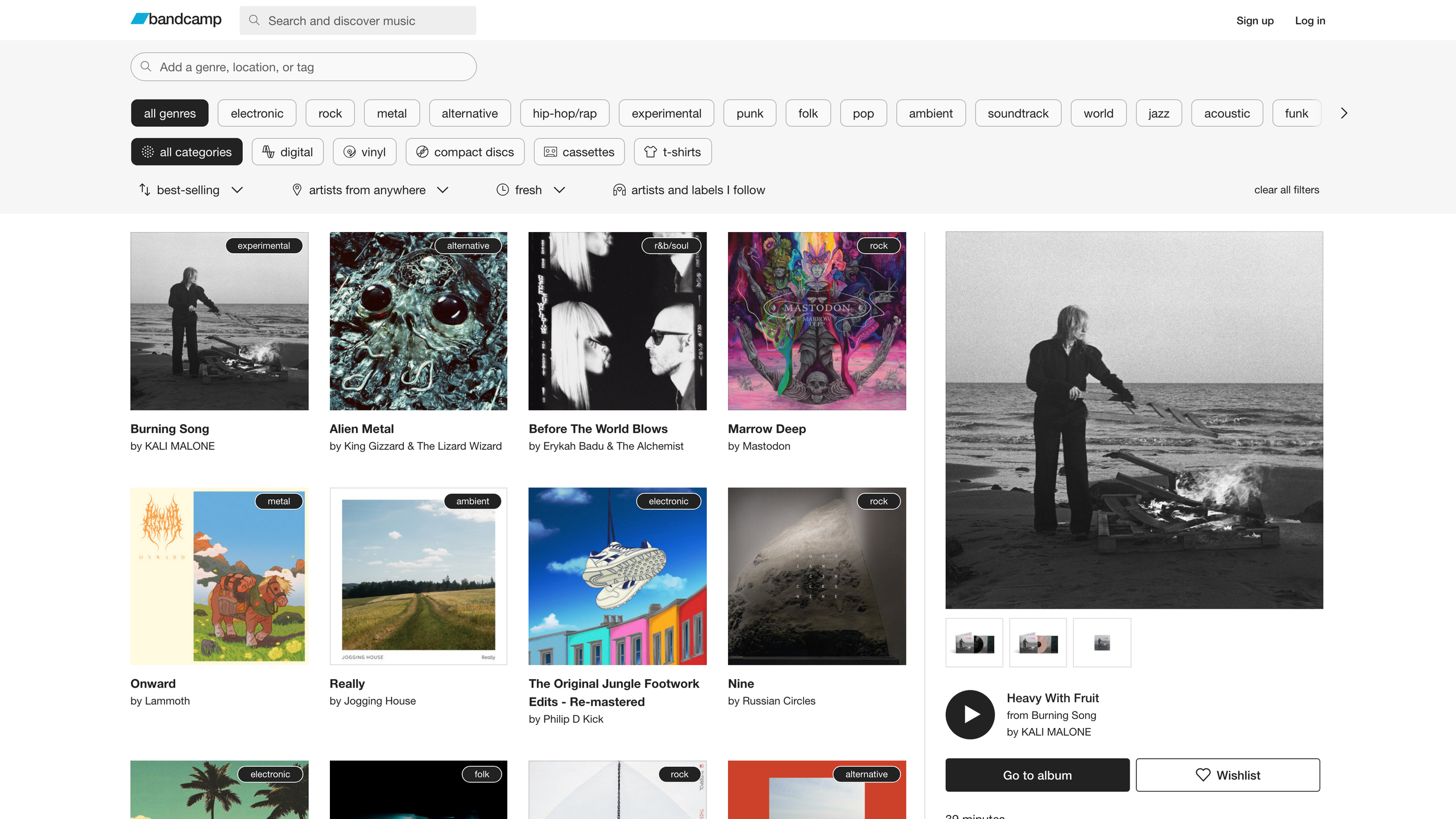
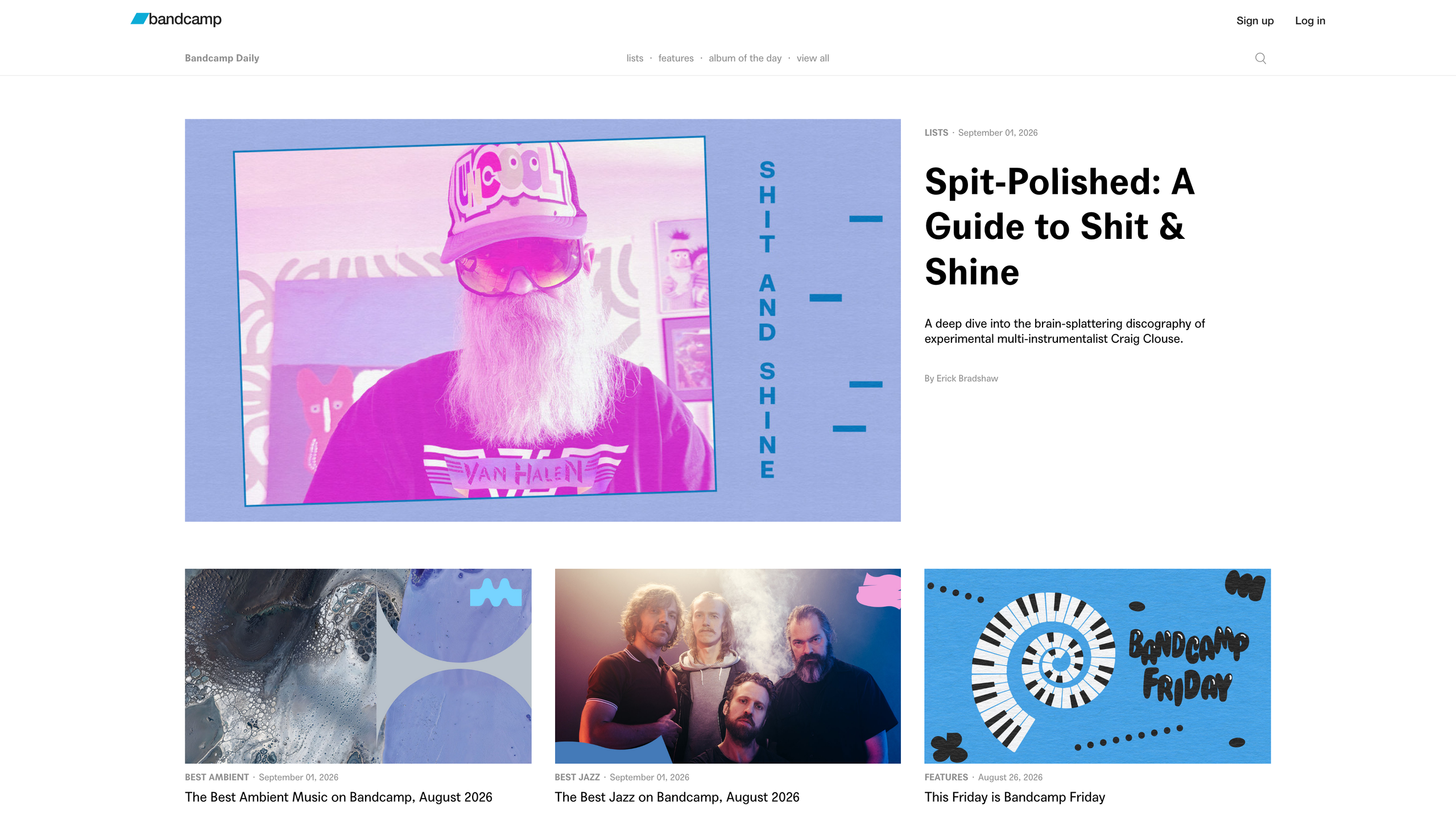
Bandcamp leans on human and social discovery rather than algorithmic recommendation, through three main paths:
- Discover (first screenshot): filter by genre tags (electronic, metal, ambient, and so on), format (digital, vinyl, CD, cassette, T-shirt), artist location, and sorts like "best-selling." Signed-in users can also restrict results to artists and labels they follow. Results play inline and can be wishlisted on the spot.
- Bandcamp Daily (second screenshot): an editorial team publishes daily — Album of the Day, monthly genre roundups (such as the best ambient and best jazz of August 2026), label profiles, and scene reports — covering thousands of records a year. The tile at the bottom right of the screenshot is that week's Bandcamp Friday feature.
- Social following: following an artist delivers new-release notifications to your feed and inbox; public fan collections make "see what people like me bought" a real discovery channel.
Accounts and Open Capabilities
- Fan accounts (free): a collection page for purchases and wishlists, artist following, unlimited re-downloads, and in-app streaming; purchases appear on album pages as supporter avatars (individually hideable).
- Artist accounts (free): uploads must be lossless stereo files of at least 16-bit / 44.1 kHz (WAV, AIFF, or FLAC); the platform supports pre-orders, download codes, discount codes, merch order management, and live streams / Listening Parties with an integrated merch table.
- Bandcamp Pro ($10/month): custom domains, private streaming for press, per-track streaming toggles, and more.
- Embedding and external clients: every release generates an embeddable player; a Subsonic API implementation (beta, announced on the official blog in 2026) lets fans stream their collection through third-party clients such as Amperfy, Feishin, and Submariner (server URL
https://bandcamp.com/api/subsonic). - Payments: payouts have been migrating to Stripe in phases since summer 2025, with PayPal remaining available in countries Stripe does not yet support.
- No advertising: Bandcamp pledges never to show ads; sales are reported to SoundScan, ARIA, Official Charts, and the Official New Zealand Music Charts, and pricing is supported in 19 currencies.
Rights and Content Policy
- Artists keep all rights to their work. The Terms of Use state that Bandcamp takes only the rights needed to operate the service (hosting, streaming, selling on the artist's behalf, displaying artwork and lyrics).
- Uploaders must own or control all rights to their content; cover songs require written permission from the composition's rights holders, whether or not the music is sold.
- In January 2026, Bandcamp published a generative-AI policy: music and audio generated wholly or in substantial part by AI is not permitted; using AI to impersonate other artists or styles is prohibited; users can report suspected AI-generated content, and Bandcamp reserves the right to remove it.
- Bandcamp works with collection societies to withhold and distribute publishing royalties to songwriters and publishers; upload forms include songwriter, publisher, and ISWC fields.
Who It's For
- Listeners who want to own music outright and keep lossless files
- Diggers exploring independent labels and niche genres through editorial coverage and tag browsing
- Vinyl, cassette, and CD collectors after indie releases, limited editions, and band merch
- Independent artists and small labels setting up a zero-upfront-cost direct store with pre-orders, codes, and direct fan messaging
Limitations
- English-only interface: the website, apps, and help center are all English only.
- Not a free listening library: it is a store, not a subscription streaming service — unpurchased tracks can only be previewed in full a few times, and long-term listening means buying.
- Physical fulfillment varies: shipping and after-sales are handled by individual artists and labels, so delivery times differ; order issues go to the seller first.
- Frequent ownership changes: two sales in three years, accompanied by major layoffs, leave long-term direction uncertain — though as of September 2, 2026, the core service, revenue share, and Bandcamp Fridays are all unchanged.
- Payments in transition: artists in some countries can only receive payouts via PayPal for now.
References
- Bandcamp About (average 82% share, $1.79B cumulative payments, past-year sales figures; checked September 2, 2026)
- Bandcamp pricing (15%/10% revenue share, processor fees, $100 cap)
- Bandcamp for Artists (pricing control, Pro features, no ads, chart reporting)
- Bandcamp Friday Help (continuation into 2026, waiver rules)
- Bandcamp official blog ($150M over five years, 2026 dates, generative-AI policy, Subsonic beta, Stripe migration)
- Terms of Use (Songtradr as operator, rights retention, cover-song rules, EU DSA disclosure)
- Help center: streaming limits, download formats, upload requirements
- TechCrunch: Epic acquires Bandcamp (March 2, 2022), TechCrunch: Epic layoffs and Bandcamp sale (September 28, 2023), Hotpress: ~50% staff layoffs
- Wikipedia: Bandcamp (2008 founding and founding team)