Atlas Obscura (atlasobscura.com) is a database-driven travel site run by an American travel and exploration media company, founded in 2009 by author Joshua Foer and documentary filmmaker Dylan Thuras (official press release). It answers a specific problem: conventional guidebooks won't tell you about the ossuary chapel, the flaming gas crater, the living root bridge, or the museum hidden in an apartment. Each entry gives a location, photos, and visitor notes. Its verifiable distinction is the production model — entries are submitted by the community and reviewed by an editorial team before publication (official FAQ) — and the way the database extends into paid small-group trips, events, books, and a podcast.
At a Glance
- URL: https://www.atlasobscura.com/
- Type: Place database + travel media (web, iOS/Android apps, podcast)
- Cost: Browsing and search are free, with ads and clearly labeled sponsored content; membership, small-group trips, and experiences are paid
- Registration: Not required for browsing; a free account is needed to submit places, suggest edits, or track visits; the Terms of Use require users to be 18 or older (Terms of Use)
- Interface language: English only
(Verified by direct visit on 2026-09-02.)
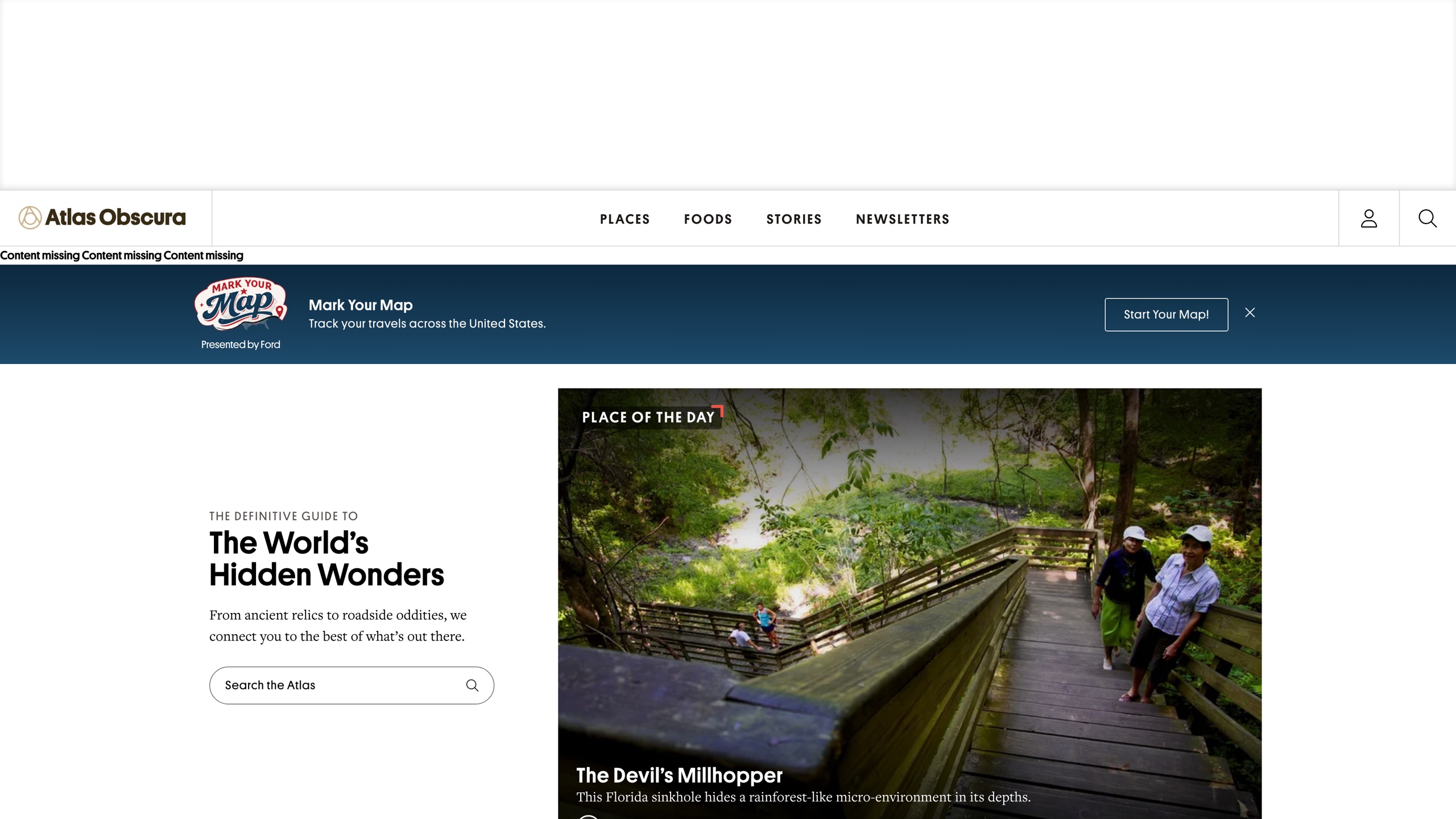
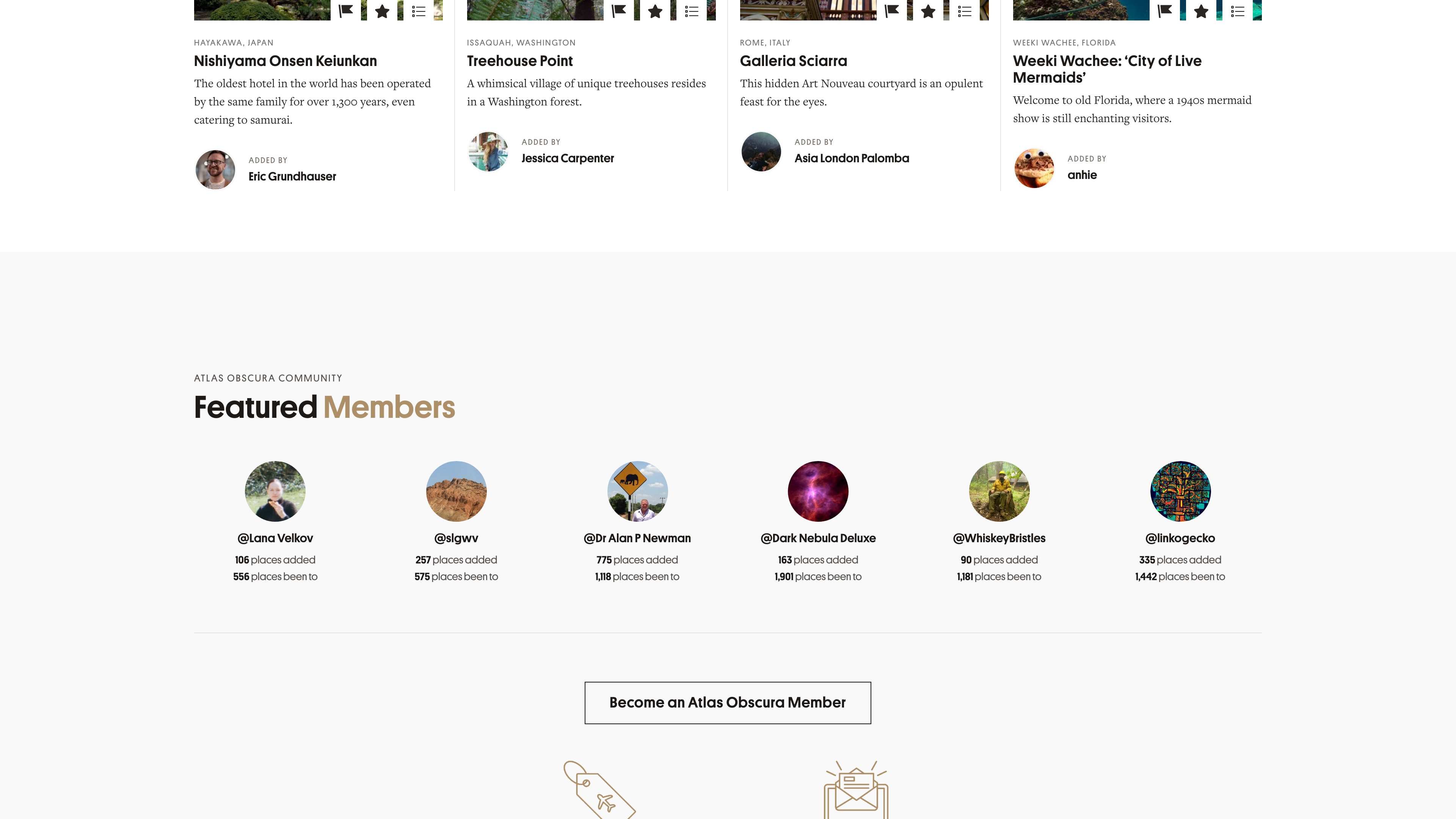
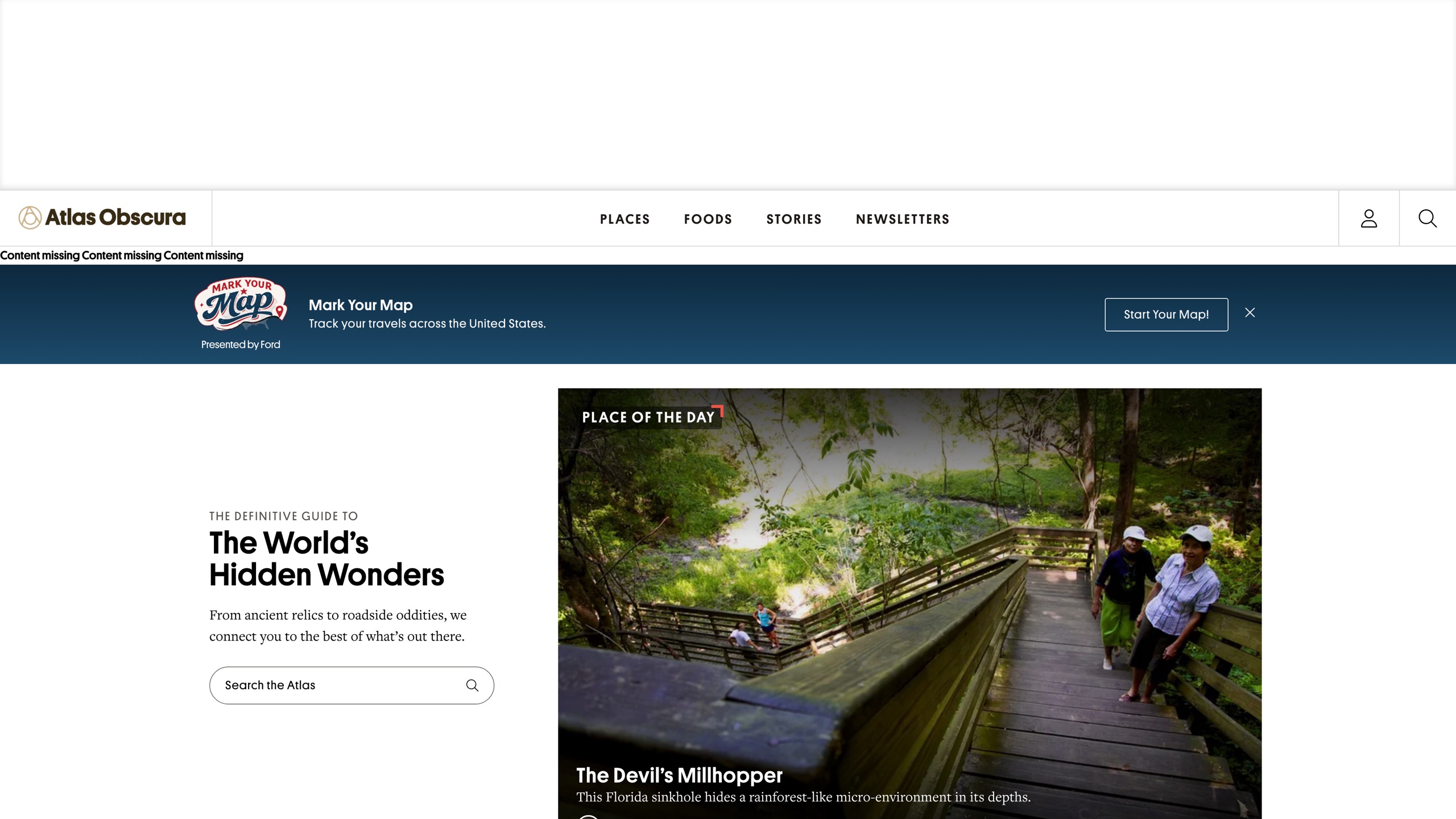
The homepage offers a search box covering the whole Atlas, destination guides with entry counts (e.g., 231 places in Tokyo, 158 in Madrid), and a "Place of the Day." Entry cards carry an "ADDED BY" line with the contributor's username, so the community model is visible right on the page. The top banner is a Ford "Mark Your Map" brand partnership, and sponsored placements in the feed are labeled SPONSORED BY.
Background
According to the Wikipedia entry and the reporting it cites, Foer and Thuras met in 2007, hired a web designer in 2008, and launched the site in 2009; the annual Obscura Day event followed in 2010. The 2016 book Atlas Obscura: An Explorer's Guide to the World's Hidden Wonders became a No. 1 bestseller on Amazon and the New York Times list (per the official About page).
On funding and expansion: a 7.5M round in 2017 followed by the launch of the Gastro Obscura food section later that year, and a $20M Series B in 2019 led by Airbnb (Wikipedia).
Leadership has turned over repeatedly. David Plotz was CEO from 2014 to 2019, succeeded by Warren Webster in 2020. In April 2025, former Wall Street Journal executive Louise Story became CEO (Adweek). Per a December 2025 Semafor report, Story cut ten staff, slowed original publishing, leaned further into user-generated content, and pushed AI integration — moves that angered parts of the staff and community; in November 2025, both founders were removed from the board by shareholder vote. The company's January 2026 open letter called 2025 its "first-ever year of profitability," said 2,232 new places were added that year, and framed a shift "from a content brand into a comprehensive travel platform." As of 2026-09-02, there is no public record of an acquisition; the operator remains Atlas Obscura Inc., a Delaware corporation (see Terms of Use).
Core Content: The Places Database and How the Community Works
Scale, in the company's own words: a December 2025 article states the Atlas holds 30,775 places, "all contributed by our community and vetted by our journalists"; the About page counters as of 2026-09-02 read 33,590 "places & foods," 14,995 stories, and 1,163 experiences held. An April 2025 press release cites 2.5 million registered users.
The contribution pipeline (official FAQ, checked 2026-09-02):
- Any registered user can submit a new place via "Add a Place," or propose changes to a published entry with "Suggest an Edit";
- Every submission is reviewed and edited by the editorial team before publication, which can take weeks; publication is not guaranteed;
- Entries should be third-person, "encyclopedic yet interesting"; text copied from Wikipedia or elsewhere, copyrighted material, and AI-written text are explicitly rejected;
- Photos must be your own or Creative Commons/public-domain images cleared for commercial use, at least 640×400 px, without watermarks;
- Published entries remain open to community edit suggestions, with all text changes again passing editorial review.
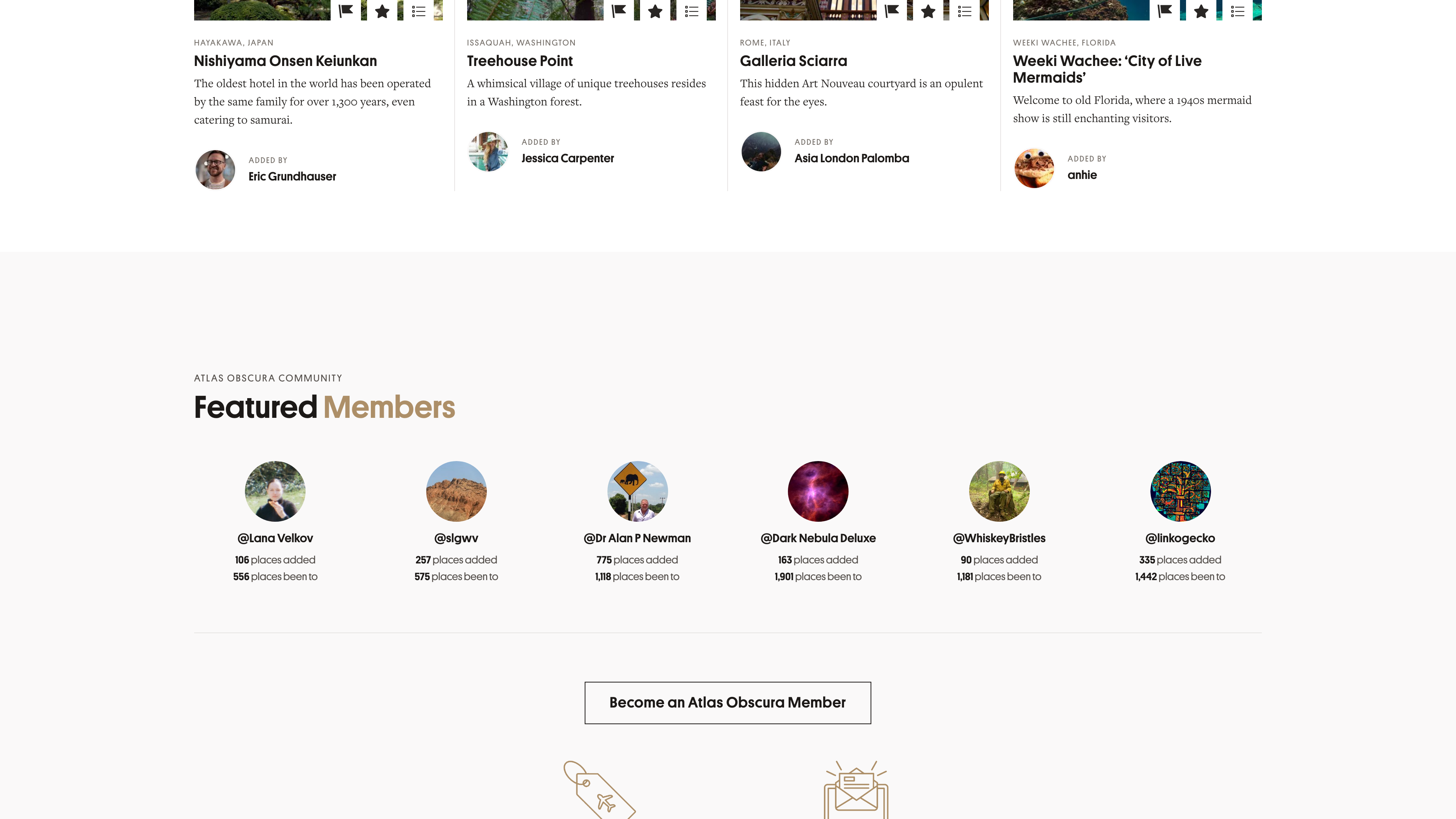
The screenshot above shows the homepage's place cards and "Featured Members" section: entries credit their contributors, and active members display running totals of places added and places visited. Registered users can mark entries as "want to visit" or "been there" — the company's 2025 Community Country of the Year pick (Japan) was computed from the ratio between those two signals.
Gastro Obscura
Gastro Obscura, launched in late 2017, is the food vertical: unusual restaurants, ingredient producers, food museums, and culinary festivals — the auto shop that becomes a taqueria at night, that kind of thing. Note the sourcing shift: the FAQ says the database originally drew on reader submissions but "is now primarily written in-house." A companion book, Gastro Obscura: A Food Adventurer's Guide, appeared in 2021 (Wikipedia), and the January 2026 letter mentions a new Gastro Obscura newsletter.
The Paid Side: Trips, Experiences, Membership
- Trips: multi-day small-group tours to niche destinations; the About page names Bhutan, Sudan, Iceland, Chile, Greece, and Mexico City, with a counter of "1,000+ travelers" as of 2026-09-02. The trips listing page was unreachable during this review (blocked by Cloudflare), so current departures and prices could not be verified — check the site directly.
- Experiences: online talks and in-person events; the About counter reads 1,163 held, and some online sessions are free for members.
- Membership: launched in May 2020, advertised then at "as little as 100 off small-group trips, fewer ads, a members-only newsletter, member-only virtual events and recordings, early access to new products, and a profile badge. The membership page was also blocked during this review, so current pricing is unverified.
- Free spin-offs: The Atlas Obscura Podcast launched in March 2021 with Stitcher's Witness Docs, publishes daily, and is now hosted by Kelly McEvers (Apple Podcasts); there are also several books and a VR app built with New Canvas (official announcement). Mobile apps exist for iOS and Android (app.atlasobscura.com).
Copyright and Content Policy
Atlas Obscura is a UGC platform, and its Terms of Use contain several clauses contributors should read first (checked 2026-09-02):
- You keep ownership of your submissions, but submitting grants Atlas Obscura an irrevocable, worldwide, royalty-free, sublicensable, transferable license to use them in any current or future media; other users get a non-exclusive license to access and share them through site features.
- Site content, including its compilation, is licensed for personal, non-commercial use only; copying or redistribution requires written authorization.
- The company may remove or decline any submission without notice and may terminate accounts at its discretion; a DMCA notice process is provided.
- The terms stress that place information is "for general planning purposes only," is not guaranteed accurate, and is "not updated on a continuous basis." Safety and legality — including not trespassing on private property — are the visitor's own responsibility.
On privacy, the Privacy Policy discloses third-party ad networks plus Google Analytics and Microsoft Clarity (including session replay), and offers access/deletion request channels under GDPR and CCPA; trip purchasers' passport details may be collected directly by partners.
Good Use Cases
- Finding offbeat attractions — odd museums, ruins, roadside Americana — that mainstream guides skip;
- Maintaining a want-to-visit/been-there bucket list, or gauging a niche destination's momentum from community signals;
- Armchair exploration via the daily podcast and newsletters;
- Travelers willing to pay a premium for themed multi-day small-group trips (pyramids in Sudan, festivals in Bhutan) without planning everything themselves.
Limitations
- No freshness guarantee: the company's own terms say entries are not continuously updated, so closed or relocated places may linger; reconfirm opening status elsewhere before you go.
- English only, with uneven geography: the FAQ admits New York and other US cities are overrepresented while places like Nairobi and Hanoi are still being expanded; coverage outside North America is patchy.
- Broad contributor license: the irrevocable, sublicensable grant means you cannot withdraw your work after submitting — read the terms before contributing.
- Editorial direction in flux: the 2025 layoffs, reduced original output, and heavier reliance on UGC and AI (Semafor) mean the content mix and quality controls may keep changing; all scale figures are self-reported.
- 18+ registration, and contributing or saving places requires an account; disputes fall under exclusive New York jurisdiction.
- Anti-bot protection on some sections: during this review the trips, membership, and place-detail pages triggered Cloudflare blocks and could not be tested individually; descriptions of those areas rely on the official FAQ and terms.
References
- Atlas Obscura official site, About, FAQ (checked 2026-09-02)
- Terms of Use, Privacy Policy (checked 2026-09-02)
- Wikipedia: Atlas Obscura
- Press release: Louise Story named CEO (2025-04)
- CEO open letter: 2025 review and 2026 direction (2026-01)
- Semafor: staff cuts and strategy squabbles split Atlas Obscura leadership (2025-12)
- Official: membership announcement (2020-05)
- Official: podcast launch (2021-03)
- Official: Japan as 2025 Community Country of the Year (with the 30,775-places figure)
- Atlas Obscura app download page