AppFlowy (appflowy.io) is an open-source collaborative workspace for documents, databases, and project management, widely positioned as the open-source alternative to Notion — its GitHub repository describes itself as "The leading open source Notion alternative." Written in Flutter and Rust and published under AGPL-3.0, its defining trait is data ownership: it runs as a fully offline local workspace, as a managed AppFlowy Cloud account, or as a server you deploy on your own infrastructure with Docker (homepage, checked 2026-10-01). The repository was created in June 2021 and had about 77,000 stars as of 2026-10-01, making it one of the most active open-source collaboration projects on GitHub (GitHub API).
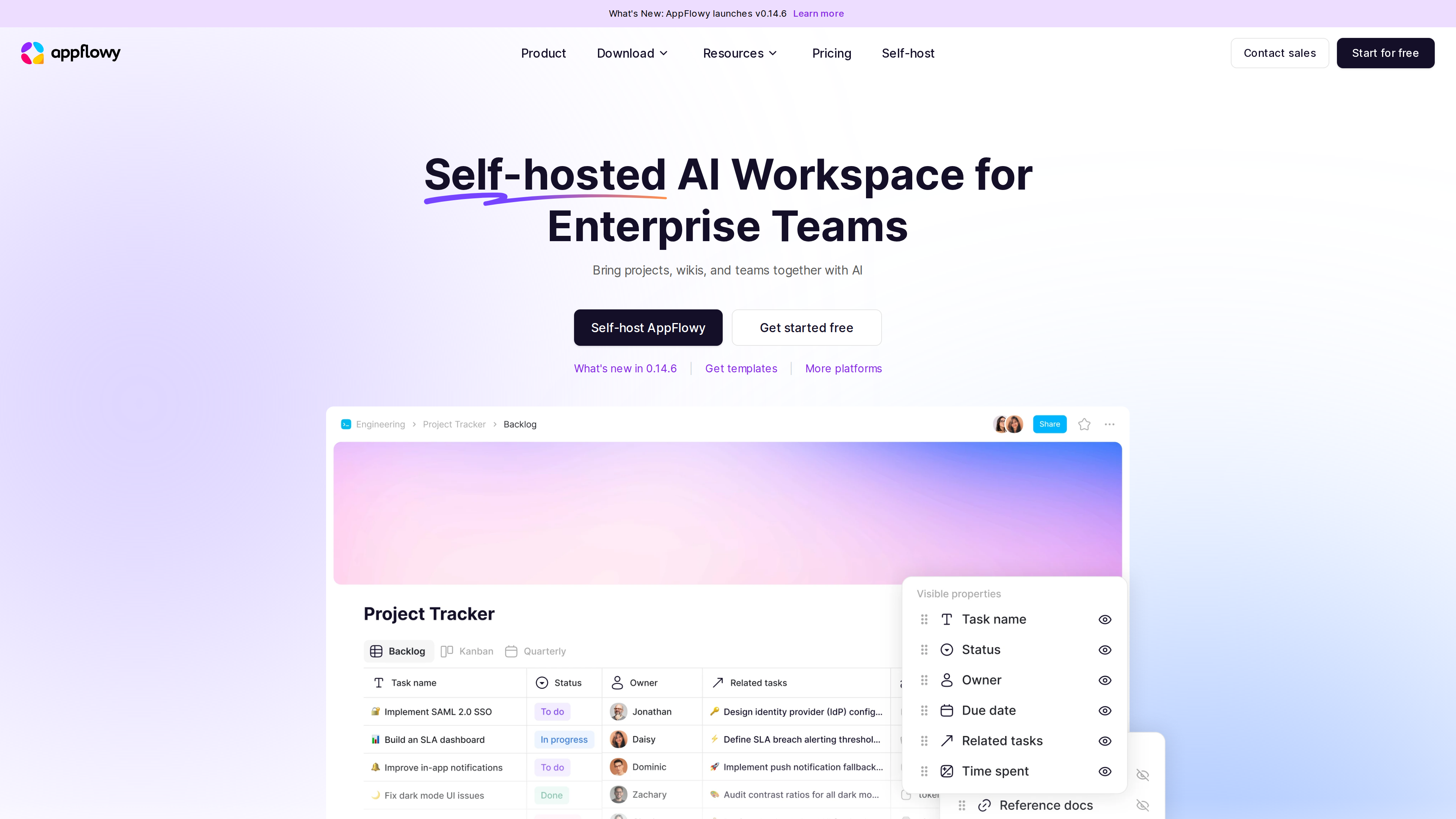
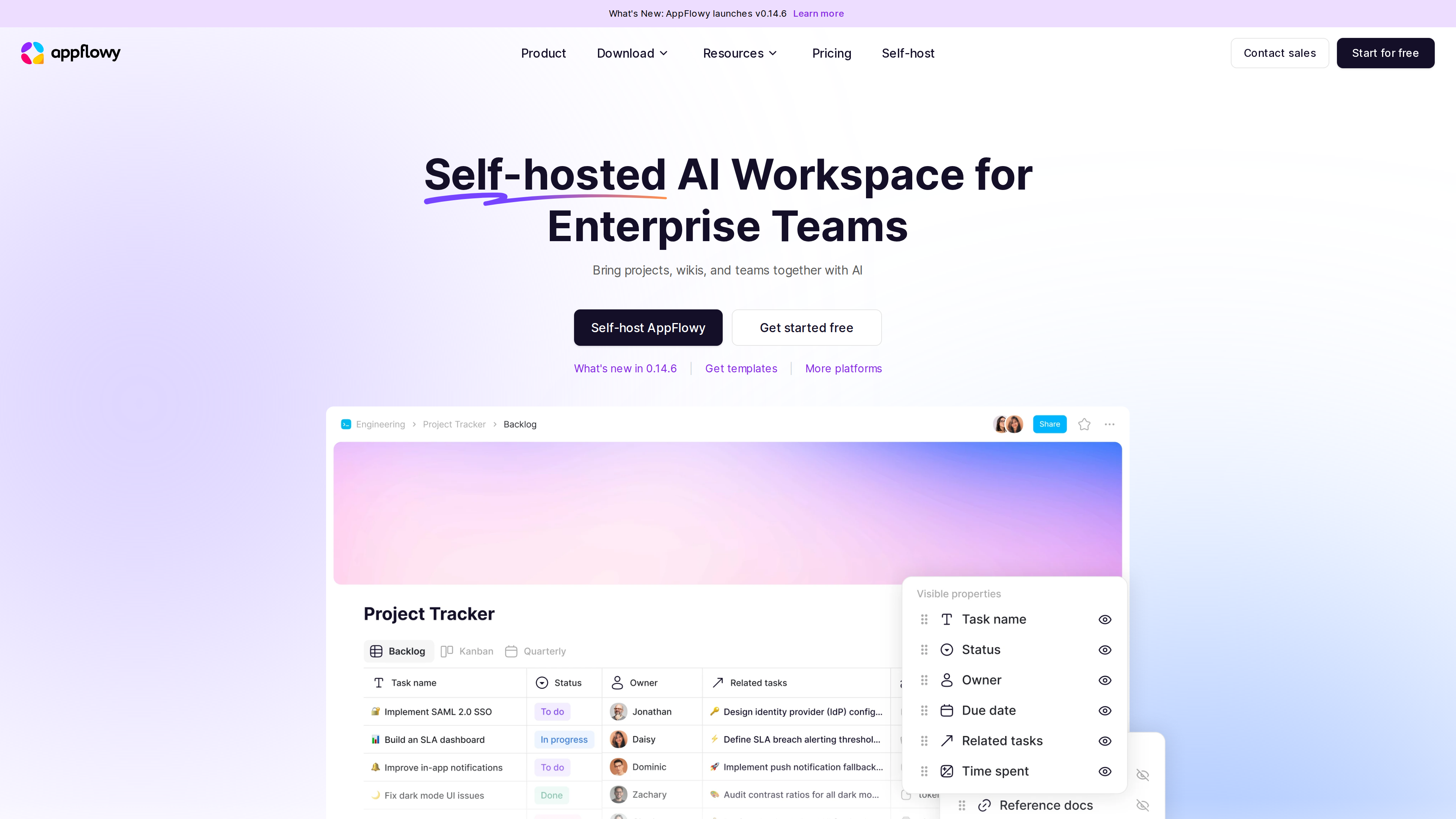
The screenshot above shows the homepage hero, which now leads with a self-hosted, enterprise-focused message. Below it, the product preview shows the in-app Project Tracker: one database that switches between Backlog (grid), Kanban, and Quarterly (calendar) views with customizable property columns.
At a Glance
| Item | Details |
|---|---|
| URL | https://appflowy.io/ (same site on appflowy.com) |
| Type | Open-source collaborative docs / knowledge base / project management (Notion alternative) |
| Cost | Clients are open source and free; cloud has a permanent free tier, Pro at 6 per seat/month (pricing, as of 2026-10-01) |
| Sign-up | Local workspaces work offline; cloud and self-hosted collaboration require an account |
| Platforms | macOS, Windows, Linux, iOS, Android, web browser (download page) |
| UI languages | ~35 community translations, including Simplified and Traditional Chinese (translations directory) |
| License | AGPL-3.0 (clients); the self-hosted server is a closed-source commercial product |
Background
- Operated by APPFLOWY PTE. LTD., incorporated in Singapore; the site's structured data lists 2021 as the founding year (privacy policy, pricing-page JSON-LD).
- Co-founder Annie Wang previously worked on an enterprise proprietary collaboration platform; the About page frames the mission as giving users "100% control of their data" and avoiding vendor lock-in (About).
- The repository was created on 2021-06-16 and the first public release, v0.0.1, shipped on 2021-11-13. Development has remained fast-paced since: v0.14.6 was released on 2026-10-01, with roughly weekly releases in the preceding month (GitHub Releases, changelog).
- Investors listed on the About page include OSS Capital and HongShan, plus individual backers such as Red Hat co-founder Bob Young, YouTube co-founder Steve Chen, GitHub co-founder Tom Preston-Werner, Automattic founder Matt Mullenweg, and Supabase co-founder Paul Copplestone.
- Claimed traction: 8M+ downloads, 1M+ Docker pulls, 400 GitHub contributors, and 20K+ community members (homepage and About, as of 2026-10-01).
Core Capabilities: Docs, Databases, and AI
- Block-based documents: a rich-text editor supporting 40+ content block types, with nestable pages forming wiki hierarchies and inline comments (site structured-data feature list).
- Multi-view databases: one database can be viewed as Grid, Kanban, Calendar, Gallery, List, Timeline, Feed, Form, or Chart; two-way relations, rollups, formula properties, grouping, and advanced filters are supported — formula properties and relational rollups only arrived in the September and October 2026 releases respectively (comparison page, changelog).
- Projects and knowledge base: the homepage organizes the product into Projects, Knowledge Base, Docs, AI Search, and AI Meeting Notes, plus forms, page publishing (Publish Pages / Site Builder), a template gallery, and basic CRM usage.
- Real-time collaboration: multi-user co-editing, async comments, and page-level guest permissions (view / comment / edit) in cloud or self-hosted workspaces.
- AI features: cloud AI covers writing assistance, summarization, Q&A, and auto-fill; local AI runs through Ollama or LM Studio, and self-hosted LLM and embedding models can power AppFlowy's AI; a Vault Workspace type keeps both data and AI inference entirely on-device and works offline (comparison page FAQ, pricing).
- Migration and integrations: a Notion importer (the enterprise tier also advertises assisted Confluence migration), plus Zapier integration, MCP, and public APIs (homepage).
Local-First and Platform Coverage
The desktop clients can run entirely without a server as offline local workspaces, with data stored on the device; the official changelog's mobile backup feature explicitly distinguishes "local and cloud workspace" (changelog), and the comparison page lists "Offline workspace" as a differentiator over Notion. Platform coverage is broad for an open-source product: macOS (separate Universal and Intel builds), Windows, Linux (AppImage, plus Flathub and Snapcraft channels), iOS, Android (Android 10+, no ARMv7), and a web browser version (download page, repository README).
Cloud Pricing (as of 2026-10-01)
From the AppFlowy Cloud section of the pricing page:
| Plan | Price | Highlights |
|---|---|---|
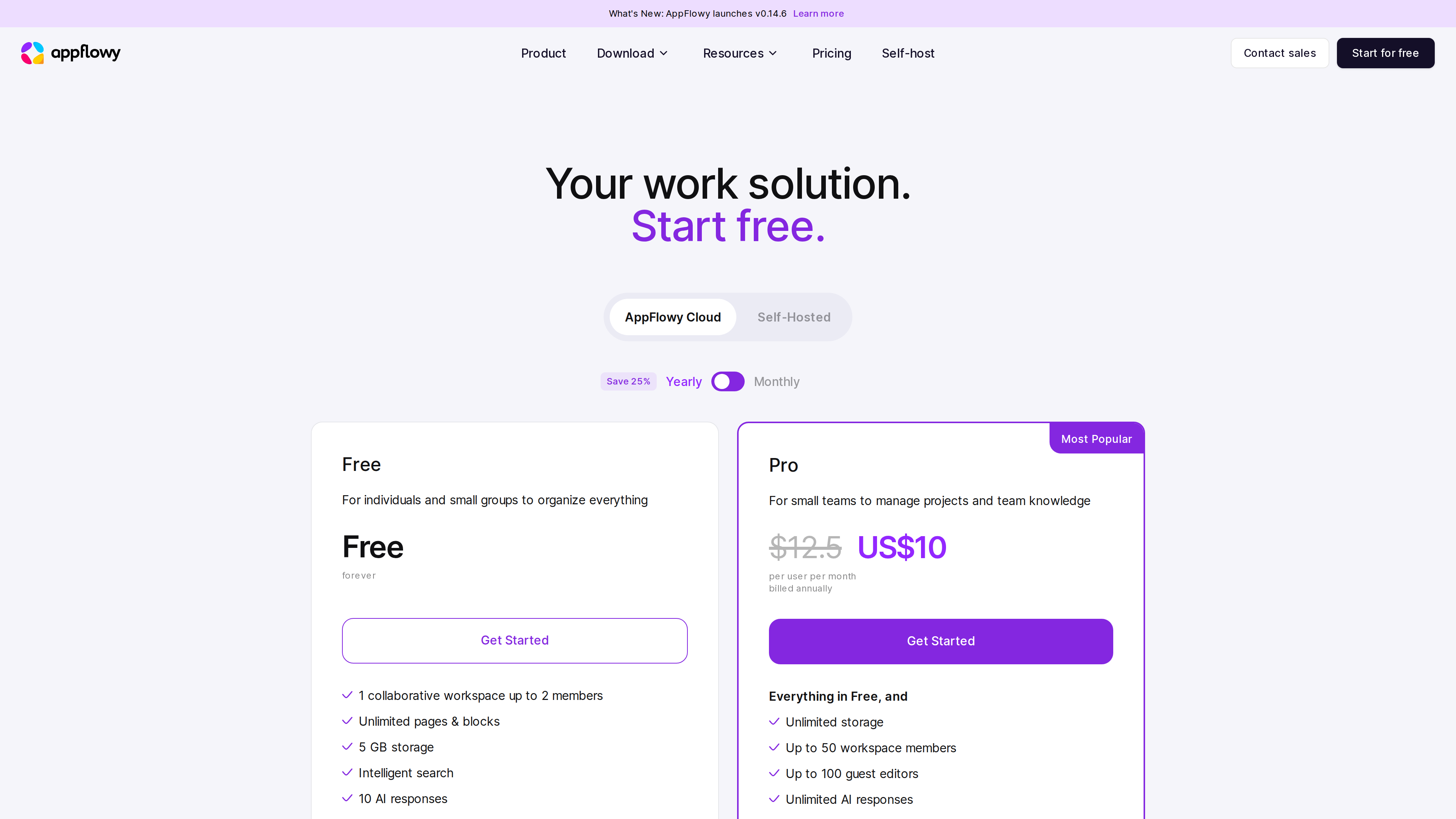
| Free | Free forever | 1 collaborative workspace (up to 2 members), unlimited pages and blocks, 5 GB storage, 10 AI responses, 2 AI images, real-time collaboration |
| Pro | 10 per user per month billed annually | Unlimited storage, up to 50 members and 100 guest editors, unlimited AI responses, 50 AI images/month, custom namespace |
| AppFlowy AI MAX (add-on) | $8 per user per month (monthly billing) | Access to advanced models incl. GPT-5, Gemini 2.5 Pro, Claude 3.7 Sonnet; unlimited AI responses |
| Vault Workspace (add-on) | $6 per user per month (annual billing) | Fully local, offline AI workspace; AI runs on-device with no data transfer; unlimited AI chat responses and file sizes |
Cloud billing is per workspace per member: the pricing FAQ's example puts a five-member Pro workspace at 600 per year.
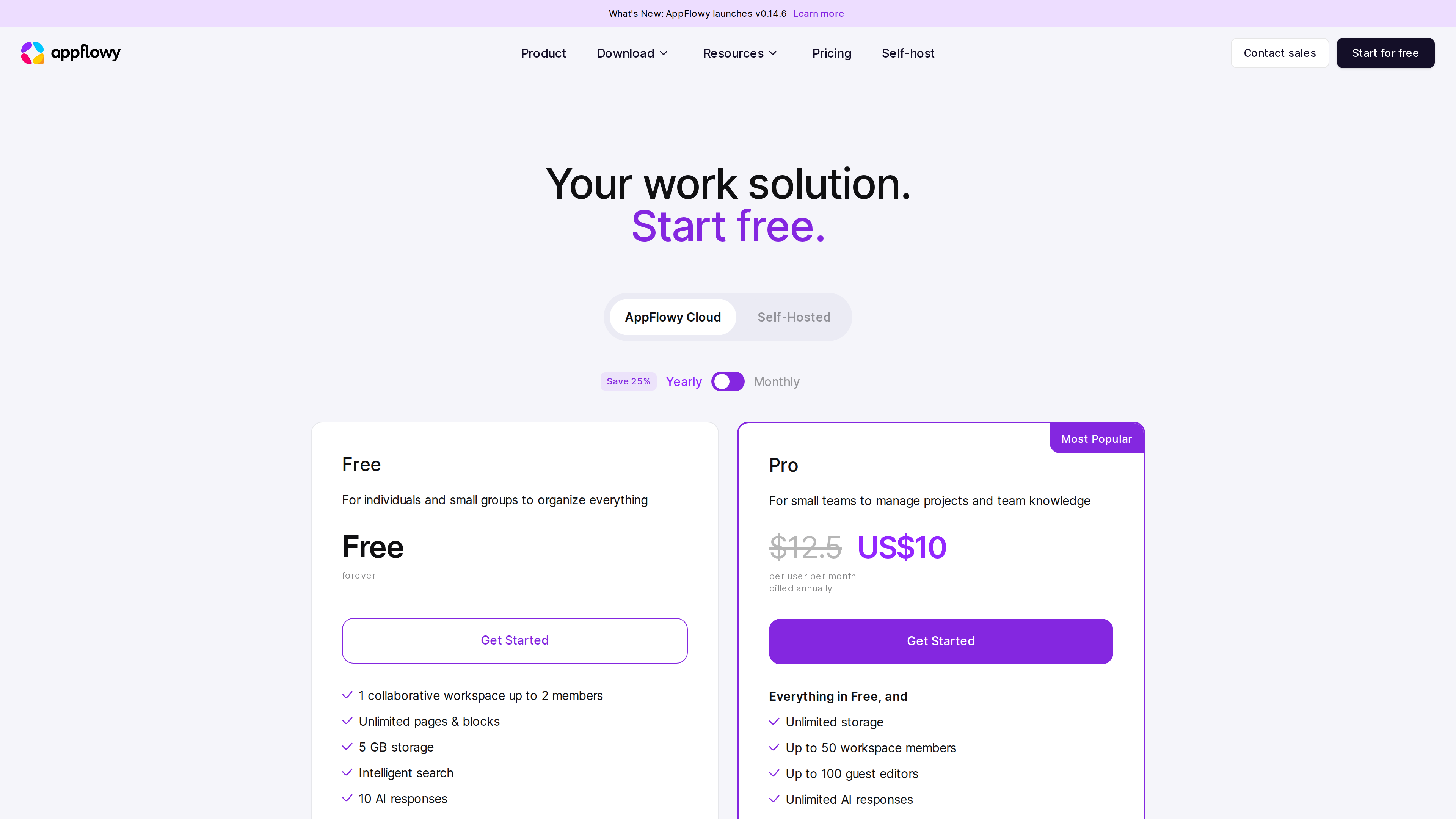
The screenshot above shows the AppFlowy Cloud tab: the Free plan ("Free forever") includes 5 GB storage and 10 AI responses; the Pro plan ("Most Popular") shows US12.5 is the monthly rate), with unlimited storage and unlimited AI responses.
Self-Hosting: Open-Source Clients + Commercial Server
Self-hosting is central to AppFlowy's current positioning, but its shape changed significantly in 2025–2026 and deserves a careful look:
- The original open-source server is archived: the AGPL-3.0 AppFlowy-Cloud repository (Rust) has been archived, and its README explicitly says it is no longer maintained and must not be used to build servers (AppFlowy-Cloud).
- The current server is closed-source and commercial: self-hosting now deploys via Docker Compose files and prebuilt images from the AppFlowy-SelfHost-Commercial repository; the server is a commercially licensed closed-source codebase (open-core model), while the web and Flutter clients remain fully open source. The managed SaaS and self-hosted distributions share the same server codebase.
- Deployment options: single-host Docker or Kubernetes, on-premises, on AWS/Azure/GCP, or in fully air-gapped environments; guides cover external PostgreSQL, external S3 storage, SMTP, reverse proxies (Nginx/Traefik), and Cloudflare Tunnel (self-hosting guide).
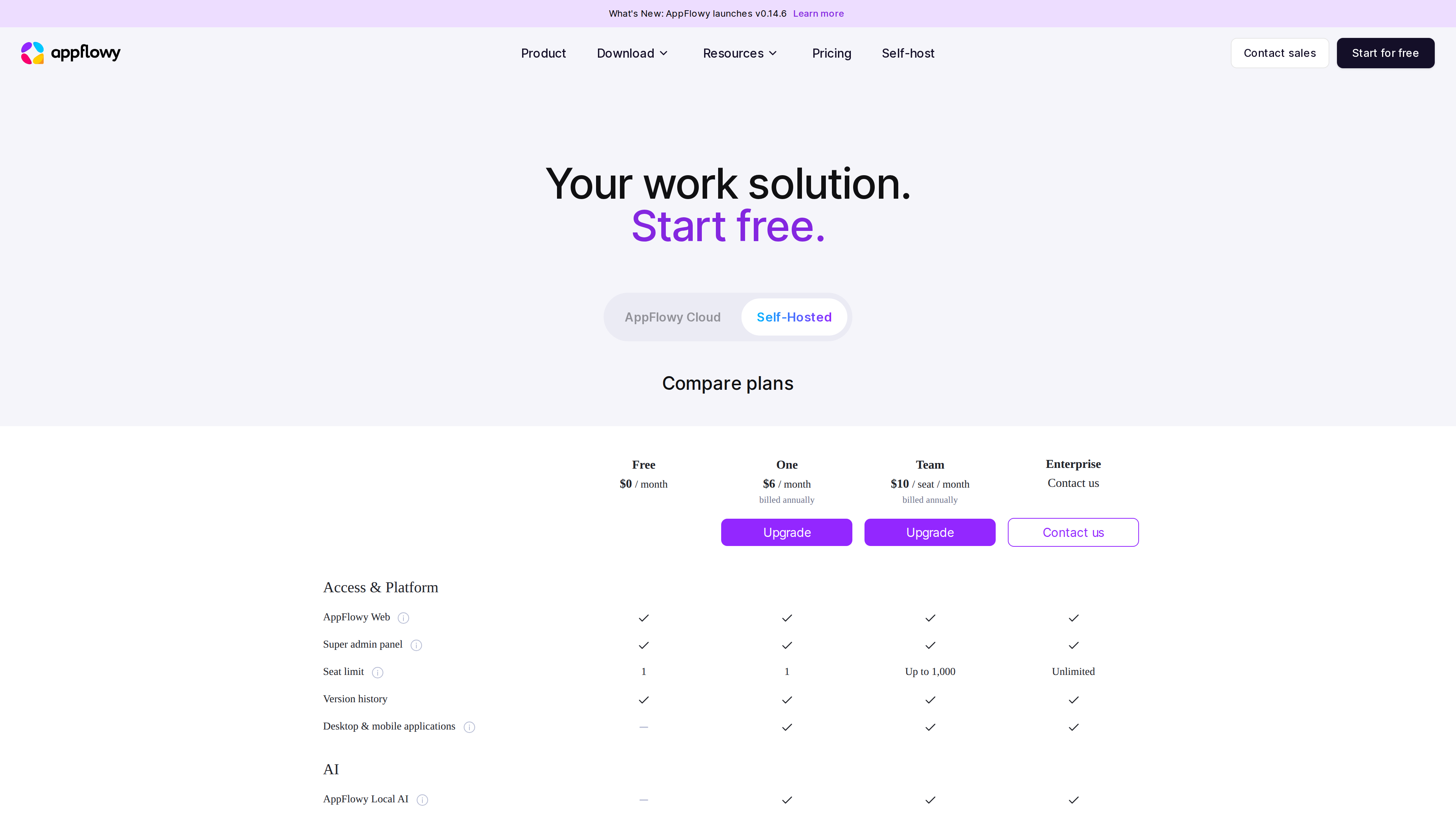
- Self-hosted pricing (pricing page, Self-Hosted tab, as of 2026-10-01): Free 6/month billed annually (1 seat, 10 guests, unlocks desktop/mobile apps and local/cloud AI), Team $10/seat/month billed annually (up to 1,000 seats, adds workspace members, SCIM, LDAP, and the security audit log), Enterprise custom (unlimited seats, whitelabel, managed deployment, support contract). Billing is per instance per seat, each instance requires its own commercial license code, and monthly billing is not offered to self-hosters.
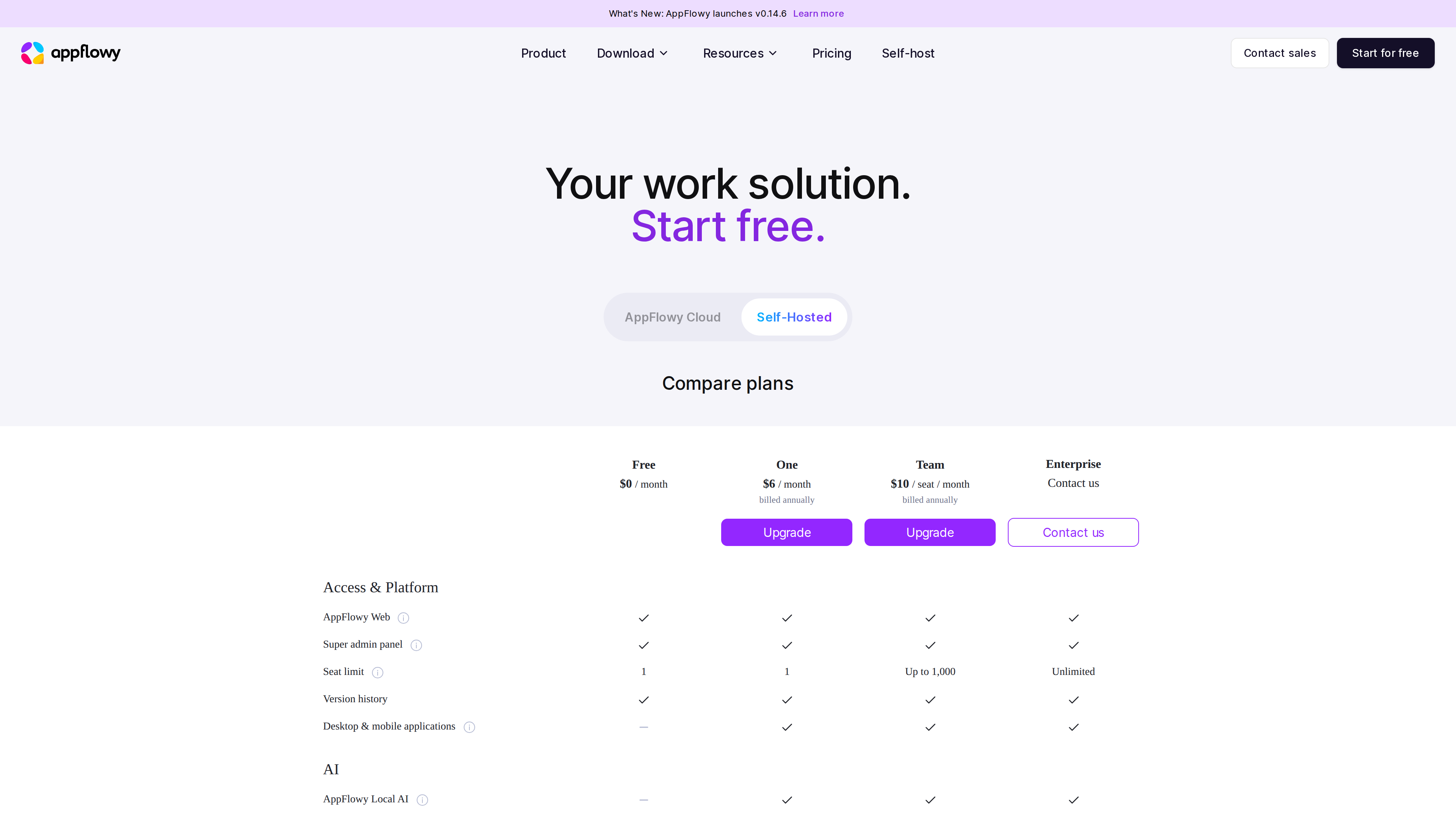
The screenshot above shows the Self-Hosted tab with all four tiers. The comparison table reveals the practical limits: SSO (incl. SAML 2.0) is available on every tier, but desktop/mobile apps and local AI require One or above, and SCIM/LDAP/audit logging require Team or above — the free self-hosted tier is effectively a single-user, web-only mode with guest editors.
Privacy Policy Notes
- The privacy policy was last updated on 2026-03-30; the company is incorporated in Singapore, and personal data may be transferred and stored across borders (privacy policy).
- AppFlowy states compliance with the Google API Services User Data Policy (including Limited Use) and does not use Google user data to train AI models.
- User Content is used to improve the services (including AppFlowy AI); users can opt out by emailing support@appflowy.io, and deletion requests are promised to be processed within one month.
- The homepage displays SOC 2 Type II, GDPR, HIPAA, and ISO/IEC 27001 badges (vendor claims, with no public reports linked); in self-hosted deployments the data is fully controlled by the operator, and AppFlowy states it has no access to self-hosted instances.
Who It's For
- Individuals and teams who want Notion-style docs and databases but need data to stay on their own devices or infrastructure.
- Organizations with compliance, data-residency, or air-gapped requirements that need a self-hosted collaboration platform.
- Users who want AI-assisted writing and Q&A on local models (Ollama/LM Studio) or in a fully offline Vault workspace.
- Developers looking to build on open-source components such as appflowy-editor and appflowy-board.
Limitations
- The self-hosted server went closed-source: the current server is a commercial product and the legacy AGPL server repository is archived and unmaintained; users committed to a fully open-source stack are left with outdated code — the community's main point of contention since 2025 (AppFlowy-Cloud README).
- Tight free tiers: the cloud Free plan includes only 5 GB storage, 2 members, and 10 AI responses; the self-hosted Free tier excludes desktop/mobile apps and AI entirely (pricing).
- Still behind Notion in places: the official comparison page acknowledges the lack of Map views and a smaller integration ecosystem, and Timeline views only arrived in September 2026 (comparison page, changelog).
- Mobile apps trail the desktop: new capabilities such as PDF/DOCX import land on desktop first; the Android app requires Android 10+ and does not support ARMv7 (repository README).
- Version coupling: desktop clients require matching self-hosted server versions (v0.14.6 requires server ≥ v0.19.0), so self-hosted upgrades must be sequenced carefully (changelog).
Alternatives for Reference
- Notion: the more mature commercial SaaS with a larger ecosystem; not self-hostable and without offline local workspaces. AppFlowy maintains a comparison page (vendor-authored).
- Anytype: another local-first, end-to-end-encrypted open-source alternative, oriented toward personal knowledge management rather than enterprise team deployment.
- Outline / BookStack: open-source self-hosted team-wiki tools with weaker database and project-management capabilities than AppFlowy.