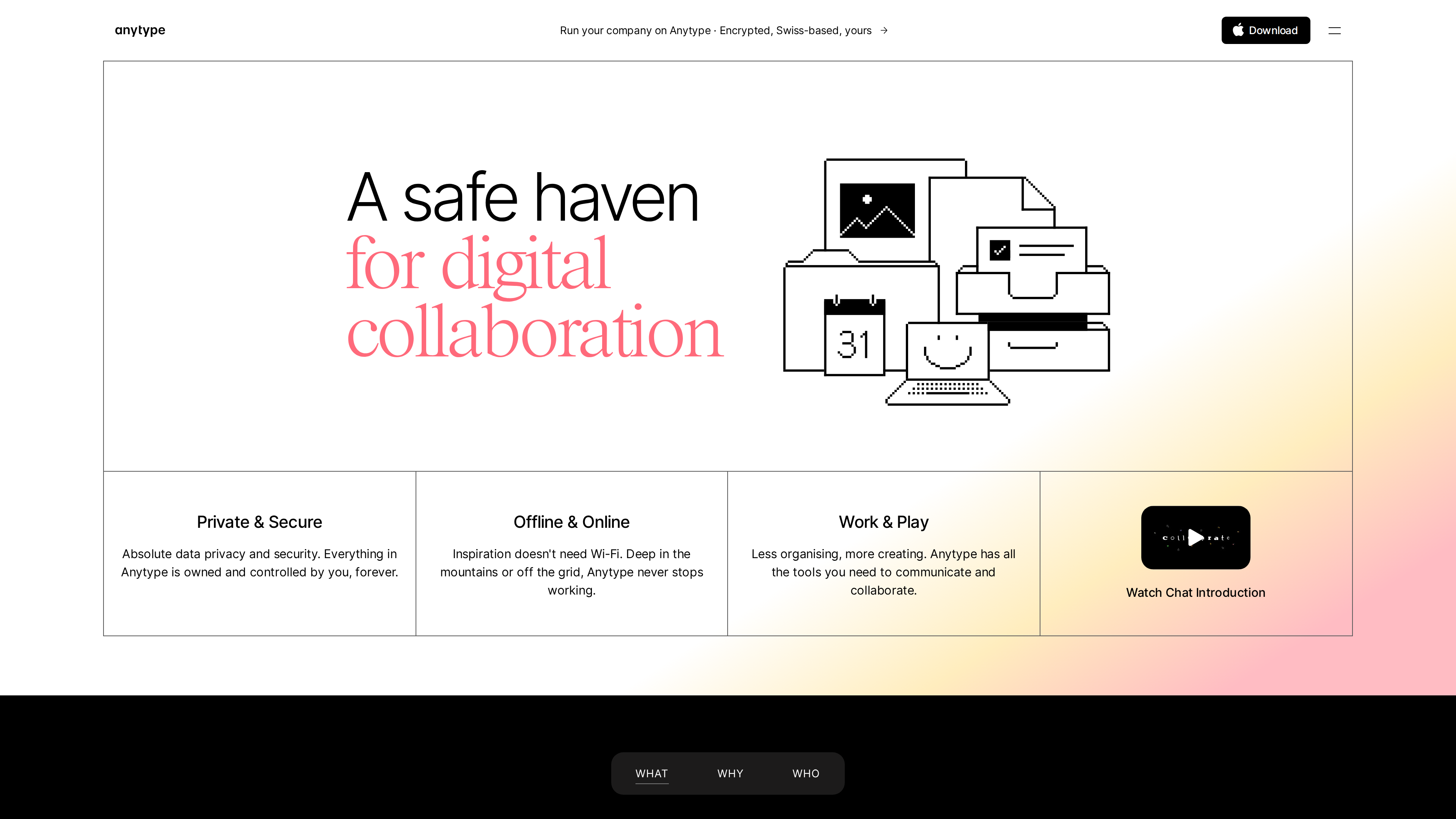
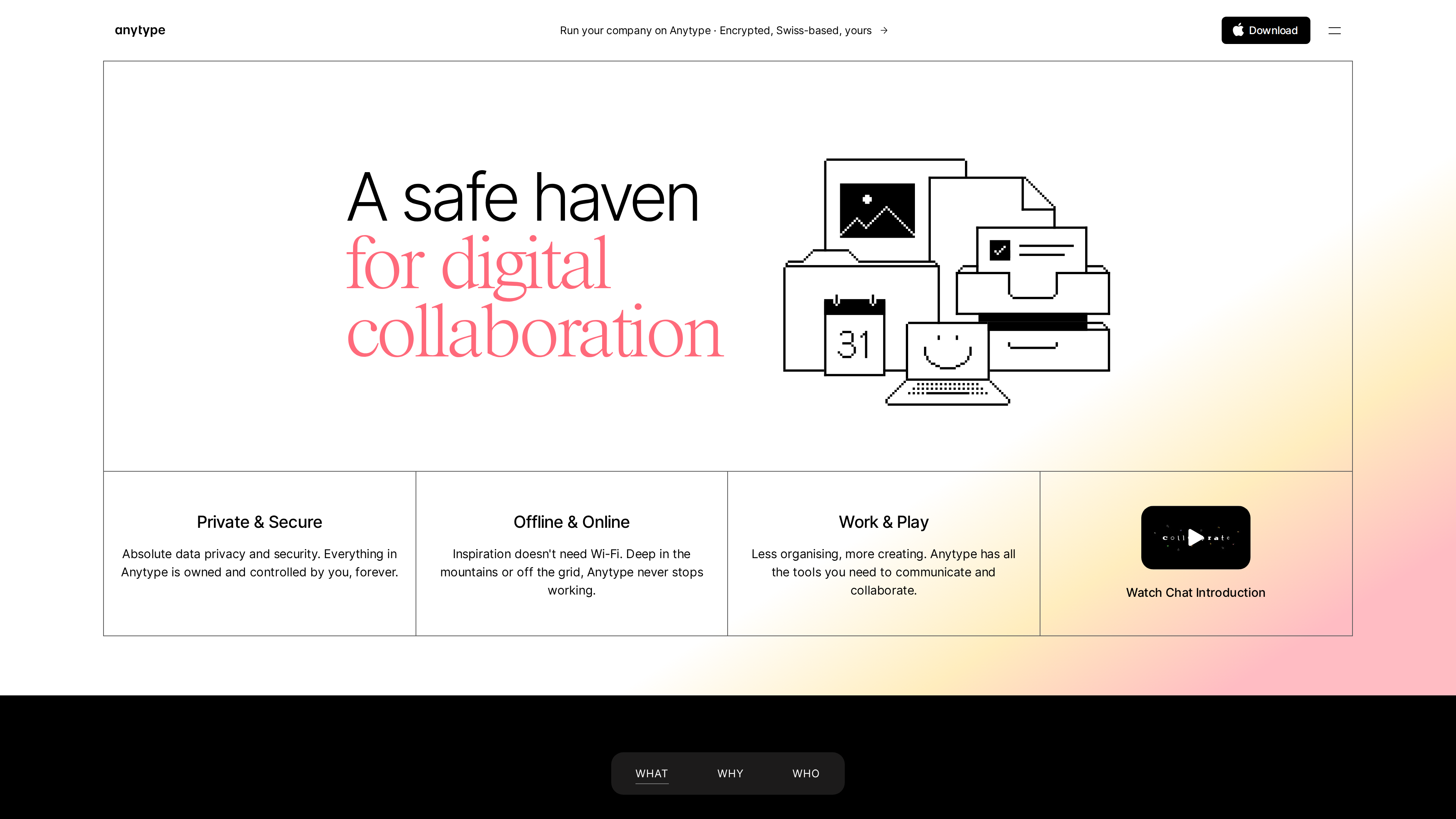
Anytype is a local-first, end-to-end encrypted knowledge management and collaboration app for macOS, Windows, Linux, iOS, and Android, with the tagline "A safe haven for digital collaboration" on its website. It addresses a specific problem: notes, tasks, databases, and chats live on your own devices first, work offline, and are encrypted before they leave the device, so the operator's servers act only as a "blind courier" that cannot read content. Its verifiable differences from cloud knowledge bases like Notion: a data model in which everything is an object linked into a graph, an account system with no email and no signup — just a 12-word key generated on-device, code published under a source-available license, and support for self-hosted sync networks.
Quick Facts
| Item | Details (as of 2026-09-30) |
|---|---|
| URL | https://anytype.io/ |
| Type | Local-first knowledge management / collaboration software (desktop and mobile apps, no web version) |
| Platforms | macOS, Windows, Linux, iOS, Android |
| Cost | Free for local use; remote backup plans Free / Plus 8 / Ultra $16 per month (pricing page, USD, monthly billing) |
| Signup | No email, no account registration; a 12-word key is generated offline on-device (official docs) |
| Interface languages | Multilingual UI, language selectable on first launch; the community translation repo contains complete Simplified and Traditional Chinese files; the official end-of-2023 figure was 20 languages on desktop and 11 on mobile |
| License | Any Source Available License 1.0 for the app layer (source-available, not OSI open source); MIT for the sync protocol layer |
Pricing (as of 2026-09-30)
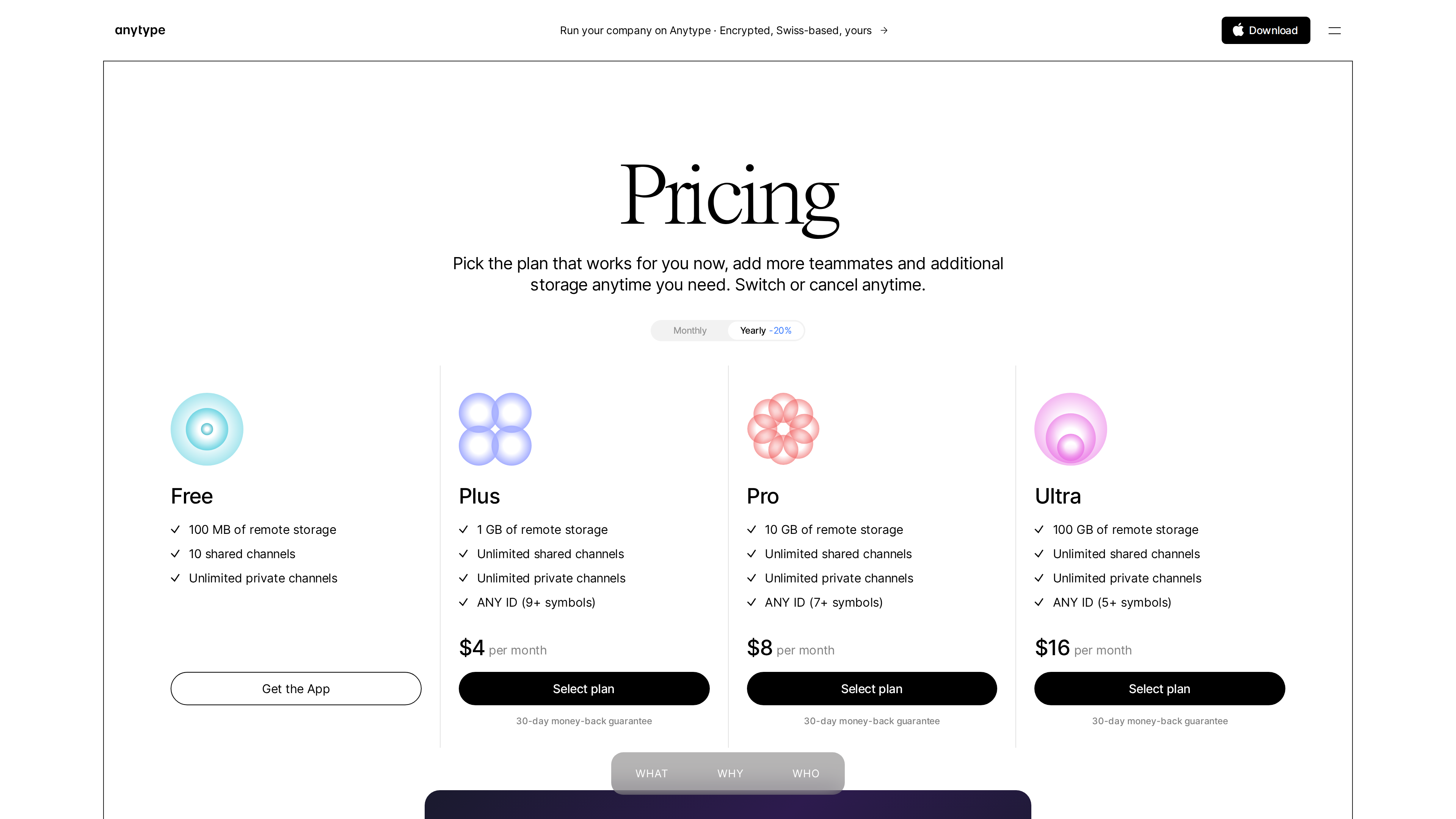
The pricing page lists four tiers, with 20% off annual billing and a 30-day money-back guarantee; purchases go through Stripe on desktop/web and through the app stores (in local currency) on iOS/Android.
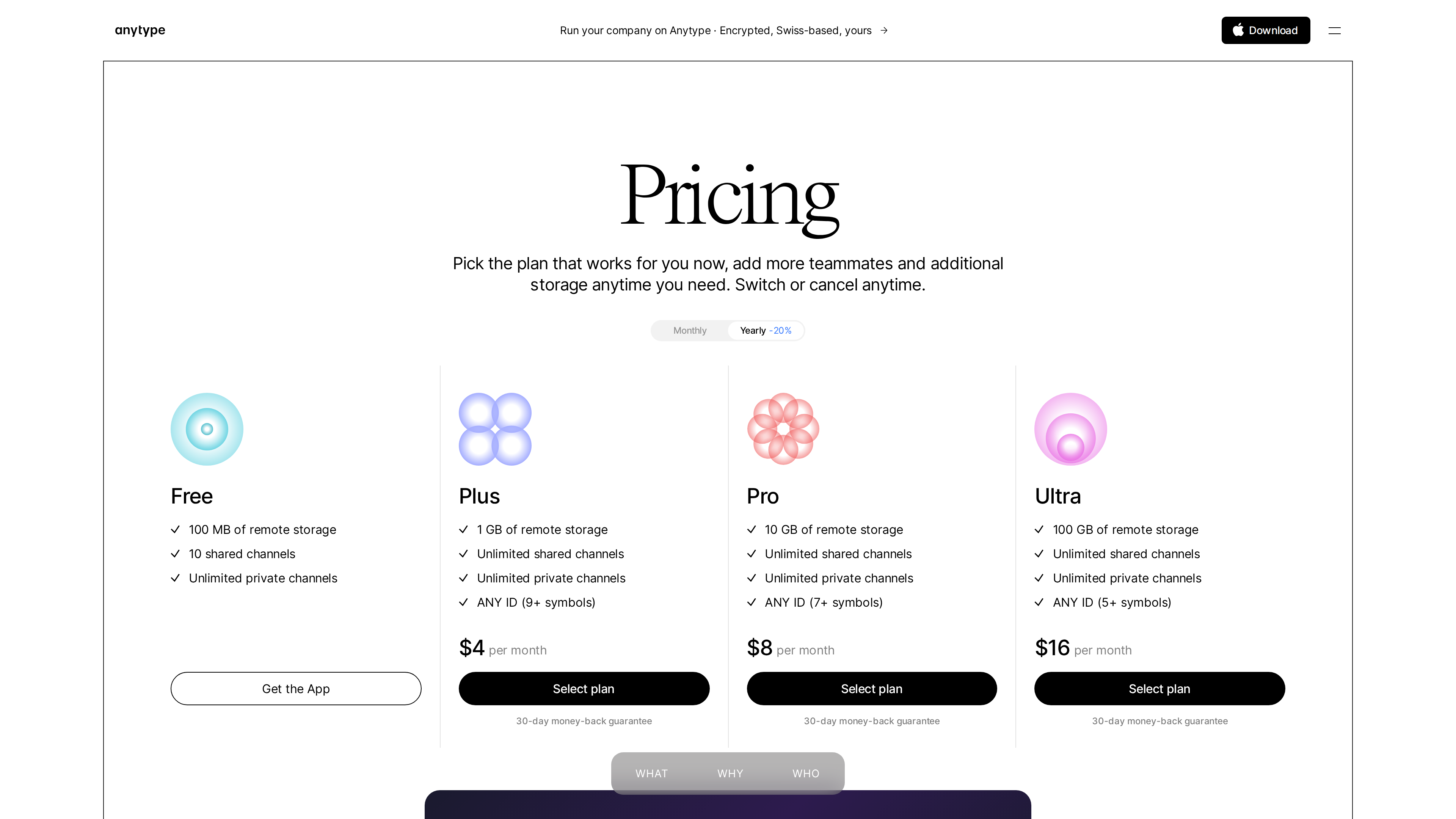
| Plan | Monthly price | Remote storage | Shared channels | ANY ID |
|---|---|---|---|---|
| Free | $0 | 100 MB | 10 | — |
| Plus | $4 | 1 GB | Unlimited | 9+ characters |
| Pro | $8 | 10 GB | Unlimited | 7+ characters |
| Ultra | $16 | 100 GB | Unlimited | 5+ characters |
Policy points worth knowing (per the official docs and the pricing FAQ):
- Local use costs nothing: objects don't count against the remote quota — only files such as images and videos do; exceeding the quota only stops new files from syncing, and the app keeps working; self-hosted networks need no membership at all, since quotas are managed by your own network configuration.
- An ANY ID is a unique name on the network that can serve as a web publishing address; it is kept for the duration of the membership, with a one-month grace period after cancellation before release (per the pricing-page FAQ).
- A 50% discount is available for educators/students and for active code or community contributors.
- If you stop paying: all members of a shared space are notified and can delete or export the space; encrypted backups on the official nodes are deleted after 30 days (membership docs).
- The pricing page also has an Anytype for Business entry with no public pricing; details could not be verified from the site's static pages.
Background
Anytype is operated by Any Association, a Swiss association. The terms of use list a contact address in Zug, Switzerland, under Swiss law, and the site footer reads "Made by Any — a Swiss association." Its GitHub organization anyproto (named Any Association, located in Switzerland) had 95 public repositories as of 2026-09-30. A retrospective letter on the official blog is signed by co-founder Anton Pronkin.
Timeline (statements are from the official blog unless noted):
- The project started in 2018; a 2019 Berlin prototype was an IPFS-based JavaScript collaborative editor, described by the team as "Notion-like."
- The alpha program began around mid-2020 on macOS/Windows, later adding Linux and Android; the first iOS alpha shipped in September 2021.
- A June 2023 post laid out the open philosophy ahead of the beta; Anytype entered open beta in July 2023, the same month the iOS app hit the global App Store (community update; no specific date was given).
- On August 23, 2023, the team announced a $13.4M raise led by Balderton Capital, with Protocol Labs and others participating (official statement only; not independently verified).
- The 2023 year-in-review claimed over 160,000 users and 2,100+ GitHub stars by the end of that year (self-reported).
- The Android app launched on the Play Store in March 2024; the first multiplayer version shipped on April 25, 2024, which the team called "very basic - it's an alpha."
- Through 2024, multiplayer, version history, inline LaTeX, and files-as-objects were added (2024 year-in-review).
- Desktop 0.54.0 "Focus & Flow" shipped on February 19, 2026 with tabs, advanced filters, in-chat search, channel ownership transfer, and more.
- Recent strategy signals: the affiliated site any.org describes a new product direction, "any" — an "LLM-native database + agent harness" built on any-sync — and repositories such as anytype-mcp and anytype-agent-runtime have appeared on GitHub.
Core Capabilities
Local-first, end-to-end encrypted knowledge management
Per the official docs, everything you create is stored on your device first and works offline; data is encrypted before leaving the device, and the Anytype network acts as a "blind orchestrator" that cannot read content. The underlying sync protocol, any-sync, is CRDT-based (each object is a DAG of change history); the team says it meets Ink & Switch's seven local-first criteria and adds two of its own: creators control the keys, and the protocol is open and verifiable.
Encryption specifics (Privacy & Encryption docs): the key is a 12-word mnemonic phrase (128-bit) generated on-device, never transmitted, with no server-side copy and no password reset — losing the key means losing the data, which the team states is intentional. Each object's change history is encrypted with two layers of keys using AES in CFB mode. One caveat: the local search index is not encrypted, stays on the device, and never syncs; the docs recommend enabling disk encryption.
Object-graph data model
In Anytype, everything is an object: pages, tasks, people, and images are all objects, each with a type (customizable), properties, and links to other objects. Types bundle properties, views, and templates to standardize similar objects. The homepage lists Graph, Table, Kanban, and Gallery views alongside a block editor, databases, and widgets. The official framing: an object asks "what is it related to" rather than "which folder does it live in."
P2P sync with three network modes
Sync and storage mechanics (Storage docs, Sync & Backup docs):
- Devices on the same LAN can sync directly, peer-to-peer, with no server involved. The storage layer uses a private IPFS network; media files stream on demand and are deduplicated (one copy per image).
- Three network modes are available: Anytype Network (the default — encrypted backup nodes plus sync relays hosted in EU data centers); Self-host (upload your own any-sync network configuration; the team maintains a docker-compose setup plus Ansible/Puppet options); and Local-only (on-device plus LAN P2P only).
Collaboration and publishing
Per the collaboration docs: spaces are personal or collaborative (current terminology calls the account container a Vault and a space a Channel). Collaborative spaces support real-time co-editing with built-in chats and discussions, joined via invite links or QR codes with optional approval. Keys are passed directly from the inviter's device to the invitee — the server never holds them — and collaborators need neither an email address nor a subscription. Objects can also be published to the web (Publish), with an ANY ID as the address.
Open Code and Extensibility
The licensing needs a clear caveat: Anytype is not open source in the OSI sense. The official term is "Open code," framed as "Cooperative Open Source" in a June 2023 blog post that cites MongoDB and Elastic as precedents:
- The app layer and middleware (anytype-ts desktop, anytype-swift, anytype-kotlin, anytype-heart) use the Any Source Available License 1.0 (ASAL 1.0): use, modification, and redistribution are allowed only for non-commercial purposes or for commercial use within "Allowed Networks"; it includes a patent-retaliation clause; GitHub flags it as "NOASSERTION" (a non-standard license).
- The infrastructure and protocol layer (the any-sync protocol and its node implementations, any-block, any-store, any-sync-dockercompose, anytype-cli, anytype-mcp, and more) is MIT-licensed (license fields via the GitHub API, as of 2026-09-30).
Repository activity (as of 2026-09-30, via the GitHub API): the main anytype-ts repo has 8,870 stars, roughly 91 contributors, and 300 releases, with the latest stable v0.57.0 dated 2026-09-22; any-sync has 1,723 stars, any-sync-dockercompose 945, and anytype-mcp 528. Localization runs through community translation on Crowdin, and the translation repo is CC0.
Import/export and APIs (official docs, desktop only):
- Export: single or multiple objects, views, or entire channels, in Markdown, Any-Block (JSON or Protobuf), PDF, and HTML, with zip packaging; excluded: space members and chats/discussions, which are bound to member keys and cannot be exported.
- Import: handled through channel settings, with dedicated guides for migrating from Obsidian and Evernote.
- Developer surface: the official portal at developers.anytype.io; the anytype-api repo ships an OpenAPI v2 spec and an llms.txt file; the desktop app exposes a gRPC API; ecosystem tools include anytype-mcp (an MCP server that lets AI assistants operate Anytype), anytype-raycast, and anytype-cli.
Good Fits
Based on the verifiable facts above, Anytype suits:
- Personal knowledge management and note-taking that must work offline and keep data on-device by default;
- Users with hard privacy requirements who want sync servers that cannot read their content;
- Small teams wanting encrypted collaboration where participants need no account or email;
- Self-hosters with the ops skills to run their own sync backend;
- Publishing notes or objects directly to the web (Publish + ANY ID).
Limitations
All of the following come from official documentation or directly verifiable facts:
- No browser version. The official FAQ states: "There's no browser version of the app... There are many points of vulnerability in-browser apps that would compromise our commitment to data security and encryption."
- Missing mobile features (same FAQ): columns, inline LaTeX, inline views, Kanban/calendar/graph views, formulas, embeds, and custom CSS are not yet supported on mobile.
- Collaboration is recent: multiplayer shipped in April 2024 as what the team called a "very basic alpha"; the free tier caps shared channels at 10; the Business plan has no public pricing.
- Import/export is desktop-only, and chats and discussions cannot be exported.
- Losing the key means losing the data: the key cannot be changed, no copy exists anywhere, and with no other logged-in device the data is permanently unrecoverable — by design, but a real risk for ordinary users.
- The data directory must not be placed inside third-party cloud sync folders (Dropbox and similar): the docs warn of database corruption and leakage of the unencrypted index — a migration hurdle for users accustomed to syncing notes through cloud drives.
- The license is source-available (ASAL 1.0): commercial use is restricted, so it is not open source software in the strict sense.
- The local search index is unencrypted (explicitly documented; it relies on the security of the device itself).
Alternatives for Context
Positioning references (analytical summary, not site-by-site verification):
- Notion: the cloud-based collaborative knowledge base Anytype explicitly benchmarks against. Notion keeps data in the cloud and is closed source; Anytype is local-first with end-to-end encryption.
- Obsidian: also local-first, but built on plain Markdown files, closed source and commercial, with sync and publish as paid add-ons; Anytype uses an object-graph model and is source-available.
- Logseq: open source (AGPL), local-first outliner.
- AppFlowy: open source (AGPL) Notion alternative with optional self-hosting; in the same "open Notion alternative" camp as Anytype, though Anytype's license is source-available rather than copyleft.
- AFFiNE: open source (MIT), local-first knowledge base with a block editor and whiteboard.
- Joplin / Standard Notes: open source and end-to-end encrypted, in a more traditional note-taking form.
In short, Anytype sits at the intersection of Notion and Obsidian alternatives: local-first + end-to-end encryption + an object-graph data model + self-hostable sync.
References
- Website and pricing: https://anytype.io/ , https://anytype.io/pricing
- Documentation: https://doc.anytype.io/anytype/ (Sync & Backup, Privacy & Encryption, Key, Storage, Import & Export, Collaboration, FAQ)
- Terms of use: https://anytype.io/terms_of_use
- GitHub organization and license: https://github.com/anyproto/ , https://github.com/anyproto/anytype-ts/blob/main/LICENSE.md
- Official blog (timeline citations): https://blog.anytype.io/