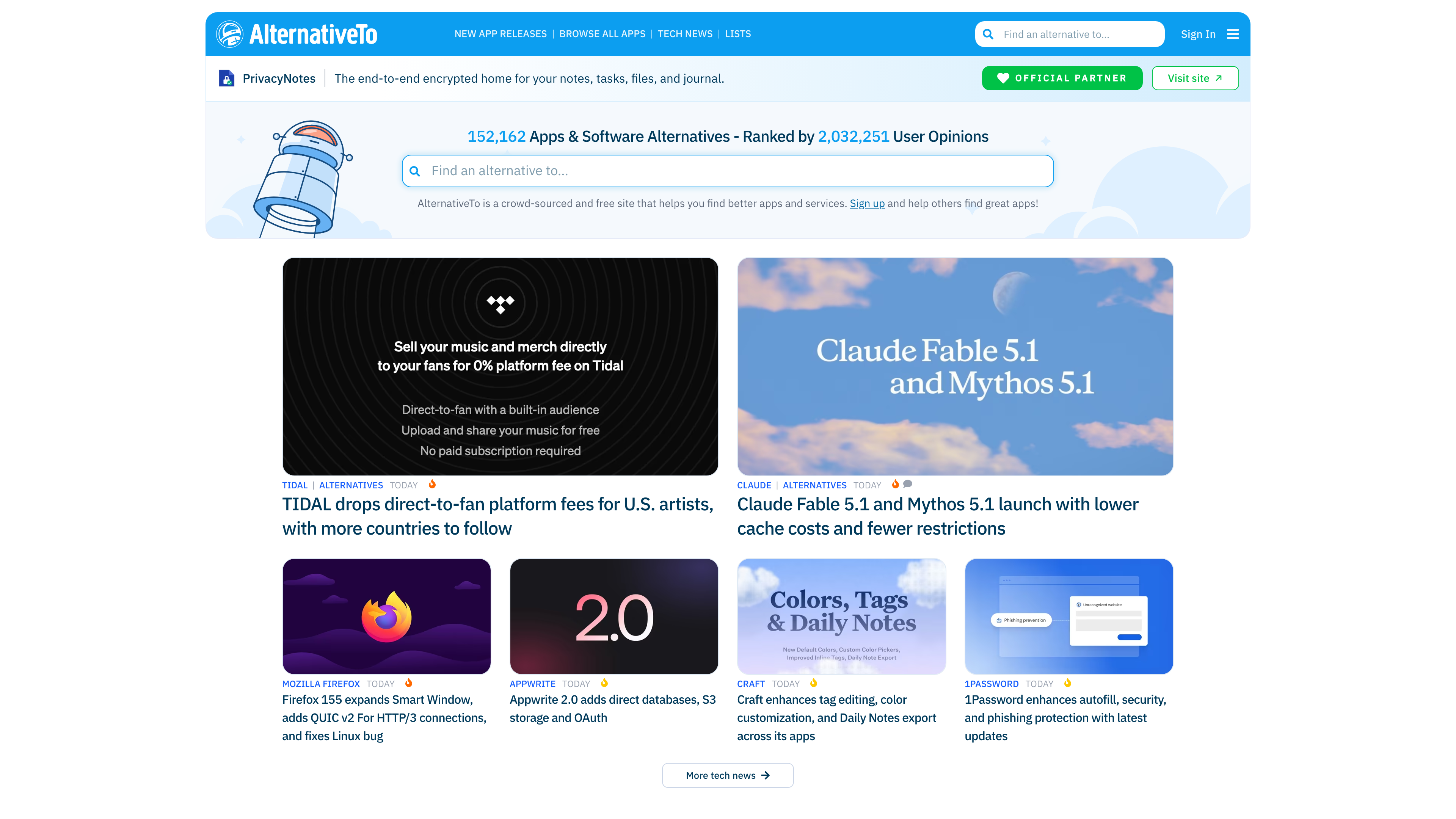
AlternativeTo answers a specific question: "I want to replace this app — what else is out there?" Type in an application you use (or want to drop), and it returns a ranked list of alternatives that you can narrow down by platform, license and price. Unlike classic software directories organized as category trees, its basic unit is each app's own list of alternatives, and the entries, relationships, votes and reviews all come from registered users. The site is run by 27 Kilobyte AB in Stockholm, Sweden, and launched in 2009; as of 2026-09-02, the homepage shows 152,162 listed apps ranked by 2,032,251 user opinions.
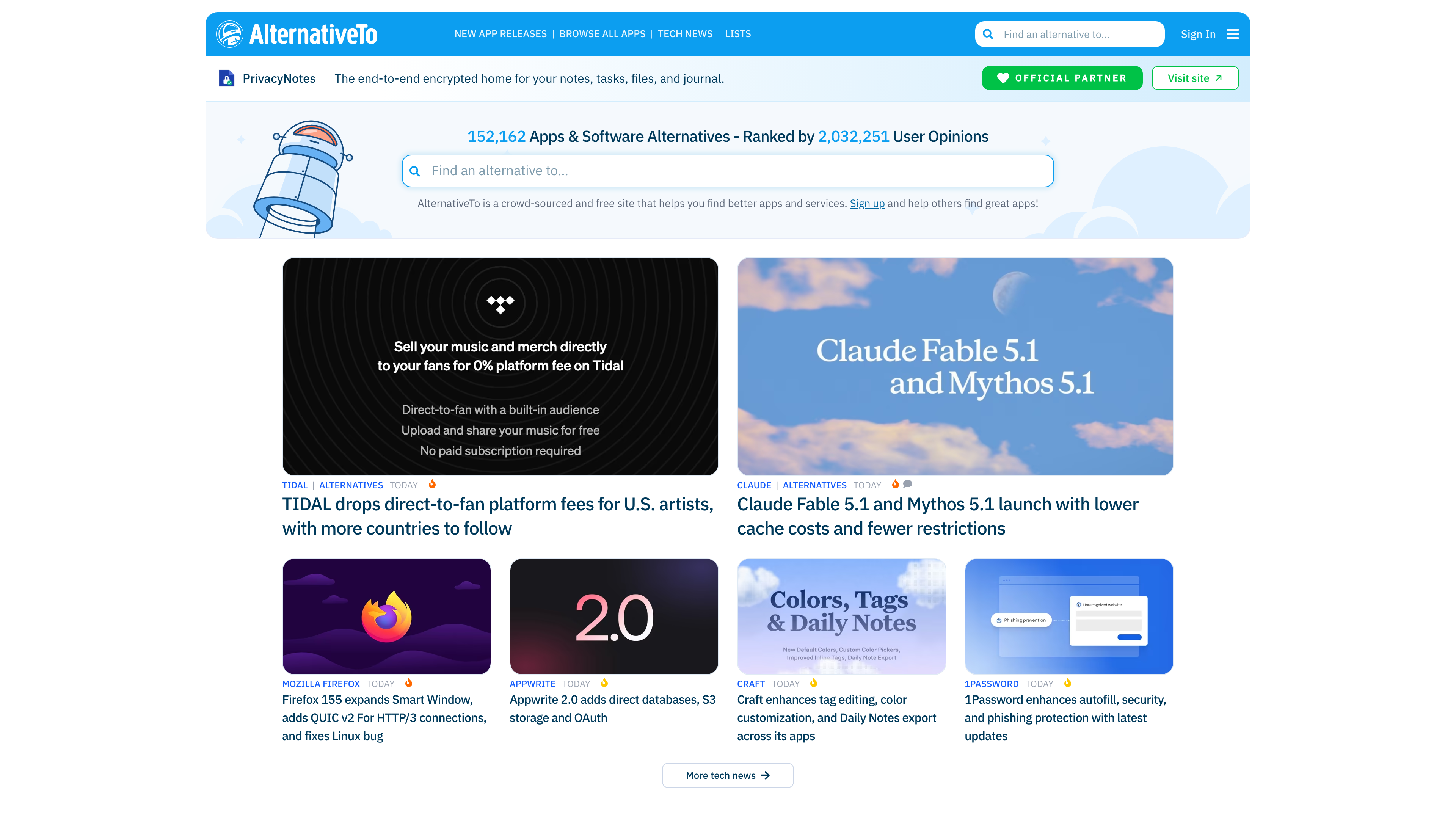
The screenshot above shows the homepage on 2026-09-02: the header displays the live catalog size (152,162 apps, 2,032,251 user opinions), the search box prompts "Find an alternative to...", and below sit newly listed apps and a tech news feed. The banner at the top is on-site advertising — the official FAQ states the site depends entirely on ads to pay its bills.
At a glance
- URL: https://alternativeto.net/
- Type: crowdsourced software alternatives directory (UGC)
- Cost: free to use, ad-supported; the only paid option is a $5 one-time priority review for submitted apps
- Registration: not required for browsing; needed for voting, commenting and submissions; you must be at least 16 (or your country's lower age of digital consent)
- Language: English only — listed apps must also support English
- Launched: 2009
- Operator: 27 Kilobyte AB, Stockholm, Sweden
Background
AlternativeTo was created by Ola Johansson and Markus Olausson and launched in 2009; in June that year Voice of America featured it as a "Website of the week" (source: the Wikipedia entry on AlternativeTo, which cites the VOA piece of 2009-06-12 and a March 2009 archive of the official site). The About page states the mission as "helping you find the right software for your computer, mobile phone or tablet", with a focus on alternatives to software you already know and want to replace, based on user recommendations.
The business model has four parts (per the FAQ and Terms of Use): advertising (the privacy policy lists Google AdSense and Google Ad Manager), PayPal donations, and a priority review fee for developers. New app submissions go into a review backlog that usually runs for months; a one-time $5 payment moves a submission to the front, where it is typically reviewed within one to two business days. The terms stress that "paying buys a faster review, not approval" — the criteria are identical, and the fee is not refunded once the review is done.
How alternatives are organized and filtered
Every app has a page listing its alternatives, ordered by an in-house "rank" algorithm. The FAQ explains that likes are one of the most important inputs, but the details are kept private to discourage manipulation. The community rule for what counts as an alternative is whether two apps share the same main task and focus: Spotify can play local files, but it is a streaming service, so it is not listed as an alternative to iTunes. Each alternatives page shows when it was last updated (the Notion page, for example, shows 2026-06-19).
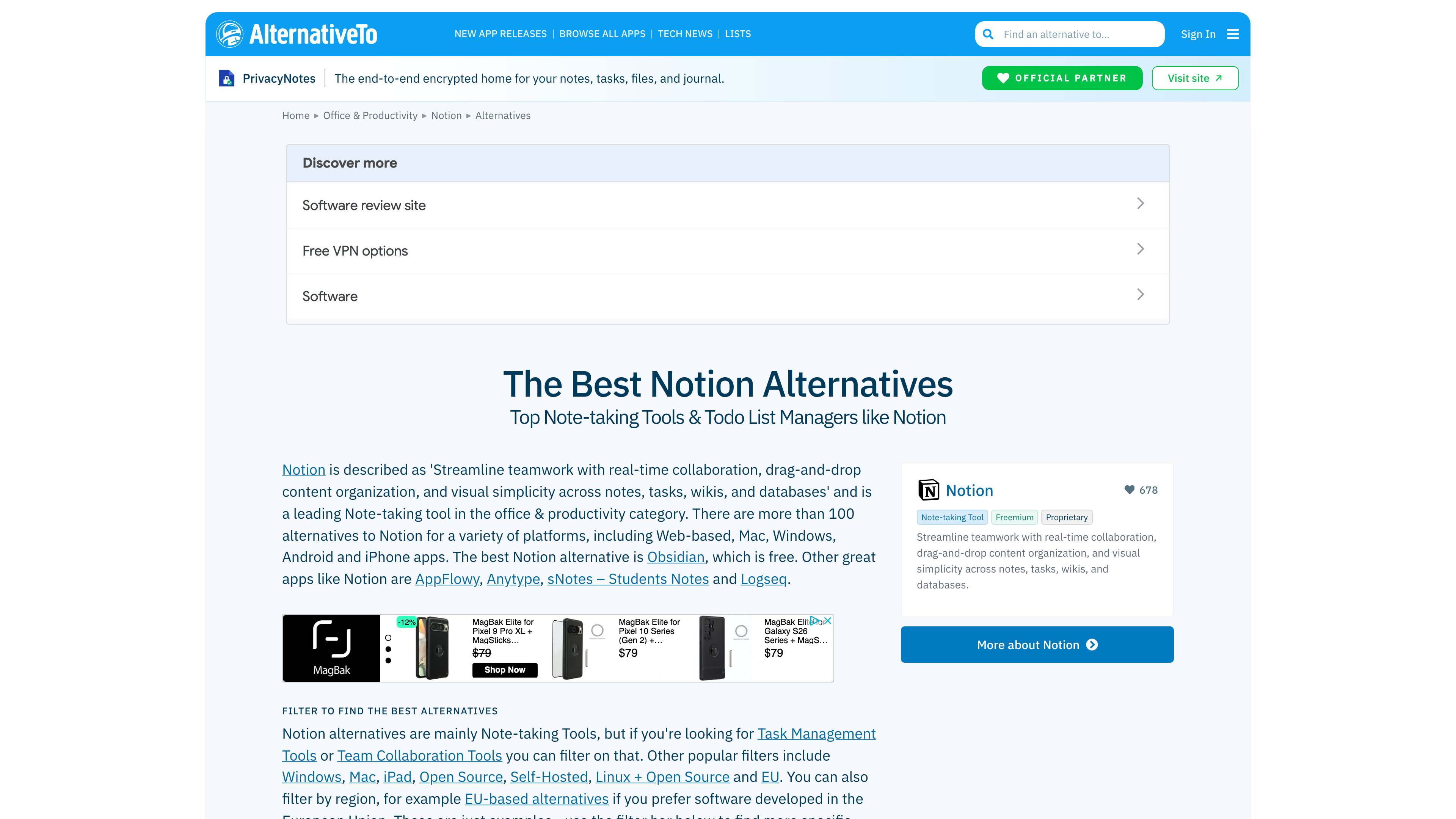
Above is the Notion alternatives page (screenshot from 2026-09-02): the intro automatically summarizes "more than 100 alternatives" and names Obsidian as the best free option, while the info card on the right shows Notion's own like count, app type (Note-taking Tool) and license (Freemium, Proprietary). The "Filter to find the best alternatives" section below documents the available dimensions: platforms such as Windows, Mac and iPad, Open Source and Self-Hosted, plus region filters such as EU for software developed in the European Union.
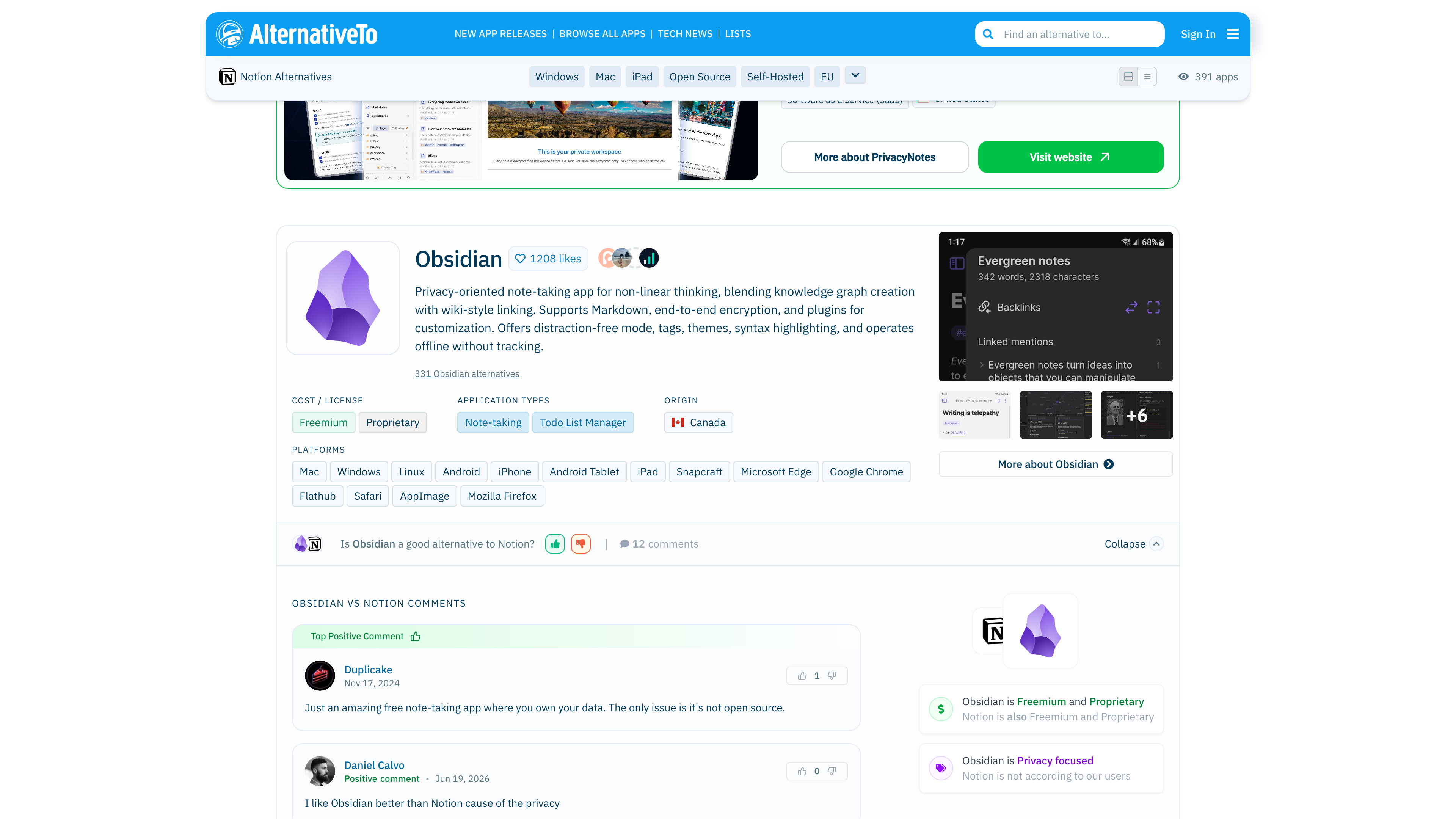
Scrolling down, the top-ranked Obsidian entry shows the full anatomy of a listing:
- Cost / License: Freemium, Proprietary. The site's license model has four tiers — Free, Freemium, Free for personal use, and Commercial — plus an open-source flag with the specific license (GPL-3.0, MIT, Apache-2.0, etc.); filters group these into "Free", "Only Open Source" and "Commercial" (FAQ on licenses).
- Application types and Origin: type tags (Note-taking, Todo List Manager) and the developer's country (Canada).
- Platforms: from Windows, Mac, Linux, Android and iOS to distribution channels like Flathub, Snapcraft and Homebrew.
- Voting and comments: "Is Obsidian a good alternative to Notion?" collects yes/no votes with opinion comments, and the system generates attribute comparisons automatically (e.g. "Obsidian is Privacy focused — Notion is not according to our users"). A sticky filter bar shows 391 apps listed on this page (observed 2026-09-02).
Alternative relationships are continuously moderated: entries that receive many "not a good alternative" votes are automatically flagged to admins, and discontinued or malicious software gets a Discontinued or Warning label. Those entries are kept on purpose — finding a replacement for abandoned software is a core use case — but they no longer appear as alternatives to other apps (FAQ).
Accounts and openness
- Browsing needs no account. Registered users can like, vote, comment, create app Lists (private or public), submit new apps and edit entries; submitting a new app requires a verified email address (FAQ).
- Comments and reviews only become visible after admin approval. Users earn points for contributions and can be promoted to Contributor status.
- Third-party sign-in via X/Twitter, Facebook and Microsoft has been discontinued (FAQ).
- There is no public data API today: the Wikipedia entry records that an early JSON API was taken down indefinitely, and the Terms of Use forbid bulk-downloading beyond what robots.txt allows and using the site's content to build a competing database. Bulk data use requires contacting the team by email.
Copyright and content policy
As a UGC site, AlternativeTo's Terms of Use spell out the content arrangement:
- You keep ownership of what you post, but grant the operator a worldwide, non-exclusive, royalty-free, transferable and sub-licensable license to host, store, reproduce, adapt, publish, translate and display it.
- Everything you post is public and may be indexed by search engines or cached by third parties.
- If you delete your account, contributions such as comments, reviews and submissions may stay on the site, disassociated from your identity, so discussions and app data remain coherent; you can ask for specific items to be removed.
- Copyright complaints go to hello@alternativeto.net and must identify the work and confirm you are the rights holder or authorized to act for them.
- Listings are not endorsements: the operator does not test, verify or certify the software, and you are solely responsible for what you download and install. The site does not host downloads — it only links to official websites (FAQ).
On the listing side (FAQ): only apps that support English are accepted; services restricted to a single country or region are not (except those available across the EU or the US); porn sites, unreleased or closed-beta products, and — in principle — hardware are rejected; descriptions may not contain links, phone numbers or email addresses. On privacy, the privacy policy lists third-party services including Google Analytics (anonymized IP), Cloudflare, hCaptcha and Algolia, and states that Do Not Track requests are not honored.
Good use cases
- Quickly listing candidates when an app you rely on gets expensive, abandoned or untrustworthy
- Finding equivalents when moving between platforms (e.g. Windows to macOS/Linux)
- Enforcing hard requirements like open source, self-hosted or EU-developed
- Discovering new tools via New App Releases, public Lists and the tech news feed
Limitations
- English only: both the interface and every listed app must support English, so coverage of non-English software is thin (FAQ).
- Information is not verified: entries are community-maintained and prices or platform data can go stale; the service is provided "as is" with no accuracy warranty (Terms of Use).
- Opaque ranking: the rank algorithm is secret, and likes can be brigaded; the team acknowledges the cat-and-mouse game and counters it with rank demotions (FAQ).
- Months-long submission queue: the $5 priority review speeds up the review but buys no guarantee of approval.
- No comparison tables: filtering and comments operate on attributes and tags; there are no side-by-side feature matrices (Wikipedia entry).
- Ads on the page: banners appear on the homepage and app pages.
Similar sites
- Product Hunt focuses on launch-day buzz for new products, whereas AlternativeTo is built for replacing software you already use.
- Free Software Directory, maintained by the Free Software Foundation, lists only free software and is narrower in both scale and filtering.
- The Wikipedia entry notes the site even hosts a page of alternatives to itself — a handy starting point for similar directories.
Sources
- AlternativeTo homepage (catalog size and positioning, checked 2026-09-02)
- About AlternativeTo (mission and operating company, checked 2026-09-02)
- AlternativeTo FAQ (filters, license model, submission and review, listing policy, ads and donations, checked 2026-09-02)
- Terms of Use (UGC license, account age, scraping ban, priority review terms, Swedish jurisdiction, checked 2026-09-02)
- Privacy Policy (data collection and third-party services, checked 2026-09-02)
- Notion alternatives page (entry structure and filter dimensions, checked 2026-09-02)
- Wikipedia: AlternativeTo (2009 launch, founders, VOA coverage, JSON API takedown, no download hosting, checked 2026-09-02)