Actual Budget (actualbudget.org) is an open-source personal budgeting app built around envelope budgeting — a zero-based method where you only budget money you actually have and give every unit of income a job. It is deliberately local-first software: your data lives on your own device, the app works fully offline, and end-to-end encryption is optional. Multi-device sync runs through a sync server you host yourself (or pay to host); there is no official hosted service (homepage, sync docs, checked 2026-10-02).
The project began as James Long's independent subscription product. On April 29, 2022 he announced it would become "100% free and completely open forever" under the MIT license, and a volunteer community has maintained it since, shipping monthly releases. As of 2026-10-02, the main GitHub repository actualbudget/actual has about 29,300 stars.
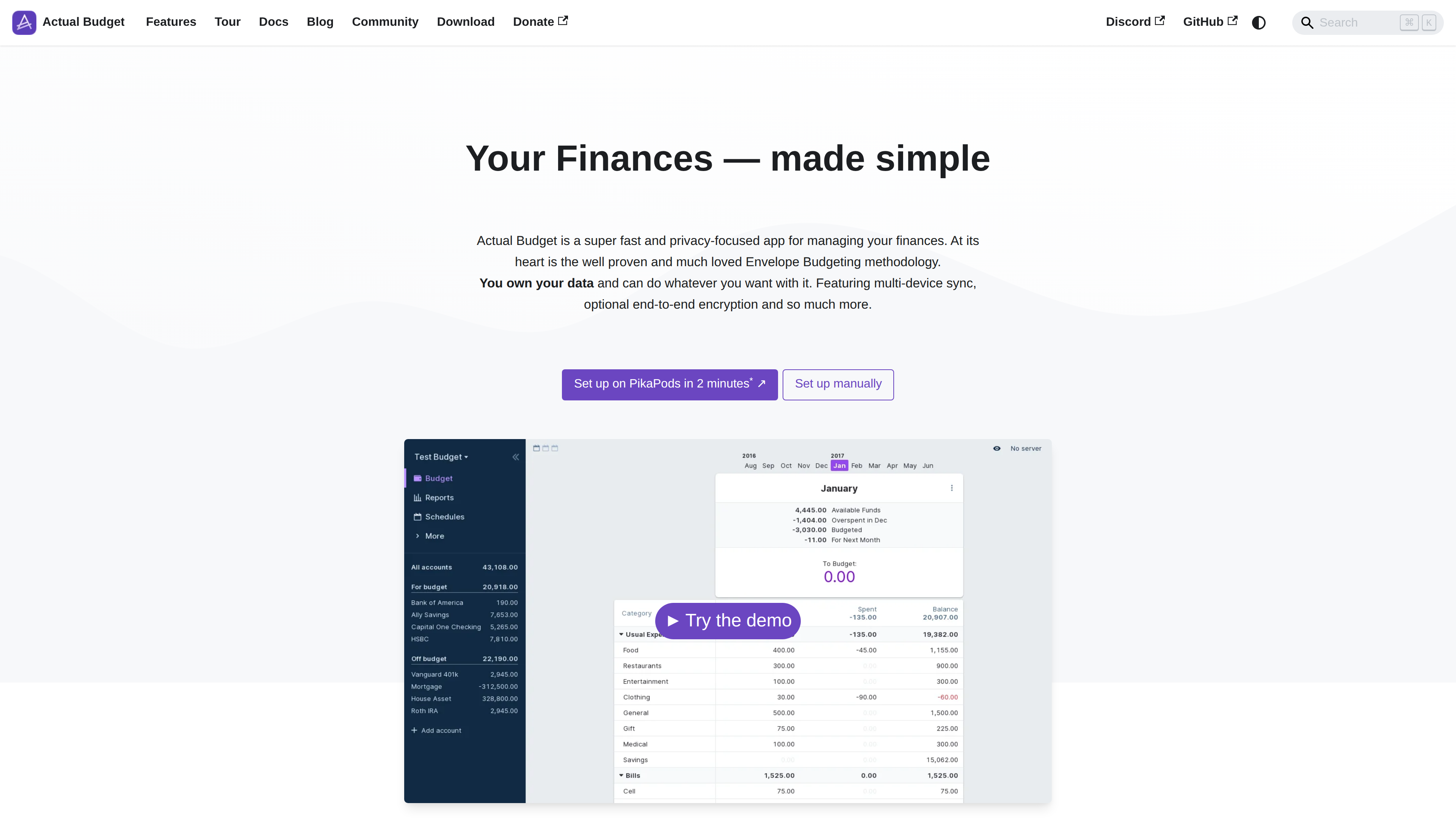
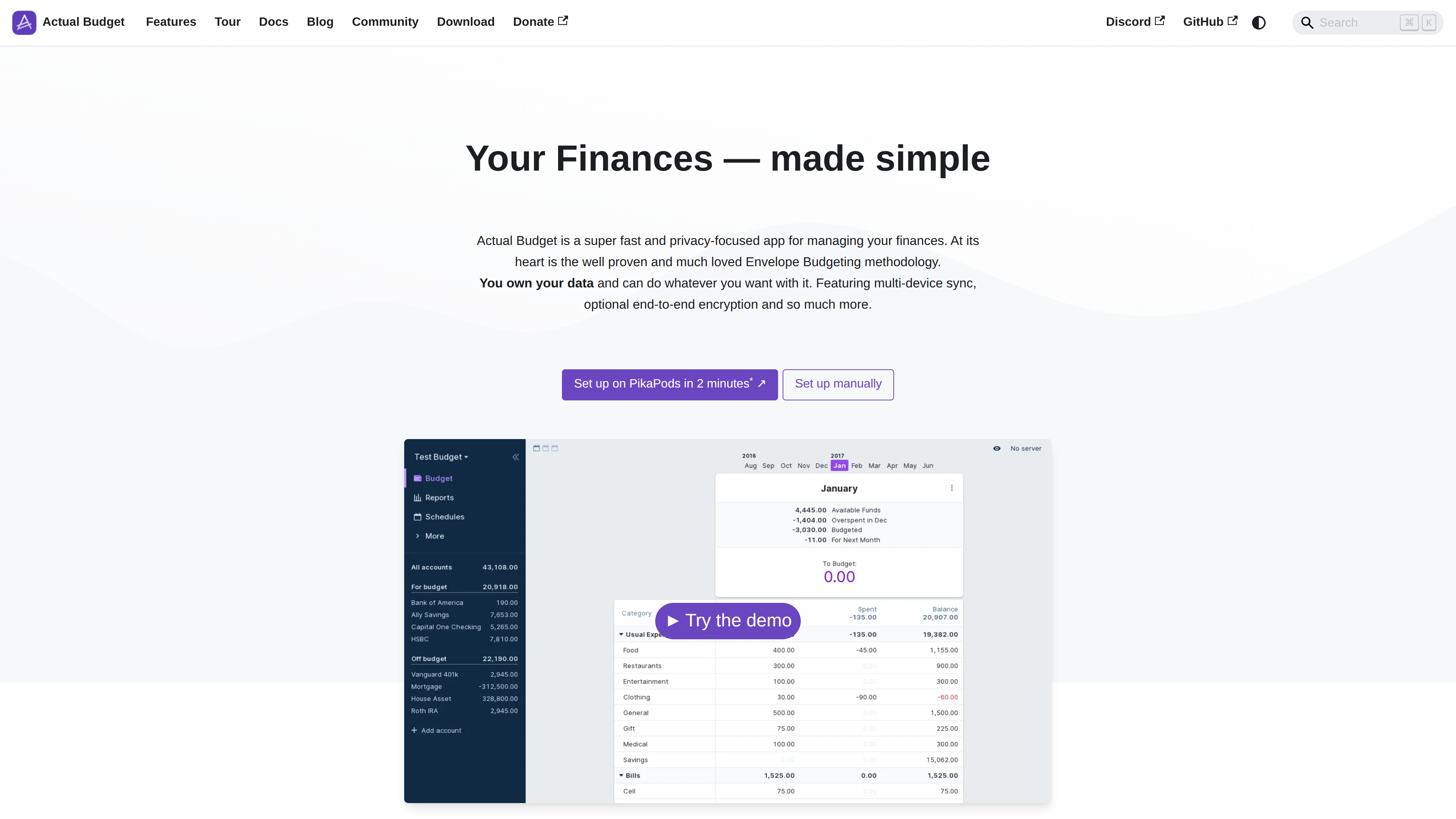
The homepage (2026-10-02) offers two starting points up front — "Set up on PikaPods in 2 minutes" or a manual setup — with the budget interface shown below.
At a Glance
| Item | Details |
|---|---|
| URL | https://actualbudget.org/ (actualbudget.com 301-redirects here) |
| Type | Personal budgeting/expense-tracking app (open source, local-first) |
| Cost | Software 100% free (MIT). Optional costs: server hosting ~1.50/month or $15/year (as of 2026-10-02; PikaPods docs, SimpleFIN docs) |
| Sign-up | None — no account system; data is local, sync via your own server |
| UI language | English by default; community translations via Weblate ship once a language reaches 50% coverage (i18n docs) |
| Platforms | Web app (PWA for desktop/mobile browsers, installable to home screen); desktop apps for Windows/macOS/Linux; official mobile apps deprecated |
| Open source | MIT; actualbudget/actual, ~29,300 stars (2026-10-02) |
Background
- Indie origins: Actual Budget was created by developer James Long. In his November 2017 post "Why I'm Building Actual" he wrote that he had been "quietly building Actual" for about a year, aiming for a local app with zero-based budgeting "similar to You Need A Budget" where users own their data.
- From business to open source: Actual later operated as a subscription service at about $4/month. On April 29, 2022, Long published "Actual is going open-source" (archived announcement), making the project "100% free and completely open forever." At the time it had roughly 810 paying subscribers; the post admits a one-person business wasn't sustainable ("building a business is even harder") and laid out the shutdown of sign-ups, the hosted sync service and the official mobile apps. The FAQ confirms the hosted subscription service was shut down in 2024 (FAQ).
- Community takeover: Development moved to GitHub and Discord, and in June 2023 the website, docs and demo instance consolidated at actualbudget.org (official blog). A volunteer maintainer team now governs the project with monthly releases (latest: v26.9.0, released September 1, 2026, as of 2026-10-02).
- Funding and paying contributors: Donations flow through Open Collective (fiscal host: Open Source Collective; tiers from 10/100 per month). Since 2025 the project uses a points-based system to pay core maintainers for reviews, issue triage and release work; in January 2026 the monthly pool was raised from 2,000 (blog, June 2025, blog, January 2026).
Core Features
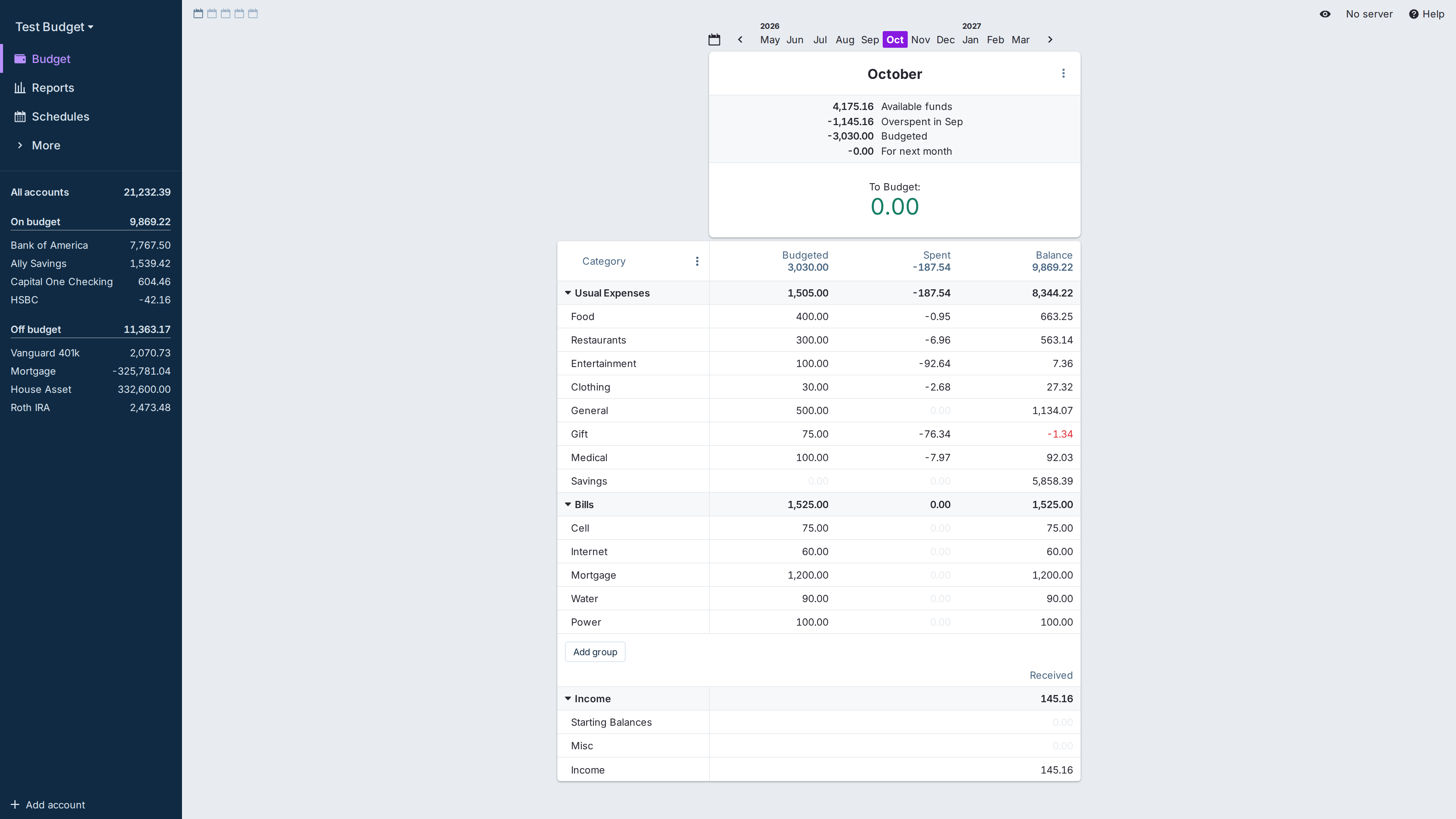
- Envelope budgeting (default): budget only cash on hand and assign every dollar a job (zero-sum); overspending rolls into next month and is flagged. A traditional tracking budget mode is also available if you prefer budgeting future income (budgeting docs, Tour).
- Accounts and net worth: on-budget and off-budget account groups, with mortgages and investment accounts feeding a net-worth total; two-sided transfers stay linked.
- Transaction management: split transactions, rules for automatic categorization, recurring schedules, duplicate merging, and robust undo/redo.
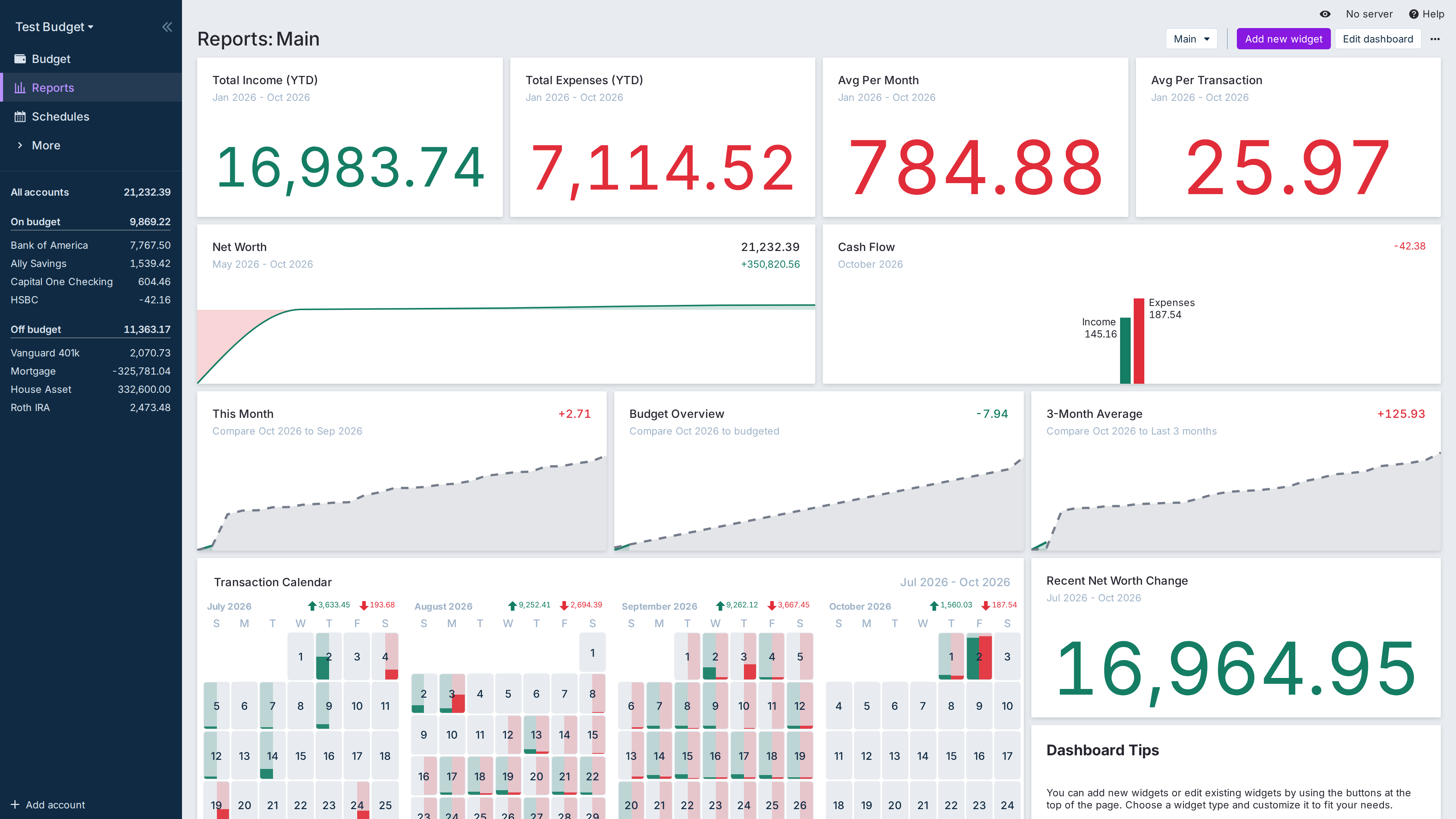
- Reports: built-in net-worth and cash-flow reports plus a custom report engine and an editable dashboard (see below).
- Sync and encryption: data is stored locally and works offline; with a server, changes sync across devices in the background, and budget data can be end-to-end encrypted (note: bank-sync credentials are stored on the server outside E2E encryption — sync docs).
- Import and migration: import QIF, OFX, QFX, CAMT.053 and CSV files; built-in YNAB4 and nYNAB importers carry over full history (feature list).
- Open capabilities: HTTP API with ActualQL queries, multi-user support with OIDC (added 2025), dark mode, and experimental multi-currency support.
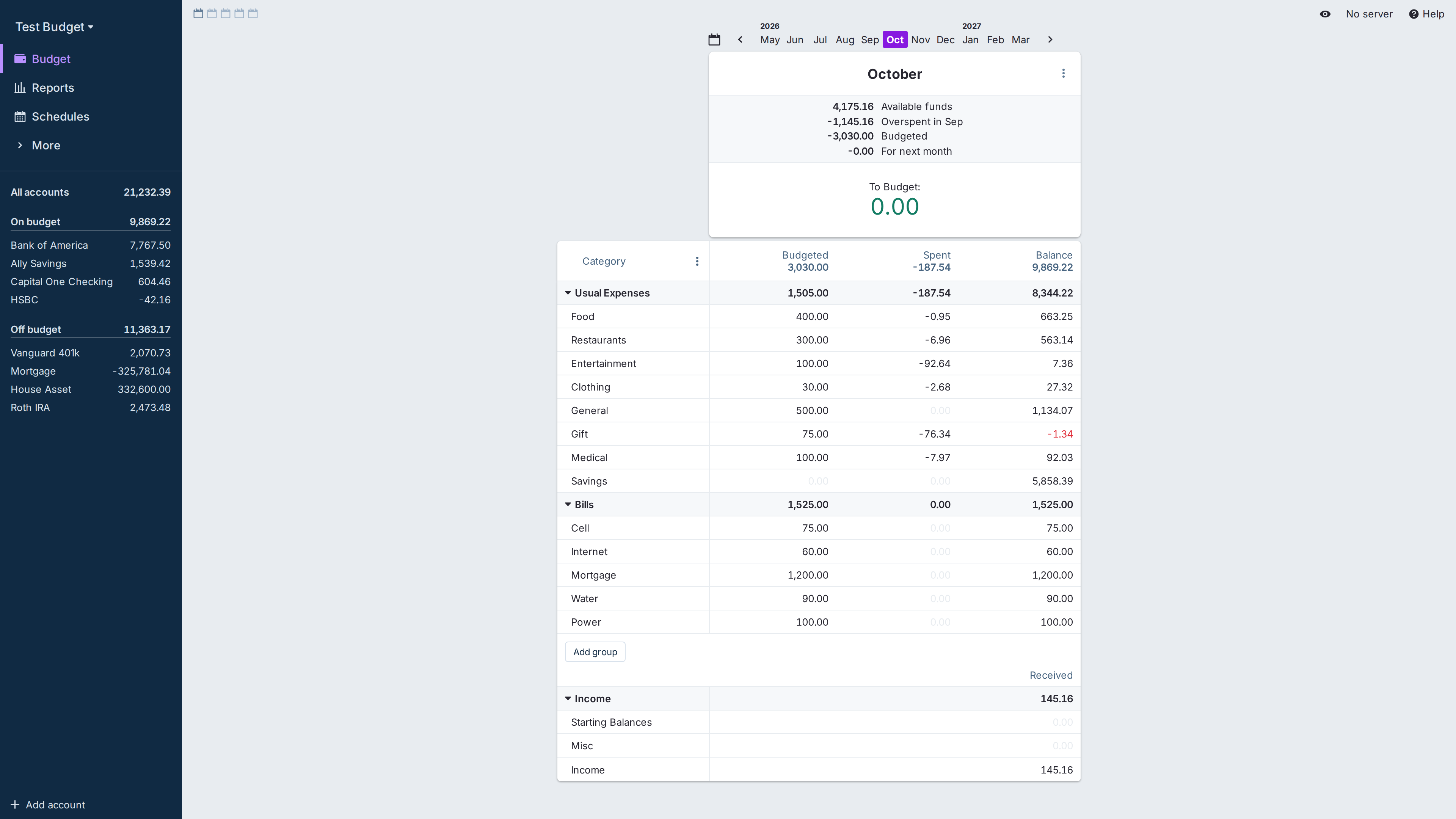
The budget view in the official demo instance (demo.actualbudget.org, sample data, 2026-10-02): the month-by-month category table is the heart of envelope budgeting.
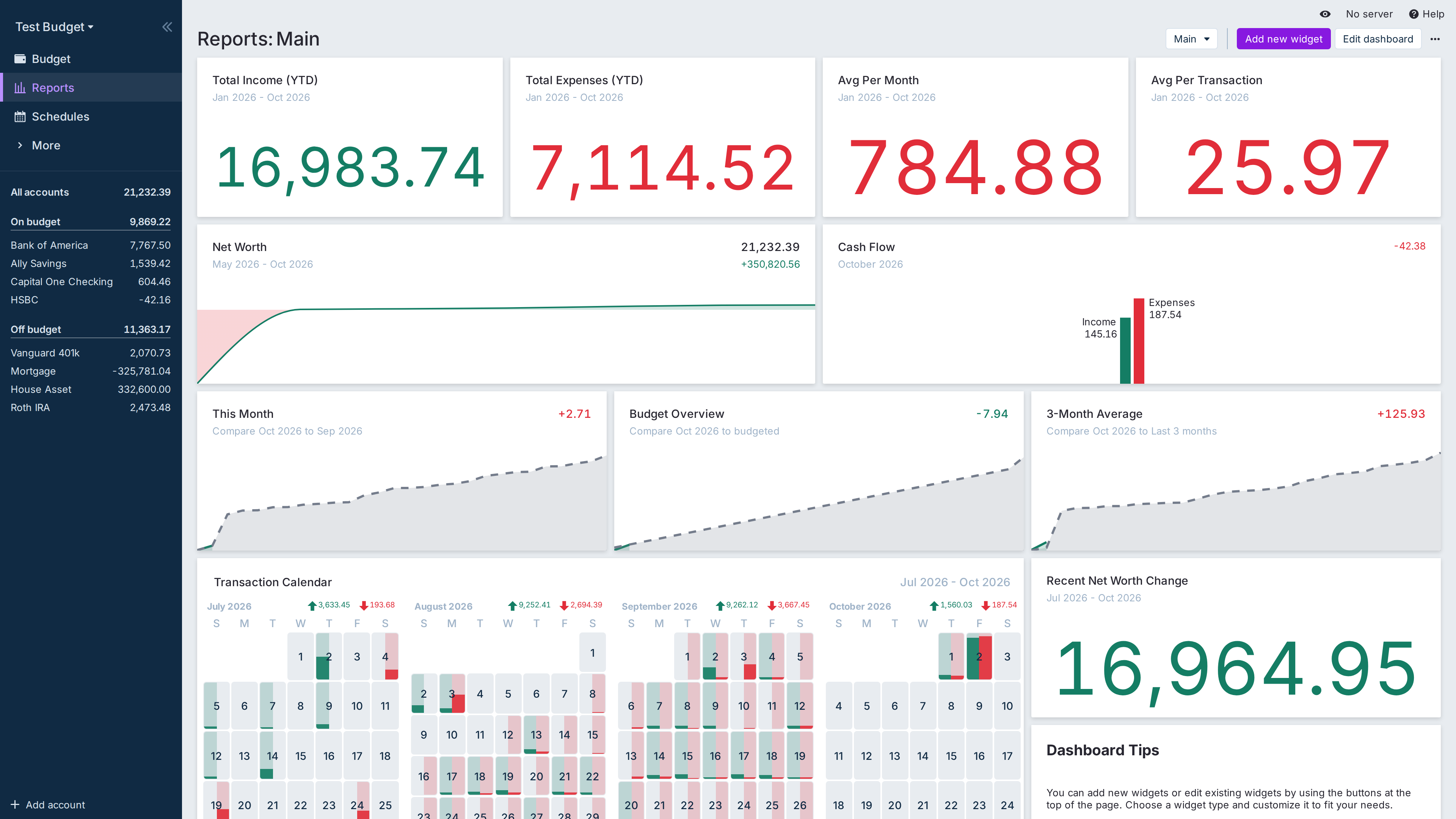
The Reports dashboard in the demo instance (2026-10-02): widgets can be added, removed and edited, covering net worth, cash flow and a calendar view.
Deployment and Platforms
Actual has two parts: the client and the sync server. All budgeting features work without a server (single device, with file import/export), but multi-device sync, bank syncing and the API all require one (installation docs):
- Web app: app.actualbudget.org is the officially hosted web client (data still lives only in your browser — export backups yourself; not recommended long-term), and demo.actualbudget.org offers a demo with sample data. The web app is a responsive PWA you can install to a phone's home screen in place of a native app.
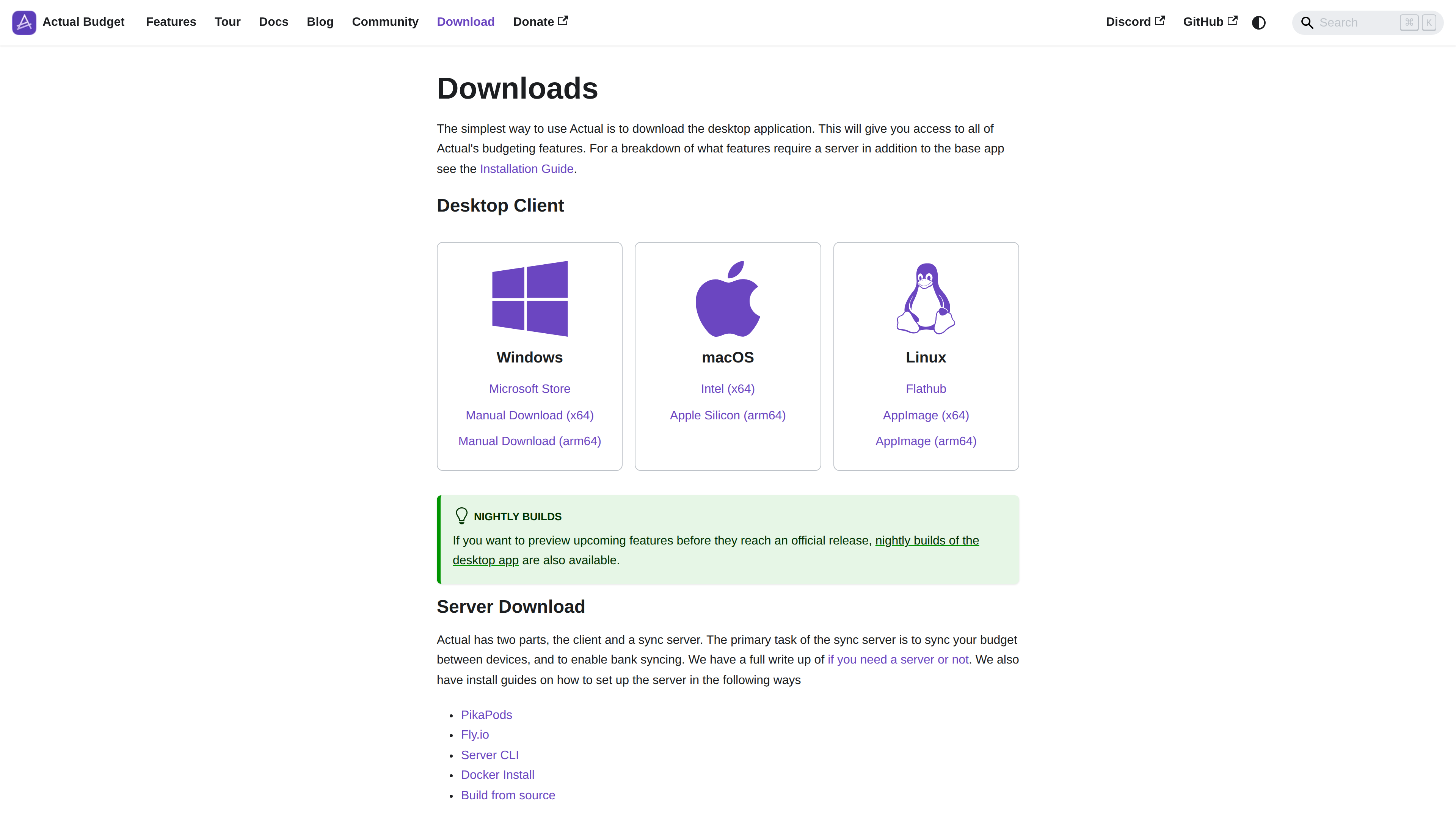
- Desktop clients (download page): Windows (Microsoft Store or x64/arm64 installers), macOS (Intel and Apple Silicon) and Linux (Flathub, AppImage), plus nightly builds. The desktop app works offline with automatic backups out of the box and can connect to a server.
- Sync server (actual-server): Docker images (Docker Hub and GitHub Container Registry), Server CLI, Fly.io or building from source. One-click hosting is available via PikaPods at about 5 signup credit, and PikaPods shares revenue with Actual (PikaPods docs, price as of November 2025).
- Mobile: the official iOS/Android apps were deprecated when the project went open source; use the PWA on phones, or one of the community-maintained unofficial native clients (FAQ).
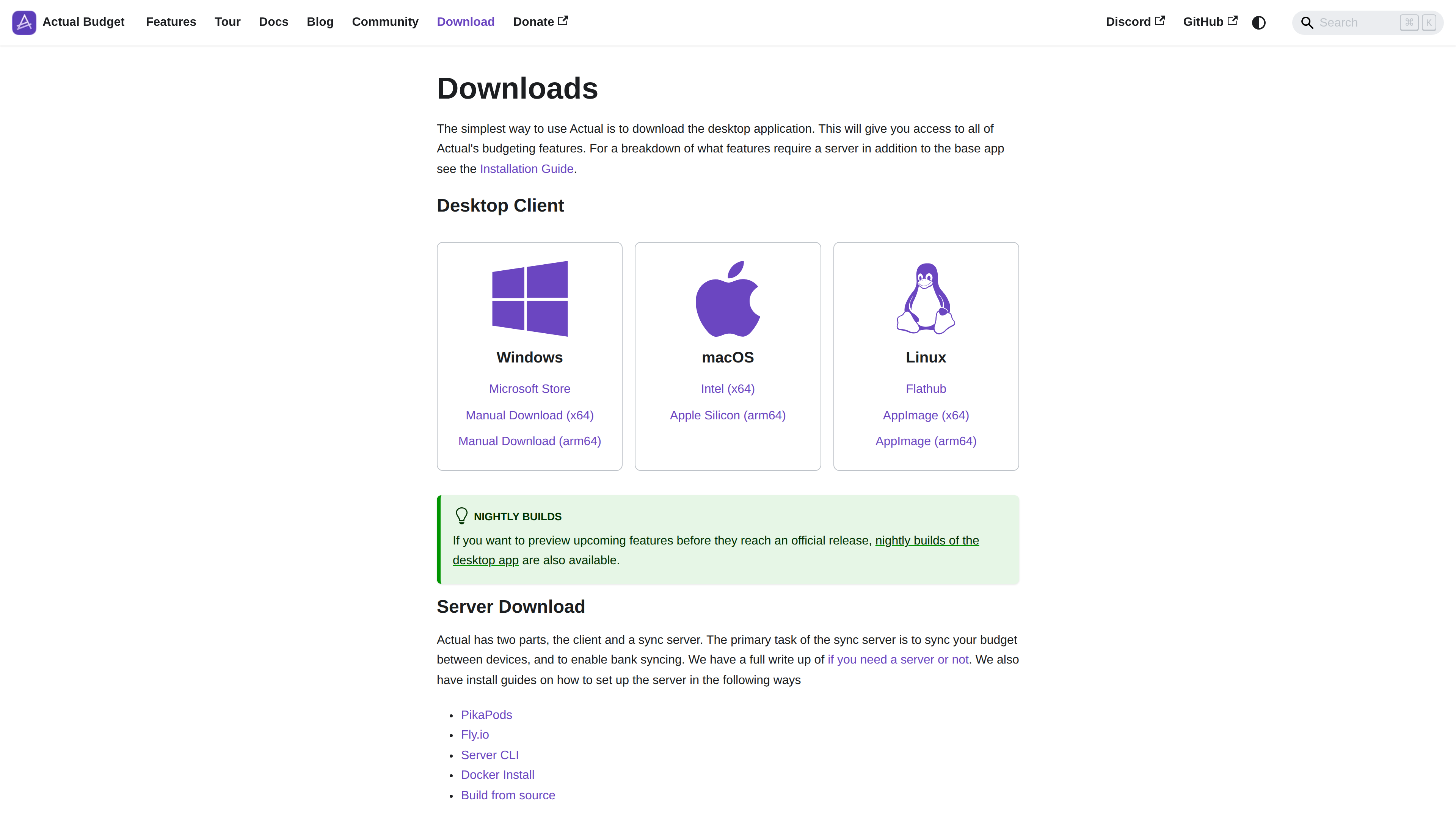
The download page (2026-10-02): three desktop platforms up top, server deployment options below.
Bank Syncing
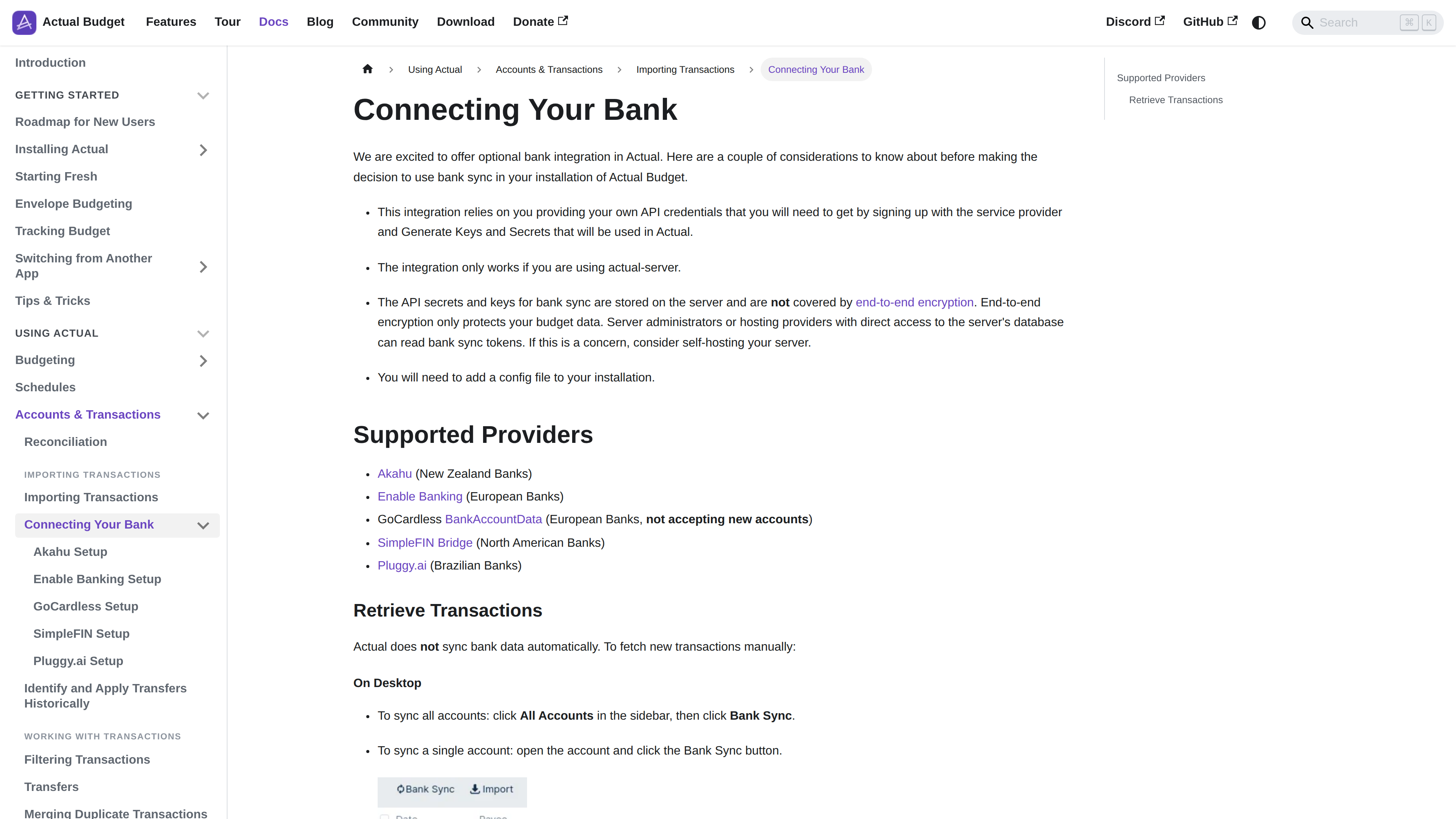
Actual doesn't connect to banks directly; it integrates third-party open-banking providers, and you supply your own API credentials (bank sync docs, checked 2026-10-02):
| Provider | Region | Notes |
|---|---|---|
| SimpleFIN Bridge | North America | Requires a SimpleFIN subscription: 15/year |
| GoCardless BankAccountData | Europe (EU/UK) | Stopped accepting new accounts in July 2025; existing accounts keep working |
| Enable Banking | Europe | Bring your own credentials |
| Akahu | New Zealand | Bring your own credentials |
| Pluggy.ai | Brazil | Bring your own credentials |
Two important caveats: bank sync only works with actual-server, and the sync tokens are stored on the server outside end-to-end encryption — self-host if that concerns you. And Actual does not poll banks automatically: you pull new transactions manually via the Bank Sync button (pull-to-refresh on mobile). Most of Asia, including China, has no supported provider, so manual entry or file import is the fallback.
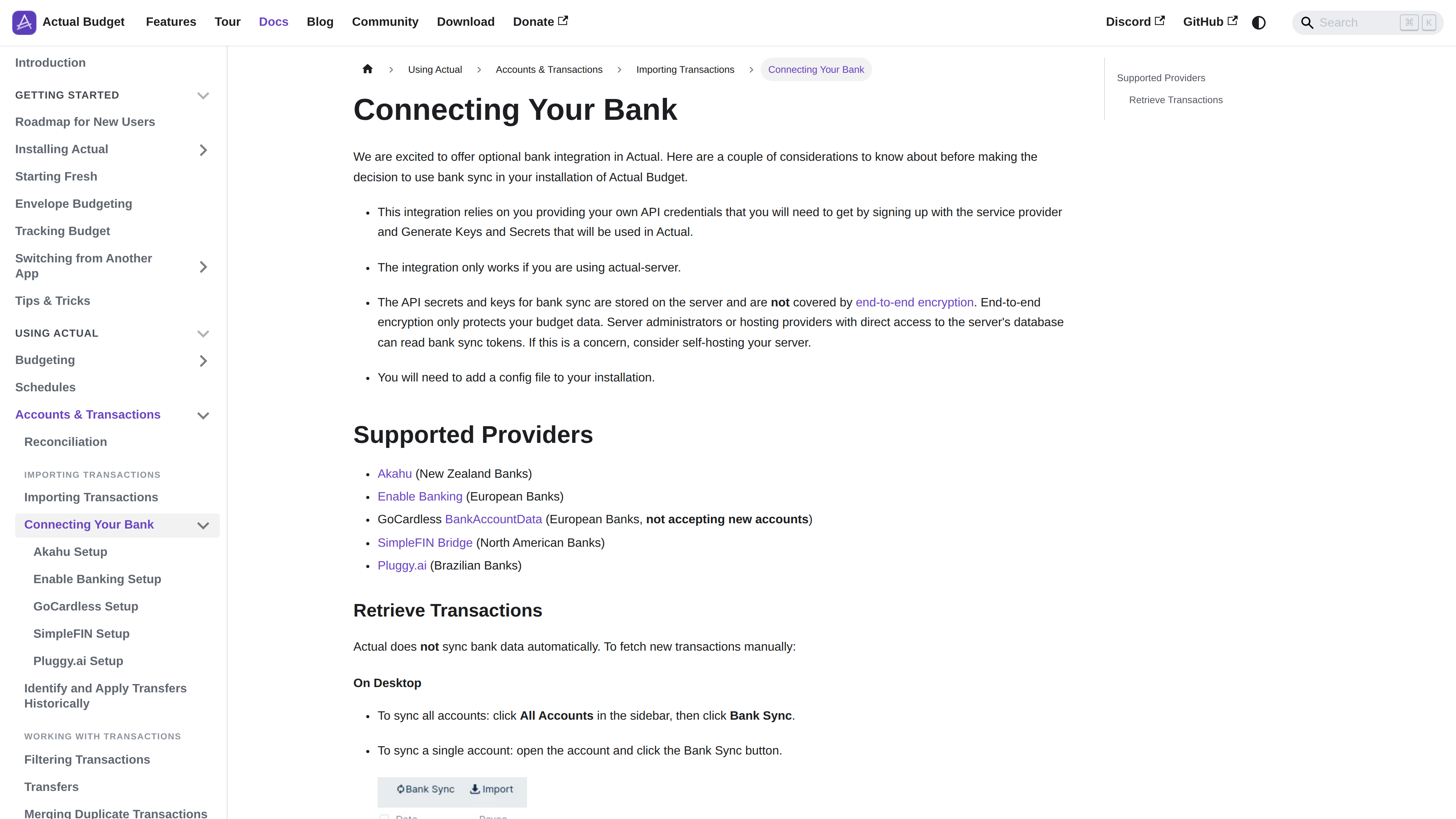
The "Connecting Your Bank" docs page (2026-10-02); the sidebar shows per-provider setup guides.
Privacy and Data
Per the privacy policy (checked 2026-10-02): Actual collects no data and uses no tracking; financial data stays on your device, and sync happens only between your devices and the server you chose. With E2E encryption enabled, keys exist only on your devices — forget the password and the data is unrecoverable. Budget files can be exported at any time in an open (SQLite-based) format, and community export tools exist.
Who It's For
- People who like YNAB-style envelope budgeting but not the subscription, or who want full control of their data: the method is shared, and there's an official Actual vs YNAB comparison plus importers.
- Privacy-conscious, self-hosting users: local-first design, optional E2E encryption and one-command Docker deployment.
- Households and individuals who want offline-capable tracking with cross-device sync: PWA on the phone, big-screen reports on the desktop.
- Longtime YNAB4/nYNAB users looking to migrate with history intact.
Limitations
- No official hosted service: multi-device sync and bank syncing require running your own server or paying roughly $1.50–2/month for hosting — a higher bar for non-technical users than commercial tools like YNAB.
- Bank sync is DIY and manual: you register with SimpleFIN/GoCardless/etc. yourself; GoCardless no longer accepts new accounts; there's no automatic polling; most of Asia has no supported provider.
- No official mobile apps: phones rely on the PWA, which isn't a native experience; browser-only use (no server) carries a real risk of data loss, and the docs tell you to keep your own backups.
- Budgeting tool only: no investment advice, portfolio management or advisory features; investment accounts are tracked as balances feeding net worth.
- English-first UI: community translations ship only at 50% coverage, so completeness for Chinese and other languages varies by release (observation).
References
- Actual Budget homepage, download page, installation docs, FAQ (checked 2026-10-02)
- Envelope budgeting docs, sync & encryption docs, bank sync docs, privacy policy
- James Long: Why I'm Building Actual (Nov 2017), Actual is going open-source (Apr 29, 2022, archived)
- Official blog: Welcome to Actual Budget Open Source (Jun 2023), Actual vs YNAB (Jul 2024), community funds proposal (Jun 2025), next steps for funding contributors (Jan 2026)
- GitHub: actualbudget/actual, Open Collective